Battle of Britain
- Dates:
- 10 July – 31 October 1940
- Front:
- Western Front
- Location:
- The skies over the English Channel, the Strait of Dover and southern England (Kent, Sussex, Hampshire, London and its surroundings), as well as over the east coast of England, the Midlands, Wales and Scotland; German airfields in northern France, Belgium, the Netherlands, Norway and DenmarkOn the battle map →
- Sides:
- United KingdomHugh Dowding, Keith Park, Trafford Leigh-MalloryNazi GermanyHermann Göring, Albert Kesselring, Hugo Sperrle
- Result:
- British victory. The Luftwaffe failed to win air superiority over southern England, and Hitler postponed the invasion of Britain – indefinitely on 17 September, and until the spring of 1941 on 12 October.
- Author:
- Łukasz
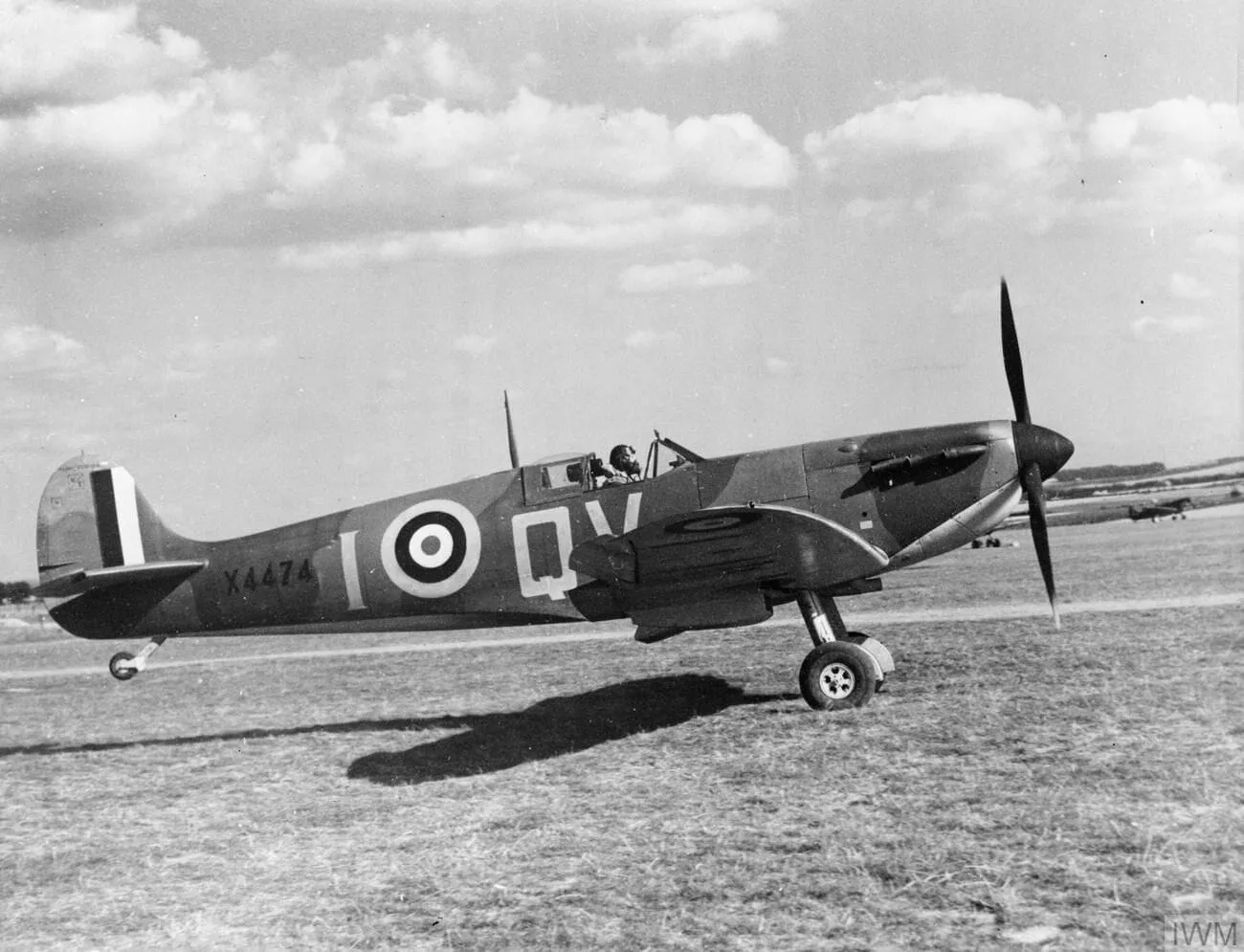
The Battle of Britain was the first campaign in history to be decided entirely in the air. After the fall of France in June 1940, Britain was the Third Reich’s only remaining enemy in Europe. Adolf Hitler expected Winston Churchill’s government to agree to peace, and when it did not, he ordered preparations for a landing across the Channel, Operation Sea Lion. Its precondition was command of the air. For nearly four months Hermann Göring’s Luftwaffe tried to destroy the fighters of the Royal Air Force, their airfields and their factories, and finally to break the spirit of London. Facing it was RAF Fighter Command under Air Chief Marshal Hugh Dowding, built around a network of radar stations and a centralised system of fighter control. Dowding did not need to win; it was enough not to lose. As long as his squadrons existed, an invasion was impossible. In September Hitler postponed the landing, and in October he deferred it to the following spring, which in practice meant abandoning it. Airmen from more than a dozen countries fought in the battle, among them 145 Poles, and the Polish No. 303 Squadron became one of the most famous fighter units of the war.
Name and dates
The battle was named by Churchill himself. In the House of Commons on 18 June 1940 he said that the Battle of France was over and that the Battle of Britain was about to begin, a battle on which the survival of Christian civilisation depended. Polish tradition adopted the name “bitwa o Anglię” (“the battle for England”), although “the battle for Britain” is the more accurate rendering. The Germans speak of the Luftschlacht um England, the air battle for England.
The dates are a matter of convention, since air fighting over the Channel had gone on since the spring and night raids on Britain continued long after the battle. The British dating can be taken as its limits: 10 July to 31 October 1940. Dowding began his account of the battle with 10 July, the day of the first large engagement over a convoy in the Strait of Dover, in his report (the so-called despatch), written in 1941 and published in 1946. The same limits, 10 July – 31 October, were adopted by the British Air Ministry as the qualifying period for the “Battle of Britain” clasp to the 1939–1945 Star; just under 3,000 men earned it, and in Britain they are known as “The Few”. An earlier Air Ministry pamphlet of 1941 dated the battle only from 8 August. The Germans regarded 13 August, “Eagle Day” (Adlertag), as the start of the offensive proper. German historians often combine the daylight battle with the night raids, the so-called Blitz, into a single campaign lasting until May 1941, when most Luftwaffe units were transferred to the east. The date of 31 October marked no particular event: it was chosen because from the end of October the great daylight raids had virtually ceased and the weight of the fighting had shifted to the night.
Background
The Luftwaffe had already attacked Britain in the autumn of 1939, when Ju 88 bombers struck warships in the Firth of Forth and at Scapa Flow, but those were raids on naval targets. The real test of strength came in May 1940. During the Battle of France the French demanded ever more fighter squadrons, and on 16 May Dowding warned that if the home defence forces were drained away over France, defeat there would bring the final, complete defeat of Britain. The Cabinet eventually accepted his view, and the core of Fighter Command stayed at home. Over Dunkirk RAF fighters fought the Messerschmitts on a large scale for the first time, covering the evacuation from airfields in England, and suffered heavy losses. On 4 June Churchill declared that the British would fight on the beaches and would never surrender. In case of a landing, the Local Defence Volunteers were being formed.
After the armistice at Compiègne Hitler expected London to make a peace that would leave Germany a free hand on the Continent. He had no ready plans for an invasion of the British Isles. The Kriegsmarine, weakened by its losses off Norway, had neither landing craft nor a fleet capable of shielding a crossing from the Royal Navy. On 30 June Göring issued his first directives for the war against Britain; that same day German troops occupied the Channel Islands, and on 2 July the Wehrmacht High Command ordered preparations for a landing. The British made it plain that they had no intention of talking: on 3 July the Royal Navy opened fire on the French fleet at Mers-el-Kébir to keep it out of German hands. On 16 July Hitler signed Directive No. 16 on Operation Sea Lion (Seelöwe), and on 19 July he made an “appeal to reason” in the Reichstag, which the British Foreign Secretary, Lord Halifax, rejected three days later. On the day of the speech Göring was made Reichsmarschall and the commanders of both air fleets in the west were promoted to field marshal. Directive No. 17 of 1 August ordered the Luftwaffe to destroy the British air force “as soon as possible”.
Forces and plans
In the west the Luftwaffe had two air fleets (Luftflotten): Luftflotte 2 under Albert Kesselring, with its headquarters in Brussels and airfields in northern France, Belgium and the Netherlands, facing Kent and London; and Luftflotte 3 under Hugo Sperrle, with its headquarters in Paris and airfields in Normandy and Brittany, facing south-west England. Luftflotte 5 under General Hans-Jürgen Stumpff could operate from Norway and Denmark. At the beginning of August together they had some 2,500 serviceable combat aircraft: He 111, Do 17 and Ju 88 medium bombers, Ju 87 dive-bombers, twin-engined Bf 110 fighters and single-engined Bf 109s. The Bf 109 was a match for the best British fighters, but its range was short: over London it could fight for no more than a quarter of an hour or so. Luftwaffe intelligence underestimated the strength of the RAF and barely grasped the importance of radar.
At the beginning of July Fighter Command had a little over 600 serviceable fighters, mainly Hurricanes and Spitfires, and their number kept growing, because the factories, driven on by the Minister of Aircraft Production, Lord Beaverbrook, turned out roughly twice as many fighters that summer as German industry. The Hurricane was slower than the Messerschmitt but rugged, and it made up the bulk of the force; it shot down more German aircraft than any other type. What Dowding lacked was trained pilots, and it was their shortage, not a shortage of machines, that was his greatest worry throughout the battle.
The RAF’s strength lay in the Dowding system, created before the war. Along the coast stood the Chain Home radar stations, which detected incoming formations over France and the Channel; over land, aircraft were tracked by volunteers of the Observer Corps. Reports went to the “filter room” at Dowding’s headquarters at Bentley Priory near London, and from there to the groups and sector stations, which guided the squadrons onto the enemy by telephone and radio. As a result the RAF did not have to keep standing patrols in the air and could scramble its fighters where they were needed. The country was divided into groups: No. 10 Group under Air Vice-Marshal Quintin Brand defended south-west England, No. 11 Group under Air Vice-Marshal Keith Park London and the south-east, No. 12 Group under Air Vice-Marshal Trafford Leigh-Mallory the Midlands and eastern England, and No. 13 Group the north of the country and Scotland. The main burden fell on Park’s No. 11 Group.
Course of the battle
“Kanalkampf”: fighting over the convoys (10 July – 12 August)
The first phase, which the Germans called the Kanalkampf (the Channel battle), consisted of attacks on coastal convoys passing through the Strait of Dover, on ports and on warships. On 10 July several dozen German aircraft attacked a convoy off the Kent coast, and the largest air battle over the Channel so far ensued. The Germans wanted to draw the RAF’s fighters into combat over the water, where a British pilot who was shot down was likely to die, and at the same time to close the strait to shipping. Dowding and Park refused to be drawn into big battles and sent only small forces to cover the convoys. On 19 July a squadron of two-seat Defiant fighters lost six of its nine aircraft over Folkestone in a matter of minutes, which ended the type’s career as a day fighter. At the end of July, after losing several destroyers, the Admiralty withdrew them from Dover, and from then on convoys were sent through the strait mainly at night. Each side was learning about the other: the British discovered that the loose German formation of pairs and fours (Rotte, Schwarm) was more effective than their own tight three-aircraft sections, and began to copy it.
“Eagle Day” and the attacks on the airfields (13–23 August)
The main offensive (Adlerangriff) was planned for 10 August but postponed because of the weather. On 12 August the Germans bombed several radar stations and airfields on the Kent coast. Most of the radars were back in operation within hours, but the Ventnor station on the Isle of Wight was out of action for many days. The Germans concluded that the stations were hard to destroy and soon stopped attacking them, which proved one of their greatest mistakes. “Eagle Day”, 13 August, began chaotically: the morning operation was called off because of cloud, but some of the bombers did not receive the order and flew on without an escort. In the afternoon the Luftwaffe flew more than a thousand sorties, bombing airfields and ports from Kent to Hampshire, although many of those airfields did not belong to Fighter Command.
15 August saw the Luftwaffe’s greatest effort. All three air fleets struck at once, including Luftflotte 5 from Norway and Denmark against north-east England, since the Germans believed that Dowding had drawn his fighters from there to the south. The bombers from Norway ran into the squadrons of No. 13 Group and suffered such losses that Luftflotte 5 never again attempted a daylight raid. That day the Luftwaffe lost about 75 aircraft and the RAF more than 30. In Germany it was called “Black Thursday”. On 16 August Flight Lieutenant James Nicolson, wounded and in a burning Hurricane, shot down a Messerschmitt before baling out; he received the only Victoria Cross awarded to a Fighter Command pilot during the war. 18 August, which the British call “the Hardest Day”, brought massed attacks on the sector stations at Kenley and Biggin Hill and on airfields in Hampshire; both sides lost many aircraft, and the Ju 87 units were so badly mauled that after that day they were withdrawn from the main battle.
On 20 August Churchill told the House of Commons: “Never in the field of human conflict was so much owed by so many to so few.” Göring, dissatisfied with the results, had ordered on 19 August that the fighters should stay close to the bombers, which robbed the Messerschmitts of their advantage in free hunting, and he replaced some of the older fighter commanders with young aces such as Adolf Galland and Werner Mölders. The weight of the offensive passed to Kesselring’s Luftflotte 2, whose airfields lay closest to England.
Fighter Command’s crisis (24 August – 6 September)
From 24 August the Luftwaffe concentrated on No. 11 Group’s airfields around London: Biggin Hill, Kenley, Hornchurch, North Weald, Debden and Manston, the last and most exposed of which had to be abandoned for a time. The raids were heavily escorted, and the damage to hangars, telephone lines and operations rooms threatened the fighter control system itself. Biggin Hill was bombed again and again, and its operations room had to be moved to makeshift premises. The most serious losses, however, were in pilots: in two weeks hundreds of airmen were killed or wounded, and their places were taken by young pilots with shortened training. Dowding rotated exhausted squadrons with fresh ones from the northern groups, but his reserves were dwindling. Park fought the battle economically, sending squadrons in singly or in pairs to intercept the bombers before they reached their targets. Leigh-Mallory, backed by the squadron commander Douglas Bader, pressed for No. 12 Group to form “Big Wings” of three to five squadrons, which, however, took a long time to assemble and often failed to arrive in time to protect No. 11 Group’s airfields. The dispute between the two commanders lasted until the end of the battle.
On the night of 24/25 August German bombers, probably through a navigational error and against Hitler’s ban, dropped bombs on the City of London and the eastern districts. The following night, on Churchill’s orders, several dozen British bombers flew to Berlin. The damage was slight, but Göring had earlier assured the Germans that not a single bomb would fall on the Reich capital. The raids on Berlin were repeated. On 4 September, in the Berlin Sportpalast, Hitler announced that if the British bombed German cities, Germany would “erase” theirs. Kesselring argued that the RAF was at the end of its tether and that its last fighter reserves could be destroyed only over London, which the British had to defend. Sperrle believed that the British air force was still strong. Hitler and Göring adopted Kesselring’s view.
The attack on London and 15 September
On the afternoon of 7 September some 350 bombers, escorted by more than 600 fighters, flew in over the Thames Estuary. Göring watched them from the coast of the Pas-de-Calais, where he had personally taken command of the battle. The bombs fell on the docks, warehouses and working-class districts of the East End, and the fires guided further waves of bombers throughout the night. According to British figures more than 400 Londoners were killed and about 1,600 seriously injured. In the evening Home Forces headquarters issued the codeword “Cromwell”, meaning that invasion was imminent; in some places church bells were rung, the signal of a German landing. Thus began the Blitz: from then on London was bombed for 57 nights in a row.
For Fighter Command the change of target was a deliverance. The airfields and operations rooms had a chance to recover, and the long flight to London gave the radars and squadrons more time to prepare an interception. The decision came on Sunday 15 September. The Luftwaffe sent two great raids against London, one before noon and one in the afternoon. Park threw every squadron of No. 11 Group into the fight, and from the north came Bader’s wing of five squadrons, including the Polish No. 302 and the Czechoslovak No. 310. Churchill, who visited No. 11 Group’s operations room at Uxbridge that day, asked Park what reserves he still had. Park replied: “None.” The RAF claimed 185 German aircraft shot down; in reality the Luftwaffe lost about 60 and the RAF just under 30. The figures were smaller than was believed at the time, but the meaning of the day was clear: German airmen who had been told for weeks that the RAF was down to its last 50 fighters saw several hundred over London. 15 September is commemorated in Britain as Battle of Britain Day.
On 17 September Hitler postponed Operation Sea Lion indefinitely. British bombers, including from mid-September the Polish No. 300 and No. 301 Squadrons, attacked the invasion barges assembled in ports from Antwerp to Boulogne, and the German command began to disperse them. In the last days of September the Luftwaffe made further daylight attacks on aircraft factories. On 25 September it bombed the works at Filton near Bristol, and on 26 September the Supermarine factory at Southampton, which forced the dispersal of Spitfire production. The large daylight bomber raids of 27 and 30 September, however, cost it so dearly that it gave them up.
October: fighter-bombers and the night
In October the Germans changed their tactics. By day they sent Messerschmitt Bf 109s at high altitude carrying bombs under the fuselage, escorted by other fighters. The damage was slight, but the radars could barely distinguish such raids from ordinary fighter sweeps, and the RAF’s fighters had to climb to altitudes at which the Hurricane performed worse than the Messerschmitt. Park began to keep standing patrols of Spitfires in the air so as to have time to intercept. The weight of the German effort shifted to the night, when the bombers were almost immune, because the RAF did not yet have effective radar-equipped night fighters. On 12 October Field Marshal Wilhelm Keitel announced Hitler’s decision that preparations for the landing were to continue until the spring of 1941 only as a means of political and military pressure on Britain. At the end of October the Italian air corps (Corpo Aereo Italiano), sent by Mussolini to Belgium, joined the attacks, but its contribution was of no consequence. By the end of October the great daylight battles had ceased, and the British dating closes the battle there.
The Poles and the Czechoslovaks
After the fall of France several thousand Polish airmen reached Britain, many of them evacuated from French ports in the second half of June. In August 1940 there were about 8,400 Polish and 900 Czechoslovak airmen and ground personnel in Britain. At first the British distrusted their training and their command of the language; they enrolled them in the RAF Volunteer Reserve and made them learn British procedures, radio signals and imperial units of measurement. The Polish–British agreement of 5 August 1940 settled the status of the Polish Armed Forces in Britain and recognised the Polish Air Force as part of the Polish Army, under the operational command of the RAF.
The order to form the first Polish fighter squadron, No. 302 “City of Poznań”, was issued on 10 July, the day from which the battle is dated; the squadron was formed at Leconfield in Yorkshire, as part of No. 12 Group, and scored its first victory on 20 August. It was commanded by Major Mieczysław Mümler together with a British officer, since for their first months the Polish squadrons had a dual command. On 2 August No. 303 “Warsaw” Squadron, named after Tadeusz Kościuszko, was formed at Northolt near London, carrying on the tradition of the Kościuszko squadrons of the Polish–Soviet War and of the Warsaw units of the September Campaign. It was commanded by Major Zdzisław Krasnodębski and Squadron Leader Ronald Kellett. On 30 August, during a training flight, Lieutenant Ludwik Paszkiewicz spotted German aircraft, broke formation and shot down a Bf 110. The next day the squadron was declared operational. Over the following six weeks, in the hardest period of the battle, No. 303 Squadron claimed 126 aircraft shot down, more than any other squadron in Fighter Command. Krasnodębski, badly burned on 6 September, handed over command to Captain Witold Urbanowicz. The squadron’s most successful pilot, with 17 victories, was the Czech Josef František, who after 1939 had fought in the Polish air force; he was killed in an accident on 8 October at Ewell. The claims, as with every participant in the battle, were inflated: post-war research reduced No. 303 Squadron’s score by roughly half, to anywhere between several dozen and just under 80 aircraft depending on the study. Even so, it remains one of the most successful squadrons of the battle.
Apart from the Polish squadrons, about 80 Poles flew in British squadrons. Sergeant Antoni Głowacki of No. 501 Squadron claimed five aircraft shot down in a single day on 24 August. In all, 145 Polish pilots fought in the battle, about 5 per cent of Fighter Command’s aircrew and the largest group from outside Britain. Twenty-nine of them were killed. Their claims are variously given as anywhere from about 170 to more than 200 aircraft. The Poles’ successes, reported in the British press, changed British attitudes towards their Polish allies, and No. 303 Squadron became a symbol of the Polish struggle during the war, described in 1942 in a book by Arkady Fiedler.
The Czechoslovaks, whose national representation had been active in London since the autumn of 1939, formed No. 310 Squadron at Duxford on 10 July, the first RAF unit made up of pilots from outside Britain. It fought in No. 12 Group, often as part of Bader’s wing, and scored its first victories on 26 August. A second Czechoslovak squadron, No. 312, was formed at the end of August and went into action only in October. Eighty-eight Czechoslovak pilots took part in the battle, roughly half of them in British units. Among “the Few” there were also New Zealanders (like Park himself), Canadians, Australians, South Africans, Belgians, Frenchmen, Irishmen and a handful of Americans.
Losses
During the battle both sides greatly exaggerated the enemy’s losses, and post-war tallies vary according to the dates adopted and the method of counting. The figure most often given is that the Luftwaffe lost some 1,700–1,900 aircraft between 10 July and 31 October. About 2,500 German airmen were killed or missing, and nearly a thousand were taken prisoner, since those shot down over England came down in enemy territory. In the same period the RAF lost about 1,000–1,100 fighters. Fighter Command lost 544 aircrew killed, and according to British tallies more than 700 airmen of Bomber Command and about 280 of Coastal Command, who bombed the invasion ports and airfields and patrolled the sea, were also killed over the same period. Most of the British pilots shot down came down over their own territory, and many returned to the fight. Britain’s civilian population lost well over ten thousand dead in the raids between July and October, most of them in London in September and October; by the end of 1940, according to British figures, the death toll had passed 23,000.
Significance
The Battle of Britain was the Third Reich’s first serious defeat. The Luftwaffe, which in Poland, Norway and France had cleared the way for the ground forces, proved too weak to break a modern air defence system on its own. The Germans had neither heavy bombers nor long-range fighters, they underestimated radar, and every few weeks they changed the target of their attacks without carrying any of them through to the end. On the British side the decisive factors were the fighter control system, an industry that replaced lost aircraft, and the endurance of the pilots, several hundred foreigners among them. The battle ended with no act of surrender and no ground taken. Its outcome simply meant that the invasion would not take place.
Its consequences proved enormous. Britain survived and stayed in the war, and its endurance convinced President Roosevelt that it was worth helping: in September 1940 the United States handed the British 50 destroyers in exchange for bases, and in March 1941 the Lend-Lease Act was passed. The British Isles became the base for the bombers that from 1942 onwards devastated German cities, and the springboard for the Normandy landings in June 1944. Unable to defeat Britain, Hitler turned east: on 18 December 1940 he signed the directive for the attack on the Soviet Union, convinced that the defeat of Russia would rob the British of their last hope. The night offensive that began on 7 September lasted until May 1941 and devastated Coventry, parts of London, Liverpool, Plymouth and many other cities, but it broke neither British industry nor British morale.
The victors were treated ungratefully. Criticism of Park’s tactics and the dispute over the “Big Wings”, as well as the inadequate night defences, led to Dowding’s removal from command in November 1940; he was succeeded by a supporter of Leigh-Mallory, Air Marshal Sholto Douglas. In December Park handed No. 11 Group over to Leigh-Mallory and moved to a training post. Only after the war was it acknowledged that the two men who had been sidelined were the ones who had won the battle.
For Poles, the Battle of Britain became one of the most important symbols of the struggle waged in exile, and No. 303 Squadron a legend that lived on in Poland too, though it was passed over in silence in the Stalinist period, and many of its airmen did not return to Poland after the war. On the tablets of the Tomb of the Unknown Soldier in Warsaw the battle is commemorated by an inscription with the dates 10 VII – 31 X 1940.