United Kingdom
Hugh Dowding
Commander-in-Chief of RAF Fighter Command (1936–1940), Air Chief Marshal (1937), Baron Dowding (1943)
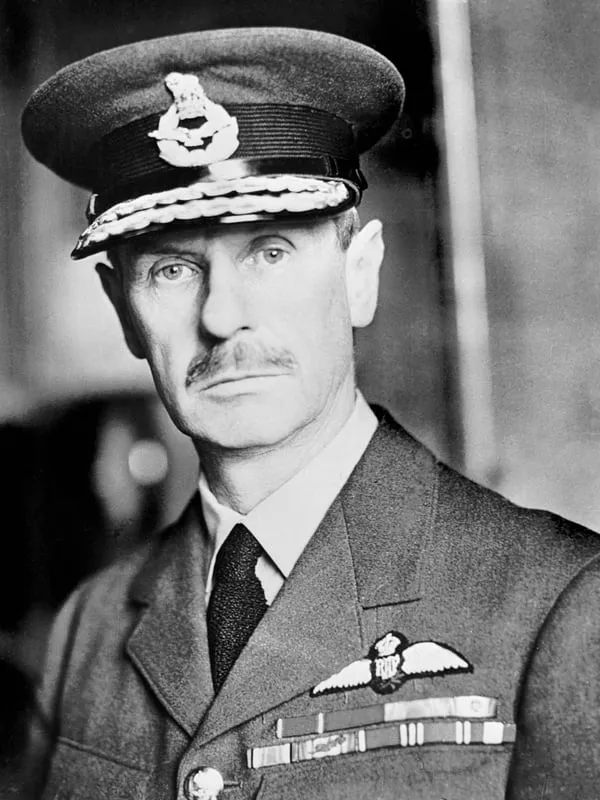
- Born:
- 24 April 1882, Moffat (Scotland)
- Died:
- 15 February 1970, Royal Tunbridge Wells (England)
- Author:
- Łukasz
- Photo:
- Ministry of Information official photographer, domena publiczna, Wikimedia Commons

Hugh Dowding is the man whose name is linked with the Battle of Britain more closely than anyone else’s. In the 1930s, when British politicians and service chiefs kept repeating that “the bomber will always get through”, he prepared the fighter force to defend the country: he brought the Hurricane and the Spitfire into service, backed the development of radar and combined it with observer posts, telephones and radio stations into the world’s first integrated air defence system. In May 1940 he refused to let his squadrons bleed to death in France, and in the summer and autumn of that year he led Fighter Command through the battle that stopped Hitler from invading Britain. Immediately afterwards he was removed from his command. He was reserved, stubborn and undiplomatic, and in retirement became known as a spiritualist and a campaigner for animals.
Gunner and airman
Hugh Caswall Tremenheere Dowding was born on 24 April 1882 in Moffat in the south of Scotland. His father, Arthur Dowding, formerly a schoolmaster in Edinburgh, ran St Ninian’s preparatory school there, which his son also attended. Hugh went on to the prestigious Winchester College and the Royal Military Academy at Woolwich, the training ground of artillery and engineer officers. In August 1900 he was commissioned as a second lieutenant in the Royal Garrison Artillery. He served in Gibraltar, Ceylon, Hong Kong and India, where for several years he was an officer in a mountain artillery battery. In 1912 he graduated from the Staff College at Camberley.
Like many young officers of the day, he took up flying out of curiosity. He paid for his own lessons at the Vickers flying school at Brooklands racing circuit and gained his pilot’s certificate on 19 December 1913. He also completed a course at the Central Flying School and was placed on the reserve list of the Royal Flying Corps, the British Army’s air arm. When war broke out in August 1914, he was called up as a pilot.
The First World War
In France Dowding flew with several squadrons as a pilot and flight commander, and in the spring of 1915 he ran the experimental wireless establishment at Brooklands in England, where radio communication with aircraft was being studied. In the summer of 1915 he took command of No. 16 Squadron, which flew reconnaissance missions and spotted for the artillery. In 1916, as a lieutenant colonel, he commanded a wing, and during the Battle of the Somme No. 9 Wing, which came directly under the headquarters of the Flying Corps. When his squadrons were suffering heavy losses, he asked the RFC’s commander, General Hugh Trenchard, to withdraw the exhausted crews for rest. Trenchard, an advocate of relentless offensive action in the air, judged him a pessimist and sent him back to England. The clash with the most important figure in British aviation weighed on Dowding for years.
He spent the rest of the war at home in training and administrative posts. In 1917 he became a temporary brigadier general. In February 1918 he married Clarice Maud Vancourt, a widow with a daughter. Their son Derek was born in 1919, but in 1920 his wife died. Dowding brought up the children with the help of his sister Hilda and withdrew still further into himself. Airmen called him “Stuffy”.
Between the wars
In 1919 Dowding received a permanent commission in the newly formed Royal Air Force with the rank of group captain. He commanded air groups, organised the air displays at Hendon, served as chief of staff of the RAF in Iraq and from 1926 was Director of Training at the Air Ministry. In 1929 Trenchard sent him to Palestine to examine security problems after bloody Arab–Jewish riots; his reports were well received. That same year he became an air vice-marshal and commander of the Fighting Area within the air defence of Great Britain. He was also a keen skier, won the first British slalom championship and served as president of the Ski Club of Great Britain.
In September 1930 he joined the Air Council, the RAF’s supreme governing body, as the member responsible for supply and research (from 1935 for research and development). In 1933 he became an air marshal and was knighted. One of his first decisions was to issue a certificate of airworthiness to the airship R101, which crashed in France in October 1930 on her first flight to India. Dowding later admitted that he should have insisted on longer trials. In the years that followed, his department ordered the fighters that were to defend the country in 1940. Dowding was no engineer, but he had an excellent grasp of technology. He championed fast monoplanes armed with eight machine guns, and when officials considered armoured windscreens for pilots too expensive, he replied that if Chicago gangsters could have bullet-proof glass in their cars, he saw no reason why his pilots should not have the same. From these requirements came the Hawker Hurricane and the Supermarine Spitfire.
In February 1935 he observed a demonstration near Daventry at which Robert Watson-Watt’s team showed that radio waves reflected from an aircraft could be detected at long range. Dowding immediately allocated money for further work. Out of it grew the Chain Home network of radar stations.
Fighter Command
In July 1936 Dowding became head of the newly created RAF Fighter Command, with its headquarters at Bentley Priory near London. On 1 January 1937 he was promoted to air chief marshal. He had hoped to become Chief of the Air Staff, but in 1937 the post went to Cyril Newall, who was junior to him. Dowding stayed at Fighter Command and devoted himself to what he regarded as most important.
Within three years he built the system later named after him. Reports from the radar stations and from the posts of the Observer Corps flowed by telephone into the “filter room” at Bentley Priory, from where a cleaned-up picture of the situation went to the fighter groups and sectors, which in turn guided the squadrons by radio onto the enemy. The telephone lines were buried deep underground. From 1938 Dowding’s closest collaborator was his senior air staff officer, Keith Park, who helped to streamline the flow of information. The system was thought through to the smallest detail and rehearsed in exercises. Yet when war threatened during the Munich crisis in the autumn of 1938, Fighter Command had only a few squadrons of Hurricanes, and most of its fighters were obsolete biplanes. Dowding used the year that remained before the outbreak of war to re-equip his squadrons and extend the radar network.
He was also short of pilots. He foresaw that losses in war would be enormous and that training a fighter pilot took a long time, and he demanded reserves that the air force did not have. At the end of the 1930s his retirement was looming: it was first set for June 1939, then postponed to March 1940, and then, because of the war, put off several more times. The uncertainty about his future lasted until the autumn of 1940.
The first months of the war brought Fighter Command more work than fighting. In October 1939 Spitfires repelled the first Luftwaffe raids on Scotland, but the real threat came only in May 1940. When the Germans broke through the front in France, the French demanded ever more fighter squadrons and Churchill wanted to send them. On 15 May Dowding argued before the prime minister and the cabinet that of the 52 squadrons regarded before the war as the minimum needed to defend the island he had 36 left, and on 16 May he wrote a letter to the Air Ministry warning that if the home defence force were drained away in desperate attempts to remedy the situation in France, defeat in France would bring with it the final and irremediable defeat of Britain. The cabinet limited assistance to squadrons flying over France from England, and a few days later decided to send no more fighters. Churchill, who had given way reluctantly, did not forget the dispute for a long time. At the end of May Dowding’s fighters, flying from No. 11 Group’s airfields in England, covered the evacuation from Dunkirk.
The Battle of Britain
In the Battle of Britain, which he himself dated from 10 July 1940, Dowding commanded from Bentley Priory. He did not direct individual engagements, leaving that to his group commanders, above all to Park at No. 11 Group, which defended London and south-east England. His task was to keep the whole system running: allocating squadrons among the groups, replacing tired units with fresh ones from the north, and ensuring the flow of new pilots and aircraft. In July, during the fighting over the convoys in the English Channel, he husbanded his strength, sending over the ships only as many fighters as were strictly necessary. That same month Churchill, surprised that the ministry was thinking of retiring him, interceded on his behalf with the Secretary of State for Air, Archibald Sinclair, and Dowding’s service was extended.
From August, when Hermann Göring’s Luftwaffe struck at the airfields and radar stations, the battle became a war of attrition. At the end of August and the beginning of September No. 11 Group was losing pilots faster than they could be replaced, and Dowding was forced to divide his squadrons into categories: the best fought in the south-east, others relieved them, and others still trained new pilots. Salvation came on 7 September, when the German command turned its bombers against London. On 15 September the Luftwaffe suffered heavy losses over the capital, and two days later Hitler postponed the invasion of Britain, prepared since July under the name Sea Lion.
Fighter Command also fought thanks to foreigners. At first Dowding hesitated to send Poles and Czechoslovaks into action, fearing that they would not cope with radio communications. But when Nos. 302 and 303 Squadrons and the Czechoslovak No. 310 Squadron went into battle, they proved among the most effective. Dowding later wrote that had it not been for the magnificent material contributed by the Polish squadrons and their unsurpassed gallantry, he would hesitate to say that the outcome of the battle would have been the same. His son Derek, a pilot with No. 74 Squadron, also fought in the battle. Dowding called his airmen his “chicks” and felt their deaths deeply.
Removal
Victory did not shield him from criticism. He had many opponents in the Air Ministry, and within Fighter Command itself there was a dispute over tactics. The commander of No. 12 Group, Trafford Leigh-Mallory, backed by the airman Douglas Bader, believed that the Germans should be attacked by large formations made up of several squadrons (the “Big Wing”), while Park and Dowding replied that in No. 11 Group there was no time to assemble them. On 17 October, at a meeting at the ministry chaired by the Deputy Chief of the Air Staff, Sholto Douglas, the two men were treated almost as if they were in the dock. The second charge against them was their inability to counter the night raids on London, which from September had become the main form of German attack. Without airborne radar, which was only just being introduced, night fighters rarely found the bombers, and the public and politicians demanded an effective defence.
In November 1940 Sinclair informed Dowding that he was to give up his command. At the end of the month he was replaced by Sholto Douglas, and soon afterwards Leigh-Mallory took over No. 11 Group. Churchill, who had agreed to the change, sent Dowding to the United States on a mission for the Ministry of Aircraft Production. Undiplomatic as he was, Dowding achieved little there. After his return he led an inquiry into possible economies in RAF manpower, and in July 1942 he retired. In June 1943 he was created Baron Dowding, of Bentley Priory. He was never made Marshal of the Royal Air Force, the service’s highest rank, which he felt as an injustice.
An Air Ministry pamphlet on the Battle of Britain published in March 1941 mentioned neither him nor Park. This outraged Churchill, and the omission was put right in a later edition. Dowding’s official dispatch on the battle, written in 1941, was published only in September 1946. In his war memoirs, however, Churchill mentioned him only a few times.
Spiritualist
After his wife’s death Dowding long lived alone, and in retirement he took up causes that seemed eccentric to many. He became interested in spiritualism, embraced the ideas of theosophy and believed in reincarnation. In 1943 he published Many Mansions, followed by further books in which he wrote about contact with the dead, including fallen airmen. He lectured on the subject, even though it exposed him to ridicule. Twelve Legions of Angels, finished in 1941, was held back by the censor and appeared only after the war. In 1951 Dowding married for the second time, to Muriel Whiting, a widow. Both were vegetarians and active in the movement against vivisection and cruel slaughter of animals, and in the House of Lords Dowding spoke several times in defence of animals.
Towards the end of his life, ailing and confined to a wheelchair, he was a consultant on the 1969 film Battle of Britain, in which he was played by Laurence Olivier. He died on 15 February 1970 at his home in Royal Tunbridge Wells. His ashes were laid in the RAF Chapel at Westminster Abbey, beneath the stained-glass window commemorating the Battle of Britain.
Significance
Dowding was neither a brilliant tactician nor a charismatic leader. He was an organiser who for several years before the war patiently built something few believed in: a defence against bombers. It was this system, combining radar, observers, communications and command, and not the heroism of the pilots alone, that allowed the RAF in 1940 to fight a numerically stronger Luftwaffe without being destroyed by it. Equally important were his decisions not to give his fighters away to France in May 1940 and not to expose them to needless losses in July. Most historians regard him as the chief architect of the British victory in the Battle of Britain, although the controversy over his removal and over the “Big Wing” tactics continues to this day.
His victory meant that, for the first time, Hitler failed to achieve an objective he had set himself, and Britain survived as the base from which Allied bombers and invasion armies would later set out. In 1988 a statue of him was unveiled outside St Clement Danes in London, the RAF church, with an inscription stating that it is to his foresight and leadership that the British people and the free world owe, in large part, their freedom.
Sources
Commanded in battles
(02)Often appears with
People who appear in the same events.