Saudi Arabia
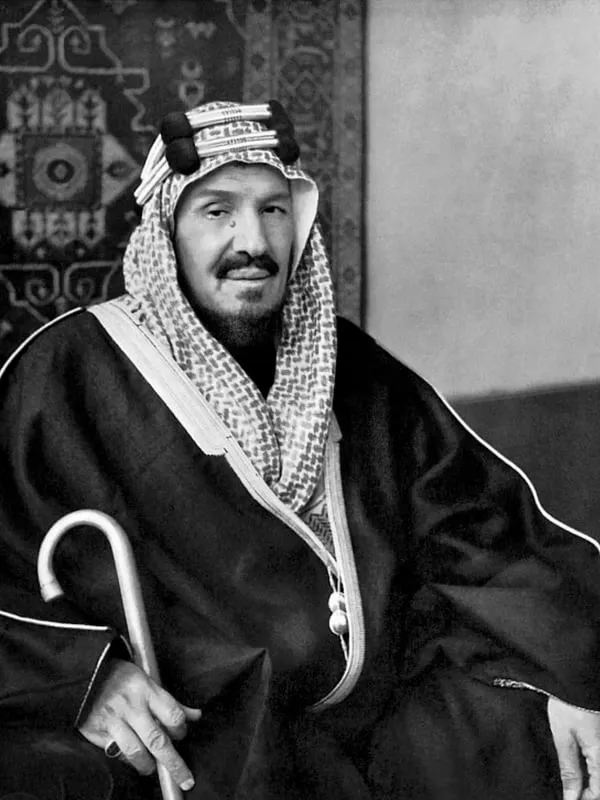
Ibn Saud
Emir of Riyadh and Najd (from 1902), Sultan of Najd (1921–1927), King of the Hejaz (1926–1932) and of Najd (1927–1932), King of Saudi Arabia (1932–1953)
- Born:
- 1876, Riyadh
- Died:
- 9 November 1953, Taif
- Author:
- Natalia
- Photo:
- Lcxzdf56, domena publiczna, Wikimedia Commons

Abd al-Aziz ibn Abd al-Rahman Al Saud, known in the West as Ibn Saud, took thirty years to build – from a handful of loyal followers and an alliance with the Wahhabi clergy – a state that came to cover almost the whole Arabian Peninsula, from the Persian Gulf to the Red Sea, together with Mecca and Medina. He gave it the name of his dynasty: since 1932 it has been called Saudi Arabia, and his sons and grandsons rule it to this day. On the road to the Second World War he was a secondary figure, but not an insignificant one. He drove the British-allied Hashemites out of the Hejaz and forced London to recognise him as a fully independent ruler in the Treaty of Jeddah in 1927. In the 1930s Germany and Italy courted him, but in the war he maintained a neutrality benevolent to the Allies, and his meeting with Franklin Delano Roosevelt in February 1945 laid the foundations of the Saudi–American alliance based on oil.
Exile and the return to Riyadh
His date of birth is uncertain. Saudi tradition gives 1876; some older sources give 1880. He was born in Riyadh, the son of Abd al-Rahman, one of the last emirs of the Second Saudi State. Since the mid-eighteenth century the House of Saud had been bound up with the religious movement of Muhammad ibn Abd al-Wahhab, which preached a return to the purity of Islam and condemned the veneration of saints and tombs. The first Saudi state was destroyed in 1818 by the Egyptians acting for the Ottoman sultan; the second disintegrated in civil wars and in 1891 fell to the House of Rashid of Ha’il, allies of the Turks. Abd al-Aziz’s family wandered through the desert, Qatar and Bahrain before settling in Kuwait, where the boy grew up at the court of its sheikh, Mubarak al-Sabah, and watched how he manoeuvred between the Turks and the British.
In January 1902 Abd al-Aziz and a few dozen companions stole into Riyadh by night, killed the Rashidi governor outside his fortress and took the town. This raid, later told as a founding legend, marked the beginning of the Third Saudi State. His father ceded power to him, keeping the dignity of imam, or religious leader. In the years that followed Abd al-Aziz took one oasis of Najd after another from the Rashidis. In 1904 he suffered defeats at the hands of Ottoman troops who had come to the Rashidis’ aid, but he waged a guerrilla war against them, and in 1906 he won at Rawdat Muhanna, where the Emir of Ha’il was killed. The Turks withdrew from Najd.
The Ikhwan and the first treaty with the British
Around 1912 Abd al-Aziz began settling nomads in agricultural communities called hijras, where Wahhabi preachers taught an austere faith. Their inhabitants, the Ikhwan (“the Brothers”), became his most devoted and most ruthless army. In 1913 he seized the Ottoman province of Al-Ahsa on the Persian Gulf, populated largely by Shiites, to whom he then guaranteed freedom of worship. He thus reached the edge of the British sphere of influence in the Gulf.
During the First World War the British sought his goodwill. In January 1915 the British political officer William Shakespear, who was accompanying him, was killed in a battle with the Rashidis at Jarrab. On 26 December 1915 at Darin, on an island in the Persian Gulf, Abd al-Aziz signed a treaty with the British representative Percy Cox in which Britain recognised him as ruler of Najd and its dependencies and promised him protection, while he undertook not to enter into agreements with other powers and not to attack the sheikhdoms under London’s protection. He received arms and a subsidy, from 1917 £5,000 a month. The British authorities in Cairo, however, placed their main bet on his rival, the Sharif of Mecca, Hussein bin Ali, who in 1916 launched the Arab Revolt and proclaimed himself King of the Hejaz.
Victory over the Hashemites
The dispute with Hussein concerned border oases and influence among the tribes. In May 1919 the Ikhwan routed the army of his son Abdullah at Turabah. In August 1921 Abd al-Aziz assumed the title of Sultan of Najd and its Dependencies, and in November he took Ha’il, ending Rashidi rule. His warriors raided Kuwait, Transjordan and Iraq, where Hussein’s sons reigned. In December 1922 at Uqair the British High Commissioner in Iraq, Percy Cox, drew the borders of Najd with Iraq and Kuwait, creating two neutral zones. Kuwait, whose opinion nobody sought, lost a considerable part of its territory in the process.
The opportunity to settle accounts with Hussein came in 1924. The British stopped paying subsidies to both rivals, and in March, when Turkey, which had abolished the sultanate in 1922, also abolished the caliphate, Hussein proclaimed himself caliph and so outraged much of the Muslim world. At the end of August 1924 Abd al-Aziz’s forces entered the Hejaz. The Ikhwan took Taif and massacred some of its inhabitants, and on 13 October his troops entered Mecca without a fight. Hussein abdicated and sailed into exile, while his son Ali held out in Jeddah and Medina until December 1925. On 8 January 1926 Abd al-Aziz was proclaimed King of the Hejaz. In the holy cities the Ikhwan demolished tombs and domes that they saw as places of idolatry, including the gravestones in the Al-Baqi cemetery in Medina, which provoked protests across the Muslim world. In the summer of 1926 Abd al-Aziz convened an Islamic congress in Mecca to persuade Muslims that the holy cities could be governed efficiently and safely for pilgrims. In January 1927 Najd too was raised to the rank of a kingdom.
The Treaty of Jeddah and the Ikhwan revolt
On 20 May 1927 in Jeddah his son, Emir Faisal, and the British envoy Gilbert Clayton signed a treaty in which Britain recognised the “complete and absolute independence” of the Kingdom of the Hejaz and Najd. In it the king undertook to maintain peaceful relations with Kuwait, Bahrain, Qatar and the Trucial Oman and to cooperate in suppressing the slave trade. His recognition of the borders with the British protectorates and mandates led to a break with the most fanatical Ikhwan chiefs. Faisal al-Duwaish of the Mutayr tribe and Sultan ibn Bajad of the Utaybah accused the king of betraying the faith for the infidel English, the telephone and motor cars. In November 1927 they attacked a post in Iraq, and in the following months Kuwait. The king, who could not allow anyone else to decide on war and peace, won the backing of the clergy and at the end of March 1929 crushed the rebels at Sabilla. Machine guns, some mounted on motor cars, swept away the Bedouin cavalry. The last leaders of the revolt surrendered to the British in Kuwait in January 1930 and were handed over to him. Al-Duwaish died in prison in Riyadh in 1931. In February 1930, aboard a British warship in the Persian Gulf, Abd al-Aziz met King Faisal I of Iraq, the son of his old enemy. The meeting eased the tension but did not dispel their mutual distrust.
King of Saudi Arabia
In September 1932 a royal decree united the Hejaz and Najd into a single state, named from 23 September the Kingdom of Saudi Arabia. In 1933 he designated his eldest surviving son, Saud, as heir to the throne, and made Faisal, experienced in diplomacy, his chief representative abroad. In 1934 he defeated the Imam of Yemen in a short war and under the Treaty of Taif kept the disputed provinces of Asir, Jizan and Najran, but returned the Yemeni lands he had occupied. In March 1935 he survived an assassination attempt during the pilgrimage in Mecca.
The state was poor: its main source of income was the pilgrims’ fees, and their numbers fell during the Great Depression. So in May 1933 the king granted an oil exploration concession to the American company Standard Oil of California, which had outbid the British. In March 1938 commercial deposits were discovered at Dammam, and in May 1939 the first tanker sailed with a Saudi cargo.
Between the Axis and the Allies
Abd al-Aziz watched the growing tension in Europe at close quarters, because it affected his neighbours. Benito Mussolini’s Italy conquered Ethiopia, across the Red Sea, in 1935–1936 and sought influence in Yemen and Arabia. The question of Palestine, where the Arab revolt against the British and Jewish settlement lasted from 1936 to 1939, drew him closer to the Arab nationalists, and his statements about the Jews were often hostile. At the same time the king maintained that the British were his friends, but that he would go with them only as far as his religion and honour allowed. At the end of the 1930s, disappointed with British policy in Palestine, he looked for other partners. From the autumn of 1938 Germany accredited its envoy in Baghdad, Fritz Grobba, to his court as well, and in 1939 a royal emissary held talks in Germany about buying arms. No significant deliveries followed.
After the outbreak of war Abd al-Aziz broke off diplomatic relations with Germany and declared a neutrality benevolent to Britain. He did not support Rashid Ali al-Gaylani’s pro-German coup in Iraq in the spring of 1941, and gave al-Gaylani himself refuge only after the war. On 19 October 1940 Italian bombers dropped bombs on the area of the American oil installations at Dhahran. The war cut the country off from pilgrims, so in its first years Saudi finances were kept afloat mainly by British subsidies. In 1943 the United States, concerned about the future of Saudi oil, extended Lend-Lease to the kingdom.
On 14 February 1945, on his way back from the Yalta Conference, Roosevelt received Abd al-Aziz aboard the cruiser USS Quincy on the Great Bitter Lake in Egypt. The king came from Jeddah on an American destroyer, with a tent pitched on deck and a flock of sheep for meat. They talked above all about Palestine. The king firmly opposed Jewish immigration, and Roosevelt assured him – and later confirmed it by letter – that he would take no action on the matter hostile to the Arabs without consulting them. A few days later the king met Winston Churchill at the Faiyum oasis. On 1 March 1945 Saudi Arabia declared war on Germany and Japan, which allowed it to become a founding member of the United Nations.
The last years
After the war American influence quickly displaced British. The Americans built an air base at Dhahran, and the company that from 1944 was called the Arabian American Oil Company, or Aramco, extracted ever more oil. Its revenues transformed the country and the court, but the king remained attached to the old style of rule: personal, patriarchal, resting on the dynasty and the clergy. Saudi Arabia took only a token part in the 1948 war with Israel. In poor health and almost blind in one eye, he spent his last years mainly in Taif. He died there of a heart attack on 9 November 1953. He was buried in Riyadh, in the Al-Oud cemetery, in a plain unmarked grave in keeping with Wahhabi tradition.
He had some twenty wives and, by various estimates, close to a hundred children, including several dozen sons. Every subsequent King of Saudi Arabia has been one of his sons.
Significance
Abd al-Aziz ibn Saud was one of the few non-European rulers of the interwar period to create a lasting state against the plans of the great powers rather than by their grant. The British, who after the First World War handed out thrones to the Hashemites in Baghdad and Amman, had to accept that their rival ruled in Arabia, and in 1927 they recognised his full independence. At the same time he knew how to remain cautious towards London: he crushed the Ikhwan when they threatened to drag him into war with the British protectorates, and in the 1930s, despite the overtures of Rome and Berlin, he did not stake his future on the Axis. His state, discovered to be a treasure-house of oil on the eve of the Second World War, emerged from it as a partner of the United States. The price of his success was the entrenchment of absolute rule and the official status given to an austere Wahhabism whose consequences are still felt in the Middle East today.
Sources
Often appears with
People who appear in the same events.