Iraq
Faisal I
Commander of the Northern Army in the Arab Revolt (1916–1918), King of Syria (1920), King of Iraq (1921–1933)
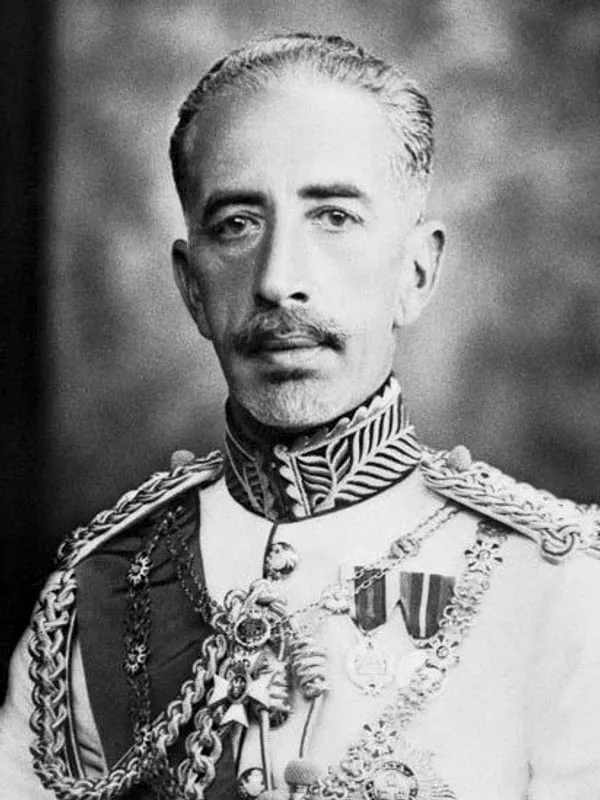
- Born:
- 20 May 1885, Mecca (Ottoman Empire)
- Died:
- 8 September 1933, Bern (Switzerland)
- Author:
- Łukasz
- Photo:
- Vandyk photographic studio, domena publiczna, Wikimedia Commons

Faisal ibn al-Hussein of the Hashemite house was the best-known Arab statesman of his generation. During the First World War he led the Arab Revolt against the Turks alongside T. E. Lawrence; in 1919 he fought in Paris for an independent Arab state; and in 1920 he was King of Syria for a few months until the French drove him out. In compensation the British gave him the throne of the newly created Iraq, which he ruled until his death in 1933. For twelve years he manoeuvred between London and the Iraqi nationalists, and in 1932 he brought Iraq into the League of Nations as the first mandated territory to become a member. Yet he left behind a weak state, divided between Sunnis, Shias and Kurds and bound to Britain by a treaty that in 1941 gave the British the grounds for armed intervention against a pro-German government in Baghdad.
Son of the Sharif of Mecca
He was born on 20 May 1885 in Mecca (according to some sources in Taif, in 1883), the third son of Hussein bin Ali, a member of a family descended from the Prophet Muhammad that had for centuries provided Mecca with its sharifs, the governors of the holy city. He spent part of his childhood among the Bedouin and, from 1893, lived in Istanbul, where Sultan Abdulhamid II kept his father under watch. In 1908 Hussein became Sharif of Mecca, and Faisal returned with him to the Hejaz and fought tribes rebelling against Ottoman rule. In 1913 he was elected to the Ottoman parliament as deputy for Jeddah.
After the Ottoman Empire entered the war, his father sent him to Istanbul for talks on Arab participation in the holy war. On the way, in Damascus, Faisal came into contact with the secret societies of Arab nationalists, al-Fatat and al-Ahd, and joined them. Meanwhile his father was corresponding with the British High Commissioner in Egypt, Henry McMahon, who in return for a revolt promised to support Arab independence within borders whose exact extent was never agreed. In 1916 Faisal was in Damascus when the Ottoman governor of Syria, Djemal Pasha, had more than twenty Arab activists hanged in Damascus and Beirut.
The Arab Revolt
In June 1916 Hussein proclaimed a revolt against the Turks. Faisal and his brother Ali led an unsuccessful attack on Medina, which was held by a strong Ottoman garrison. On 23 October 1916, in Wadi Safra, Faisal met a young British intelligence officer, T. E. Lawrence, who judged him the best leader of the revolt. From then on Faisal commanded the Northern Army, which carried the fighting northwards along the Red Sea coast and the Hejaz Railway. In July 1917 the rebels, among them Lawrence and the Bedouin chief Auda abu Tayi, took Aqaba from the landward side. Thereafter Faisal’s forces operated as the right wing of General Edmund Allenby’s British army, wrecking railway lines and tying down Turkish garrisons.
Faisal was not, however, as unconditionally loyal to the British as Lawrence portrayed him in Seven Pillars of Wisdom. When at the end of 1917 the Bolsheviks published the Sykes–Picot Agreement, in which Britain and France had divided the Arab lands between themselves, Faisal held secret talks with Djemal Pasha about a possible settlement with the Turks. They came to nothing. At the beginning of October 1918 the Arab rebels and Australian troops entered Damascus, and Faisal, who arrived there on 3 October, formed an Arab government.
Paris and Damascus
In January 1919 Faisal came to the Paris Peace Conference as his father’s representative, in Arab dress and accompanied by Lawrence. On 3 January he signed an agreement with the Zionist leader Chaim Weizmann in which he accepted Jewish immigration into Palestine, making it conditional on the fulfilment of the Arab demands for independence. On 6 February he presented the Council of Ten with the demand for the independence of the Arab lands. The victorious powers, however, had no intention of giving up their influence. Georges Clemenceau demanded Syria and Lebanon for France, and David Lloyd George, though he thought highly of Faisal, did not want to damage relations with Paris for his sake. The American King–Crane Commission, sent on the initiative of Woodrow Wilson, found in the summer of 1919 that the people of Syria wanted independence, but its report was shelved.
On 8 March 1920 the Syrian Congress in Damascus proclaimed Syria’s independence and Faisal its king. In April, at the San Remo Conference, the Supreme Council of the Allied Powers assigned France the mandate for Syria and Lebanon, and Britain that for Mesopotamia and Palestine. This division was written into the Treaty of Sèvres. In July the French general Henri Gouraud presented Faisal with an ultimatum. Faisal accepted it, but part of his army under the war minister Yusuf al-Azma resisted and on 24 July 1920 was crushed at the Battle of Maysalun. The French occupied Damascus, and Faisal had to leave the country.
King of Iraq
Driven out of Syria, he proved useful to the British in Mesopotamia, where in the summer of 1920 they had suppressed a bloody revolt against their rule. At the Cairo Conference in March 1921 the Colonial Secretary, Winston Churchill, and his advisers, among them Lawrence and Gertrude Bell, decided to give him the throne of the new state. Faisal, who had never before been to Iraq, landed at Basra on 23 June 1921. The Sunni notables of Baghdad received him well, the Shia clergy and the tribes of the south coolly. After a plebiscite organised by the British, in which according to official figures 96 per cent of the votes were cast for him, he was crowned King of Iraq in Baghdad on 23 August 1921. The band played “God Save the King”, as Iraq did not yet have an anthem.
His power was limited. Britain held the League of Nations mandate for Iraq and exercised its rights under a treaty of alliance signed on 10 October 1922: the High Commissioner advised the king on foreign and financial affairs, the British had advisers in the ministries, and security was guarded by the Royal Air Force. Faisal had to persuade the nationalists that only co-operation with London would lead to independence, while also persuading the British that further concessions were necessary, as otherwise he would lose his authority. The Constituent Assembly ratified the treaty only in 1924. When Turkey, refusing to accept the Treaty of Lausanne, laid claim to Mosul, Faisal agreed in 1926 to extend the British mandate to 25 years, since only on that condition would the League of Nations award the disputed vilayet to Iraq.
He tried to forge a nation out of very different communities. He relied on Sunni officers, his old comrades from the Arab Revolt, such as Nuri al-Said and Jafar al-Askari, but he also courted the Shias and gave assurances of his goodwill towards the Kurds and the Jews. He wanted to introduce universal conscription to create a strong army, but the British, who feared tribal revolts, advised him against it. In 1927 he spent several months in Europe and personally oversaw the negotiations in London that produced the Anglo-Iraqi Treaty of 14 December 1927. In it Britain recognised Iraq as an independent state and promised to support its admission to the League of Nations in 1932 “if all went well”. The treaty never came into force, but it set the goal. He was divided by enmity from the House of Saud, which in 1925 had driven his father and brother out of the Hejaz, an enmity fuelled by raids by Wahhabi warriors on the Iraqi borderlands. In February 1930 he met Abdulaziz ibn Saud aboard a British warship in the Persian Gulf, and the two rulers were reconciled, at least formally.
Independence
After Labour’s victory in Britain, the government of Ramsay MacDonald announced in September 1929 its unconditional support for Iraq’s membership of the League in 1932. On 30 June 1930 the prime minister, Nuri al-Said, signed a new 25-year treaty of alliance in Baghdad: Iraq would maintain close co-operation with London in foreign policy, hand over two air bases to the British, at Shaibah near Basra and at Habbaniya, and allow British troops to cross its territory in the event of war. On 3 October 1932 Iraq was admitted to the League of Nations, and the British mandate came to an end.
Faisal had no illusions about the state of his kingdom. In a confidential memorandum of March 1932 he wrote that there was as yet no Iraqi nation in Iraq, only “unimaginable masses of human beings” devoid of any common idea and divided into Sunnis, Shias and Kurds. He dreamed of a pan-Arab federation of Iraq, Syria, Lebanon, Palestine and Transjordan under his sceptre, but met resistance from France, Turkey, Egypt and Ibn Saud. On Palestine, where bloody clashes between Arabs and Jews had taken place in 1929, he pressed London to restrict Jewish immigration and land purchases.
Simele and death
In the summer of 1933 the Iraqi army under General Bakr Sidqi turned on the Assyrians, a Christian community from the north of the country from which the British had recruited their auxiliary levies. In August came the Simele massacre. The number of victims of the whole operation is estimated at anything from several hundred to more than three thousand. Faisal, who was abroad at the time, returned to Baghdad, but given the mood in the army and among the nationalists he was unable to punish those responsible. In poor health, he went to Switzerland for treatment and died of a heart attack in Bern on 8 September 1933, aged 48. There were rumours that he had been poisoned, which were never confirmed. He was buried in Baghdad.
He was succeeded by his only son, Ghazi, who was young, popular with the nationalists and inexperienced. During his reign the army took on the role of arbiter of politics. In 1936 Bakr Sidqi staged a coup d’état, and the German minister Fritz Grobba was gaining influence among the officers. Ghazi was killed in a car accident in April 1939, and Abd al-Ilah became regent for the four-year-old Faisal II.
Significance
Faisal was the first Arab leader to try to build a modern nation state on the ruins of the Ottoman Empire within the order imposed by the victorious powers. He won formal independence for Iraq sooner than London wanted, but the price was an alliance that left the British their bases and the right of passage. It was this very treaty of 1930 that decided Iraq’s fate in the Second World War in 1941. When on 1 April 1941 a group of officers trained in Faisal’s army installed the pro-German Rashid Ali al-Gaylani in power, the British invoked the treaty, landed troops at Basra, held the base at Habbaniya and in May 1941 overthrew a government that had been counting on help from Adolf Hitler. The Hashemite monarchy survived in Iraq for another seventeen years. On 14 July 1958, during a military revolution, his grandson Faisal II, the regent Abd al-Ilah and Nuri al-Said were killed. Faisal’s equestrian statue in Baghdad was pulled down but later put back up.
Sources
Often appears with
People who appear in the same events.