Russia
Nikolai Linevich
Commander of the Russian troops in the march on Beijing (1900), commander of the Priamur Military District (1903–1904), commander of the 1st Manchurian Army (1904–1905), Commander-in-Chief in the Far East (1905–1906)
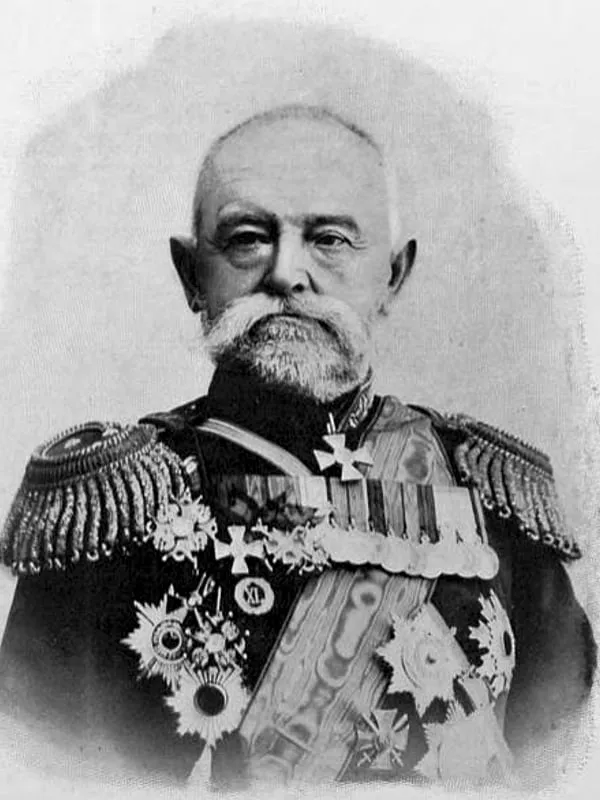
- Born:
- 5 January 1839, Chernihiv (Russian Empire)
- Died:
- 23 April 1908
- Author:
- Łukasz
- Photo:
- Д. Янчевецкий, domena publiczna, Wikimedia Commons

Nikolai Linevich was a soldier of the old school who rose all the way from a cadet with no military education to commander-in-chief of the Russian army. He fought the mountaineers of the Caucasus and the Turks at Batumi, and in 1900 he led the Russian troops on Beijing during the Boxer Rebellion, which won him a reputation in Europe as an energetic commander. In the war with Japan he first commanded the 1st Manchurian Army, the only one to come out of the Battle of Mukden in good order, and in March 1905 he replaced Aleksey Kuropatkin as commander-in-chief. He rebuilt the shattered army, but did not dare to fight another battle, and to the end he tried to persuade the tsar that making peace would be a disaster. Peace was nevertheless concluded, and Japan came out of the war with a foothold in Manchuria that in 1931 became the starting point of its conquest.
The Caucasus and the war with Turkey
He was born on 5 January 1839 (24 December 1838 in the Julian calendar) in Chernihiv, into a noble family descended from a Cossack sotnik (captain) of the Chernihiv regiment. After finishing grammar school he joined the army as a cadet in 1855, during the Crimean War, and the very next year, without completing any military school, he was commissioned as an ensign. He spent most of his youth in infantry regiments stationed in the Caucasus. In 1862–1864, in the final phase of the Caucasian War, he took part as a company commander in the fighting against the Circassians in the western Caucasus, and later in Chechnya and Dagestan. He earned a reputation as a brave officer and an excellent drillmaster, the best shot and swordsman in his regiment. He then served for ten years with a training company in Tiflis.
In the Russo-Turkish War of 1877–1878 he fought first at Kars, and from August 1877, as a lieutenant colonel, he commanded the 2nd Caucasian Rifle Battalion in the fighting for Batumi. In April 1878, in an attack on Turkish positions on the Kintrishi river, he was hit by three bullets, in the arm and the leg, and suffered a contusion. For this action he received the Order of St George, 4th Class, a golden sword “For Bravery” and the rank of colonel. In 1879 he took command of an infantry regiment, and in 1885 of a rifle brigade in the Transcaspian Region, recently conquered by Russia in Central Asia, whose battalions were stationed from Ashgabat to Merv. In 1888, at a time of tension on the Afghan border, he commanded an observation detachment there.
The Far East and the march on Beijing
In 1895 Linevich became commander of the troops in the South Ussuri region, at the far eastern edge of the empire, around Vladivostok. When in the summer of 1900 the Boxer Rebellion engulfed northern China and the insurgents besieged the Legation Quarter in Beijing, he took command of the Siberian corps sent to Zhili province. In mid-July he arrived in Tianjin, where he took over command of the Russian detachment from General Anatoly Stessel. As the most senior in rank of the commanders of the contingents of the international intervention, he presided over the councils of the allied commanders until the arrival of the German Field Marshal Alfred von Waldersee, who had been appointed supreme commander of the coalition forces.
At a council on 21 July it was decided to march on Beijing despite the heat and the shortage of supplies. Stessel protested, considering the march premature, but Linevich was determined. At the beginning of August the allies took the Chinese positions at Beicang, and on 14 August they began the assault on the walls of the capital. Linevich’s Russian column was one of the first to attack and suffered heavy losses, and that same day the allies broke into the city and relieved the besieged legations. The swift capture of Beijing made an impression in Europe. The tsar awarded Linevich the Order of St George, 3rd Class, and the allied governments showered him with decorations. In 1901 he was still fighting the remnants of the insurgents in Manchuria, and in 1903 he became commander of the Priamur Military District and acting Governor-General, based in Khabarovsk.
The war with Japan
When the Russo-Japanese War broke out in February 1904, Linevich went to Liaoyang and temporarily took command of the Manchurian Army. His name is said to have headed the list of candidates for the permanent command submitted to the tsar, but Nicholas II chose the War Minister, Kuropatkin. When Kuropatkin arrived in Manchuria at the end of March, Linevich returned to Khabarovsk.
He returned to the front in the autumn. After the indecisive Battle of the Shaho the Russian forces in Manchuria were divided into three armies, and in October 1904 Linevich took command of the 1st Manchurian Army, made up mainly of Siberian corps. At Kuropatkin’s councils of war he usually argued for decisive action. At the Battle of Mukden, from 20 February to 10 March 1905, his army held the eastern wing of the front, which the Japanese struck first. When Kuropatkin ordered a general retreat, the 1st Army withdrew in good order, while the other two were caught in the pocket at Mukden and fought their way north in confusion.
On 16 March 1905 (3 March in the Julian calendar) the tsar dismissed Kuropatkin and appointed Linevich commander-in-chief of all land and naval forces operating against Japan. Kuropatkin, at his own request, took over the 1st Army from him. Linevich halted the retreating troops at positions near Sipingjie, some two hundred kilometres north of Mukden, and prevented a retreat all the way to Harbin. Over the following months new corps arrived along the Trans-Siberian Railway, and by the summer of 1905 the Russian army in Manchuria was larger than at any time in the war. The Japanese, who had exhausted their reserves at Mukden, no longer had the strength to pursue and watched this build-up with alarm. Linevich, however, did not go over to the attack. He demanded further reinforcements and claimed that he could attack only with a one-and-a-half-fold superiority. No further major battle was fought in Manchuria before the end of the war.
When President Theodore Roosevelt proposed negotiations in June, Linevich, together with Kuropatkin, tried to persuade the tsar by telegram that victory on land was certain and that peace would be a great misfortune. But the tsar, threatened by revolution and with his fleet lost at Tsushima, chose peace, and on 5 September 1905 the Treaty of Portsmouth was signed.
Revolution and dismissal
After the peace Linevich directed the army’s return to Russia. It proved very difficult, because the 1905 Revolution had reached Siberia and Manchuria too. Railwaymen on the Trans-Siberian line were on strike, revolutionary committees were taking power in the towns along the railway, and reservists eager to get home as quickly as possible mutinied in Harbin and Vladivostok. Linevich was unwilling to use force against the strikers and his own soldiers. In January 1906 the government sent two punitive expeditions along the Trans-Siberian Railway, one from European Russia and one from Manchuria – the latter under General Paul von Rennenkampf – which restored order on the railway by bloody means. In February 1906 Linevich was removed from the supreme command and an investigation was opened against him for “inaction of authority”. After eight months the tsar ordered it to be dropped, and on the fiftieth anniversary of his service awarded him the Order of St Vladimir, 2nd Class.
Linevich spent his last years in retirement, writing his memoirs. He died on 23 April 1908 (10 April in the Julian calendar) and was buried in the cemetery of the Alexander Nevsky Lavra in St Petersburg. Among the wreaths laid on his coffin was one from his recent enemies, the Japanese. His war diary was published in Leningrad in 1925 together with Kuropatkin’s diaries, with a preface by the Bolshevik historian Mikhail Pokrovsky.
Significance
Linevich was a brave and experienced regimental and corps commander, but, like many generals of his generation, he proved too cautious at the head of the huge armies of the age of mass warfare. Historians still argue over whether Russia could still have won the war on land in the summer of 1905, given its growing numerical superiority in Manchuria and Japan’s state of near-exhaustion. Linevich gave no answer to that question, because he never risked a battle. The peace thus sealed the outcome of Mukden and Tsushima: Russia ceded southern Manchuria with Port Arthur and the railway to Japan, and on it the Japanese built up the power from which, in 1931, the Kwantung Army set out to conquer the whole of Manchuria. His last months in Manchuria also revealed the other side of the defeat: the lost war shook the army itself, which in 1905–1906 for the first time refused obedience to the tsar – something that was repeated on a far larger scale in 1917.