Russia
Aleksey Kuropatkin
Minister of War of Russia (1898–1904), commander of the Manchurian Army and Commander-in-Chief in the Far East (1904–1905), commander of the Northern Front (1916), Governor-General of Turkestan (1916–1917)
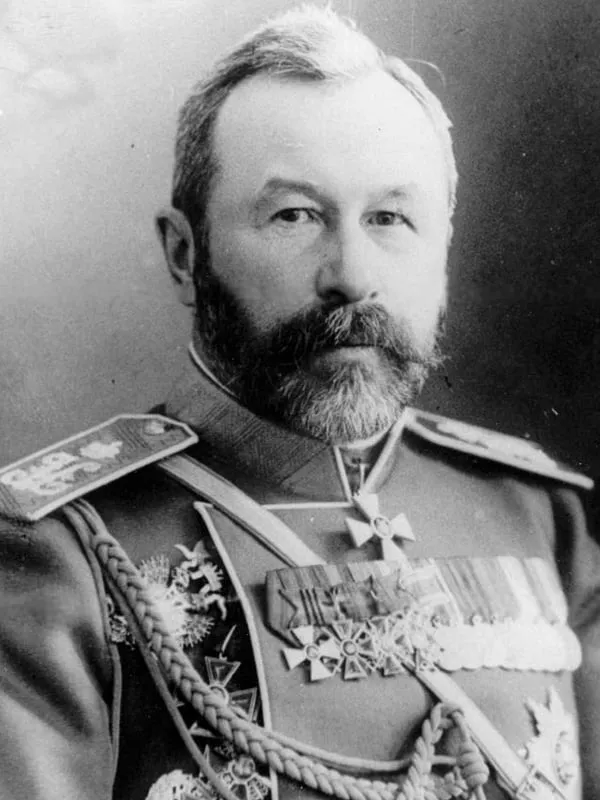
- Born:
- 29 March 1848
- Died:
- 16 January 1925, Sheshurino, Pskov Governorate (Soviet Union)
- Author:
- Natalia
- Photo:
- autor nieznany, domena publiczna, Wikimedia Commons

In late nineteenth-century Russia Aleksey Kuropatkin was regarded as one of the ablest generals of his generation. A hero of the conquest of Central Asia, chief of staff to the legendary General Mikhail Skobelev, the learned author of studies on Kashgaria and Turkmenia and, from 1898, Minister of War, he was expected in 1904 to lead the Russian army to an easy victory over Japan. Instead he lost every major battle of the land war – at Liaoyang, on the Shaho, at Sandepu and at Mukden – and went down in history as a symbol of the incompetence of the tsarist high command. His defeat opened Manchuria to Japan, which a quarter of a century later set out from there to conquer China, while in Russia it pushed the country towards revolution. Kuropatkin himself outlived both tsarism and the revolution and died in 1925 as a village schoolteacher.
Youth and Turkestan
He was born on 29 March 1848 (17 March in the Julian calendar) into an impoverished noble family. His father, the son of a soldier, rose to officer’s rank in the Corps of Topographers and taught topography at a cadet corps in St Petersburg. Most sources give the future general’s birthplace as Kholm district in Pskov Governorate, with which the family was connected, while some, including Russian biographical works, give Vitebsk. Kuropatkin graduated from the 1st Cadet Corps and, in 1866, from the Pavlovsk Military School in St Petersburg, after which he was posted as a second lieutenant to the 1st Turkestan Rifle Battalion.
Turkestan was then the most distant and most promising front of Russian expansion. The young officer fought against Bukhara in 1867–1868, among other places at Samarkand, and won rapid promotion. In 1871–1874 he studied at the Nicholas General Staff Academy, from which he graduated top of his class. As a reward he was sent to study in Germany and France, and with the French he took part in an expedition into the Sahara from French Algeria, which he later described in a book. After his return he fought in the war against the Khanate of Kokand and for the storming of the fortress of Uch-Kurgan received the Order of St George, 4th Class. In 1876–1877 he led a mission to Yakub Beg, ruler of Kashgaria in western China, concerning the border with Fergana, and that journey produced his study of the country, later translated into English.
Plevna and Geok Tepe
During the Russo-Turkish War of 1877–1878 Kuropatkin was chief of staff of the 16th Infantry Division under General Mikhail Skobelev, the most famous Russian commander of the day, and fought at Lovcha and Plevna, among other places. He came away from these experiences with admiration for Skobelev and the conviction that wars are won by careful preparation, not by daring. He later wrote an extensive study of the fighting at Plevna.
In 1880–1881 he again served with Skobelev, this time in the expedition against the Teke Turkmens. At the head of a small detachment he crossed some five hundred kilometres of desert in eighteen days, and on 24 January 1881 (12 January in the Julian calendar) he led the main assault column, which broke through a breach blown by a mine into the fortress of Geok Tepe, today’s Gökdepe. For this he received the Order of St George, 3rd Class. The capture of the fortress was accompanied by a massacre: thousands of Turkmens, women and children among them, were killed in the pursuit of those who fled. In 1882 Kuropatkin was made a major general.
The Main Staff and Transcaspia
He spent the years 1883–1890 at the Main Staff in St Petersburg, where he worked on preparing plans for war in the west, above all against Germany and Austria-Hungary. In 1890, by now a lieutenant general, he took over the administration of the Transcaspian Oblast, today’s Turkmenistan, with its seat in Ashgabat. For eight years he governed the territory as a provincial reformer: he built roads and schools, reformed the courts, promoted agriculture and trade and brought in settlers from the Russian interior. In 1895 he travelled at the head of an extraordinary mission to Tehran to inform the Shah of the accession of Nicholas II.
Minister of War
At the beginning of 1898 the Tsar entrusted him with running the War Ministry, and from July that year he was minister in his own right. Kuropatkin wanted to rejuvenate and educate the officer corps. He introduced age limits for commanders, lengthened the course at the junker schools, opened new cadet corps, raised officers’ pay and extended manoeuvres. He abolished corporal punishment, introduced field kitchens and improved conditions in the barracks, but he did not get the money to feed and clothe the soldiers better. During his tenure the field artillery received quick-firing 76 mm guns and the first machine-gun companies began to be formed. According to some historians, it was his fear of a costly artillery race with Austria-Hungary that gave the Tsar the idea of convening the first peace conference at The Hague in 1899.
In the Far East Kuropatkin acted in two ways. In 1900, when the Boxer Rebellion broke out in China, he directed the dispatch of troops who occupied the whole of Manchuria, and he wanted to keep at least its northern part. At the same time, however, he believed that Russia should not let itself be drawn into a war over Korea, and he opposed the adventurers grouped around Aleksandr Bezobrazov, who were urging the Tsar to expand along the Yalu River. In June 1903 he visited Japan and came back convinced that the Japanese were ready to fight. His diary from these years is one of the more important sources for the history of Russian policy before the war. According to the memoirs of Sergei Witte, the Minister of the Interior, Vyacheslav von Plehve, is supposed to have told him at that time that what Russia needed to hold back revolution was “a small victorious war”.
The war with Japan
When the Japanese attacked Port Arthur in February 1904 and the Russo-Japanese War broke out, the Tsar appointed Kuropatkin commander of the Manchurian Army. He was subordinate to the Viceroy of the Far East, Admiral Yevgeny Alekseyev, with whom he quarrelled from the outset. Kuropatkin wanted to fall back until enough troops had arrived along the Trans-Siberian Railway, and only then go over to the offensive. Alekseyev and the Tsar demanded action and the defence of Port Arthur. As a result the Russians sent too small forces into battle, which the Japanese defeated one after another, as on the Yalu at the turn of April and May and at Telissu in June, where a corps sent to relieve Port Arthur against Kuropatkin’s judgement was beaten back.
At Liaoyang, from 25 August to 3 September 1904, Kuropatkin fought the first great battle against the armies of Marshal Iwao Ōyama. He had numerical superiority and for several days repelled the attacks, but when the Japanese First Army crossed the Taizi River and threatened his rear, he overestimated the enemy’s strength and ordered a retreat to Mukden. In October he attacked on the Shaho himself, but after two weeks of fighting and heavy losses he called off the offensive. Even so, in October the Tsar appointed him Commander-in-Chief of all land and naval forces in the Far East in place of Alekseyev. In January 1905, at Sandepu, an attack by General Oskar Grippenberg’s Second Army took the Japanese by surprise, but Kuropatkin, seeing no chance of success, ordered it halted. Grippenberg left for St Petersburg and publicly accused him of throwing away a victory.
The decisive battle was the Battle of Mukden, from 20 February to 10 March 1905. Ōyama outflanked the Russians on both sides, while Kuropatkin shifted his reserves from place to place, breaking up his own formations, and on the evening of 9 March ordered a general retreat. The army lost some 90,000 men but escaped encirclement. The Tsar removed Kuropatkin from the supreme command and gave it to General Nikolai Linevich. Kuropatkin asked to be allowed to remain in Manchuria, even in a lower post, and commanded the 1st Manchurian Army until the Peace of Portsmouth was concluded and the army disbanded at the beginning of 1906.
Historians differ in their assessment of his generalship. Many, especially in Soviet and Western historiography, saw him as a passive and indecisive commander who could not take a risk and twice gave up the field before the battle was lost. More recent works draw attention to circumstances beyond his control: a single railway line, interference by the Viceroy and the Tsar, poorly trained reservists and disloyal subordinates. All agree that the Japanese, despite Russian numerical superiority in successive battles, almost always held the initiative.
After the war
On his return Kuropatkin became a member of the State Council, but he was no longer given any post in the army. He defended himself with his pen. He wrote an extensive report on the war, which the authorities did not want to make public; an abridged version was published in English in 1909 as The Russian Army and the Japanese War. He blamed the defeat above all on the country’s unpreparedness, the policy of the court and the mistakes of his subordinates. In 1910 he published a three-volume work, Russia for the Russians, setting out a nationalist programme, and in 1913 a book on the Russo-Chinese question, in which he warned against China’s growing power.
The Great War
When war with Germany broke out in 1914, Kuropatkin asked to be sent to the front, but the Commander-in-Chief, Grand Duke Nicholas Nikolaevich, did not want him in the army. Only when the Tsar himself took over the supreme command in September 1915 did Kuropatkin receive the Grenadier Corps, then at the beginning of 1916 the Fifth Army, and in February command of the entire Northern Front, which covered the road to Petrograd. In March 1916 his troops launched an offensive near Riga and Jakobstadt intended to draw the Germans away from Verdun. It brought only small gains at the cost of heavy losses, and in a night attack using searchlights, which in the war with Japan had dazzled the enemy, the Russian infantry, silhouetted against the lights, became an easy target. Kuropatkin concluded that, given German technical superiority, offensives were pointless, and when the Brusilov offensive began in the south in June, his front did nothing for many weeks to support it. In July 1916 the Tsar removed him.
Turkestan, 1916
The Tsar sent him as Governor-General to Turkestan, where in the summer of 1916 a revolt broke out among the Kazakhs, the Kyrgyz and other peoples of Central Asia against a decree conscripting their men for labour behind the front. Kuropatkin directed its suppression. Troops and armed Russian settlers burned villages and murdered the inhabitants, and tens of thousands of Kyrgyz and Kazakhs fled across the mountains to China, where many died of hunger and cold. The number of victims is disputed, but many historians estimate it at no fewer than several tens of thousands, and some much higher. According to researchers, Kuropatkin also planned to remove the Kyrgyz from part of Semirechye and hand their land over to settlers. Today these events are commemorated in Kyrgyzstan as a national tragedy.
Revolution and last years
The February Revolution found Kuropatkin in Petrograd, and he quickly recognised the Provisional Government. The Minister of War, Alexander Guchkov, confirmed him in his post in Turkestan, but in the spring of 1917 the Tashkent Soviet of Workers’ and Soldiers’ Deputies removed him from power, arrested him and sent him back to Petrograd, where the Provisional Government released him. In June he was given an honorary seat on a committee for the care of the wounded, and he then left for his estate of Sheshurino in Pskov Governorate.
After the October Revolution he neither emigrated nor joined the Whites, although according to some sources such offers were made to him. He stayed in the countryside, taught at a village school that he had founded himself, ran a village library and lectured at an agricultural school. He died at Sheshurino on 16 January 1925 and was buried there. Rumours that he had been murdered by bandits proved untrue. In 1964 a monument was erected on his grave with an inscription commemorating the founder of the village school.
Significance
Kuropatkin belonged to a generation of generals who had grown up on easy victories over the peoples of Central Asia and were unprepared for war against a modern army. His defeat in Manchuria had consequences reaching far beyond the fate of one commander. Beaten in the field, Russia had to cede Port Arthur and the South Manchurian railway to Japan, and on that basis the Japanese built up their position in China over the following decades, spearheaded by the Kwantung Army, which in 1931 seized the whole of Manchuria. In Russia itself the defeats of 1904 and 1905 undermined the authority of tsarism and contributed to the Revolution of 1905, which was a dress rehearsal for 1917. His Japanese opponents, Ōyama and Admiral Heihachirō Tōgō, were revered at home as national heroes, while Kuropatkin, who died in obscurity, became a byword in Russia for a commander who loses because he waits too long.