Russia
Nicholas II
Emperor of All Russia and King of Poland (1894–1917), Commander-in-Chief of the Russian Army (1915–1917)
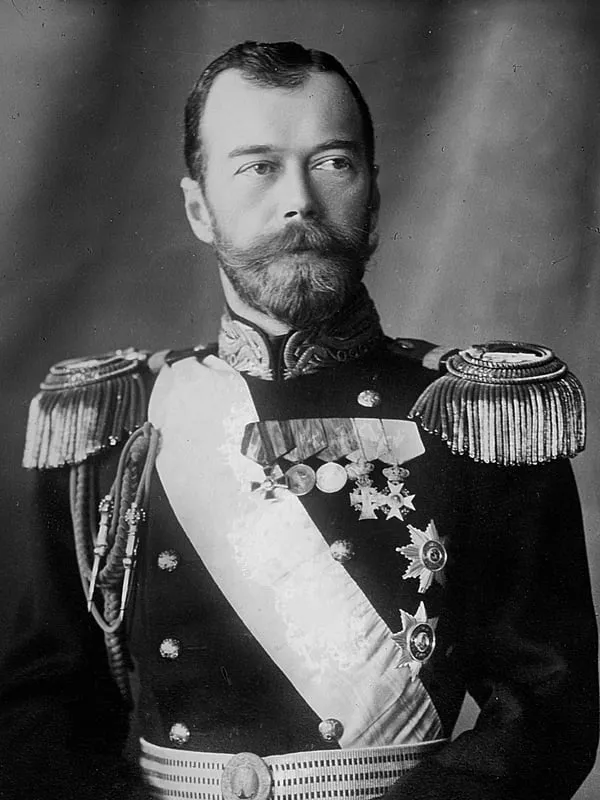
- Born:
- 18 May 1868, Tsarskoye Selo (Russian Empire)
- Died:
- 17 July 1918, Yekaterinburg
- Author:
- Łukasz
- Photo:
- autor nieznany, domena publiczna, Wikimedia Commons

Nicholas II Romanov was the last Emperor of Russia. He reigned for more than twenty-two years, from 1894 to 1917, and throughout that time he defended the principle of autocracy, which he was no longer able to turn into effective government. His Far Eastern policy led to a lost war with Japan that opened the way for the Japanese into Korea and Manchuria. In 1914 he agreed to the mobilisation that pushed Europe into the Great War, and in 1915 he placed himself at the head of the army. When the garrison of the capital mutinied in March 1917, his generals abandoned him and he was forced to renounce the throne. Sixteen months later the Bolsheviks murdered him together with his family. The fall of his monarchy opened the road to power for Lenin and Stalin, and the break-up of the empire determined the shape of Eastern Europe for the next twenty years.
Heir to the throne
He was born on 18 May 1868 (6 May in the Julian calendar) at Tsarskoye Selo near St Petersburg, the eldest son of Grand Duke Alexander, later Emperor Alexander III, and the Danish Princess Dagmar, who took the name Maria Feodorovna in Russia. He had three brothers, the youngest of whom was Michael, and two sisters. In 1881, when revolutionaries assassinated his grandfather Alexander II, the twelve-year-old Nicholas became heir to the throne. An upbringing in the spirit of his father, a stern defender of autocracy, and lessons from the conservative ideologue Konstantin Pobedonostsev shaped his convictions for life. He received a careful education at home, knew several languages and served for some years in Guards regiments, but he was poorly prepared for the exercise of power.
In 1890–1891 he made a grand tour of the East, through Egypt and India to China and Japan. On 11 May 1891, in the Japanese town of Ōtsu, a policeman from his escort attacked him with a sabre. The Tsesarevich survived the attack with a head wound and a scar he bore for the rest of his life. On his way home, at Vladivostok, he ceremonially inaugurated the construction of the Trans-Siberian Railway, which was to bind the Far East to the rest of the empire.
The first years of the reign
Alexander III died suddenly on 1 November 1894 at the age of 49, and the 26-year-old Nicholas became Emperor. A few weeks later he married Princess Alix of Hesse, a granddaughter of Queen Victoria, who took the name Alexandra Feodorovna. The couple had four daughters and a son. As early as January 1895 the Emperor dismissed the hopes of the zemstvos – the elected local councils – for a share in government as “senseless dreams”. The coronation festivities in Moscow in May 1896 were overshadowed by the Khodynka tragedy, a stampede in which more than a thousand people died. That evening the imperial couple went to a ball at the French embassy, which many Russians took as proof of their indifference.
On Russia’s initiative the first Peace Conference was convened at The Hague in 1899, and it adopted the first Hague Conventions. At the same time the Tsar was watching Asia with interest. In 1895 Russia, France and Germany forced Japan to return the Liaodong Peninsula, which it had taken from China, and three years later Russia itself leased its tip, with Port Arthur, from China. The Chinese Eastern Railway was built across Manchuria, and after the Boxer Rebellion of 1900 Russian troops occupied Manchuria and were in no hurry to leave. In Korea the Russians competed with the Japanese for influence at the court of King Gojong, who after the murder of Queen Min took refuge in the Russian legation for more than a year from 1896.
The Finance Minister, Sergei Witte, wanted to conquer the Far East with railways and banks, but the Tsar listened more and more readily to an adventurist clique of hardliners grouped around Alexander Bezobrazov, who ran timber concessions on the Yalu River on the Korean border. In 1903 Witte lost his post as minister. Nicholas did not believe that Japan would dare to attack a great power, and in private conversations and letters he is said to have called the Japanese “macaques”.
The war with Japan and the Revolution of 1905
On the night of 8–9 February 1904 the Japanese fleet attacked the Russian ships at Port Arthur, and the Russo-Japanese War began. For Russia it was a string of defeats: the Japanese besieged and took Port Arthur, beat the army of General Aleksey Kuropatkin at Mukden, and in May 1905 Admiral Heihachirō Tōgō destroyed at Tsushima a fleet that had sailed halfway around the world. The defeats set the country seething. On 22 January 1905 troops in St Petersburg fired on a peaceful procession of workers carrying a petition to the Tsar. This Bloody Sunday destroyed many subjects’ faith in the “good Tsar” and marked the start of the Revolution of 1905, which also engulfed the Kingdom of Poland.
The Tsar had to make peace. Through the mediation of the President of the United States, Theodore Roosevelt, Witte negotiated the Treaty of Portsmouth, signed on 5 September 1905. Russia paid no indemnity, but it ceded to Japan the southern half of Sakhalin, the lease of Port Arthur and the southern section of the Manchurian railway, and it recognised Japanese influence in Korea. Five years later Japan annexed Korea, and its Manchurian railway zone gave rise to the army that seized the whole of Manchuria in 1931. In July 1905, at Björkö, Nicholas also signed a treaty of alliance with his cousin, Emperor Wilhelm II, but his ministers convinced him that it was incompatible with the alliance with France, and it never came into force.
In October 1905, faced with a general strike, the Tsar issued the October Manifesto under pressure from Witte. In it he promised civil liberties and a parliament, the State Duma. He never fully accepted this concession. In the Fundamental Laws of 1906 he kept the title of autocrat, he dissolved the first two Dumas, and he backed the agrarian reforms of his Prime Minister, Pyotr Stolypin, who was assassinated in Kiev in 1911, with ever less enthusiasm.
Family and Rasputin
In 1904 the long-awaited heir to the throne, Alexei, was born. It turned out that the boy suffered from haemophilia and that any cut or knock could kill him. The illness was a state secret, and the family withdrew more and more into Tsarskoye Selo. The desperate Empress put her trust in a Siberian peasant and self-proclaimed holy man (starets), Grigori Rasputin, who she believed could ease her son’s suffering. Rumours of his debauchery and influence were discrediting the court even before the war. The Tsar brushed aside the warnings of the President of the Duma, Mikhail Rodzianko, with the remark that it was a family matter.
July 1914
In foreign policy the Tsar wanted peace, but he believed that Russia could not give way in the Balkans a second time, as it had during the Bosnian crisis of 1909. After the assassination in Sarajevo and the Austrian ultimatum, Russia stood behind Serbia. Until the last moment Nicholas exchanged telegrams with Wilhelm II, signing himself “Nicky”. On the evening of 29 July he held back the general mobilisation order he had already signed and replaced it with a partial one. The next day, however, the Foreign Minister, Sergei Sazonov, convinced him that war with Germany was inevitable, and on 30 July the Tsar agreed to the mobilisation of the entire army. On 1 August Germany declared war on Russia.
On 2 August the Tsar proclaimed the war from a balcony of the Winter Palace, and the crowd in the square fell to its knees. For a few weeks the monarchy enjoyed support such as it had not known for decades. The sale of vodka was banned, which was meant to improve discipline but deprived the treasury of enormous revenue, and German-sounding St Petersburg was renamed Petrograd. The Tsar’s uncle, Grand Duke Nicholas Nikolaevich, became Commander-in-Chief. In August 1914 the Grand Duke issued a proclamation to the Poles promising the unification of the Polish lands under the Tsar’s sceptre.
Commander-in-Chief
In the spring of 1915 the Germans and Austrians broke through the front at Gorlice, and the Great Retreat began, costing Russia Galicia, the Kingdom of Poland and Lithuania. The Tsar dismissed several conservative ministers, but at the same time decided to take command of the army himself. Eight ministers warned him in a collective letter that this threatened Russia and the dynasty with grave consequences. Nicholas remained unmoved, and in September 1915 he arrived at General Headquarters (Stavka) in Mogilev. Operations were in fact directed by his chief of staff, General Mikhail Alekseyev. The front stabilised, supplies improved, and in 1916 the Brusilov offensive smashed the Austro-Hungarian armies in Volhynia and Galicia.
The Tsar’s absence from the capital had far worse consequences. In Petrograd appointments were in practice decided by the Empress, often in line with Rasputin’s wishes. In 1915–1917 Russia had four prime ministers, and interior ministers changed even more often. In November 1916 the leader of the Kadets, Pavel Milyukov, asked from the rostrum of the Duma whether the government’s policy was “stupidity or treason”. The Tsar refused to accept a government enjoying the confidence of the Duma. Warnings reached him from his family, including his brother Michael, from Allied ambassadors and from his generals. The murder of Rasputin by aristocratic conspirators in December 1916 did not persuade him to change course. On the Polish question the Tsar declared only in December 1916, after the Central Powers’ Act of 5 November, that the aim of the war was a free Poland made up of all three of its parts.
The fall
On 7 March 1917 the Tsar left Tsarskoye Selo for Mogilev. The next day strikes broke out in Petrograd, and on 12 March the garrison mutinied and the February Revolution began. Nicholas ordered the disturbances to be put down by force and decided to return to his family, but his train was unable to reach Tsarskoye Selo and turned back to Pskov. There the commander of the Northern Front, General Nikolai Ruzsky, extracted his consent to a government responsible to the Duma, while Alekseyev canvassed the views of the front commanders. All of them advised abdication. Late in the evening of 15 March 1917 the Tsar renounced the throne for himself and for his sick son in favour of his brother Michael, who the following day made his acceptance of the crown conditional on the will of a Constituent Assembly. In his diary Nicholas wrote: “All around me there is treason, cowardice and deceit!” In one of his last decrees he appointed Prince Georgy Lvov Prime Minister.
On 21 March he was informed at Mogilev that he was under arrest, and the next day he returned under guard to Tsarskoye Selo. The Provisional Government wanted to send the imperial family to Britain, but King George V, Nicholas’s cousin, feared that the presence of the deposed Tsar would damage the British monarchy, and the invitation was withdrawn. In August 1917 the Prime Minister, Alexander Kerensky, had the Romanovs moved to Tobolsk in Siberia. After the Bolshevik seizure of power their situation worsened, and in the spring of 1918 they were taken to Yekaterinburg and confined in the house of the engineer Ipatiev.
On the night of 16–17 July 1918, as the Czechoslovaks and the Whites were approaching the city, a squad commanded by Yakov Yurovsky murdered Nicholas, his wife, their five children and four of their companions in the cellar of the house. The bodies were destroyed and hidden outside the city. The decision was formally taken by the Ural Regional Soviet. Historians disagree over the extent to which it had been agreed beforehand with Vladimir Lenin and Yakov Sverdlov in Moscow, but the central authorities approved it at once. A month earlier, in Perm, Chekists had murdered Grand Duke Michael.
Memory
For years the Soviet authorities concealed the fact that the whole family had been killed. The remains were found near Yekaterinburg in 1979, but those who found them revealed this only at the end of the 1980s, and they were exhumed in 1991. After DNA testing, the remains of the Tsar, the Empress and three of their daughters were buried in 1998 in the Peter and Paul Cathedral in St Petersburg. The Russian Orthodox Church Outside Russia canonised Nicholas and his family as martyrs in 1981, and the Russian Orthodox Church recognised them as saints in 2000.
Assessment
Few rulers provoke such divergent judgements. To his critics, from liberal contemporaries to many historians such as Orlando Figes, he was a courteous, pious man devoted to his family, but stubborn, susceptible to his wife’s influence and incapable of understanding that autocracy no longer suited a modern state. He is blamed for dragging Russia into a war with Japan that nobody but a court clique wanted, for leading an unprepared state into total war in 1914, and for rejecting to the very end an accommodation with the Duma that might have saved the monarchy. Others, such as the British historian Dominic Lieven, stress that he was more intelligent and hard-working than legend held, and that he faced a task few could have mastered.
For the history that leads to 1939 his reign matters in two ways. Defeat in the war with Japan showed that an Asian power could beat a European one, and it gave Japan a foothold in Manchuria from which its expansion of the 1930s sprang. The fall of the monarchy in 1917, in turn, opened the way for the Bolsheviks, who built the Soviet Union from the ruins of the empire. In Poland he is remembered above all because his state ruled the largest part of the Polish lands, and because concrete promises to the Poles came only when the Kingdom of Poland had already been lost.
Sources
Mentioned in battles
(02)Often appears with
People who appear in the same events.