Russia
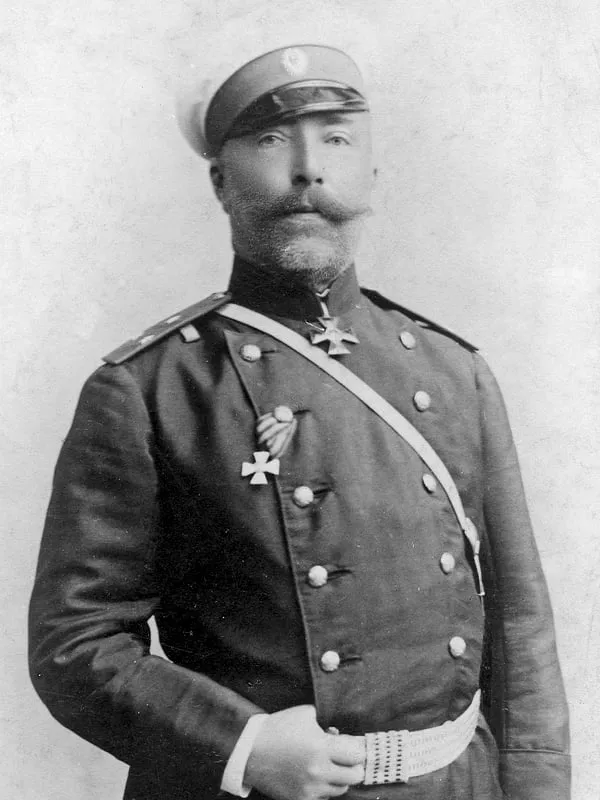
Anatoly Stessel
Commandant of the fortress of Port Arthur (1903–1904), commander of the Kwantung Fortified Region (1904–1905), lieutenant general
- Born:
- 10 July 1848, St Petersburg
- Died:
- 31 January 1915, Khmilnyk (Podolia Governorate)
- Author:
- Łukasz
- Photo:
- autor nieznany, domena publiczna, Wikimedia Commons

Anatoly Stessel was the best-known and at the same time the most hated Russian general of the war with Japan. For eleven months, from the outbreak of war in February 1904 to January 1905, he directed the defence of Port Arthur, Russia’s most important fortress on the Pacific. During the siege the press in Russia and in Europe turned him into a hero; the Tsar conferred high orders on him, and the German Emperor the Prussian order Pour le Mérite. On 2 January 1905, however, against the view of most of his council of war, Stessel surrendered to the Japanese a fortress that still held more than 20,000 men fit to fight and stocks of ammunition. A court martial sentenced him to death for this; the Tsar commuted the sentence to imprisonment and pardoned him a year later. The fall of Port Arthur sealed the transfer of the Liaodong Peninsula, with its naval base and railway, to Japan, which made it the base for its expansion in Manchuria.
Origins and early service
He was born on 10 July 1848 (28 June in the Julian calendar) in St Petersburg, into a noble family of German origin from the Baltic governorates. His father was an officer and his grandfather a general and commandant of Tsarskoye Selo. He finished the military gymnasium in St Petersburg and, in 1866, the Pavlovsk Military School, and was posted to the infantry as a second lieutenant. He fought in the Russo-Turkish War of 1877–1878 and then served for many years in garrisons, rising slowly through the ranks. In the 1890s he commanded three infantry regiments in turn, and in 1899 he was given the 3rd East Siberian Rifle Brigade, stationed on the Kwantung Peninsula, which Russia had leased from China the year before.
In 1900, during the Boxer Rebellion, he led a Russian detachment to relieve Tianjin, which was besieged by the insurgents, and was wounded in the fighting for the city. For this campaign he received the Order of St George, 4th Class, and in 1901 the rank of lieutenant general. The Russian detachment on the march to Beijing, however, was commanded by General Nikolai Linevich, whom Stessel, regarding the march as premature, had opposed without success.
Port Arthur before the siege
In August 1903 Stessel became acting commandant of the fortress of Port Arthur. When Japanese torpedo boats attacked the squadron lying in the roadstead on the night of 8–9 February 1904 and the Russo-Japanese War began, he took command of the 3rd Siberian Corps, and in March he became commander of the Kwantung Fortified Region, that is, of all the troops on the peninsula. General Konstantin Smirnov was appointed the new commandant of the fortress. Stessel, however, took the view that Smirnov was subordinate to him, did not leave Port Arthur and went on running the fortress, often overruling the commandant’s decisions. That is why the literature usually calls him simply the commandant or the defender of Port Arthur. Hostility quickly broke out between Stessel’s men and Smirnov’s, and it accompanied the defence to the very end.
In May 1904 the Japanese Second Army under General Yasukata Oku landed on the Liaodong Peninsula and cut the railway linking Port Arthur with Manchuria. On 26 May, after a bloody assault, it took the fortifications on the isthmus at Jinzhou, defended by a single regiment from General Alexander Fock’s division while the rest of the forces stood in reserve. A few days later the Russians abandoned the commercial port of Dalny, today’s Dalian, without a fight. Stessel, as commander of the region, did not see to it that the port installations were destroyed. The Japanese took over intact warehouses, railway workshops, a power station, quays and stocks of coal, and for the rest of the war they landed reinforcements, ammunition and heavy guns there for the army besieging Port Arthur.
The commander of the Manchurian Army, Aleksey Kuropatkin, who did not trust Stessel, ordered him in the summer of 1904 to hand over command to Smirnov and leave the fortress on a destroyer. Stessel concealed the order from those around him and stayed.
The siege
In August the Japanese Third Army under General Maresuke Nogi began the siege of Port Arthur. The fortress was defended by a garrison which, together with the sailors, numbered some 50,000 men. The first general assault, on 19–24 August, broke down under machine-gun and artillery fire. Further assaults in the autumn again cost the Japanese tens of thousands of dead and wounded. The defence was one of the most stubborn sieges of the age, but according to most accounts its true soul was not Stessel but General Roman Kondratenko, commander of the 7th East Siberian Rifle Division and a fortifications engineer, who directed the strengthening and defence of the forts on the land front.
Stessel, meanwhile, sent reports to the Tsar and to Mukden in which he claimed the main credit for himself and blamed Smirnov for the setbacks. At home his name became a symbol of heroic defence. In August 1904 the Tsar made him an adjutant general and awarded him the Order of St George, 3rd Class. In France a medal was struck privately bearing the inscription “France to General Stessel and his heroic soldiers”, and in January 1905, after the capitulation, Wilhelm II awarded him the Pour le Mérite.
On 5 December the Japanese took 203 Metre Hill, from which heavy howitzers could shell the harbour, and within a few days they sank the ships lying there. On 15 December Kondratenko was killed by a shell in one of the forts. His place in directing the defence of the land front was taken by Fock, an opponent of further resistance. In the last days of December the Japanese blew up one fort after another with mines. At the council of war on 29 December most of the officers, Smirnov among them, spoke in favour of continuing the defence. On 1 January 1905, after the fall of further positions, Stessel, without consulting the council, sent an envoy to Nogi with a proposal for negotiations. The act of capitulation was signed the next day in the village of Shuishiying. The entire garrison was to go into captivity, and the forts, weapons, ships and stores were to be handed over to the Japanese intact. Stessel sent a telegram to the Tsar: “Great Sovereign, forgive us. We have done everything that was humanly possible. Judge us, but judge us mercifully.” Nicholas II noted in his diary that the news was shattering, although it had been foreseeable.
After occupying the fortress the Japanese were surprised at how much remained in it. According to Smirnov’s testimony at the trial, some 23,000 soldiers and sailors were still under arms, and the depots held around 200,000 artillery shells and flour for more than a month. The number of prisoners turned out to be many times higher than the figure Stessel had given the Japanese, because the sick, the wounded and rear-echelon personnel also went into captivity. On 5 January Stessel met Nogi at Shuishiying. The Japanese general allowed the Russian officers to keep their swords, and victors and vanquished posed together for a single photograph. Officers who gave their word not to fight until the end of the war were allowed to go home. Stessel took advantage of this and returned to Russia with his family and baggage, while his soldiers went to Japanese prisoner-of-war camps.
Trial
In Russia, as officers from Port Arthur began to return and the circumstances of the capitulation came to light, enthusiasm turned to indignation. In March 1905 the Tsar set up a commission of inquiry chaired by a member of the State Council, General Khristofor Roop. In September 1906 Stessel was discharged from the service. The indictment charged him, among other things, with failing to carry out the order to leave the fortress, encroaching on the powers of the commandant, submitting false reports of his own part in the fighting, recommending subordinates for undeserved decorations and surrendering the fortress before the means of defence had been exhausted.
The trial before the Supreme Military Criminal Court took place at the turn of 1907 and 1908. In the course of the hearings most of the charges collapsed. In February 1908 the court found Stessel guilty of surrendering the fortress without using all the means of defence and sentenced him to death by shooting, while itself recommending that the Tsar mitigate the sentence. At the same time it acknowledged in its verdict that the fortress under his command had put up a resistance “unprecedented in history”. The Tsar commuted the sentence to ten years’ confinement in a fortress, with dismissal from the service and loss of rank and decorations. Stessel was sent to the Peter and Paul Fortress in St Petersburg, but as early as May 1909 Nicholas II pardoned him. Some of his former subordinates greeted this with joy and sent him their congratulations.
Last years
Stessel was not allowed to live in the large cities and settled on an estate near the small town of Khmilnyk (Chmielnik) in Podolia Governorate. He lived there forgotten and in poor health. He died in January 1915, in the first year of the world war, and was buried in Khmilnyk. Sources do not agree on the exact day. Most Russian works give 31 January (18 January in the Julian calendar), while some give 18 January in the Gregorian calendar.
Significance
The dispute over Stessel continues to this day. To his contemporaries and to most historians he was a mediocre and petty man who claimed credit that belonged to others and surrendered the fortress prematurely. Some authors point out that Port Arthur would have fallen anyway, that the garrison was exhausted by disease and losses, and that the trial served to find a culprit for a defeat for which the Tsar, the Viceroy Yevgeny Alekseyev and Kuropatkin also bore responsibility. What is certain is that the siege of Port Arthur cost the Japanese army nearly 60,000 dead and wounded and tied down Nogi’s army for five months, and that the fall of the fortress allowed it to join Marshal Iwao Ōyama before the decisive Battle of Mukden.
Port Arthur was Japan’s most important prize in this war. Under the Treaty of Portsmouth Japan took over the Russian lease of the Kwantung Peninsula, and in 1919 the garrison guarding it was transformed into the Kwantung Army, which in 1931 began the conquest of Manchuria. Russia did not regain Port Arthur until August 1945, when the Red Army occupied Manchuria and Joseph Stalin presented this as wiping out the disgrace of 1904.