United States
Theodore Roosevelt
President of the United States (1901–1909), mediator of the Portsmouth negotiations (1905), Nobel Peace Prize laureate (1906)
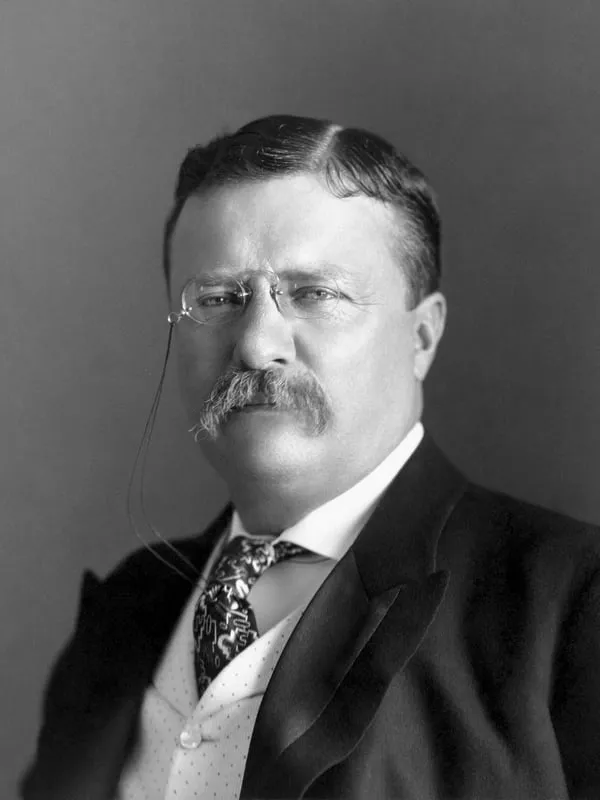
- Born:
- 27 October 1858, New York City
- Died:
- 6 January 1919, Oyster Bay (New York)
- Author:
- Łukasz
- Photo:
- Adam Cuerden, domena publiczna, Wikimedia Commons

Theodore Roosevelt was the president who brought the United States into great-power politics. A volunteer soldier in the war with Spain, an advocate of a strong navy and the “big stick”, and the builder of the Panama Canal, in 1905 he became the arbiter between two great powers. His mediation led to the Peace of Portsmouth, which ended the Russo-Japanese War and won him the Nobel Peace Prize. The same peace, with his tacit consent, handed Korea to Japan and opened the way for Japan into Manchuria. Roosevelt was the first American president to grasp that Japan had become a power with which America would have to contend in the Pacific, and it was in his time that the American–Japanese rivalry began that lasted until 1941. His distant cousin Franklin Delano Roosevelt led America through the Second World War.
Early life
He was born on 27 October 1858 in New York City into a wealthy merchant family of Dutch descent. A sickly child who suffered from severe asthma, he was educated at home. He resolved to “make his body”: he exercised, boxed, hunted and hiked, and the cult of effort, courage and “the strenuous life” stayed with him for ever. In 1880 he graduated from Harvard University. While still a student he began writing a history of America’s naval war with Britain in 1812. Published in 1882, the book was a serious work of scholarship and was long regarded as a classic. Already the navy had become one of his greatest passions.
From 1882 to 1884 he sat in the New York State legislature. On 14 February 1884 his mother and his wife Alice, two days after giving birth to their daughter, died in the same house. Devastated, he left for a ranch in Dakota, where for two years he raised cattle, hunted and wrote. He returned in 1886, lost the election for mayor of New York and married again, to Edith Carow, with whom he had five children.
From police commissioner to San Juan
In the years that followed he built a career as a reformer. From 1889 to 1895 he sat on the federal Civil Service Commission, which fought the spoils system, and from 1895 to 1897 he presided over the New York police board. In 1897 President William McKinley appointed him Assistant Secretary of the Navy. Influenced by Admiral Alfred Mahan’s theories on the importance of sea power, Roosevelt prepared the fleet for war with Spain, and when the USS Maine blew up in Havana harbour in February 1898, he was one of the loudest advocates of intervention.
When the Spanish–American War broke out, he resigned and helped to raise a volunteer cavalry regiment known as the Rough Riders, of which he became second-in-command and then commander. On 1 July 1898 he led his men in the charge up Kettle Hill in the Battle of San Juan Hill outside Santiago de Cuba. He came home a national hero and that same year won the election for Governor of New York. The war gave the United States the Philippines, Guam and Puerto Rico, and for the first time America became a colonial power in the Pacific and Japan’s direct neighbour.
President
The Republican party bosses, who found Governor Roosevelt a nuisance, nominated him for vice-president in 1900, hoping that the office would neutralise him. Six months after the inauguration, in September 1901, an anarchist shot McKinley in Buffalo, and on 14 September 1901 Roosevelt, aged 42, became the youngest president in the history of the United States. In 1904 he won the election by a wide margin.
At home he fought the monopolies, pressed employers into compromises with strikers, introduced the first laws on the inspection of food and drugs, and protected the natural world by creating national parks and reserves. In foreign policy he followed a maxim he liked to repeat: “speak softly and carry a big stick”. He expanded the navy from one among many into one of the most powerful in the world. In 1903 he backed Panama’s secession from Colombia and obtained for America the zone in which the Panama Canal was built. In 1904 he declared that the United States might intervene in Latin American countries that failed to pay their debts, so that the European powers would not do so. In 1906 his diplomats helped to settle the Franco-German dispute over Morocco at the Algeciras Conference.
The peacemaker
When the Russo-Japanese War broke out in February 1904, Roosevelt’s sympathies lay with Japan. He regarded Russia as a threat to the Open Door principle in China and admired Japanese efficiency. Yet he did not want either side to dominate East Asia. In his view the best outcome for America was a balance in which Russia and Japan held each other in check.
After Tsushima, at Japan’s request conveyed on 1 June 1905 by its minister Kogorō Takahira, Roosevelt called on both states on 8 June to open negotiations. On 5 August he received the two delegations aboard the yacht Mayflower off his estate of Sagamore Hill at Oyster Bay and deftly solved the problem of protocol: the refreshments were served standing, and he proposed a single toast to the rulers and peoples of both countries at once. The negotiations at Portsmouth were conducted by Sergei Witte and Jutarō Komura, and Roosevelt never appeared there once. When, in the second half of August, the talks stalled over an indemnity and Sakhalin, he intervened with letters and telegrams. Through Ambassador George Meyer he pressed Nicholas II to give up at least part of Sakhalin, and through Kentarō Kaneko he argued to the Japanese that the world would not understand prolonging the war for money. The treaty was signed on 5 September 1905.
The mediation had a second, less noble face. In July 1905 Secretary of War William Taft held talks in Tokyo with Prime Minister Tarō Katsura. In the memorandum drawn up at the time Japan gave assurances that it had no designs on the Philippines, and Taft took note that Japan would establish suzerainty over Korea. Roosevelt approved the substance of this conversation. He had already written privately that America could not intervene on behalf of the Koreans against Japan when they themselves were unable to strike a blow in their own defence. When Korean envoys came to him in August 1905 asking for help under the American–Korean treaty of 1882, he referred them to the State Department. After the protectorate was imposed on Korea in November 1905, the United States was the first country to close its legation in Seoul.
On 10 December 1906 the Nobel Committee awarded Roosevelt the Nobel Peace Prize, above all for his mediation in the Russo-Japanese War. He was the first American to receive a Nobel Prize of any kind. He did not deliver his Nobel lecture until May 1910, in Kristiania.
Tensions with Japan
Tokyo’s gratitude did not last long. In Japan America was blamed for a peace without an indemnity, and during the riots in Tokyo American premises were attacked as well. In October 1906 the San Francisco school board ordered Japanese children to be moved to separate schools for Asians. Japan was in uproar, and newspapers on both sides of the Pacific began to write of war. Roosevelt persuaded the Californian authorities to drop the segregation, and in return concluded with Japan in 1907–1908 the so-called Gentlemen’s Agreement: Japan itself stopped issuing passports to labourers bound for the United States.
At the same time he wanted to show that America was not afraid. In December 1907 he sent sixteen battleships on a voyage around the world, known from the colour of their hulls as the Great White Fleet. In October 1908 the ships put in at Yokohama, where they were received with great warmth. In November that year Secretary of State Elihu Root and Ambassador Takahira concluded an agreement in which the two states undertook to respect each other’s possessions in the Pacific and the Open Door in China. Roosevelt believed that America should not compete with Japan over Manchuria, as it was not prepared to fight for it. During the crisis of 1906–1907, however, American military planners began drawing up plans for a war with Japan, later developed as War Plan Orange, which became the basis of American strategy in the Pacific during the Second World War.
After the presidency
In 1909 he handed over office to his chosen successor, William Taft, and set off on a great hunting expedition to Africa. He soon became disillusioned with Taft, and in 1912, having failed to win the Republican nomination, he ran for president for the new Progressive Party. During the campaign, on 14 October 1912 in Milwaukee, he was shot by a would-be assassin. The bullet was slowed by the folded manuscript of his speech and his spectacle case, and Roosevelt, with the bullet in his chest, went on speaking for more than an hour. He won more votes than Taft, but the Republican split handed victory to the Democrat Woodrow Wilson. In 1913–1914 he took part in an exploring expedition to the Amazon basin, from which he returned gravely ill with malaria.
When the Great War broke out in 1914, Roosevelt quickly became the loudest critic of Wilson’s neutrality. After the sinking of the Lusitania in 1915 he demanded rearmament and entry into the war on the side of the Entente. In 1917, when America entered the war, he wanted to raise a volunteer division and lead it to France, but Wilson refused. All four of his sons, however, went to the front. The youngest, the airman Quentin, was killed in aerial combat over France in July 1918. Roosevelt never recovered from the blow. He died in his sleep on 6 January 1919 at his home, Sagamore Hill, in Oyster Bay, aged 60.
Significance
Roosevelt brought America into world politics and showed that its president could settle disputes between great powers. The mediation at Portsmouth ended a war, but it also arranged East Asia in a way whose consequences were felt until 1945. American and British consent to Japan’s seizure of Korea opened the way to its annexation in 1910, and the South Manchuria Railway, handed to Japan at Portsmouth, became the scene of the Mukden Incident in 1931. Japanese disappointment with the peace and the immigration crises began a mutual mistrust from which grew the rivalry in the Pacific that ended in war in 1941.
Roosevelt’s family played a great part in that war. His niece Eleanor was the wife of Franklin Delano Roosevelt, president from 1933 to 1945, who had followed a similar path through the post of Assistant Secretary of the Navy. His eldest son, Theodore Roosevelt Jr., landed as a brigadier general with the first wave on Utah Beach in Normandy on 6 June 1944 and died of a heart attack a few weeks later. For Utah he was posthumously awarded the Medal of Honor, the same decoration his father received, also posthumously, in 2001 for the charge on Kettle Hill.
Sources
Mentioned in battles
(01)Often appears with
People who appear in the same events.