Russia
Sergei Witte
Russian Minister of Finance (1892–1903), chief delegate at Portsmouth (1905), Chairman of the Council of Ministers (1905–1906)
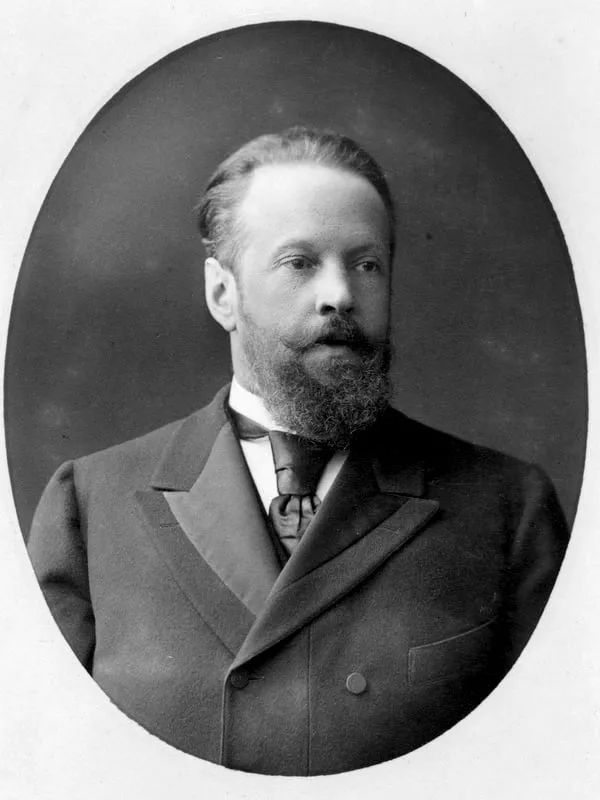
- Born:
- 29 June 1849, Tiflis (Russian Empire, now Tbilisi)
- Died:
- 13 March 1915, Petrograd
- Author:
- Łukasz
- Photo:
- Chapiro, St. Petersburg, domena publiczna, Wikimedia Commons

Sergei Witte was the ablest official of the last two Tsars and one of the few men in St Petersburg who understood that Russia could not survive as a great power without modern industry and without reform. As finance minister he built the Trans-Siberian Railway, put the rouble on the gold standard and drew billions of francs of foreign capital into Russia. It was also he who brought Russia into Manchuria by building the Chinese Eastern Railway there, though he later tried to restrain the adventurers who were pushing the country towards war with Japan. When the war was lost, the Tsar sent him to Portsmouth, and Witte secured a better peace than the course of the fighting warranted. A few weeks later he extracted the October Manifesto from Nicholas II and became head of Russia’s first government. The railway he laid in Manchuria was for the next forty years the axis of the struggle between Russia, China and Japan, and his warnings that a great war would sweep away the monarchy came true two years after his death.
The railwayman from Tiflis
He was born on 29 June 1849 (17 June in the Julian calendar) in Tiflis in the Caucasus. His father, Julius Witte, came from a Lutheran German family from the Baltic provinces, converted to Orthodoxy and rose in state service to become a departmental director in the administration of the Caucasus. His mother, Yekaterina Fadeyeva, was the daughter of Andrei Fadeyev, governor of Saratov, and Princess Yelena Dolgorukaya. Sergei grew up in the home of his maternal grandparents, and his first cousin was Helena Blavatsky, later the founder of Theosophy.
As a youth he did not apply himself much to his studies, but at the Novorossiysk University in Odessa he proved an outstanding mathematician, graduating from the faculty of physics and mathematics in 1870. He considered an academic career, but his family thought it unworthy of a nobleman and pushed him into the railways, then a new and fashionable field. He began as a trainee at ticket offices and stations of the Odessa Railway and was quickly promoted to head of traffic. At the end of 1875, after a disaster near Tiligul in which many people were killed, a court sentenced him to four months in prison. During the Russo-Turkish War of 1877–1878 he managed the transport of troops to the front so efficiently that Grand Duke Nicholas Nikolaevich the Elder secured a reduction of his sentence.
In the 1880s he ran the private South-Western Railway in Kiev, which he made profitable. He also became known for warning the entourage of Tsar Alexander III against the dangerously fast running of the heavy imperial train. When in October 1888 the train was derailed at Borki and the imperial family survived by a miracle, the Tsar remembered Witte. In 1889 the finance minister, Ivan Vyshnegradsky, appointed him director of the railway department in his ministry.
Finance minister
In February 1892 Witte became Minister of Communications, and in August of the same year Minister of Finance. He ran the ministry for eleven years, first under Alexander III, who is said to have told his son on his deathbed in 1894 to listen to Witte above all, and then under Nicholas II. In practice it was the post of minister for the economy: industry, trade, railways and customs all came under him.
Witte believed that Russia had to industrialise within a single generation or become a semi-colony of the West. He took as his model the German economist Friedrich List: he protected domestic industry with high tariffs, built railways at state expense and bought up private lines. In 1894 he concluded a trade treaty with Germany that was favourable to Russia. From the mid-1890s he gradually introduced a state spirits monopoly, which became one of the treasury’s main sources of revenue. In 1897 he carried out a currency reform, putting the rouble on gold. A stable currency and French loans, made possible by the Franco-Russian Alliance, attracted foreign investment to Russia. By the late 1890s Russian industry was growing faster than that of any other large country, though at the price of high indirect taxes paid above all by the countryside.
Witte’s most important undertaking was the Trans-Siberian Railway, built from 1891 from the Urals to the Pacific. It was to open Siberia to settlement and trade and give Russia the standing of a Pacific power. Witte imagined Russian expansion in Asia as peaceful economic penetration, with banks and railways instead of armies.
The road to Manchuria
After the Sino-Japanese War of 1894–1895, Witte was one of the chief advocates of the intervention that forced Japan to return the Liaodong Peninsula to China. Russia cast itself as China’s protector, and Witte made sure that Beijing paid for it. In 1895 the Russo-Chinese Bank was founded on his initiative, and in 1896, during the coronation of Nicholas II in Moscow, Witte and the foreign minister, Aleksei Lobanov-Rostovsky, concluded a secret treaty of alliance with the Chinese statesman Li Hongzhang. Under it Russia gained the right to run a shortcut of the Trans-Siberian Railway across northern Manchuria to Vladivostok. Thus was born the Chinese Eastern Railway, formally a private company but in reality controlled by the Russian finance ministry, with its own guards, its own administration and the city of Harbin at its centre.
In 1898 Witte opposed the seizure of Port Arthur, believing that it would alienate China and Japan. When the Tsar decided otherwise, he carried out the decision, and his ministry’s money helped secure the consent of Chinese officials to the lease. The railway was extended south from Harbin to Port Arthur and to the new commercial port of Dalny. After the Boxer Rebellion of 1900, Russian troops occupied the whole of Manchuria and were in no hurry to leave. Witte grew increasingly afraid of a conflict with Japan. At court, however, the upper hand went to the faction of Aleksandr Bezobrazov, which pushed for a timber concession on the Yalu river, on the Korean border, and a hard line towards Tokyo. In August 1903 Witte, who also had powerful enemies within the government, among them the interior minister Vyacheslav von Plehve, was moved to the honourable but powerless post of Chairman of the Committee of Ministers. Six months later Japan began the war.
Portsmouth
The war he had warned against brought Russia defeat after defeat: Port Arthur, Mukden, Tsushima. When in June 1905 President Theodore Roosevelt proposed negotiations, the first candidates for Russian plenipotentiary declined, and the Tsar, although he disliked Witte, had to turn to him. His instructions were clear: no territorial concessions and no indemnity.
In America Witte proved a master of public relations. He knew that public opinion favoured Japan and set out to win it over. He talked to journalists, shook hands with workers and engine drivers, appeared at church services and presented Russia as a country that had by no means lost the war and did not have to pay. At the negotiating table in Portsmouth he gave way on matters the war had already decided: Korea, Port Arthur and the railway in southern Manchuria. On money, however, he did not yield. When on 29 August the Japanese foreign minister, Jutarō Komura, dropped the indemnity in exchange for half of Sakhalin, Witte accepted the compromise, although the signals coming from St Petersburg leaned rather towards breaking off the talks. A few days earlier, however, the Tsar himself had conceded to the Americans that he could give up the southern part of the island. On 5 September 1905 Witte signed the treaty.
In Russia the peace was regarded as a success, given the circumstances. Nicholas II made Witte a count, though his right-wing opponents nicknamed him “Count Half-Sakhalin”. Witte had kept northern Manchuria with the Chinese Eastern Railway, and Russia did not pay a single rouble in indemnity.
The Manifesto and the government
Witte returned to a country engulfed by revolution. In October 1905 a general strike paralysed the railways and the cities. Witte put a choice to the Tsar: either a military dictatorship or a constitution. Nicholas II hesitated for a long time, and the deciding voice is said to have been that of his kinsman, Grand Duke Nicholas Nikolaevich the Younger, who reportedly threatened to shoot himself if the Tsar did not accept Witte’s programme. On 30 October (17 October in the Julian calendar) the Tsar signed the October Manifesto, drafted by Witte, which promised civil liberties and a State Duma with legislative powers. Two days later Witte became head of the new Council of Ministers, the first head of government in Russian history who was not merely an executor of the Tsar’s will.
His premiership lasted six months and was a constant struggle on two fronts. The liberals with whom he discussed joining the government, among them the Kadet leader Pavel Milyukov, did not trust the Tsar and refused to take part. The left wanted to go further. After the Manifesto a wave of pogroms against Jews and violence by right-wing gangs swept the country, and the local authorities often turned a blind eye. Witte, although he himself believed that repression would not solve Russia’s problems, in practice left the initiative to the interior minister, Pyotr Durnovo. In December the members of the St Petersburg Soviet of Workers’ Deputies were arrested, among them Leon Trotsky, and the uprising in Moscow was crushed with artillery. In November 1905 martial law was imposed in the Kingdom of Poland.
His government’s greatest success was a huge French loan of April 1906, 2.25 billion francs, which saved the state’s finances and made the government independent of the future Duma. As soon as the money was secured, the Tsar no longer needed him. Witte left office at the beginning of May 1906 (at the end of April in the Julian calendar), a few days before the opening of the first Duma. He was succeeded by Ivan Goremykin, and soon afterwards power passed to Pyotr Stolypin, who took up some of Witte’s plans, above all land reform.
On the sidelines
Witte spent the last nine years of his life as a member of the State Council, without influence on the government. The court loathed him, the right regarded him as a traitor to the monarchy and the left as the executioner of the revolution. In January 1907 bombs were found planted in his St Petersburg house. The investigation led to the far-right Union of the Russian People and pointed to links between the perpetrators and the political police. Witte spent much time abroad, especially in Biarritz, where he wrote his memoirs. He finished them around 1912 and deposited them in a bank in France on condition that they were not to be printed in his lifetime or that of his contemporaries.
All his life he repeated that Russia needed peace and that any great war could destroy it. In July 1914, like Grigori Rasputin, he warned against war with Germany, and once it had broken out he argued for peace as soon as possible. No one listened to him. He died suddenly on 13 March 1915 (28 February in the Julian calendar) in Petrograd, probably of meningitis. He was buried in the cemetery of the Alexander Nevsky Lavra. Besides the dates of his birth and death, his tombstone bears the date 17 October 1905, the day of the Manifesto. According to contemporaries, the Tsar made no secret of his relief at the news of his death.
He was married twice. His first wife died in 1890. His second marriage, to Matilda Lisanevich, a divorcee of Jewish origin, caused a scandal at court and closed many salons to him. He had no children of his own and adopted his wife’s daughter.
Significance
Witte was the architect of the Russian presence in Manchuria, and that presence became one of the causes of the war with Japan and, indirectly, of Japanese expansion on the mainland. The Chinese Eastern Railway, his creation, outlived the fall of Tsarism: in 1929 the Soviet Union fought a short war with China over it, and in 1935 sold it to the Japanese puppet state of Manchukuo. The southern section, lost by Witte at Portsmouth, became the basis of the South Manchuria Railway and of the Kwantung Army, which in 1931 began the conquest of Manchuria. In 1945 Joseph Stalin took back from Japan what Witte had been forced to give up.
In Russia itself Witte is regarded as the last great reformer of Tsarism. His programme of rapid state-led industrialisation, with foreign capital and at the expense of the countryside, is sometimes compared with Stalin’s later industrialisation, though that was carried out by different methods and at the cost of millions of lives. The October Manifesto gave Russia a semblance of a constitution, but the Tsar, who had not wanted it, had no intention of abiding by it. Witte’s memoirs, first published in 1921, are one of the most important and most partisan sources for the last years of the empire, which collapsed in the February Revolution just as he had predicted.