Russia
Leon Trotsky
Chairman of the St Petersburg Soviet (1905) and the Petrograd Soviet (1917), People’s Commissar for Foreign Affairs (1917–1918) and for War (1918–1925)
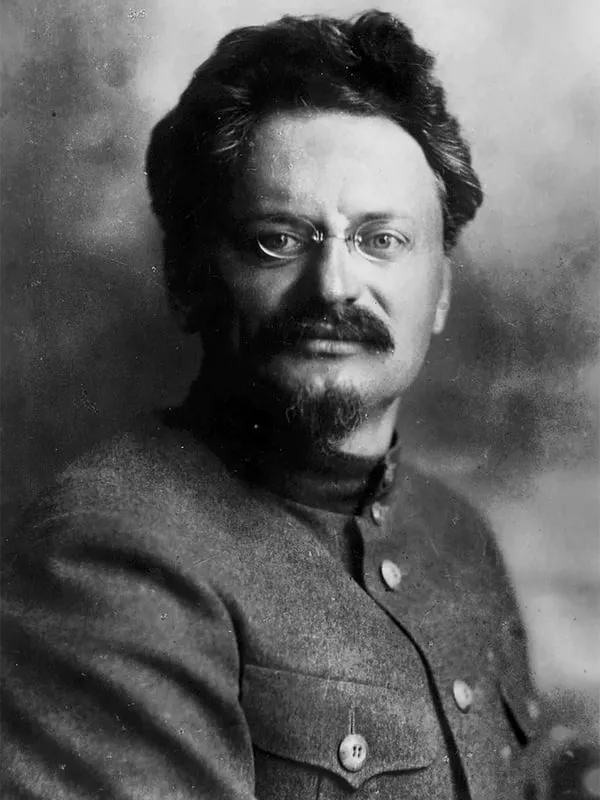
- Born:
- 7 November 1879, Yanovka, Kherson Governorate (Russian Empire)
- Died:
- 21 August 1940, Coyoacán (Mexico)
- Author:
- Łukasz
- Photo:
- autor nieznany, domena publiczna, Wikimedia Commons

Lev Davidovich Bronstein, who went down in history under the pseudonym Trotsky, was, alongside Vladimir Lenin, the most important leader of the October Revolution. In the autumn of 1917, as chairman of the Petrograd Soviet, he prepared the coup that gave the Bolsheviks power. As Commissar for Foreign Affairs he conducted the negotiations at Brest-Litovsk, and as Commissar for War he built the Red Army from scratch and led it to victory in the Civil War. After Lenin’s death he lost the struggle for power to Joseph Stalin, was expelled from the country and remained Stalin’s most vocal critic for the rest of his life. In the 1930s he warned against Adolf Hitler and predicted an understanding between Stalin and Germany. He was killed by an agent of Soviet intelligence in Mexico, a year after the outbreak of the Second World War.
Youth and the 1905 Revolution
He was born on 7 November 1879 (26 October in the Julian calendar) in Yanovka in Kherson Governorate, in the south of today’s Ukraine, the son of David Bronstein, a prosperous Jewish farmer-colonist. He went to school in Odessa and in Nikolaev, where at the age of seventeen he came into contact with the revolutionary movement. In 1898 he was arrested and, after two years in prison, exiled to Siberia. In 1902 he escaped from exile on a false passport in which he had written the name Trotsky. He made his way to London, to Lenin and the editorial board of Iskra. At the party congress in 1903, however, he took a stand against Lenin, and for years he kept aloof from both factions, the Bolsheviks and the Mensheviks, trying to reconcile them.
He won fame in the 1905 Revolution, brought about in large part by the defeats in the war with Japan. The 26-year-old Trotsky became first vice-chairman and then, after the chairman’s arrest, the de facto leader of the St Petersburg Soviet of Workers’ Deputies. A court sentenced him to settlement in Siberia for life, but he escaped on the way to his place of exile. From 1907 he lived in Vienna, published a newspaper called Pravda and developed the theory of “permanent revolution”: in backward Russia the democratic revolution would pass at once into a socialist one, and it could survive only if it set off revolution in Europe. As a newspaper correspondent he reported on the Balkan Wars of 1912–1913.
Against the war
The outbreak of war forced him to flee Vienna. He made his way through Switzerland to Paris, where he wrote as a war correspondent and co-edited the internationalist newspaper Nashe Slovo (Our Word). Like Lenin, he believed that the socialists who supported their governments had betrayed the idea of international solidarity, but he did not share Lenin’s slogan calling for the defeat of one’s own country. In September 1915 he wrote much of the manifesto of the conference of anti-war socialists at Zimmerwald. In 1916 the French authorities deported him to Spain, from where he was sent on to the United States. He reached New York in January 1917.
1917
After the February Revolution he sailed for Russia, but the British detained him at Halifax in Canada and interned him for several weeks. He reached Petrograd in May. He took charge of a small group of Social Democrats known as the Mezhraiontsy (the Inter-District Group) and quickly drew close to the Bolsheviks. His quarrel with Lenin had lost its significance, since both now wanted power for the soviets and an immediate end to the war. After the July disturbances in Petrograd he was arrested, and while he was in prison he was formally admitted to the Bolshevik party. He was released in September, after the collapse of General Lavr Kornilov’s revolt, and on 8 October (25 September Old Style) he became chairman of the Petrograd Soviet, in which the Bolsheviks now had a majority.
Lenin wanted an uprising at once. Trotsky argued that the coup should be carried out under the cover of the Soviet and linked to the Second Congress of Soviets, so that it would look like a defence of the revolution rather than one party’s conspiracy. The key was the Military Revolutionary Committee (PL), set up formally to defend the capital against the Germans. Its commissars took control of the garrison regiments before a shot was fired. On 7 November the committee’s units took Petrograd almost without a fight, and during the night the Winter Palace. To the Mensheviks and Socialist Revolutionaries who walked out of the Congress of Soviets in protest, Trotsky flung the retort that their place was in “the dustbin of history”. A few days later he was at Pulkovo, where Red Guards and sailors drove back the Cossacks marching on the capital with the overthrown prime minister, Alexander Kerensky.
Brest-Litovsk
In the new government, the Council of People’s Commissars, he took charge of foreign affairs. He began by publishing the secret treaties from the ministry’s archives, including the agreements on the partition of the Ottoman Empire, which caused a storm throughout Europe. When, at the peace talks in Brest-Litovsk, the Germans demanded Polish, Lithuanian and Courland territory, Lenin sent Trotsky himself to spin out the talks in expectation of a revolution in Germany. Trotsky turned the proceedings into a verbal duel with the German State Secretary, Richard von Kühlmann, and General Max Hoffmann, speaking over their heads to the workers of Europe. On 10 February 1918 he announced that Russia was ending the war and demobilising its army but would not sign an annexationist peace. This formula, “neither war nor peace”, ended in a German offensive and a peace even harsher than the one he had rejected. In the decisive vote in the Central Committee Trotsky abstained, securing Lenin a majority, and he did not sign the Treaty of Brest-Litovsk himself.
Creator of the Red Army
In March 1918 he took over the War Commissariat, and from September he headed the Revolutionary Military Council of the Republic. He found an army made up of volunteers and Red Guards, without discipline or commanders. He staked everything on compulsory conscription, the death penalty for desertion and the recruitment of tens of thousands of officers of the old tsarist army, watched over by political commissars and often also by hostages taken from their families. Many Bolsheviks, Stalin among them, regarded this as a betrayal of revolutionary principles. His order to disarm the Czechoslovak Legion in May 1918 provoked the Legion’s revolt and one of the gravest crises of Soviet power. For most of the Civil War Trotsky travelled from front to front in his armoured train, restoring discipline by draconian methods.
The Red Army, which grew to several million men, defeated the Whites of Admiral Alexander Kolchak and General Anton Denikin, and in the autumn of 1919 Trotsky personally organised the defence of Petrograd. In 1920 he was sceptical of the march on Warsaw but did not block it. In March 1921 he directed the suppression of the revolt of the Kronstadt sailors, whom in 1917 he had called the pride of the revolution. It was also at that time that the first military contacts with Germany were made, which after the Treaty of Rapallo in 1922 developed into secret cooperation between the Red Army and the Reichswehr.
Defeat in the struggle for power
Trotsky was the best-known Bolshevik leader after Lenin, but he had many enemies in the party. He was regarded as arrogant, he built no power base of his own in the apparatus, and old Bolsheviks held against him his years of quarrels with Lenin. Stalin, General Secretary of the party from 1922, allied himself against him with Grigory Zinoviev and Lev Kamenev. After Lenin’s death in January 1924 Trotsky gradually lost everything. Against Stalin’s slogan of “socialism in one country” he set permanent revolution, but he kept losing the votes. In 1925 he lost the War Commissariat, in 1926 his seat on the Politburo, and in November 1927 he was expelled from the party. In January 1928 he was exiled to Alma-Ata, and in February 1929 he was deported from the Soviet Union.
Exile
For four years he lived on the island of Prinkipo near Istanbul, where he wrote his memoirs, My Life, and The History of the Russian Revolution, on which historians still draw today, albeit with caution. He then lived in France, from 1935 in Norway, and in January 1937 Mexico took him in. In the early 1930s, during the crisis in Germany, he repeatedly warned that Hitler’s coming to power would mean catastrophe for the labour movement and war, and he called on the German Communists to form a united front with the Social Democrats against the Nazis. The Comintern, obedient to Stalin, was at that time fighting the Social Democrats as “social fascists”.
During the Moscow trials of 1936–1938 Trotsky was the chief defendant in absentia. The prosecution presented him as the leader of a conspiracy in the service of Germany and Japan. In 1937 an independent commission chaired by the American philosopher John Dewey found the charges false. The repression struck his family: his son Sergei perished in the Soviet Union, and his elder son, Lev Sedov, died in a Paris hospital in 1938 in unexplained circumstances. In September 1938 Trotsky’s followers founded the Fourth International. For years Trotsky had predicted that Stalin might come to an understanding with Hitler, and he regarded the pact of August 1939 and the joint invasion of Poland as confirmation of his warnings, although he still considered the Soviet Union a “degenerated workers’ state” that had to be defended.
In May 1940 a group of armed men led by the painter David Alfaro Siqueiros raked his house in Coyoacán, outside Mexico City, with gunfire. Trotsky survived. On 20 August 1940 an agent of Soviet intelligence, Ramón Mercader, who had won the confidence of his entourage, struck him on the head with an ice axe in his study. Trotsky died the next day, 21 August.
Significance
For decades judgements of Trotsky were held hostage by politics. In the Soviet Union under Stalin he was erased from the history of the revolution and from photographs, and “Trotskyism” became a charge for which people were shot. In the West his followers portrayed him as a revolutionary true to his ideals who had been betrayed by Stalin. His biographer Isaac Deutscher wrote of the “prophet” of the revolution, while Robert Service and other critics point out that Trotsky was a co-founder of one-party dictatorship, the Red Terror and the militarisation of labour, and that his dispute with Stalin was a dispute about power and the direction of the revolution, not about freedom.
For the road to the Second World War two of his works matter. The Red Army he built became the foundation of the Soviet Union’s armed might, even though Stalin decimated its officer corps in 1937–1938, partly on the pretext of fighting “Trotskyists”. And his defeat in the struggle for power meant the victory of Stalin and of his policies, which led to the pact with Hitler in 1939.
Sources
Commanded in battles
(01)Often appears with
People who appear in the same events.