Albania
Zog I
Prime Minister (1922–1924), President (1925–1928) and King of the Albanians as Zog I (1928–1939)
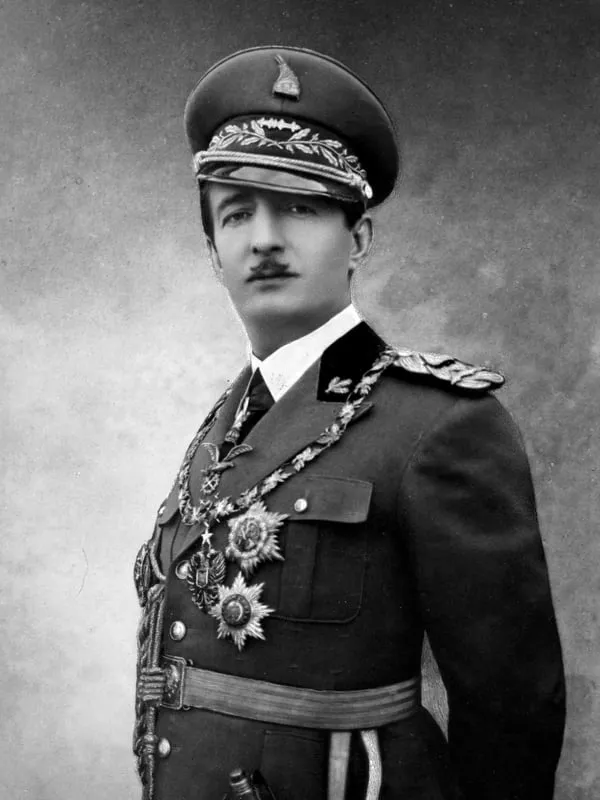
- Born:
- 8 October 1895, Burgajet (Ottoman Empire)
- Died:
- 9 April 1961, Suresnes (France)
- Author:
- Łukasz
- Photo:
- autor nieznany, domena publiczna, Wikimedia Commons

Ahmed Zogu, as King Zog I, ruled Albania for seventeen years: first as Prime Minister, then as President of the republic, and from 1928 as the self-proclaimed “King of the Albanians”. The son of the chieftain of a mountain clan from the Mat region, brought up while the country was still part of the Ottoman Empire, he turned a land divided into clans and tribes into a centralised state – poor, and ruled as a dictatorship, but a state nonetheless. To keep it going he needed money, and the only one offering it was fascist Rome. In this way Albania became first an informal protectorate of Italy and then, in April 1939, Mussolini’s first victim in Europe. Zog’s story shows how a small state, manoeuvring between stronger neighbours, can lose its independence without a war in the strict sense of the word: through debts, loans and advisers, and in the end through a landing lasting a few hours.
Son of the chieftain of Mat
He was born on 8 October 1895 in the family stronghold of Burgajet near Burrel, in the mountainous north-central part of Albania, then part of the Ottoman Empire. At the time his surname was Zogolli. His father, Xhemal Pasha Zogolli, was hereditary governor of the Mat district, and his mother, Sadije, came from the influential Toptani family, which, according to family tradition, was descended from a sister of the Albanian national hero Skanderbeg. The family was Muslim. Ahmed was educated in Istanbul at the elite Galatasaray Lycée. When his father died in 1911, it was he, rather than his older half-brother, who took over the leadership of Mat.
In 1912 Albania declared its independence, but for years afterwards it was a battleground for foreign armies and local leaders. The young Zogolli changed sides with skill. He worked alongside a relative on his mother’s side, Essad Pasha Toptani, and during the First World War, when the Austrians occupied the north of the country, he went over to them and commanded volunteer units as a colonel in the Austro-Hungarian army. The Austrians did not trust him, however, and from 1917 kept him in Vienna, where he acquired a taste for the European way of life. After the war he spent several months in Rome and returned to Albania in 1919.
Minister, Prime Minister, exile
In January 1920 the Congress of Lushnjë formed a government charged with defending the country’s independence against plans for its partition. The 24-year-old Zogolli became its Minister of the Interior. Tirana, close to his native Mat, was chosen as the capital. Over the following years he served as a minister, as governor of Shkodër and as commander of the army, suppressing his opponents’ revolts and building up his own network of loyal men. In 1922 he changed his name to the more Albanian-sounding Zogu, and in December of that year, aged 27, he became the youngest prime minister in the country’s history. He relied on the landowners, the beys of the south, and the tribal chieftains of the north.
His opponents were the liberals and reformers grouped around the Orthodox bishop Fan Noli and the radical activist Avni Rustemi. On 23 February 1924 Beqir Valteri shot him in the parliament building. Zogu survived but had to give up the premiership. In April Rustemi was murdered, and Zogu’s men were accused of the crime. In June 1924 an uprising broke out, Noli took power, and Zogu fled with several hundred supporters to the Kingdom of Serbs, Croats and Slovenes. He returned in December 1924 at the head of forces equipped by Belgrade and reinforced by White Russian émigrés from the army of Pyotr Wrangel. Noli fled. In return for the help, Zogu promised Yugoslavia the border Monastery of Saint Naum on Lake Ohrid, which he handed over in 1925.
President and dictator
In January 1925 a constituent assembly proclaimed Albania a republic and elected Zogu president for seven years. He took office on 1 February. The constitution gave him almost unlimited power: he appointed ministers and senior officials and nominated part of the parliament. He forced his opponents into exile or had them killed. In 1925 one of the opposition leaders, Luigj Gurakuqi, was shot dead in Bari, and Bajram Curri died in the mountains, hunted down by gendarmes. The press was censored and the prisons were full of political opponents.
Yet Zogu managed to bring the country a degree of order that Albania had never known before. He curbed banditry and the blood feud, disarmed some of the tribes, began collecting taxes and building roads. The problem was money. The state rested on the beys, whom he did not want to burden with taxes, and it had no revenue for the army, schools and administration. Yugoslavia could not help him and the Western powers would not. Benito Mussolini, however, was willing, for to him Albania was the key to the Adriatic and the Balkans. In 1925 the Italians founded the National Bank of Albania, controlled by Italian capital, and granted a loan for public works. On 27 November 1926 Zogu signed the first pact with Italy in Tirana, on friendship and security, and on 22 November 1927 the second, a twenty-year defensive alliance. Italian instructors arrived in the Albanian army, and Italian advisers in government offices.
King of the Albanians
On 1 September 1928 a constituent assembly proclaimed Albania a monarchy, and the president took the oath as Zog I, “King of the Albanians”. The title was meant to emphasise that he was the ruler of the whole nation, including the Albanians living in Kosovo and elsewhere beyond the state’s borders. He did not take Ahmed as his regnal name, so as not to emphasise his Islamic background on the European stage. He was not crowned; he swore his oath before parliament on both the Bible and the Koran, which was meant to symbolise the unity of a country of three faiths. The constitution forbade combining the Albanian throne with the crown of another state. The courts of Europe regarded the “self-proclaimed” king without royal ancestors with reserve.
Zog reformed the country on the model of Mustafa Kemal. In 1929 he replaced sharia law with a civil code modelled on the Swiss one; in the 1930s he banned women from veiling their faces and built a system of state schools. He nevertheless remained a dictator, ruling through the gendarmerie, censorship and the prisons. According to his biographers he survived several dozen attempts on his life, and hundreds of blood feuds hung over him. The most famous attempt took place on 20 February 1931 outside the Vienna Opera: the king escaped unharmed, but his aide-de-camp was killed.
Throughout the 1930s Zog tried to keep his dependence on Rome from crossing the line beyond which the loss of statehood begins. In 1931 he did not renew the first Pact of Tirana. When during the Great Depression Albania stopped paying interest on the Italian loans and the Italians demanded a customs union, Italian commanders for the gendarmerie, monopolies and the teaching of Italian in all schools, he refused. He cut spending, sent the Italian military advisers home and nationalised the Catholic schools run by Italians. As a counterweight to the Italians he kept British officers in the gendarmerie. He tried to draw closer to France, Germany and the Balkan states, but no one was willing to pay Albania’s bills. In 1934, after a show of force by the Italian fleet off Durrës, he returned to Rome’s orbit, and new loans, including one in 1937, bound him ever more tightly. In 1938 Albania took in Jewish refugees from Germany and Austria.
On 27 April 1938 Zog married a Hungarian countess, Geraldine Apponyi, a Catholic with an American mother. The wedding in Tirana was a great society occasion, and Italy was represented by its Foreign Minister, Galeazzo Ciano. Ciano came back convinced that the king would never voluntarily accept a protectorate and that Albania would have to be annexed to Italy. Zog knew about the Italian intrigues. In February 1939 he announced the discovery of a plot against his life and expelled one of the Italian agents.
Loss of the throne
After Hitler’s seizure of Bohemia and Moravia, Mussolini decided to act. On 25 March 1939 Rome sent Tirana a draft agreement that gave the Italian army the right to occupy the country and gave Italians in Albania full civil rights. Zog did not sign, but neither did he openly refuse. For two weeks he played for time, accepting some of the demands and rejecting those that infringed sovereignty. On 5 April the queen gave birth to a son, Leka. That same day the king appealed for help to the Western powers, and the next day to the states of the Balkan Entente. No one answered.
On 7 April, Good Friday, the Italians landed at four Albanian ports, beginning the Italian invasion of Albania. Zog did not organise the resistance in the mountains on which some of his supporters had been counting. The queen left for Greece with her two-day-old baby before dawn, and the king, after broadcasting a radio appeal to fight, followed her the same day. The family took with them a considerable part of the Albanian bank’s gold reserves. This flight did great harm to his memory. The historian Bernd Fischer believed that had Zog led resistance in the mountains he could have united the Albanians and gone down in history as a hero, even though he would not have reversed the outcome. Instead, on 12 April an assembly convened in Tirana by the Italians declared him deposed and offered the crown to Victor Emmanuel III.
In exile
From Greece Zog told journalists that Hitler and Mussolini were madmen, and Chamberlain and Daladier “two fools who are asleep”. The world did not listen to him with much sympathy, as it knew about the gold he had taken out. After a short stay in Greece the king, with his family and court, went to Turkey, and from there through Romania, Poland, the Baltic states and Scandinavia to France. After the fall of France in 1940 he made his way to Britain. He lived first at the Ritz Hotel in London, and then at country houses in Berkshire and Buckinghamshire.
The British did not recognise him as the legitimate representative of Albania and did not allow him to form a government-in-exile. In Albania itself his supporters, led by Abaz Kupi, the hero of the defence of Durrës in 1939, formed the royalist organisation Legaliteti in 1943, but it lost the struggle for power to Enver Hoxha’s communists. In November 1944 the communists took control of the whole country and barred Zog from returning. In January 1946 a constituent assembly proclaimed a people’s republic and formally deposed him, which Zog never recognised.
In 1946 he moved to Egypt at the invitation of King Farouk I, whose dynasty had Albanian roots. In the early 1950s Western intelligence services tried to overthrow Hoxha by infiltrating émigrés into the country, among them supporters of the king, but most of them were caught in ambushes because the plans were being betrayed to Moscow by Kim Philby. After Farouk was overthrown in 1952, Zog lost his privileges in Egypt, and in 1955 he left for France. He died on 9 April 1961 in a hospital at Suresnes near Paris and was buried in the cemetery at Thiais. The émigrés proclaimed his son Leka king. On 17 November 2012, in the centenary year of Albanian independence, Zog’s remains were brought to Tirana and laid in the royal mausoleum.
Assessment
Zog was one of the many authoritarian rulers of interwar Central Europe and the Balkans, and at the same time the most unusual of them: a highland chieftain who proclaimed himself king in a capital founded not far from his family stronghold. He left Albania more centralised, with legal codes, schools and roads, but also poor, run as a police state and in debt to Italy. His strategy was to take Mussolini’s money while refusing him what mattered most. It worked as long as Rome was prepared to wait. In the spring of 1939, when Mussolini, after Hitler’s coup in Prague, was looking for a prize of his own, it turned out that a state dependent on Italy, with an army trained by Italian officers, had nothing to defend itself with.
For the history of the road to the Second World War, Zog’s fall was another sign that the Axis powers would not stop at revising the borders of 1919. Albania became the base from which the Italians attacked Greece on 28 October 1940. In Albania itself the memory of the king was long forbidden, and after the fall of communism, in a referendum in 1997, a majority of voters came out against restoring the monarchy under Leka. Today one of Tirana’s main streets bears the name of Zog I.
Sources
Commanded in battles
(01)Often appears with
People who appear in the same events.