Italy
Victor Emmanuel III
King of Italy (1900–1946), Emperor of Ethiopia (1936–1941), King of Albania (1939–1943)
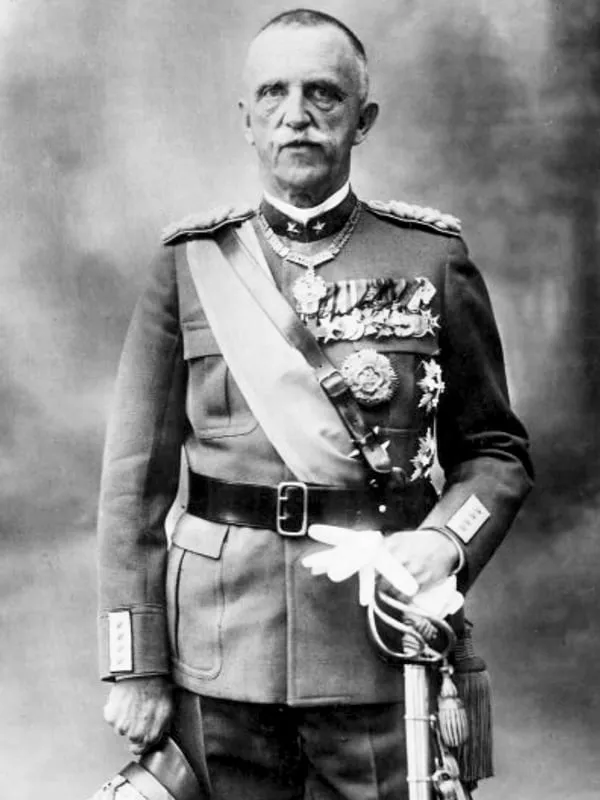
- Born:
- 11 November 1869, Naples (Kingdom of Italy)
- Died:
- 28 December 1947, Alexandria (Egypt)
- Author:
- Natalia
- Photo:
- Possibly Mario Nunes Vais, domena publiczna, Wikimedia Commons

Victor Emmanuel III reigned in Italy for almost forty-six years, longer than any other king of united Italy. A short, shy and conscientious constitutional monarch who preferred numismatics and military history to society drawing rooms, he is remembered above all for two decisions. On the morning of 28 October 1922 he refused to sign a decree imposing a state of siege against the fascists marching on Rome, and a day later he summoned Benito Mussolini to form a government. For the next twenty years he signed the laws of the dictatorship, accepted the crowns of Ethiopia and Albania, signed the anti-Jewish laws and consented to war at Hitler’s side. On 25 July 1943, when the war was already lost, he himself ordered Mussolini’s arrest. It did not save the monarchy. Italians forgave the king neither the twenty years of fascism nor his flight from Rome in September 1943. He abdicated in 1946, and a month later Italy became a republic.
Prince of Naples
He was born on 11 November 1869 in Naples, the only child of the heir to the throne, Umberto, and his wife and cousin Margherita of Savoy. He was christened Vittorio Emanuele Ferdinando Maria Gennaro and given the title Prince of Naples. He was sickly and very short – little more than one and a half metres tall – which his opponents mocked by calling him “Little Sabre” (Sciaboletta), since a sabre supposedly had to be shortened for him. He was brought up strictly, under the eye of army officers, to a rhythm of long hours of study. He grew into a well-educated man who knew several languages, reserved and mistrustful. All his life he collected coins. His collection numbered some one hundred thousand pieces, and the multi-volume catalogue of Italian coins, the Corpus Nummorum Italicorum, on which he worked for more than thirty years, remains a standard reference to this day.
On 24 October 1896 he married Princess Elena, daughter of Nicholas I, then Prince and later King of Montenegro. The marriage was a happy one. They had five children, among them the heir to the throne, Umberto, born in 1904, and Mafalda, who died in a German concentration camp.
King after an assassination
On 29 July 1900 the anarchist Gaetano Bresci shot King Umberto I dead in Monza. The thirty-year-old Victor Emmanuel learned the news while cruising in the Mediterranean. Contrary to fears that repression would follow the assassination, the new king opted for constitutional government and reconciliation. For the first fourteen years of his reign Italian politics was directed by the liberal Giovanni Giolitti, who tolerated strikes, promoted industry and in 1912 introduced almost universal male suffrage. In 1911–1912 Italy took Libya from Turkey in the Italo-Turkish War. The king seldom appeared in public, but under the Statute of the Kingdom it was he who appointed prime ministers and decided on war and peace, and in government crises his voice could be decisive.
The soldier king
The most personal decision of his early years was Italy’s entry into the First World War. In 1914 Italy, although bound to Germany and Austria-Hungary by the Triple Alliance, declared neutrality. In the spring of 1915 Prime Minister Antonio Salandra and Foreign Minister Sidney Sonnino, with the king’s knowledge, signed the secret Treaty of London with the Entente. A majority of parliament opposed the war, and Salandra resigned. The king refused to accept his resignation, and under the pressure of street agitation by the interventionists, among them Gabriele D’Annunzio and Mussolini, the Chamber gave way. On 24 May 1915 Italy went to war with Austria-Hungary.
Throughout the war the king lived in a small villa near general headquarters in Friuli and drove to the front almost every day. He earned the nickname of “the soldier king”. After the defeat at Caporetto in October 1917, at a meeting with the British and French prime ministers at Peschiera on 8 November, he defended the Italian army’s ability to fight on and approved the replacement of General Luigi Cadorna by General Armando Diaz. Victory at Vittorio Veneto in 1918 made him “the king of victory”.
Post-war crisis and the March on Rome
Peace brought disappointment. At the Paris conference Prime Minister Vittorio Emanuele Orlando failed to obtain Fiume or Dalmatia, nationalists spoke of a “mutilated victory”, and D’Annunzio seized Fiume in defiance of the government. At home strikes and factory occupations went on, and from the end of 1920 fascist squads terrorised the socialists. One weak liberal government after another failed to control the situation. The king, disillusioned with parliamentary intrigue and terrified at the prospect of revolution, had less and less faith in politicians.
When the fascists set off for Rome in October 1922, the government of Luigi Facta resolved at dawn on 28 October to proclaim a state of siege. At about nine o’clock Victor Emmanuel refused to sign the decree. According to one account, he told the prime minister that after a state of siege there could only be civil war. Historians point to several possible reasons: the uncertainty of the generals, fear of bloodshed, fear of the ambitions of his cousin the Duke of Aosta, who sympathised with the fascists, and finally his dislike of a weak government and hope for a right-wing cabinet including the fascists. The army in Rome clearly outmatched the squads, so the king’s decision settled the outcome. On 29 October he summoned Mussolini to Rome, and on 30 October he appointed him prime minister. On 31 October he took the salute of the Blackshirts’ parade in front of the Quirinal.
Twenty years with Mussolini
Victor Emmanuel valued Mussolini as a “strong man” who had restored order and freed him from constant government crises. In 1924, after the kidnapping and murder of the socialist deputy Giacomo Matteotti, the opposition walked out of parliament and hoped that the king would dismiss the prime minister. The monarch replied that the Chamber and the Senate were his eyes and ears, and that as long as they did not withdraw their confidence in Mussolini, he would do nothing. In 1925–1926 he signed without protest the laws that abolished the freedom of the press, banned every party except the fascist one and set up a special tribunal to try political opponents. He retained supreme command of the army and refused to allow the fascist emblem to be added to the national flag.
Throughout the fascist period Italy had a peculiar “diarchy”: the king formally remained head of state and supreme commander of the armed forces, to whom officers swore their oath, but real power lay with the Duce. Victor Emmanuel disliked many of the regime’s innovations. He protested when in 1928 the Grand Council of Fascism was given a say in the succession to the throne, and he took it as an insult when in March 1938 parliament conferred on both him and Mussolini the same new rank of First Marshal of the Empire. In public, however, he kept silent. He also embraced the regime’s successes: in 1929, with his consent, Mussolini signed the Lateran Treaties with the Vatican.
On 9 May 1936, after the conquest of Ethiopia, in which the Italian army used poison gas, Victor Emmanuel assumed the title of Emperor of Ethiopia, while the rightful emperor, Haile Selassie, went into exile. In 1938 the king signed the racial laws, which barred Italian Jews from employment in public offices, schools and the army and prohibited mixed marriages. According to the diary of Foreign Minister Galeazzo Ciano, he told Mussolini that he “felt infinite pity for the Jews”, but he did not block the laws. In April 1939, after the invasion of Albania, he accepted the Albanian crown as well.
The war
The king considered the army unprepared and in August 1939 opposed Italy’s entry into the war. Yet he behaved more like an adviser than a head of state. When Germany was crushing France in May 1940, he gave way. He agreed that Mussolini should declare war on France and Britain on 10 June 1940 and handed him operational command of the armed forces. He supported the attack on Greece, and in December 1941 he consented to the declaration of war on the United States. In Tirana in 1941 a young Albanian, Vasil Laçi, fired several shots at him but missed.
Successive defeats in Africa, the Balkans and Russia stripped the regime of support. Generals and some fascist leaders urged the king to dismiss Mussolini as early as 1941 and 1942, but Victor Emmanuel hesitated. He began to act only after the Allies landed in Sicily on 10 July 1943 and bombed Rome for the first time on 19 July. During the night of 24–25 July the Grand Council of Fascism adopted the motion of Dino Grandi calling on the king to assume full military authority. On the afternoon of 25 July the king received Mussolini at his villa in Rome, told him he was dismissed and had him arrested as he left. He appointed Marshal Pietro Badoglio prime minister, officially announcing that the war at Germany’s side would continue while secretly opening talks with the Allies.
Flight to Brindisi and the end of the monarchy
On 8 September 1943 the armistice with the Allies was announced. That night the king, Badoglio and the high command left Rome and made their way via Pescara and Ortona by sea to Brindisi in the south, while the army, left without orders, disintegrated within days under German blows in Operation Achse. Hundreds of thousands of Italian soldiers were taken prisoner. The Germans freed Mussolini and installed him at the head of a republic in the north. The king’s daughter, Princess Mafalda, wife of a German aristocrat, was arrested by the Germans and died in August 1944 in Buchenwald concentration camp of wounds suffered during an Allied air raid.
On 13 October 1943 the royal government declared war on Germany, and the Allies recognised Italy as a co-belligerent. To the anti-fascist parties, however, the king was the symbol of twenty years of dictatorship. Under pressure from the Allies and from politicians, he announced in April 1944 that he would hand over power to his son once Rome was liberated. On 5 June 1944, the day after the Allies entered Rome, Umberto became Lieutenant General of the Realm. On 9 May 1946, a month before the referendum on the form of government, Victor Emmanuel abdicated in the hope of thereby saving the crown for his son, and left for Egypt the same day. In the referendum of 2 June 1946 a majority of Italians, about 54 per cent of those voting, chose a republic, and Umberto II had to leave the country.
Victor Emmanuel died on 28 December 1947 in Alexandria, where he was the guest of King Farouk I of Egypt. He was buried in St Catherine’s Cathedral in Alexandria. In December 2017 his remains were brought back to Italy and laid to rest in the sanctuary at Vicoforte in Piedmont, beside those of Queen Elena.
Legacy
Victor Emmanuel III was not a fascist. He was a conservative constitutional monarch who feared revolution more than dictatorship and judged that Mussolini could be used to restore order. That calculation weighed on the fate of Europe. It was he who in 1922, with the army and the law in his hands, opened the way to power for the fascists, and in 1924, when after Matteotti’s murder a single word from him would have sufficed, he did not dismiss the dictator. As head of state he signed every act that led Italy to war: the assault on Ethiopia, the alliance with Hitler, the racial laws, the seizure of Albania and the declaration of war in 1940. In 1943 he preserved the continuity of the Italian state by removing Mussolini and going over to the Allies, but he did so too late and in a way that left the army and the nation at the mercy of the Germans. The republic that Italians chose in 1946 was in large measure a verdict on his reign.
Sources
Mentioned in battles
(05)Often appears with
People who appear in the same events.
On the timeline
(47)The 40 most important of 47 events. All tagged “Victor Emmanuel III” (5) →