Turkey
Mustafa Kemal Atatürk
Leader of the Turkish national movement (1919–1923), Commander-in-Chief in the war with Greece (1921–1922), President of Turkey (1923–1938)
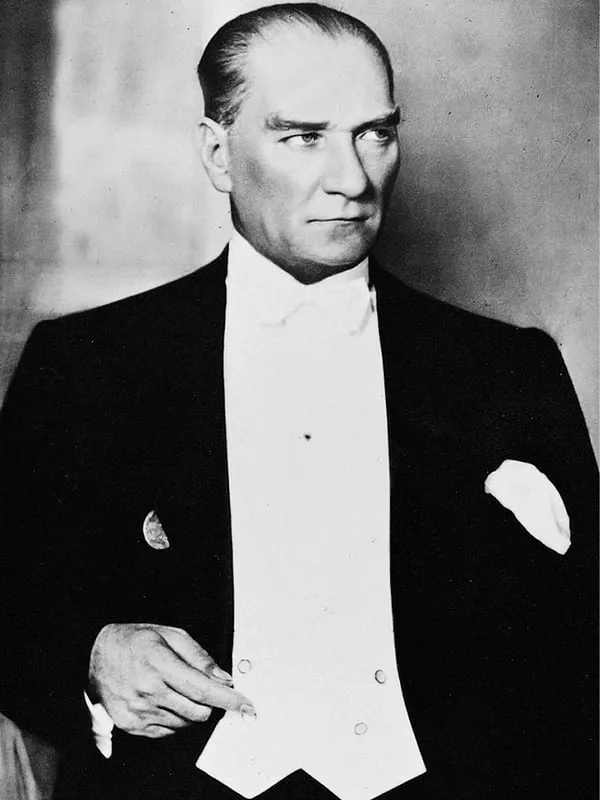
- Born:
- 1881, Salonika (Ottoman Empire)
- Died:
- 10 November 1938, Istanbul (Dolmabahçe Palace)
- Author:
- Natalia
- Photo:
- autor nieznany, domena publiczna, Wikimedia Commons

Mustafa Kemal, known from 1934 as Atatürk, was an Ottoman officer who made his name in the defence of Gallipoli and, after the Ottoman Empire’s defeat in the First World War, placed himself at the head of the Turkish national movement. In 1919–1922 he built a new government and a new army in Ankara, defeated the Greeks in the Greco-Turkish War and forced the victorious powers to replace the Treaty of Sèvres with the Treaty of Lausanne. Turkey was the only defeated state of the Great War to overturn by force the peace imposed on it, and its example was followed closely by German nationalists, Adolf Hitler among them. As the first President of the Republic of Turkey, Kemal ruled in authoritarian fashion for fifteen years and imposed a radical westernisation on the country: he abolished the caliphate, introduced secular law and the Latin alphabet, and gave women the vote. At the same time his state built a uniform Turkish nation at the expense of the minorities, and his power rested on a single party and on repression. He died less than a year before the outbreak of the Second World War, leaving his successor, İsmet İnönü, a state that managed to come through it as a neutral.
Salonika and the military schools
He was born in 1881 in Salonika (Thessaloniki), a multinational port city in Ottoman Macedonia, into a Muslim, Turkish-speaking family; his father, Ali Rıza, was a minor official and timber merchant, and his mother was Zübeyde. The exact date of his birth is unknown. He later named 19 May, the anniversary of his landing at Samsun in 1919, as his symbolic birthday. His father died when Mustafa was a few years old. Against his mother’s wishes, in 1893 the boy passed the entrance examination to the military secondary school in Salonika. According to tradition, it was there that his mathematics teacher gave him the second name Kemal, meaning “perfection”. He went on to the military school at Monastir (Bitola), the War College in Istanbul and the General Staff Academy, from which he graduated in January 1905 as a staff captain.
Like many young officers of his generation, he absorbed patriotic and constitutional ideas directed against the absolutism of Sultan Abdülhamid II. He was briefly arrested for his activity in a clandestine circle and then posted to Damascus. He joined the Committee of Union and Progress, which carried out the Young Turk Revolution in 1908, but he did not belong to its inner leadership. He criticised the army’s involvement in politics and soon fell out of favour with the committee’s leaders, especially the ambitious Enver, with whom he was a rival throughout his career.
Libya, the Balkans and Gallipoli
In 1911 he went to Libya as a volunteer, where during the Italo-Turkish War he organised Arab resistance to the Italians around Tobruk and Derna and was wounded in the eye. In the Balkan Wars he fought on the Gallipoli peninsula, and in 1913 he took part in the recapture of Adrianople (Edirne) from the Bulgarians. He then served as military attaché in Sofia.
The Ottoman Empire entered the First World War on Germany’s side in November 1914, against his conviction that it was a mistake. He won fame in the Gallipoli campaign. On 25 April 1915, when Australian and New Zealand troops landed on the peninsula, Lieutenant Colonel Kemal, commander of the 19th Division, threw his troops into a counter-attack on his own initiative and halted them on the heights above the beach. He is credited with words spoken to his soldiers at the time: “I do not order you to attack, I order you to die.” In August, when the British landed at Suvla Bay, he commanded the whole threatened sector and stopped them again. Gallipoli made him a national hero, although the propaganda in Istanbul preferred to praise Enver and the German commander Otto Liman von Sanders.
In 1916, by then a general, or pasha, he commanded a corps on the Caucasus front and recaptured Muş and Bitlis from the Russians. In 1917 he took command of the 7th Army on the Syria–Palestine front, but quarrelled with the German commander Erich von Falkenhayn and resigned. At the turn of 1917 and 1918 he accompanied the heir to the throne, Mehmed Vahideddin, the future Sultan Mehmed VI, on a journey to Germany, where he met Kaiser Wilhelm II and Paul von Hindenburg. After visiting the Western Front he tried to convince his hosts that the war was lost. In the autumn of 1918 he again commanded the 7th Army in Palestine. After the British breakthrough at Megiddo he led the remnants of his forces northwards and formed a defensive line near Aleppo, where the Armistice of Mudros of 30 October 1918 found him. On 13 November he returned to Istanbul, on the same day that the Allied fleet sailed in.
Samsun and Ankara
The victors set about partitioning the empire. The British occupied Mosul, the French Cilicia and the Italians Antalya, and on 15 May 1919, with the approval of the Paris Peace Conference, Greek troops landed at Smyrna. Meanwhile the government of Sultan Mehmed VI appointed Kemal inspector of the army in Anatolia, with the task of disarming the remnants of the army and restoring order. On 19 May 1919 Kemal landed at Samsun and did exactly the opposite. In the Amasya Circular of June he proclaimed that the nation’s independence was in danger and that only the nation itself could save it. In July he left the army, and the congresses at Erzurum and Sivas elected him chairman of the Representative Committee of the national movement. His programme, adopted by the Ottoman parliament in January 1920 as the National Pact, demanded the indivisibility of the lands inhabited by a Muslim majority.
When the Allies occupied Istanbul in March 1920 and dispersed the parliament, Kemal summoned the Grand National Assembly to Ankara; it met on 23 April 1920 and elected him its president. The Sultan’s court martial sentenced him to death in absentia. On 10 August 1920 the Sultan’s government signed the Treaty of Sèvres, which left the Turks a truncated Anatolia, and Ankara declared it null and void. The national movement fought on three fronts. In the east, Kâzım Karabekir’s troops recovered Kars in the autumn of 1920 in the war with Armenia. In the south, irregulars harassed the French in Cilicia. In the west stood the Greeks. Kemal sought support from the only power that was also an enemy of Britain. In April 1920 he wrote to Vladimir Lenin asking for gold and weapons, and in March 1921 Ankara signed the Treaty of Moscow with Soviet Russia. At home, however, he did not tolerate communists.
The war with the Greeks
On the Greek front the first victories were won by İsmet, whom Kemal had put in charge of the Western Front: in January and March 1921 he repulsed Greek attacks at İnönü. In the summer of 1921, however, the Greek army of King Constantine I broke through the defences at Kütahya and Eskişehir. Kemal ordered a retreat behind the Sakarya river, trading territory for time. On 5 August 1921 the Assembly entrusted him with supreme command and the full extent of its own powers, and Fevzi Pasha became his chief of staff. In the Battle of the Sakarya, which lasted from 23 August to 13 September, he directed the defence with a broken rib and stopped the Greeks a few dozen kilometres from Ankara. The Assembly conferred on him the rank of marshal and the title of gazi, or “victor”. Kemal knew how to exploit this victory diplomatically: in October 1921 France concluded an agreement with Ankara and withdrew from Cilicia, and the Italians pulled out of the area around Antalya. Greece, now supported only by David Lloyd George, was left on its own.
For a year Kemal prepared the army for an offensive, resisting pressure to strike sooner. On 26 August 1922, from the hill of Kocatepe near Afyon, he launched a great offensive that within a few days shattered the Greek army at Dumlupınar. On 1 September he issued the order: “Armies, your first goal is the Mediterranean. Forward!” On 9 September Turkish cavalry entered Smyrna, and Kemal arrived the next day. Over the following days Metropolitan Chrysostomos was murdered by a mob, there was a massacre in the Armenian quarter, and from 13 September the Great Fire destroyed the Christian quarters. Most historians hold Turkish soldiers responsible for starting the fire; Kemal and the Turkish authorities blamed the Armenians and Greeks. When the Turkish army approached the Straits, provoking a crisis with Britain, Kemal agreed to negotiations, which ended on 11 October 1922 with the Armistice of Mudanya.
One matter that cannot be passed over is the national movement’s attitude to the Christians of Anatolia. Kemal took no direct part in the Armenian genocide of 1915–1916, but his movement drew on the cadres and structures of the Committee of Union and Progress, including men responsible for the deportations and massacres. The Armenian survivors could not return to their homes, and in 1919–1923 Turkish troops and irregulars murdered and deported Greeks in Pontus and in the Anatolian interior. According to some accounts, Kemal condemned the crimes of 1915 in conversations with foreigners, but at home he presented the Turks as the victims. The population exchange with Greece agreed in 1923 brought the history of Anatolia’s Orthodox communities to a definitive end.
The Republic
On 1 November 1922 the Assembly abolished the sultanate, and the last sultan left Istanbul aboard a British warship. At the Lausanne conference İsmet secured recognition of Turkey’s full sovereignty in the treaty signed on 24 July 1923. On 13 October Ankara became the capital, and on 29 October 1923 the Republic of Turkey was proclaimed, with Kemal as president and İsmet as prime minister. In the same year Kemal married Latife Uşaklıgil, the educated daughter of a Smyrna merchant. The marriage broke down after two years.
Over the following years Kemal carried out one of the most radical transformations of state and society of the 20th century. On 3 March 1924 the caliphate was abolished and the Ottoman dynasty expelled from the country. In 1925 the fez was banned and the dervish orders were closed; in 1926 a civil code modelled on the Swiss one was introduced, which banned polygamy and gave women the right to divorce and to inherit, together with the Gregorian calendar. In 1928 the clause naming Islam as the state religion was removed from the constitution, and on 1 November the Latin alphabet replaced the Arabic script. Kemal himself toured the country with a blackboard and chalk, teaching the new letters. Women gained the vote in local elections in 1930 and in parliamentary elections in 1934, earlier than in France or Italy. In 1934 a law required all citizens to adopt surnames, and the Assembly gave the president the surname Atatürk, “father of the Turks”. The state ideology, known as Kemalism, was defined by six “arrows”: republicanism, nationalism, populism, statism, secularism and revolutionism.
The reforms were imposed from above, and resistance was broken by force. Kemal ruled through the Republican People’s Party, the only legal party for most of his rule. The opposition Progressive Republican Party was dissolved in 1925, after the outbreak of the Kurdish rebellion of Sheikh Said, which was crushed and its leaders hanged. The Law on the Maintenance of Order and the extraordinary Independence Tribunals were used to deal with all opponents. After the discovery in 1926 of a plot in İzmir against the president’s life, many former Unionist leaders were executed, including some whose involvement in the plot was never proven. In 1927 Kemal presented his own version of the history of the War of Independence in a speech lasting six days, known as the Nutuk, which became canonical for decades. An experiment with a controlled opposition, the Liberal Republican Party, was ended after only three months in 1930. The state promoted a nationalism which held that all the Muslims of Anatolia were Turks, together with pseudo-scientific theories about the Turkish origins of civilisation. Kurdish language and identity were not recognised. In 1937–1938 the army bloodily suppressed a rising in the Kurdish region of Dersim. According to various estimates, between ten thousand and several tens of thousands of people were killed, and thousands were deported.
Foreign policy
Kemal’s foreign-policy motto was “Peace at home, peace in the world”. Turkey, which had fought wars almost without a break from 1911 to 1922, needed calm in order to rebuild. Kemal maintained friendly relations with the USSR, and in 1932 he took the country into the League of Nations. He was reconciled with the old enemy: in 1930 the Greek prime minister, Eleftherios Venizelos, came to Ankara and signed a treaty of friendship, and in 1934 Greece and Turkey concluded the Balkan Entente with Yugoslavia and Romania. Venizelos even nominated Kemal for the Nobel Peace Prize.
In the 1930s the main threat to Turkey came from Fascist Italy, which looked across from the Dodecanese islands to the Anatolian coast. Kemal responded with diplomacy. In 1936, a few months after Hitler had unilaterally sent troops into the Rhineland, Turkey obtained the consent of the powers to revise the Treaty of Lausanne by negotiation: the Montreux Convention of 20 July 1936 restored its right to fortify the Straits. In 1937 it concluded the Saadabad Pact with Iran, Iraq and Afghanistan. Kemal’s last cause was the district of Alexandretta in French-mandated Syria. Under Turkish pressure France agreed in 1938 to the creation of an autonomous Hatay State, which was annexed to Turkey in 1939, after Kemal’s death. Paris paid this price in order to win Turkey as an ally against Germany and Italy.
Kemal had admirers in Germany. The historian Stefan Ihrig has shown that in the 1920s the German right presented Ankara as a model for a country that ought to throw off the Versailles “diktat”, and that Hitler and the propaganda of the Third Reich repeatedly expressed admiration for the “new Turkey” and its leader. Kemal himself kept his distance from Germany and refused to be drawn into any bloc.
Death and legacy
From 1937 Kemal was seriously ill with cirrhosis of the liver, the result of many years of heavy drinking. He died at 9.05 a.m. on 10 November 1938 in the Dolmabahçe Palace in Istanbul. The next day the Assembly elected İsmet İnönü president. In 1953 Kemal’s body was moved to a monumental mausoleum in Ankara.
In Turkey Atatürk remains the object of a cult, and insulting his memory has been a criminal offence since 1951. For many colonial and semi-colonial peoples he was the model of a leader who defended independence against the European powers and modernised his country. His critics point to the dictatorship, the repression of the Kurds and other minorities, and the fact that his movement completed the removal of the Christians from Anatolia. For the history of the road to the Second World War, what matters most is that Kemal was the first to show that the order established after 1918 could be overturned by force, and that, unlike his German admirers, he then contented himself with what he had won. The state he left behind had settled borders, an army capable of defending it and a foreign policy geared to avoiding war. Thanks to this, Turkey came through the Second World War as a neutral country, formally joining it on the Allied side only in February 1945.
Sources
Commanded in battles
(01)Often appears with
People who appear in the same events.