Italy
Galeazzo Ciano
Minister of Press and Propaganda (1935–1936), Minister of Foreign Affairs of Italy (1936–1943), Ambassador to the Holy See (1943)
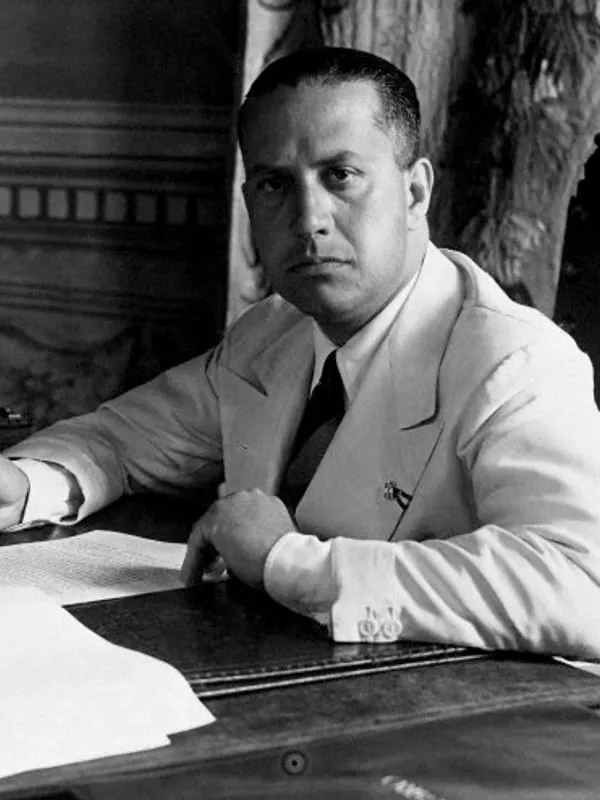
- Born:
- 18 March 1903, Livorno (Kingdom of Italy)
- Died:
- 11 January 1944, Verona (Italy)
- Author:
- Łukasz
- Photo:
- autor nieznany, domena publiczna, Wikimedia Commons

For almost seven years Galeazzo Ciano was the face of Italian foreign policy. The son of an admiral who had been one of the founders of the Fascist movement, and the son-in-law of Benito Mussolini, he became foreign minister at the age of 33 and was regarded as the Duce’s likely successor. In Mussolini’s name he signed the instruments that bound Italy to Germany: the protocol on cooperation of 1936, accession to the Anti-Comintern Pact, the First Vienna Award, the Pact of Steel and the Tripartite Pact. He personally prepared the conquest of Albania and was one of the chief advocates of the attack on Greece. Yet earlier than the regime’s other dignitaries he understood where the alliance with Hitler was leading; in August 1939 he helped to keep Italy from entering the war at once, and in July 1943 he voted to remove his father-in-law from power. For this the Salò Fascists sentenced him to death. He left a diary covering 1937–1943, one of the most important sources for the history of Axis diplomacy.
The admiral’s son
Gian Galeazzo Ciano was born on 18 March 1903 in Livorno. His father, Costanzo Ciano, was a naval officer who in the First World War led raids by MAS torpedo motor boats in the Adriatic, including the celebrated foray into the Bay of Bakar (Buccari) in February 1918 with Gabriele D’Annunzio. For his war service he received the gold medal for military valour and later the title of Count of Cortellazzo, which his son inherited. After the war he joined the Fascists, took part in the March on Rome in 1922, and then for ten years was minister of communications and one of the most influential – and wealthiest – men of the regime.
Galeazzo, brought up under his father’s stern eye, attended secondary schools in Venice and Genoa. In 1921 the family moved to Rome, where he studied law. At that time he was more interested in the theatre than in politics: he wrote reviews for newspapers, including the Fascist L’Impero, and two plays, neither of which was a success. He took part in the March on Rome, but in his youth he was not an important figure in the movement. After graduating in 1925 he followed his father’s advice and passed the examination for the diplomatic service.
Diplomat and son-in-law
Ciano’s first postings were Rio de Janeiro and Buenos Aires, then the legation in Beijing and the newly opened embassy to the Holy See. In January 1930 he met Edda, Mussolini’s eldest and favourite daughter. They married in Rome on 24 April 1930, and the wedding was a great press event. They had three children: Fabrizio, Raimonda and Marzio. The marriage was stormy and both had affairs, but Edda proved loyal to her husband when he was in greatest need.
Immediately after the wedding the couple left for China, where Ciano became consul general in Shanghai and then headed the Italian diplomatic mission in China. In 1932, during the fighting for Shanghai, he took part as Italy’s representative in the mediation by the powers that led to a ceasefire between China and Japan. He maintained close relations with Chinese politicians. Ciano and Edda became friends with Marshal Zhang Xueliang, who stayed in Italy in 1933.
Propagandist and airman
Back in Italy, Ciano rose rapidly. In August 1933 his father-in-law put him in charge of the head of government’s press office; in 1934 he became under-secretary of state for press and propaganda, and in June 1935 minister of press and propaganda. This office controlled newspapers, radio and cinema and in later years turned into the notorious Ministry of Popular Culture.
When Italy attacked Ethiopia, Ciano volunteered for the air force and commanded a bomber squadron called “La Disperata”. For taking part in the raids he received two silver medals for military valour. The regime’s propaganda made him a hero of a war in which the Italians bombed an Ethiopian army defenceless in the air and used poison gas.
Foreign minister
In June 1936, after the capture of Addis Ababa, Mussolini handed Ciano the foreign ministry, which he had until then held himself. Ciano was the youngest head of Italian diplomacy in history. He worked in the Palazzo Chigi, but the key decisions were taken in conversations with his father-in-law in the Palazzo Venezia. He was ambitious, brilliant and vain, frequented the salons of the Roman aristocracy and quickly acquired a reputation as a lightweight. Contemporaries such as the minister Giuseppe Bottai described him as a man made of two halves: one outstanding, the other superficial.
From the start Ciano pursued a policy of rapprochement with Germany. In October 1936 he travelled to Germany; on 23 October in Berlin he signed a secret protocol on cooperation with Foreign Minister Konstantin von Neurath, and the next day Hitler received him at Berchtesgaden. A few days later, in Milan, Mussolini announced the existence of the Rome–Berlin “Axis”. Ciano advised his father-in-law on sending troops to Spain, and in January 1937 he concluded a “gentlemen’s agreement” with Britain on the Mediterranean. According to some historians, his ministry and military intelligence were behind the murder in France on 9 June 1937 of the brothers Carlo and Nello Rosselli, leaders of the anti-Fascist Giustizia e Libertà movement, by French assassins from the Cagoule organisation. His direct involvement has never been proved.
In March 1937 Ciano concluded an agreement with the Yugoslav prime minister Milan Stojadinović. On 6 November 1937 in Rome he signed the protocol of Italy’s accession to the Anti-Comintern Pact, noting in his diary that three nations were setting out on a road that might lead them to war. In December Italy left the League of Nations. When the Anschluss came in March 1938, Italy accepted it without objection. In September Ciano accompanied Mussolini to the Munich Conference, and on 2 November 1938 in Vienna, together with Joachim von Ribbentrop, he announced the First Vienna Award, which gave Hungary the southern areas of Slovakia and Carpathian Ruthenia.
Albania, Poland and the Pact of Steel
Albania was Ciano’s personal affair. From 1938 he prepared its occupation, and when Hitler seized Bohemia and Moravia in March 1939, he pressed his father-in-law to answer with a conquest of Italy’s own. After an ultimatum to King Zog I, Italian troops landed in Albania on 7 April 1939, and Zog fled to Greece. The Albanian crown was accepted by Victor Emmanuel III. The Albanian ministries of foreign affairs and defence were abolished, and the country was ruled by the king’s lieutenant-general Francesco Jacomoni, who was closely subordinate to Ciano. Historians often call Ciano the de facto viceroy of Albania, and one of its ports was renamed Porto Edda in honour of his wife.
At the end of February 1939 Ciano paid a visit to Poland. In Warsaw he held talks with Foreign Minister Józef Beck, took part in ceremonies honouring Francesco Nullo, the Italian hero of the January Uprising of 1863, hunted in the Białowieża Forest and visited Kraków, where he paid his respects at the coffin of Józef Piłsudski. In his diary he wrote that Poland, despite Beck’s policy, was by nature anti-German, and that Beck wanted to settle the question of Gdańsk (Danzig) in free negotiations, without pressure. The visit did not change Rome’s policy. In May Ciano told the Polish ambassador, Bolesław Wieniawa-Długoszowski, that in the event of war Poland would pay for the conflict whatever its outcome.
Ciano was no enthusiast for a military alliance with Germany, but he negotiated it. At a meeting with Ribbentrop in Milan on 6–7 May 1939 he accepted assurances that Germany wanted several years of peace and agreed that the German side should draft the text of the treaty. When he read it, he noted that it contained “real dynamite”. On 22 May 1939 in Berlin, in Hitler’s presence, he signed the Pact of Steel, which bound both states to support each other with all their armed forces in any war.
August 1939
On 11 August 1939 Ciano came to Salzburg to convince the Germans that a war with Poland would not remain local. Ribbentrop at Schloss Fuschl, and then Hitler on the Obersalzberg, told him that the decision had been taken. According to Ciano’s account, when he asked Ribbentrop what Germany actually wanted, the Corridor or Danzig, he was told: “Not that any more. We want war.” He returned to Rome, as he wrote, “disgusted with the Germans”, convinced that Hitler had lied to his ally, and not knowing whether to wish Italy a German victory or a German defeat. Over the following days he urged his father-in-law not to go to war alongside Germany, a war that Italy did not want and for which it was not prepared.
Mussolini wavered between his sense of honour and his awareness of the army’s weakness. Ciano helped him find a way out. On 25 August the Duce informed Hitler that Italy could not enter the war without large deliveries of arms and raw materials, and on 26 August, after a conference with the chiefs of staff whose participants Ciano urged not to be “criminally optimistic”, a list of requirements was sent to Berlin so enormous that the Germans could not meet it. On 1 September 1939 the Italian Council of Ministers proclaimed “non-belligerence”. In the first days of September Ciano was still trying to arrange a peace conference, but Britain demanded first the withdrawal of German troops from Poland.
The war
When Germany defeated France in the spring of 1940, Mussolini decided that he could wait no longer. On 10 June 1940 it was Ciano who handed the declarations of war to the French and British ambassadors, André François-Poncet and Percy Loraine. That day he wrote: “I am sad, very sad. The adventure begins. May God help Italy.” As a major in the air force he then took command of a bomber group at Pisa, and on 1 November 1940 he himself took part in a raid on Salonika.
On 30 August 1940 in Vienna Ciano and Ribbentrop announced the Second Vienna Award, which gave northern Transylvania to Hungary, and on 27 September 1940 in Berlin they and the Japanese ambassador signed the Tripartite Pact. Ciano was one of the chief advocates of the attack on Greece, which in his diary he called a “useful and easy” war. The Italian offensive from Albania, launched on 28 October 1940, ended in defeat and a retreat deep into Albania, from which the Italians were rescued only by the German intervention in the Balkans in the spring of 1941. After the destruction of Yugoslavia Ciano negotiated with the Ustaša leader Ante Pavelić the annexation of the greater part of Dalmatia to Italy.
In the years that followed he distanced himself ever more clearly from the war and from the Germans. His diary records their contempt for their Italian ally, the defeats in Africa and on the Eastern Front, and conversations in which German dignitaries spoke cynically of the crimes in the East – such as Hermann Göring, who in November 1941 predicted that 20 to 30 million people would starve to death in Russia. After the defeats at El Alamein and Stalingrad Ciano favoured Italy’s withdrawal from the war. In February 1943, in a government reshuffle, Mussolini took the ministry away from him and sent him as ambassador to the Holy See, where Ciano kept in touch with the diplomacy of Pope Pius XII.
25 July 1943
After the Allied invasion of Sicily Mussolini convened the first meeting since 1939 of the Grand Council of Fascism. On the night of 24–25 July 1943 the council adopted a motion by Dino Grandi that the king should assume supreme command and full powers. Nineteen members voted for the motion, Ciano among them. For Mussolini his son-in-law’s vote was the most painful blow. The next day the king had the Duce arrested, and Marshal Pietro Badoglio formed a government.
If Ciano thought he would keep his influence, he miscalculated. The new government shut him out of all influence, and he feared an investigation into his fortune. On 27 August 1943, with German help, Ciano fled by air to Munich with Edda and the children, hoping to go on from there to Spain. The Germans did not let him leave and kept him under guard in a villa near Munich. In September, after Mussolini’s liberation, the Italian Social Republic was set up in northern Italy, and its Fascists demanded the punishment of the “traitors of 25 July”. In October the Germans handed Ciano over to them, and he was imprisoned in Verona.
Trial and death
On 8–10 January 1944, in the Castelvecchio in Verona, six members of the Grand Council who had voted against Mussolini and were in Fascist hands were put on trial. Five of them, including Ciano and the 77-year-old Marshal Emilio De Bono, were sentenced to death for treason. Edda begged her father for mercy and tried to save her husband by offering the Germans his diaries, but Hitler did not approve the plan. Mussolini did not exercise his right of pardon. According to the account of SS General Karl Wolff, Mussolini asked him whether Hitler would take a pardon for his son-in-law badly, and was told that he certainly would.
On the morning of 11 January 1944, at the firing range by the fort of San Procolo in Verona, the condemned men were tied to chairs with their backs to the firing squad, as traitors. At the last moment Ciano turned to face the riflemen. He was not killed by the first volley and was finished off with shots to the head. Before he died he asked that his children be told he was dying without bearing a grudge against anyone. He was buried in Livorno.
The diary
A few days earlier, on 9 January 1944, Edda, helped by a friend, the airman Emilio Pucci, had escaped to Switzerland with her husband’s diary notebooks. Ciano had kept the diary from 1937 until his dismissal from the ministry in February 1943, recording daily his conversations with Mussolini, Hitler, Ribbentrop and ambassadors. It was published in 1946 and at once became a fundamental source for the history of Axis diplomacy. It was used by the prosecution at the Nuremberg trials, and Winston Churchill drew on it in his history of the war. Historians have shown that after his dismissal Ciano revised some entries to make himself look like an opponent of the war, but most of the entries are considered reliable, all the more so as he also left in passages that incriminated him.
Significance
Ciano is an ambiguous figure. He was not the creator of Fascist foreign policy but its executor and co-author, a man who owed his career to his marriage and to his father. He put his name to the rapprochement with Germany, the conquest of Albania and the attack on Greece; he believed in Italian expansion in the Balkans and did not shrink from violence. And yet in August 1939 he was one of the few who told Mussolini that Hitler was leading Italy to disaster, and he helped to delay Italy’s entry into the war by nine months. He died because he broke too late, and too half-heartedly, with the regime that had made him. His diary remains one of the most important testimonies to how the alliances that led Europe into the Second World War were forged.
Sources
Mentioned in battles
(04)Often appears with
People who appear in the same events.
On the timeline
(64)The 40 most important of 64 events. All tagged “Galeazzo Ciano” (4) →
1924
1936
1937
1938
1939
March
- 15
- Key eventGermany occupies Bohemia and MoraviaOn 15 March 1939 the Wehrmacht marched into Bohemia and Moravia, and that night Hitler slept at Prague Castle. Breaking the Munich Agreement ended appeasement.
- Hungary occupies Carpatho-UkraineOn 15 March 1939, as Carpatho-Ukraine proclaimed independence, Hungarian troops advanced on Khust. In three days they took it and reached the Polish border.
April
May
August
September
- 01
- Italy and the neutral statesOn 1 September 1939 Italy announced it would not take up arms. The Nordic states, Estonia, Latvia and Portugal, England’s ally, also declared neutrality.
- Britain and France demand a German withdrawal from PolandOn the evening of 1 September 1939 Henderson and Coulondre demanded that Germany withdraw from Poland. The notes were a warning, not an ultimatum.