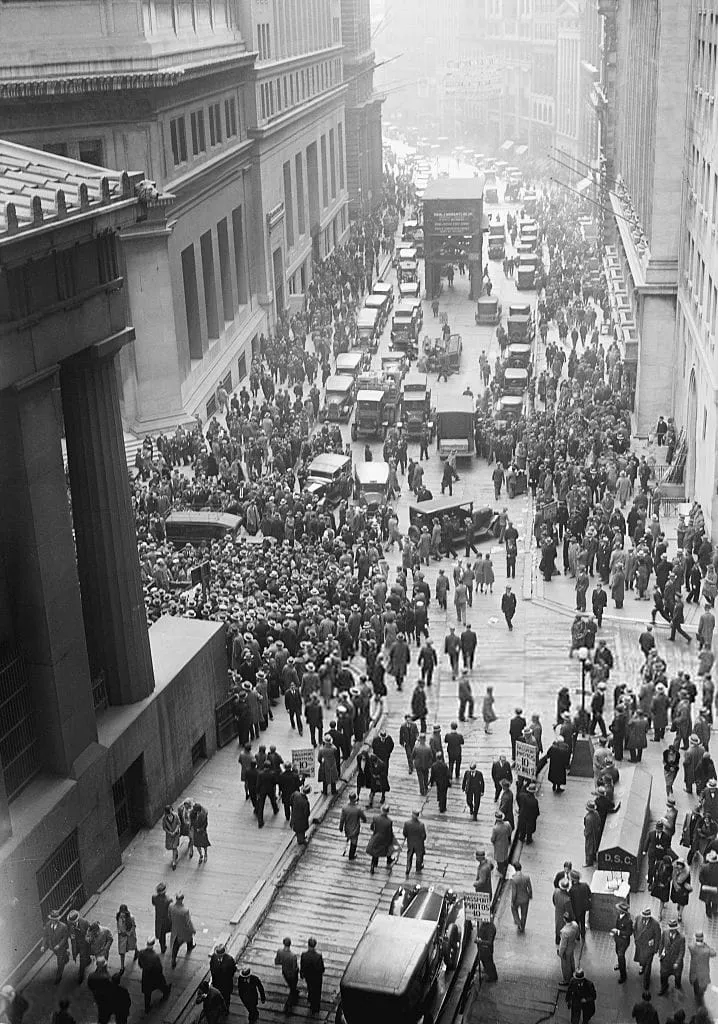
On Tuesday 29 October 1929 panic gripped the New York Stock Exchange on Wall Street. Shareholders sold at any price, and for some stocks there were no buyers at all. Turnover reached some 16 million shares, a record that stood for almost 40 years. The Dow Jones index fell by almost 12 per cent that day, after a fall of almost 13 per cent the day before. In two days nearly a quarter of the value of American shares evaporated. The day went down in history as Black Tuesday, and the stock market crash of October 1929 became the symbol of the beginning of the Great Depression, the deepest economic collapse in the history of the modern world. The Depression brought mass unemployment in America and Europe, shattered the system of reparations and loans on which post-war stabilisation rested, and opened the way to power for Adolf Hitler in Germany and the military in Japan. On the road to the Second World War it was one of the most important events of the entire interwar period.
The beginning of the Great Depression is often linked with 29 October. The date is a convention. The crash lasted several weeks, and Polish historical writing often dates its start to Black Thursday, 24 October. Economists, for their part, date the beginning of the recession in the United States to the summer of 1929, several months before the stock market collapse. The crash was the spark and the symbol of the Depression, but not its only cause.
The great bull market
For America the 1920s were a decade of prosperity. After a short recession in 1920–1921 the economy grew almost without interruption. Millions of families bought their first cars, radio sets, refrigerators and vacuum cleaners, often on hire purchase. Cities were electrified, and corporations such as General Motors and the Radio Corporation of America became symbols of a new age. The Republican presidents Warren Harding and Calvin Coolidge and the Treasury Secretary Andrew Mellon cut taxes and left business alone. When Herbert Hoover was elected President in November 1928 and took office in March 1929, he believed, like most Americans, that the country was closer than ever to defeating poverty.
Share prices rose fastest of all. The Dow Jones index rose almost sixfold from 1921, and in 1928 and the first months of 1929 alone the prices of many companies doubled. People who had never invested before rushed into the market. Many bought shares on credit, paying only part of the price and borrowing the rest from their broker against the shares themselves. By the summer of 1929 such loans exceeded 8.5 billion dollars – more than all the currency in circulation in the United States. As long as prices rose, it paid. When they began to fall, the broker issued a margin call, and anyone without the money had to sell, which drove prices down still further. The market was also full of investment trusts that bought shares in other trusts, likewise on credit. All this was a speculative bubble, though only a few were willing to admit it.
The warning signs were visible. From the spring of 1929 steel production, construction and car sales weakened, and farmers had been suffering from low grain prices for years. The Federal Reserve tried to cool speculation and in August 1929 raised its discount rate. The Dow Jones peaked on 3 September 1929 at 381 points. Two days later the economist Roger Babson predicted a crash, and the market wobbled. On 20 September the financial empire of Clarence Hatry, accused of fraud, collapsed in London. At the beginning of October the British Chancellor of the Exchequer, Philip Snowden, called the American market an “orgy of speculation”. Yet as late as mid-October the eminent economist Irving Fisher was assuring the public that share prices had reached “a permanently high plateau”.
Black Thursday and Black Tuesday
The selling accelerated in the last week of October. On 23 October prices fell sharply in the last hour of trading. The next morning, Thursday 24 October, panic broke out. The index lost about 11 per cent in the first hours, and turnover reached an unprecedented 12.9 million shares. The ticker tapes that carried prices to brokers’ offices across the country ran hours late, so investors did not know what their shares were worth and sold blind. A crowd gathered outside the exchange, and police were called to the scene.
At noon the heads of New York’s largest banks met at the offices of J.P. Morgan, under the chairmanship of Thomas Lamont of the Morgan bank. They resolved to rescue the market as John Pierpont Morgan himself had done in 1907. In the afternoon the vice-president of the exchange, Richard Whitney, acting on behalf of the bankers, crossed the floor and conspicuously placed an order for 25,000 shares of US Steel at 205 dollars, well above the current price, followed by similar orders for the shares of other large companies. The panic subsided, and the index closed only about 2 per cent down. On 25 October President Hoover declared that “the fundamental business of the country, that is production and distribution of commodities, is on a sound and prosperous basis”.
The calm did not last. Over the weekend margin calls reached investors, and on Monday 28 October the index fell by 12.8 per cent. This time the bankers did not intervene. On Tuesday 29 October the selling reached its peak. The Dow Jones fell by another 11.7 per cent, to 230 points, and the ticker ran into the evening. By some estimates shares lost about 14 billion dollars in value on that single day. Announcements by great financiers, including the Rockefeller family, that they were buying shares to show their confidence in the market had no effect. On 30 October the index rebounded by more than 12 per cent, but then began falling again. On 13 November it stood at just under 199 points, roughly half its value at the beginning of September.
The popular stories of waves of suicides on Wall Street, of bankers leaping from windows, are largely legend. The economist John Kenneth Galbraith pointed this out as early as 1955 in his classic book on the crash. What was real was the ruin of thousands of small investors who lost their life savings, and of large institutions that had invested on credit.
From crash to depression
In the winter and spring of 1930 the market partly recovered. In April 1930 the Dow Jones climbed back to 294 points, and many concluded that the worst was over. It was then that the real collapse began. The index fell for more than two years, until on 8 July 1932 it closed at 41 points, almost 90 per cent below its peak. It did not regain its September 1929 level until November 1954.
The economy followed the market. People who had lost money or feared for their jobs stopped buying. Firms cut production and laid off workers, prices fell, and debtors could not repay their loans. Banks that had lent money for buying shares or had invested in them themselves began to fail, and their customers lost their savings. Between 1930 and 1933 some 9,000 banks failed in the United States. The Federal Reserve did not prevent the money supply from shrinking by roughly a third. Industrial production fell by almost half, and national income at constant prices by roughly a quarter. In 1933 one in four Americans able to work was unemployed. On the edges of cities shanty towns of tin and cardboard sprang up, which the unemployed called “Hoovervilles”.
Hoover was not idle, as legend has it. In November 1929 he summoned industrialists to the White House and urged them not to cut wages, and later he increased spending on public works and set up a credit corporation to rescue the banks. He believed, however, that relief for the unemployed was a task for the states, local authorities and charity, and he regarded a balanced budget and the convertibility of the dollar into gold as paramount. Trade policy proved the most damaging. On 17 June 1930 Hoover signed the Smoot–Hawley Tariff Act, which raised duties on thousands of goods. Other countries retaliated in kind, and within a few years the value of world trade fell by about two thirds.
The Depression goes global
The crisis quickly spread to Europe, whose economy depended on American money. After the adoption of the Dawes Plan in 1924, large American loans, many of them short-term, had flowed into Germany. With this money Germany paid reparations to France and Great Britain, which in turn repaid their war debts to America. The circle held as long as American investors were willing to lend. As early as 1928, as the bull market on Wall Street gathered pace, money began to flow back across the Atlantic, and after the crash the outflow accelerated. The hope of financing reparations under the Young Plan, adopted in principle in August 1929, through bonds sold to Americans collapsed.
In May 1931 Austria’s largest bank, the Vienna Creditanstalt, went bankrupt. The panic spread to Germany, where in July 1931 one of the big Berlin banks failed and the government closed all banks for several days. In June Hoover announced a one-year moratorium on reparations and war-debt payments, but it was already too late. In September 1931 Great Britain suspended the convertibility of the pound into gold, and in the years that followed other countries did the same. Each defended itself as best it could with tariffs, quotas and devaluation. The world broke up into economic blocs, and trust between states, already weak after the war, collapsed.
In Germany unemployment rose from about 1.3 million in September 1929 to more than 6 million registered unemployed at the beginning of 1932. In March 1930 the last coalition based on a parliamentary majority broke up, and the new Chancellor, Heinrich Brüning, governed by decrees of President Paul von Hindenburg. Seeking to prove that Germany could not pay reparations, he cut spending, wages and benefits and raised taxes, which deepened the crisis. The Germans still remembered the hyperinflation of 1923, which had wiped out the savings of the middle class, and now the Depression was taking away their jobs. People who had lost faith in the Republic began to listen to the extremes. Adolf Hitler’s NSDAP, which had won only 2.6 per cent of the vote in the election of May 1928, took 18.3 per cent in September 1930 and more than 37 per cent in July 1932, becoming the largest party in the Reichstag. The Communist KPD grew too. On 30 January 1933 Hitler became Chancellor.
The Depression struck Japan as well. In January 1930 the government of Osachi Hamaguchi restored the convertibility of the yen into gold, just as deflation was setting in worldwide. The prices of silk, the main export, and of rice collapsed, and poverty in the countryside, from which most soldiers came, pushed young officers towards radical nationalism. Soldiers and nationalists argued that Japan had to acquire its own sources of raw materials and markets, and the nearest was Manchuria. On 18 September 1931 the Kwantung Army staged an attack on the railway line near Mukden and began the conquest of Manchuria. The Depression also hit Poland hard; there it lasted longer than in most European countries. Industrial production fell by several tens of per cent, and the prices of farm produce fell so far that peasants had nothing with which to buy manufactured goods.
Against this background Soviet propaganda hailed the first Five-Year Plan as proof of the superiority of the planned economy. There was no unemployment in the Soviet Union, and the West was losing faith in capitalism, although few wanted to know that at the same time millions of people in Ukraine and Kazakhstan were dying of hunger.
Causes and controversies
Economists still argue about the causes of the Great Depression. Few believe that the stock market crash alone could have produced so deep and prolonged a depression. In 1929 only a few million Americans owned shares, and in 1987 the market fell even further in a single day without causing a depression. Followers of John Maynard Keynes emphasised the collapse of demand, which the market could not restore on its own, and the lack of state action. In 1963 Milton Friedman and Anna Schwartz laid the blame on the Federal Reserve, which had allowed thousands of banks to fail and the money supply to contract. In 2002 Ben Bernanke, later Chairman of the Federal Reserve, publicly acknowledged that the Fed bore responsibility for this. Other economic historians point to the gold standard, which transmitted the crisis from country to country and forced governments to make cuts at the worst possible moment, and to the absence of a state willing and able to take responsibility for the world economy, as Great Britain had done before 1914. The common conclusion is that policy mistakes deepened the Depression, and that the crash of October 1929 was the beginning, not the whole story.
The United States drew lessons from the crash. In 1933 Congress separated deposit banking from investment banking, and in 1934 it set up a commission to supervise the stock market. Franklin Delano Roosevelt, elected President in 1932, launched the New Deal, under which the state for the first time took responsibility for fighting unemployment.
Significance
Without the Great Depression the history of the 1930s would very probably have turned out differently. In 1924–1929 the Weimar Republic had managed to stabilise, and the NSDAP was a fringe party. The Depression destroyed what had been built in those years. Unemployment, bankruptcies and fear of the future gave Hitler millions of voters, and the campaign against the Young Plan, waged in the autumn of 1929 in the same weeks as the crash, brought him into the company of respectable right-wing politicians. When he came to power in 1933, he solved the unemployment problem with a programme of public works and rearmament financed by credit that could only be repaid with the spoils of war. Reparations, suspended by the Hoover moratorium, were in practice abolished at the Lausanne Conference in 1932. The Versailles order lost one of its main instruments.
The Depression also changed relations between the powers. In Japan it convinced the military and much of public opinion that the country had to conquer an empire of its own, and it led to the occupation of Manchuria in 1931, the first great act of aggression in the face of which the League of Nations proved powerless. In Great Britain and France the Depression forced governments to cut spending, including on defence, and postponed rearmament at a time when Germany was already arming. The United States, preoccupied with its own hardship, withdrew into isolationism, and in 1935–1937 Congress passed the Neutrality Acts, meant to keep America out of another war in Europe. The collapse of world trade convinced many states that only their own raw materials and markets – autarky and conquest – could guarantee their security. Hitler later used this kind of thinking to justify the struggle for “living space” in the east, and Japan to build its “Co-Prosperity Sphere” in Asia. Less than ten years passed between Black Tuesday and the outbreak of war in Europe.
Sources
Related events
(04)The same battle, people or subject.
- 14 September 1930 · PoliticsThe Reichstag election of 1930On 14 September 1930 the NSDAP won 18.3 per cent and 107 seats. Hitler’s party leapt from the fringe to second place, and the republic lost its majority.
- 30 June 1930 · MilitaryThe end of the occupation of the RhinelandOn 30 June 1930 the last French troops left the Mainz zone. The occupation of the Rhineland ended five years before the date set at Versailles.
- 6 November 1928 · PoliticsHoover wins the presidential electionOn 6 November 1928 the Republican Herbert Hoover soundly beat Al Smith. A year later the Wall Street Crash began the Great Depression, which changed the world.
- 24 July 1929 · DiplomacyThe Kellogg–Briand Pact comes into forceOn 24 July 1929 Hoover announced at the White House that the Kellogg–Briand Pact was in force. It bound 46 states, while a railway dispute brewed in Manchuria.