United States
Herbert Hoover
Head of the American Relief Administration (1919–1923), Secretary of Commerce (1921–1928), 31st President of the United States (1929–1933)
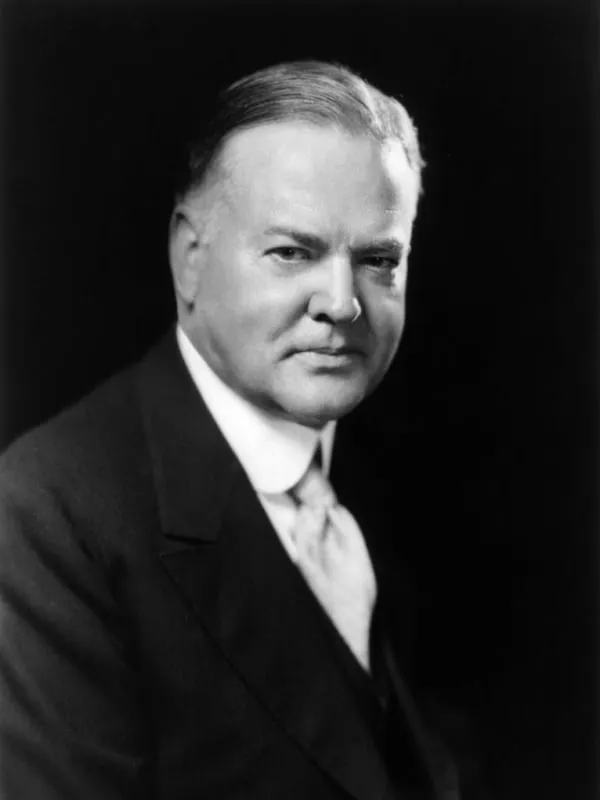
- Born:
- 10 August 1874, West Branch (Iowa, United States)
- Died:
- 20 October 1964, New York
- Author:
- Natalia
- Photo:
- Underwood & Underwood, domena publiczna, Wikimedia Commons

Herbert Clark Hoover earned his place in history twice, and each time in a different way. As the organiser of food relief during and after the First World War he saved millions of people from starvation in Belgium, Poland, Austria, Hungary and Soviet Russia. As President of the United States from 1929 to 1933 he failed to master the Great Depression, which began a few months after his inauguration and which in Europe carried Adolf Hitler to power and undermined the Versailles order. He lost to Franklin Delano Roosevelt and for more than thirty years remained one of the harshest critics of his policies, foreign policy included.
An orphan from Iowa
He was born on 10 August 1874 in West Branch, Iowa, into a Quaker family. His father, a blacksmith, died when the boy was six, and his mother four years later. The orphaned Herbert was taken in by an uncle, a doctor in Oregon, and at thirteen left school to work in his uncle’s office. He studied in the evenings and in 1891 was admitted to the first year of the newly opened Stanford University in California, where he read geology. He graduated in 1895.
Engineer in Australia, China and London
After a short spell in Californian mines he was hired by the London firm of Bewick, Moreing & Co., which in 1897 sent him to the goldfields of Western Australia. He proved an outstanding organiser. In 1899 he married Lou Henry, a fellow student, and went with her to China, where he managed mining ventures around Tianjin. In 1900 the couple lived through the siege of the city during the Boxer Rebellion. From 1901 he was a partner in the firm, and later an independent consultant and financier in London, known as the “doctor of sick mines”. He did business on every continent, Russia included, and by 1914 had made several million dollars. Together with his wife he translated into English Agricola’s sixteenth-century Latin treatise on mining.
Relief for Belgium and for Europe
The outbreak of war in 1914 found him in London. First he organised the return home of thousands of Americans stranded in Europe, and in the autumn of 1914 he became head of the Commission for Relief in Belgium. German-occupied Belgium, cut off by the British blockade, had no means of feeding itself. As the representative of a neutral country Hoover negotiated with the British and the Germans, crossed the North Sea dozens of times and built an organisation that throughout the war supplied food to millions of people in Belgium and northern France. When the United States entered the war in 1917, President Woodrow Wilson put him in charge of the federal Food Administration. Hoover avoided rationing by persuading Americans to save food voluntarily, and the verb “to Hooverize” entered everyday speech.
After the Armistice he headed the American Relief Administration (ARA), which delivered food to devastated Central and Eastern Europe. In Paris he was one of Wilson’s advisers. He believed that the defeated should be neither humiliated nor starved, and John Maynard Keynes wrote that had his realism and disinterestedness carried more weight in the negotiations, the world would have had “the Good Peace”. In Hungary in August 1919 his people opposed the regency of Archduke Joseph August. Poland held a special place in his work. Between 1919 and 1922 the ARA and its affiliated organisations fed more than a million Polish children, and Hoover himself visited Warsaw in August 1919, meeting Józef Piłsudski and the Prime Minister, Ignacy Jan Paderewski. In November 1921 he was made an honorary citizen of Warsaw, the universities of Warsaw and Lwów awarded him honorary doctorates, and a square on Krakowskie Przedmieście in Warsaw bears his name today.
In 1921, despite opposition from some Republicans, the ARA undertook relief for the victims of the great famine in Russia. The agreement with the Soviet government was signed in Riga in August 1921 by Maxim Litvinov. At the peak, in the summer of 1922, American kitchens were feeding more than ten million people a day. Hoover was a determined opponent of the Bolsheviks, but to the charge that he was helping their regime he replied that the starving must be fed regardless of politics. The historian Richard Pipes wrote that Hoover, criticised for his presidency, had the rare distinction of having saved millions of lives.
In 1919 he gave Stanford University the archives of his organisations and funded a collection of documents on war and revolution, which grew into the Hoover Institution, one of the most important archives of twentieth-century history, Polish and Russian history included.
Secretary of Commerce
In 1920, after briefly hesitating over which party to join, he declared himself a Republican and sought the presidential nomination without success. The young Democrat Franklin Delano Roosevelt had earlier urged him to run for his own party. President Warren Harding made him Secretary of Commerce, and Hoover stayed in the post under Calvin Coolidge until 1928. He turned a second-rank department into the centre of economic policy. He promoted the standardisation of production, the regulation of radio and civil aviation, the building of a great dam on the Colorado, later named after him, and the growth of exports. He believed in voluntary cooperation between industry, workers and the state, but rejected unemployment benefits as a road to “paternalism”. In 1927 he directed the relief operation after the Great Mississippi Flood, which made him the most popular member of the cabinet.
President
When Coolidge announced that he would not run, Hoover won the Republican nomination and on 6 November 1928 defeated the Democrat Al Smith by a wide margin. He took office on 4 March 1929 as the embodiment of the era of prosperity. Less than eight months later came the Wall Street Crash. Hoover reacted faster than his legend suggests: he called on industrialists not to cut wages, urged investment, and in 1932 created a federal credit corporation that rescued banks and railways. Yet he rejected federal relief for the unemployed, long defended a balanced budget and the gold standard, and in June 1930 signed the Smoot–Hawley Act, which raised tariffs and set off a trade war. Unemployment rose above 20 per cent, and the shanty towns of the homeless, built of tin and cardboard, were called “Hoovervilles”. In July 1932 troops under General Douglas MacArthur broke up a camp in Washington of war veterans demanding payment of their bonus, which finally destroyed the President’s image.
Hoover’s foreign policy was one of peace and arms limitation. After the Kellogg–Briand Pact came into force, as proclaimed at the White House in July 1929, his administration brought about the London Naval Treaty in 1930. Towards Latin America he moved away from the policy of intervention. In June 1931, to rescue the tottering Germany of Chancellor Heinrich Brüning, he announced a one-year moratorium on war debt and reparation payments, which proved the beginning of the end of the Young Plan. When Japan seized Manchuria in September 1931, Hoover did not want sanctions. In January 1932 Secretary of State Henry Stimson merely proclaimed the doctrine that the United States would not recognise gains made by force. In the election of 8 November 1932 Hoover lost to Roosevelt, carrying only six states.
Critic of Roosevelt
After leaving the White House he became a leading opponent of the New Deal, which he regarded as a threat to liberty. In 1936 and 1940 he hoped in vain to be nominated again. In March 1938, during a tour of Europe, he met Adolf Hitler in Berlin and was a guest at Hermann Göring’s hunting estate. He left troubled by the persecution of the Jews and convinced that Hitler was a fanatic, but also that Germany posed no direct threat to America and that the best course was to keep the war away from the United States. After war broke out in September 1939 he opposed American entry into the conflict and the Lend-Lease programme, drawing close to the isolationist America First Committee. At the same time he returned to humanitarian work: he organised a relief commission for Poland, occupied by Germany and the USSR, then a relief fund for Finland, invaded by the Soviet Union, and a campaign for Belgium. The British, unwilling to weaken the blockade, nevertheless restricted his efforts.
After Germany attacked the USSR he warned in a radio address on 29 June 1941 that if America entered the war and Stalin won, it would be helping him impose communism on Europe. Roosevelt gave him no task during the war. Hoover later called Tehran and Yalta a betrayal of Poland and the other nations of Central Europe, and set this out in a lengthy critique of Roosevelt’s policy, Freedom Betrayed, published only in the twenty-first century.
Last years
The new President, Harry Truman, valued his experience. In 1946 Hoover toured several dozen countries, Poland among them, to assess the world’s post-war food needs, and in a report on occupied Germany he rejected the idea of turning it into an agricultural country. On his initiative, in 1947 millions of children in the American and British occupation zones began to receive school meals. In 1947–1949 and 1953–1955 he chaired commissions on the reorganisation of the federal government, known as the Hoover Commissions. He died in New York on 20 October 1964, aged 90, and was buried in his native West Branch.
Legacy
Hoover is among the lowest-rated presidents in American historians’ rankings, although more recent research stresses that his response to the Depression was more active than its image suggests and that many New Deal institutions grew out of his ideas. As a humanitarian he had no equal in his era: the organisations he led fed millions of people in Europe, Poland included, where throughout the interwar years he was one of the most respected Americans. For the road to the Second World War, however, what mattered most was that the world of the 1920s collapsed during his presidency. The Depression he could not halt destroyed the Weimar Republic and encouraged Japan’s aggression, and the American response to the first acts of violence, limited to a moratorium and a doctrine of non-recognition, showed the aggressors that the United States had no intention of defending the Versailles order.
Sources
Often appears with
People who appear in the same events.