Germany
Paul von Hindenburg
Chief of the General Staff of the Field Army (1916–1919), field marshal, Reich President (1925–1934)
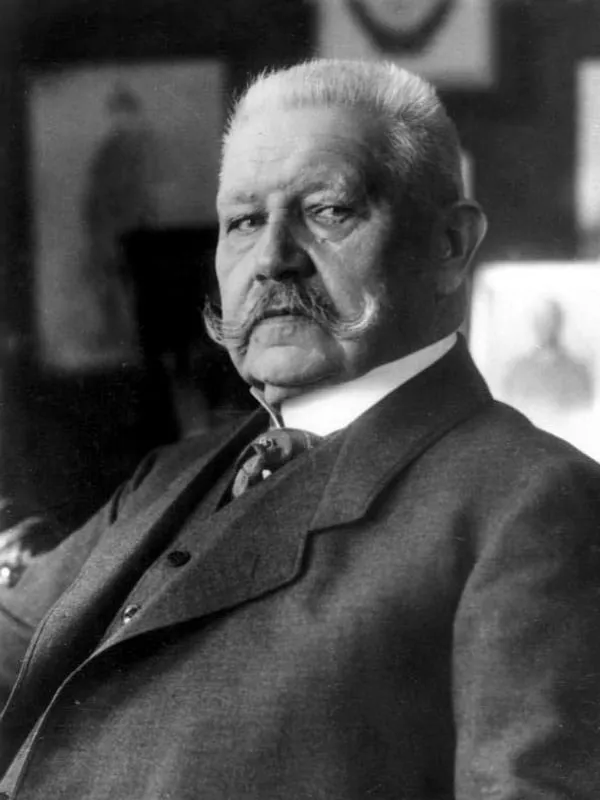
- Born:
- 2 October 1847, Poznań
- Died:
- 2 August 1934, Neudeck (today Ogrodzieniec, Poland)
- Author:
- Łukasz
- Photo:
- autor nieznany, CC BY-SA 3.0 DE, Wikimedia Commons

No other German links the First World War with the Second as Paul von Hindenburg does. In 1914 the victory at Tannenberg made the retired general a national hero, and from 1916, together with Erich Ludendorff, he directed the entire German army and, in practice, the policy of the Reich. In September 1918 it was he and Ludendorff who demanded that the government ask for an armistice, and in November Hindenburg instructed the delegates in the Forest of Compiègne to sign it even without concessions. A year later, before a parliamentary committee, he declared that the army had been “stabbed in the back”, lending his authority to a legend that poisoned the Weimar Republic. In 1925 the Germans elected him Reich President. He governed in an increasingly authoritarian manner, and on 30 January 1933 he appointed Adolf Hitler Chancellor and in the following weeks signed the decrees that allowed the Nazis to destroy democracy.
A Prussian officer
He was born on 2 October 1847 in Poznań (Posen), where his father was stationed, an officer from the von Beneckendorff und von Hindenburg family, Prussian nobility from East Prussia. He grew up in a military and Protestant tradition. He passed through the cadet corps at Legnickie Pole (Wahlstatt) and in Berlin, and in 1866, as a young Guards lieutenant, he fought the Austrians at Königgrätz (Sadowa), where he was slightly wounded in the head. In the Franco-Prussian War he fought at Saint-Privat and Sedan, and on 18 January 1871 he was present at Versailles for the proclamation of the German Empire. To the end of his days he regarded it as one of the most important days of his life.
There followed a solid but unspectacular career: the War Academy, the General Staff, the War Ministry, command of a regiment and of a division. In 1903 he took command of IV Corps in Magdeburg. In 1911, at the age of 63, he retired and settled in Hanover. Married to Gertrud von Sperling, he had three children, among them his son Oskar, who later became his closest adviser.
Tannenberg and the Third OHL
In August 1914, when Russian armies entered East Prussia and the commander of the German 8th Army wanted to fall back behind the Vistula, the Supreme Command dismissed him and recalled Hindenburg from retirement in his place, giving him General Erich Ludendorff as chief of staff. At the Battle of Tannenberg on 26–30 August the Russian 2nd Army was encircled and destroyed, and soon afterwards the 8th Army drove the Russians out of East Prussia. The concept of the operation was not Hindenburg’s, and its course was largely determined by Ludendorff, but it was Hindenburg who became the “saviour of East Prussia” and a living symbol of German might. In November 1914 he became Commander-in-Chief in the East and a field marshal. In 1915 his troops occupied Lithuania and Courland, where the military occupation state of Ober Ost was created.
On 29 August 1916 Hindenburg became Chief of the General Staff of the Field Army, with Ludendorff as First Quartermaster General. So began the Third OHL, the third leadership of the Supreme Army Command (Oberste Heeresleitung). Hindenburg represented the army before Emperor Wilhelm II and the public, while Ludendorff ran the staff. Together they imposed their will on the government: they forced through unrestricted submarine warfare, which in 1917 brought the United States into the war, they brought about the fall of Chancellor Bethmann Hollweg, and in 1918 they imposed the Treaty of Brest-Litovsk on the Bolsheviks. Contemporaries spoke of the “silent dictatorship” of the Supreme Command. In 1916 the OHL also backed the proclamation of the Kingdom of Poland by the Act of 5 November, counting on Polish recruits who never materialised.
Defeat and armistice
In the spring of 1918 Ludendorff hurled the army into great offensives in the west, which brought only territorial gains and enormous losses. After the defeat at Amiens on 8 August the initiative passed to the Allies. On 29 September at Spa Hindenburg and Ludendorff told the Emperor that it was necessary to ask for an armistice at once and to form a government based on a parliamentary majority. The new Chancellor, Prince Max von Baden, sent a note to President Wilson. When at the end of October Ludendorff wanted to break off the negotiations, the Emperor accepted his resignation but kept Hindenburg. Ludendorff was succeeded by General Wilhelm Groener.
In November, while revolution gripped the country, Hindenburg at Spa remained mostly silent. On 9 November Groener told the Emperor that the army no longer stood behind him, and Hindenburg advised Wilhelm II to leave for the Netherlands. On 10 November the Supreme Command reminded Friedrich Ebert’s government that the armistice had to be signed even if its terms could not be softened. Yet the signature was put to it by a civilian, Matthias Erzberger, and not by any of the generals. Hindenburg remained at the head of the army and brought the troops home within the deadlines set by the armistice. The Supreme Command moved to Kassel and then to Kołobrzeg (Kolberg), and supported the formation of the volunteer Freikorps (PL), which fought the left in Germany and the Poles in the east. In June 1919, when the government asked whether the army could defend itself if the Treaty of Versailles were rejected, Hindenburg judged resistance hopeless, but left it to Groener to convey this message to the politicians. Shortly afterwards he retired for the second time.
The stab in the back
On 18 November 1919 Hindenburg appeared before the committee of the National Assembly investigating the causes of the defeat. He read out a prepared statement without answering questions. He asserted that in the autumn of 1918 the army had been close to victory and that the defeat had been decided by the collapse of discipline at home. He invoked the words of some English general that the German army had been “stabbed in the back”. Coming from the most popular man in Germany, the statement gave credibility to the stab-in-the-back myth, according to which the undefeated army had been betrayed by socialists, democrats and Jews. It was he who had demanded an armistice in September 1918, and now he laid the blame on those who had been forced to sign it. The legend became one of the pillars of nationalist and Nazi propaganda.
Reich President
When President Ebert died in February 1925 and no candidate won a majority in the first round of the election, the right put forward the 77-year-old field marshal. Hindenburg agreed after some hesitation; his biographers disagree over whether he had first sought the consent of the exiled Emperor. In the second round on 26 April 1925 he defeated the candidate of the republican parties, Wilhelm Marx, partly because the communists did not withdraw their candidate, Ernst Thälmann. The election of a monarchist and war hero as president of the republic alarmed France and the democrats in Germany.
In his first years Hindenburg surprised his critics. He swore an oath to the constitution and abided by it, supported the policy of the Foreign Minister, Gustav Stresemann, who in 1925 signed the Locarno Treaties guaranteeing Germany’s western border, and did not back the right-wing campaign against the Young Plan. He made no secret, however, of being a monarchist, and in 1927, at the unveiling of the Tannenberg Memorial, he publicly denied that Germany bore guilt for the outbreak of the war. He spoke of Poland with hostility and never reconciled himself to the loss of the lands in the east.
From presidential government to Hitler
The Great Depression changed everything. In March 1930 the last parliamentary government, under the Social Democrat Hermann Müller, fell, and Hindenburg, on the advice of General Kurt von Schleicher, appointed the Centre Party politician Heinrich Brüning Chancellor. Brüning governed by presidential decrees issued under Article 48 of the constitution, and the Reichstag, dissolved in July 1930, returned after the election with the Nazis as the second-largest party. The parliamentary republic in effect ceased to function, and who governed was decided by the President’s entourage: his son Oskar, the head of his office Otto Meissner, and Schleicher.
In 1932 Hindenburg stood for a second term. This time he was backed by the Social Democrats and the Centre, who saw him as the only barrier against Hitler, while Hitler and Thälmann stood against him. On 10 April he won the second round with 53 per cent of the vote. Immediately afterwards he turned against those who had elected him. At the end of May he forced Brüning to resign and appointed Franz von Papen, an aristocrat with no base in parliament. In July Papen removed the Social Democratic government of Prussia, and in the election the Nazis won 37 per cent of the vote and became the largest party in the Reichstag. In August Hindenburg still refused Hitler the chancellorship, and in December he appointed Schleicher.
In January 1933 Papen, Oskar von Hindenburg and Meissner persuaded the old President that Hitler, surrounded by conservative ministers, could be kept under control. On 30 January 1933 Hindenburg appointed him Chancellor. After the Reichstag fire, on 28 February, he signed the Decree for the Protection of People and State, which suspended basic civil rights, and in March he did not oppose the Enabling Act, which gave the government legislative power. On 21 March, in the Garrison Church in Potsdam, Hitler bowed before Hindenburg, in a ceremony meant to show that the new regime was the heir of old Prussia. Within a few months the parties and trade unions were dissolved and Jews were removed from the civil service. Hindenburg protested only on behalf of Jewish war veterans, who at his request were for a time exempted from these regulations.
Death
By the summer of 1934 Hindenburg was gravely ill. During the Night of the Long Knives, at the turn of June and July, Hitler had the leaders of the SA and many political opponents murdered, Schleicher among them. A telegram of thanks was sent to Hitler in the President’s name, which, according to the later testimony of Hermann Göring, Hindenburg never even saw. Hindenburg died on 2 August 1934 on his estate at Neudeck in East Prussia, today Ogrodzieniec near Kwidzyn. The day before, the government had passed a law that on his death merged the offices of President and Chancellor. Hitler became “Führer and Reich Chancellor”, and the armed forces swore an oath to him personally. Against the wishes of the deceased, who had wanted to be laid to rest beside his wife in Hanover, he was buried in the Tannenberg Memorial near Olsztynek (Hohenstein), where a mausoleum was soon created. In 1945 the Germans took his coffin west, and today it rests in St Elizabeth’s Church in Marburg.
Assessment
In his lifetime Hindenburg was for millions of Germans a symbol of loyalty, duty and steadfastness, an “ersatz emperor” onto whom they projected feelings that Wilhelm II no longer inspired. Historians judge him far more severely. His military achievements are largely credited to Ludendorff and other staff officers. The German historian Wolfram Pyta has shown, however, that Hindenburg was no figurehead but deliberately built and guarded his own myth, and was able to turn his popularity against the Emperor, against chancellors and ultimately against the republic.
On the road to the Second World War Hindenburg played a double role. In 1918 he shifted the responsibility for defeat from the army to the politicians and lent credibility to the legend from which Nazism grew. In 1930–1933, as President, he dismantled parliamentary democracy and handed power to Hitler, and his authority helped the Nazis win over the army and the conservative elites. No other German had a greater opportunity to stop Hitler, and none did more to open the way for him.
Sources
Mentioned in battles
(01)Often appears with
People who appear in the same events.
On the timeline
(37)1918
1919
1920
1922
1924
1925
1926
1929
1930
1931
1932
1933
1934
June
August
- 02
- Hitler becomes FührerPresident Hindenburg died on 2 August 1934. Under a law of 1 August Hitler took over his powers and became head of state as “Führer and Reich Chancellor”.
- The Wehrmacht's oath of loyalty to HitlerOn 2 August 1934, the day Hindenburg died, Reichswehr soldiers swore unconditional obedience not to the constitution but to Adolf Hitler in person.