1940–1942: Fighting against Vichy France
Battle of Gabon
- Dates:
- 27 October – 12 November 1940
- Front:
- Africa
- Location:
- Gabon (French Equatorial Africa): the north of the colony with Mitzic, the Ogooué valley with Lambaréné, the coast with Mayumba, the Mondah peninsula and Libreville, and Port-Gentil on Cape LopezOn the battle map →
- Sides:
- Free France (with Royal Navy support)Philippe Leclerc de Hauteclocque, Marie-Pierre Kœnig, Edgard de LarminatVichy FranceGeorges Pierre Masson, Marcel Têtu
- Result:
- Free French victory. Libreville capitulated on 10 November and Port-Gentil on 12 November. Gabon, the last colony of French Equatorial Africa loyal to Vichy, passed under de Gaulle's authority, and Governor Masson committed suicide.
- Author:
- Łukasz
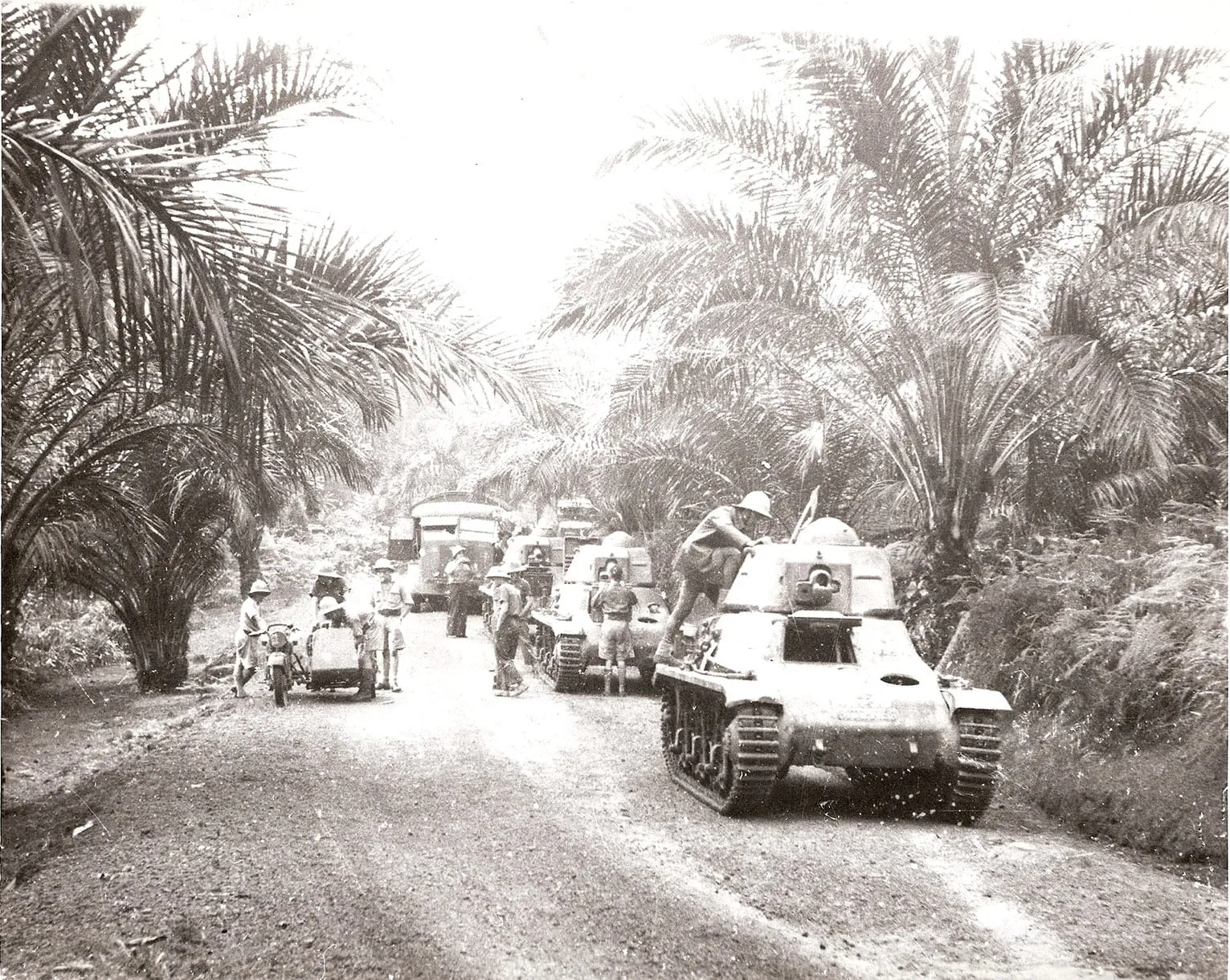
The Battle of Gabon, also called the Gabon campaign or the Battle of Libreville, was the first campaign the Free French conducted on their own, and also the first in which Frenchmen fought Frenchmen on land, in the jungle and in the streets of an African town. It lasted a little over two weeks, from 27 October to 12 November 1940. Columns sent from Cameroon and the Middle Congo occupied the north and south of the colony, and a landing near Libreville decided the fate of the capital. The Vichy forces were more numerous, but not everywhere were they willing to fight. After the capitulation of Libreville and Port-Gentil the whole of French Equatorial Africa came under the authority of General Charles de Gaulle. The Governor of Gabon, Georges Pierre Masson, who in August had first brought the colony over to Free France and then gone back on that decision, took his own life.
Name and dates
Some accounts describe the fighting as the Battle of Gabon or the Battle of Libreville. The French speak of the Gabon campaign (campagne du Gabon), the Battle of Libreville (bataille de Libreville) or the “rallying of Gabon to Free France” (ralliement du Gabon); English-language writers of the Battle of Gabon. That last name is somewhat misleading: it was not a single battle but a series of clashes scattered across a colony larger than Great Britain, separated by marches through the equatorial forest and journeys by boat along the rivers.
The campaign is taken to begin on 27 October 1940, when the column from Cameroon entered northern Gabon and took Mitzic. The bloodless seizures of the border posts of Bitam, Oyem and Mayumba a few weeks earlier formed its background. It is taken to end on 12 November, when the garrison of Port-Gentil, the last centre of Vichy resistance, surrendered. Sources differ over the date of Libreville’s capitulation: some give 9 November, the evening of the day on which General Marcel Têtu agreed to stop fighting, others 10 November, when the Free French entered the town. The latter can be taken as the date of the capitulation.
Popular war chronologies sometimes state that it was “British forces” that completed the wresting of Central Africa from Vichy in Gabon. This is inaccurate. On land only the Free French and their African soldiers fought. The Royal Navy blockaded the coast and covered the landing, and its ships were under orders not to open fire first. The British financed Free France and protected it at sea, but the campaign was planned and led by de Gaulle.
Background
Gabon in August 1940
Gabon was the westernmost of the four colonies of French Equatorial Africa (AEF), alongside the Middle Congo, Ubangi-Shari and Chad. It lay on the Atlantic, on both sides of the equator, and was mostly covered by equatorial forest. It had a population of several hundred thousand Africans, many of them from the Fang people, and few Europeans: officials, missionaries, traders and men working the forestry concessions. The colony’s wealth was okoumé timber, floated down the Ogooué river to Port-Gentil. Its capital was Libreville, a small town on the estuary of the Gabon river with no road or rail link to Brazzaville, the capital of the federation.
When, at the end of August 1940, Chad, Cameroon, the Middle Congo and Ubangi-Shari went over to de Gaulle within three days, the Governor of Gabon, Georges Pierre Masson, also made up his mind. On the night of 28–29 August he announced that the colony was joining Free France. He immediately met resistance from some of the French in Libreville, from naval officers and from the influential vicar apostolic, Bishop Louis Tardy, who supported the government of Marshal Philippe Pétain, among other things for its policy against Freemasonry. After a few dozen hours Masson backed down. De Gaulle’s supporters were arrested; some were held aboard the ship Cap des Palmes, others were deported to Dakar.
The government in Vichy decided to hold on to Gabon as a bridgehead from which the whole of Equatorial Africa might one day be recovered. It sent there Air Force General Marcel Têtu, who in May and June 1940 had commanded the air forces cooperating with the armies in north-eastern France, and who now became deputy governor-general and military commander of the part of the AEF loyal to Pétain. Têtu was to stiffen Masson’s wavering resolve. In September reinforcements arrived from Dakar: the colonial sloop (aviso) Bougainville, the submarine Poncelet and transports carrying troops. By the end of October, according to French figures, Têtu had four battalions of colonial infantry with artillery, a few modern bombers, the sloop and the submarine. In all this may have amounted to some 4,000 men, most of them African tirailleurs commanded by French officers and NCOs.
The war for the borderlands
De Gaulle later described Gabon as “a hostile enclave, difficult to eliminate because it opened on to the ocean, in the very heart of our equatorial possessions”. General Edgard de Larminat, who ran the administration of Free French Africa from Brazzaville, warned that the loss of the territory would threaten “the very principle of our presence in Africa”. Libreville lay a few hundred kilometres from Douala and from Pointe-Noire. Vichy warships based in Gabon could cut the sea communications between Cameroon and Brazzaville, and its aircraft could bomb both cities.
The first moves came quickly, still without fighting. In the north, in the province of Woleu-Ntem on the Cameroon border, Free French emissaries from Cameroon used guile and persuasion in the first days of September to take over the posts at Bitam and Oyem. In the south Major André Parant – an officer who had flown to Africa in August together with Philippe Leclerc and now commanded at Pointe-Noire – took the coastal post of Mayumba in mid-September with a dozen or so men. Vichy reinforcements sent there, brought by the Cap des Palmes escorted by the Poncelet, failed to retake the post. Accounts differ in detail, but according to some of them most of the newly arrived soldiers, after several hours of talks, chose to stay with the Free French, and the submarine’s commander, Lieutenant Commander Bertrand de Saussine du Pont de Gault, was allowed to sail away with those who wished to return. Parant pushed on inland and took Sindara. On 7 October the column from the Middle Congo occupied Booué on the Ogooué.
De Gaulle’s decision
After the failure at Dakar in September, de Gaulle needed a success, and Equatorial Africa had to become a secure base. On 8 October he arrived in Douala, where for several days he conferred with Leclerc, Larminat and his staff. On 12 October he approved the plan to take Gabon by force. He then flew to Chad to see the border with Italian Libya, since it was from Equatorial Africa that he intended one day to strike at the Italians. The British viewed the idea with reserve: they doubted that de Gaulle could take the colony and, after Dakar, did not want another humiliation. In the end they agreed to a naval blockade and to cover the landing, but not to take part in the fighting on land.
The plan provided for an advance from two directions. From Cameroon southwards, through the province of Woleu-Ntem, would come the column of Captain Louis Dio, the officer who in August had been the first to hand his soldiers over to Leclerc in Douala. From the Middle Congo, up the Ogooué towards Lambaréné, would come the detachments of Parant and Major Raymond Delange. Once the defenders’ attention was focused on the interior, the main force was to land from the sea near Libreville. Overall command lay with Colonel Leclerc, Commissioner-General of Cameroon since August. The landing group was commanded by Major Marie-Pierre Kœnig, a veteran of the fighting at Narvik, who had come to Africa with the Dakar expedition. Its core was a battalion of the 13th Foreign Legion Half-Brigade, reinforced with Senegalese and Cameroonian tirailleurs.
The Free French forces numbered in all a little over a thousand men, clearly fewer than Têtu’s. They did, however, have a company of Hotchkiss H39 light tanks brought from Britain, which according to French studies had previously taken part in the Norwegian campaign and the Dakar expedition, a battery of 75 mm guns and aircraft: a few Westland Lysanders and Bristol Blenheims of Combat Group No. 1 of the Free French Air Force, commanded by Lionel de Marmier. The Free French naval forces were commanded by Lieutenant Commander Georges Thierry d’Argenlieu, the same man who had been wounded in the harbour at Dakar a month earlier. He had the sloops Savorgnan de Brazza and Commandant Dominé and transport ships, among them the Casamance and the Commandant Brias. A British squadron under Vice Admiral John Cunningham, with the cruisers Devonshire and Delhi, the sloop Milford and smaller vessels, was to blockade the coast and intercept Vichy warships.
On 27 October, the day Dio’s column crossed the Gabonese border, de Gaulle issued a manifesto in Brazzaville in which he declared the Vichy government illegitimate and subservient to the enemy, and set up the Empire Defence Council, the first governing body of Free France. From the outset, therefore, the Battle of Gabon was also a test: could the new authority proclaimed in Brazzaville take control of the whole of Equatorial Africa?
Course of the fighting
Mitzic and the north (27 October – early November)
On 27 October Dio’s column, with Lieutenant Raymond Dronne’s infantry company, tanks and artillery, came south from Cameroon and took Mitzic, an administrative centre on the road from Woleu-Ntem into the interior of the colony. The fighting was brief. According to Free French accounts, a raid by their aircraft was enough to make the French officers and Vichy officials leave the town, and the African soldiers of the garrison went over to the attackers. There were nonetheless casualties: several graves of men killed in the area were left at Mitzic. From Mitzic the column moved on south, towards the Ogooué and the road to Libreville, skirmishing with Vichy detachments retreating through the forest.
Lambaréné (to 5 November)
The key to the south was Lambaréné, a small town on an island in the Ogooué where the waterways and land routes to Libreville and Port-Gentil converged. Vichy had built up a strong post there. Parant’s and Delange’s detachments, advancing from Sindara and Booué, needed several weeks of marching and skirmishing in the forest to approach the island and surround it. Lambaréné was then home to the hospital of Albert Schweitzer, who had been unable to return to Europe since 1939. The hospital found itself in the combat zone, but according to accounts from those days both sides tried to spare it. On 5 November the Vichy garrison of Lambaréné capitulated. According to accounts, after some of the officers had fled, the soldiers of the garrison looted the town. Parant, promoted to lieutenant colonel on 6 November for this success, could now threaten Port-Gentil from the river.
The landing near Libreville (7–9 November)
On the same day that Lambaréné fell, Kœnig’s group sailed from Douala. The ships carrying legionnaires and tirailleurs, covered by the Free French sloops and, at a distance, by the British cruisers, headed for Mondah Bay north of Libreville. The commander of the sloop Bougainville, Captain Robert Morin, knowing that the force was approaching, called for help from the submarine Poncelet, which lay off Port-Gentil. Part of the submarine’s crew had earlier gone ashore to reinforce the garrison there, but on the afternoon of 7 November the Poncelet put to sea with the rest of her men to attack the transports.
The submarine sighted the sloop Milford, which was patrolling the waters north of Cape Lopez. The British sloop was too slow to catch a submarine running on the surface, so Admiral Cunningham ordered a Supermarine Walrus seaplane to be sent up from the Devonshire. The aircraft dropped depth charges, damaged the Poncelet and forced her to dive. The Poncelet fired a torpedo at the Milford, which passed under the sloop’s hull without exploding. A second jammed in its tube, releasing toxic fumes into the boat and causing a leak. After a depth-charge attack by the Milford the submarine surfaced and came under fire. Lieutenant Commander de Saussine ordered the crew to abandon ship and, once his men were safe, went back aboard, opened the valves and went down with the Poncelet so that she would not fall into British hands. He was the only man killed. The Milford picked up 54 survivors. In France de Saussine became a symbol of naval honour, and his classmate from the naval academy, the Gaullist Honoré d’Estienne d’Orves, took his death hard. Some sources date the sinking to 8 November; detailed compilations of British signals point to the evening of 7 November.
On the night of 8–9 November Kœnig’s group landed on the beach at Pointe La Mondah, north of the town. On the morning of 9 November Lysanders from Douala bombed Libreville airfield. The legionnaires and tirailleurs, advancing towards the airfield, ran into stiff resistance. By evening the airfield was in Kœnig’s hands. Those killed in the fighting for Libreville are commemorated today by the “Wall of Remembrance” at the Gué-Gué bridge in the Gabonese capital.
The fratricidal duel of the sloops (9 November)
On the same day, in the waters off Libreville, there was a clash that France remembers as one of the bitterest episodes of the war. The Savorgnan de Brazza of Lieutenant Commander André Roux and Captain Morin’s Bougainville were sister ships of the same class, flying the same tricolour ensign. After a raid by Free French aircraft, the Bougainville opened fire first. She was, however, at a disadvantage: roughly a third of her crew had gone ashore to defend the town, and her fire was sporadic and inaccurate. After about twenty minutes the Bougainville was ablaze, with many dead and wounded on board, and had ceased to count as a fighting ship. Within three days Vichy had lost both vessels on which the seaward defence of Gabon depended.
The capitulation of Libreville (9–10 November)
On the evening of 9 November d’Argenlieu called on General Têtu to stop fighting. Têtu, whose units in the field were melting away and whose ships were lost, agreed to capitulate. On the morning of 10 November the Free French entered Libreville. De Gaulle appointed Parant Governor of Gabon. Têtu and his officers were detained. Governor Masson agreed to help bring the fighting in the rest of the colony to an end.
Port-Gentil (12 November)
Still beyond the Free French reach was Port-Gentil, the port at the mouth of the Ogooué, held by a strong garrison reinforced by sailors from the Poncelet. Masson sailed there in a sloop to persuade the defenders to lay down their arms. According to accounts, two Gaullists also flew into the town and announced the imminent arrival of a large assault force, although in fact no one had authorised them to negotiate. On 12 November the garrison surrendered without a fight. It was the end of Vichy resistance in Equatorial Africa.
Masson did not return ashore. On the way back from Port-Gentil he hanged himself in his cabin aboard the ship. Sources differ on the exact date: most link his suicide with the capitulation of Port-Gentil on 12 November, others give later days, up to 16 November. The governor who in August had for a few dozen hours been on de Gaulle’s side, and then for two and a half months had defended the colony for Pétain, was one of the last victims of this fratricidal campaign.
Losses
Losses were small compared with the battles being fought at the time in Europe and the Mediterranean, but the figures vary widely from source to source. De Gaulle wrote in his memoirs of “roughly twenty” dead. The French historian Jean-Christophe Notin counted 33 killed, the Gabonese historian Barthélémy Ntoma Mengome about fifty, which matches the number commemorated at the Gué-Gué bridge (“more than fifty people” from Mitzic to Port-Gentil). Jean-Pierre Azéma gives “about a hundred” dead. According to one compilation, 35 men were killed on the Vichy side and eight on the Free French side, to which must be added the dead aboard the Bougainville, the single fatality from the Poncelet and the losses among the African civilian population, which no one counted precisely. The Free French Air Force lost four aircraft and six airmen.
Vichy lost the submarine Poncelet and the sloop Bougainville, several aircraft and the colony’s entire garrison. Several hundred soldiers, most of them Africans, went over to the Free French at once or within a few weeks. John Hasey, an American serving in the Foreign Legion, recalled that about 150 prisoners taken in the first days of the fighting, after discussing it among themselves, volunteered for de Gaulle’s forces – “nobody talked them into it”. The French cadre behaved differently. On 15 November de Gaulle personally addressed the imprisoned Vichy officers and NCOs. Most of them, led by General Têtu, refused to come over to his side. They were interned as prisoners of war in Brazzaville, where they spent about two years. After the Allied landings in North Africa in November 1942 most of them, Têtu included, made their way to Algiers and fought on under the command of General Henri Giraud.
Significance
The Battle of Gabon closed the chapter opened in August by the coups in Fort-Lamy, Douala and Brazzaville. From 12 November 1940 the whole of French Equatorial Africa, together with Cameroon, formed Free French Africa. On the same day the Governor of Chad, Félix Éboué, became Governor-General of the AEF and Larminat High Commissioner of Free French Africa. On 16 November de Gaulle issued in Brazzaville an organic declaration supplementing the manifesto of 27 October, and instituted the Order of Liberation, the highest decoration of Free France. The Free French were no longer merely a group of émigrés in London: they governed a territory several times the size of France, with their own administration, army, a radio station in Brazzaville and revenue from exports, which had been redirected to trade with British Nigeria. On 6 January 1941 Britain formally recognised the Empire Defence Council.
After Dakar it also restored de Gaulle’s prestige and proved that his men could carry out an operation on their own. Leclerc, Kœnig, Dio, Dronne and Parant took from Gabon experience of fighting with small forces in difficult terrain. Leclerc soon took command of the troops in Chad, from where on 1 March 1941 his column captured the Italian oasis of Kufra in Libya. Kœnig later led the 1st Free French Brigade at Bir Hakeim in 1942. The battalion of the 13th Foreign Legion Half-Brigade sailed from Equatorial Africa to East Africa and fought the Italians in Eritrea. Gone, too, was the danger that Vichy warships and aircraft based in Gabon would threaten Douala, Pointe-Noire and the air route through Fort-Lamy, along which the British ferried aircraft from the Gulf of Guinea to Egypt.
The price was a deepening of the rift among the French. For Vichy, Gabon was proof that the Gaullists, backed by the British, were ready to shed French blood, and de Saussine, who had gone down with his boat, became a hero of the Vichy navy. The Vichy government began to discuss with the Germans retaking Chad by force, although the plan never went beyond talks. Fratricidal fighting recurred on a larger scale in 1941 in Syria and Lebanon, and in 1942 in Madagascar and North Africa.
For the people of Gabon the campaign was someone else’s war, yet it was they who made up most of the soldiers on both sides. Some of the population of the north of the colony fled the fighting to neighbouring Spanish Guinea. The new authorities, like the old ones, demanded labour, food, rubber and recruits from the Africans for the war effort. In 1944, at the Brazzaville Conference, de Gaulle announced reforms in the colonial empire, and sixteen years later, on 17 August 1960, Gabon declared independence. Libreville, where in November 1940 Frenchmen had fought Frenchmen for a single colony, became the capital of an independent state.