France
Charles de Gaulle
Commander of the 4th Armoured Division (1940), Under-Secretary of State for War (1940), leader of Free France (1940–1943), Chairman of the Provisional Government (1944–1946), President of France (1959–1969)
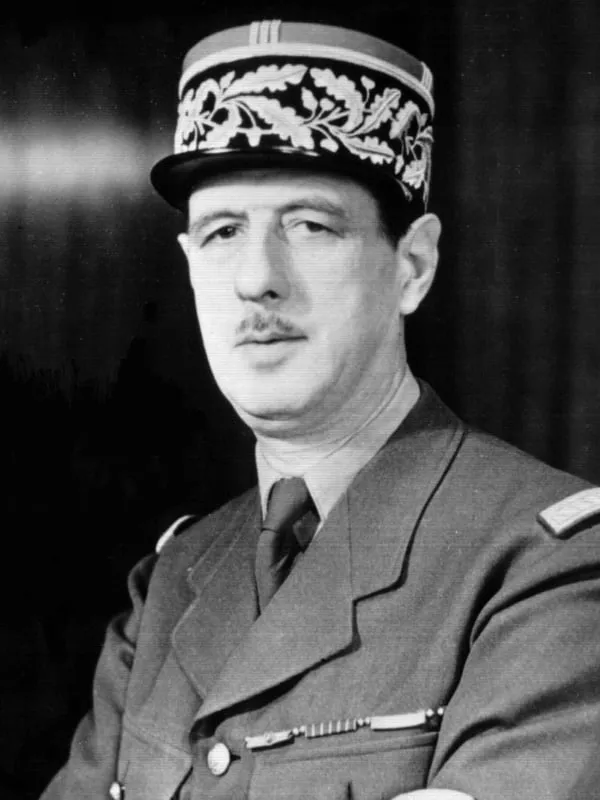
- Born:
- 22 November 1890, Lille
- Died:
- 9 November 1970, Colombey-les-Deux-Églises
- Author:
- Łukasz
- Photo:
- Office of War Information, domena publiczna, Wikimedia Commons

Before the war Charles de Gaulle was a little-known colonel who argued in books and memoranda that the next war would be decided by professional armoured divisions, not by a mass army sheltering behind the Maginot Line. In May 1940 he commanded one of the divisions meant to stop the German tanks, and in June, as the youngest general in the French army and a member of Paul Reynaud’s government, he rejected the armistice and called on his compatriots from London to fight on. Out of a handful of volunteers he built Free France and then, quarrelling in turn with the British, the Americans and his French rivals, ensured that France emerged from the war as one of the victorious powers. After the war he twice stood at the head of the state and created the Fifth Republic, whose constitution remains in force today.
Family and officer school
Charles André Joseph Marie de Gaulle was born on 22 November 1890 in Lille, in the house of his maternal grandparents, although the family lived in Paris. He was the third of the five children of Henri de Gaulle, a teacher in Jesuit schools, and Jeanne, née Maillot. He grew up in a Catholic home, monarchist by sentiment and fervently patriotic.
In 1909 he passed the entrance examination for the military academy of Saint-Cyr. As the regulations of the time required, he first served a year in the ranks of the 33rd Infantry Regiment at Arras, and studied at the academy from 1910 to 1912. In 1912 he returned to the same regiment as a second lieutenant. Its commander was then Colonel Philippe Pétain, the man who over the following decades was to be first his patron and finally his greatest adversary.
The First World War and captivity
In his first engagement, on 15 August 1914 at Dinant in Belgium, de Gaulle was wounded in the leg. In 1915, by then a captain, he was wounded a second time in Champagne. On 2 March 1916 his company was defending the village of Douaumont near Verdun. Surrounded, with a bayonet wound in the thigh, he was taken prisoner. In France he was believed killed and was honoured with what was thought to be a posthumous mention in army dispatches.
He spent 32 months in captivity. He tried to escape five times and as punishment was sent to the fortress at Ingolstadt, a camp for recalcitrant officers. Among his fellow prisoners there was a Russian second lieutenant, Mikhail Tukhachevsky. He returned after the armistice feeling that the war had passed him by.
In Poland
In the spring of 1919 de Gaulle volunteered for service with the Polish Army, and in April he left for Poland with General Paul Henrys’s French military mission. He lectured at the officer school in Rembertów, teaching tactics to Polish officers, and rose to head a course for senior officers. In the summer of 1920, during the Polish–Soviet War, he served on the staff of the front commanded by General Edward Rydz-Śmigły and came to know a war of movement, decided by rapid cavalry strikes and manoeuvre rather than by trenches. For his part in the fighting he received the Silver Cross of the Virtuti Militari. He returned to France in January 1921, although he had been offered the chance to stay in Poland. He visited the country again in 1967 as president.
On 6 April 1921 he married Yvonne Vendroux, the daughter of an industrialist from Calais. They had three children: Philippe (1921), later an admiral, Élisabeth (1924) and Anne (1928), who was born with Down syndrome and died in 1948.
Officer and writer
In the 1920s de Gaulle taught military history at Saint-Cyr and completed the École supérieure de guerre, the French staff college, where he received poor marks for his independence of judgement and his defiance of doctrine. He was helped by Pétain, then Vice-President of the Supreme War Council, who in 1925 took him onto his staff, set him to writing a book on the history of the French soldier and in 1927 had him deliver a series of lectures on command at the staff college. That same year de Gaulle was promoted to major and took command of a battalion of chasseurs in occupied Trier. In 1929–1931 he served on the staff of the French forces in the Levant, in Beirut, and from the end of 1931 in the General Secretariat for National Defence in Paris, where he learned the workings of the state from the inside.
He wrote a great deal. After La Discorde chez l’ennemi (“Discord among the Enemy”, 1924) and Le Fil de l’épée (“The Edge of the Sword”, 1932), a portrait of a leader unafraid of solitude, his best-known work was Vers l’armée de métier (“Towards a Professional Army”), published in 1934. In it de Gaulle proposed a corps of six armoured divisions manned by a hundred thousand professional soldiers, capable of striking rapidly in any direction. The idea ran counter to the army’s defensive doctrine, and on the left Léon Blum saw a professional army as a threat to the Republic. The high command dismissed the book; in Germany it was read with interest.
In December 1934 de Gaulle met Paul Reynaud, the only politician of any standing to embrace his ideas, who in 1935 put a bill for a mechanised corps before the Chamber of Deputies. The bill failed. After the remilitarisation of the Rhineland in 1936 and the Munich Agreement in 1938, de Gaulle became convinced that France, with an army fit only for defence, could not help its allies in the east. In 1938 he published under his own name La France et son armée (“France and Her Army”), a book originally prepared for Pétain, which led to a break with the marshal. In 1937 he took command of the 507th Tank Regiment at Metz, and on 25 December of that year he was promoted to colonel.
September 1939 – May 1940
When war broke out, de Gaulle commanded the tanks of the Fifth Army in Alsace. From the inactivity of the Phoney War and the defeat of Poland he drew conclusions which he set out on 26 January 1940 in a memorandum, “The Advent of Mechanised Force”. He sent it to several dozen politicians and generals. An army that did not concentrate its tanks and aircraft in large independent formations, he warned, would be crushed as the Polish army had been. In March 1940 he wrote the new government’s declaration for Reynaud, but because of opposition from Édouard Daladier he was given no post in Paris.
In April he was appointed to command the 4th Armoured Division, which was still being formed. He took command on 11 May, the day after the German attack, while his units were still arriving from all over the country. On 16 May, as Churchill was hearing from Gamelin in Paris that there was no reserve, de Gaulle watched refugees and soldiers disarmed by the Germans on the roads near Laon. He later wrote that on that day he resolved everything he went on to do. On 17 May he led a counter-attack on Montcornet, into the rear of Heinz Guderian’s corps, and on 19 May another on Crécy-sur-Serre. His tanks, without radio communications, without air cover and with little infantry, inflicted losses on the Germans but were forced to withdraw. At the end of the month, on 28–30 May, the division attacked the German bridgehead at Abbeville on the Somme. The bridgehead was reduced but not eliminated.
At the end of May de Gaulle was made a temporary brigadier general, with seniority from 1 June 1940. He was the youngest general in the French army. On 5 June Reynaud, who had taken over the defence portfolio, appointed him Under-Secretary of State for War. De Gaulle was to coordinate cooperation with Britain and prepare the transfer of troops to North Africa. On 9 June he met Winston Churchill in London for the first time. He attended the conferences at Briare and Tours, at which General Maxime Weygand and Marshal Pétain argued that the war was lost.
The Appeal of 18 June
On 16 June de Gaulle was in London, and he telephoned Reynaud with the British proposal for a Franco-British union, with a joint government and common citizenship. When he flew back to Bordeaux that evening, Reynaud had already resigned and Pétain was forming a government that would ask for an armistice. On the morning of 17 June de Gaulle flew to London in the aircraft of the British general Edward Spears, carrying money from a secret fund that Reynaud had handed to him.
On the evening of 18 June he broadcast an appeal to the French on the BBC. France, he said, had lost a battle but had not lost the war, for she had an empire, an ally that commanded the seas, and access to the industry of the United States. He called on officers, soldiers, engineers and armaments workers who were in Britain, or might find themselves there, to get in touch with him. “Whatever happens, the flame of French resistance must not and shall not die,” he concluded. The British Cabinet agreed to the broadcast only after a long discussion and insisted that the opening sentences be toned down so as not to alienate the new French government. Few heard the appeal, but in time it became the founding myth of Free France.
Pétain’s government revoked his promotion and ordered him to return. On 28 June the British government recognised him as leader of all Free Frenchmen. A military court sentenced him in absentia on 4 July to four years’ imprisonment, and on 2 August a court in Clermont-Ferrand sentenced him to death for treason. The British attack on the French fleet at Mers-el-Kébir on 3 July (Operation Catapult) turned many of his compatriots against de Gaulle, but the general publicly accepted it as a painful necessity.
Free France
On 7 August 1940 de Gaulle signed an agreement with Churchill under which Britain recognised his forces, undertook to finance them and promised to restore the independence and greatness of France. At the end of August Chad, under its governor Félix Éboué, rallied to Free France, and soon the whole of French Equatorial Africa followed. An attempt to take Dakar in September 1940 ended in humiliation. On 27 October, in Brazzaville, de Gaulle set up the Empire Defence Council and declared the Vichy regime illegitimate. The Cross of Lorraine became the movement’s symbol.
Relations with the Allies were stormy. De Gaulle held that he alone represented France and defended her interests with an obstinacy that Churchill regarded as ingratitude. In June and July 1941 the Free French fought alongside the British against Vichy forces in Syria and Lebanon, and a dispute over authority in the Levant very nearly led to a break. In September 1941 de Gaulle created the French National Committee, the nucleus of a government. In December 1941 his ships seized the islands of Saint-Pierre and Miquelon against American wishes, which President Franklin Delano Roosevelt and Secretary of State Cordell Hull took as an affront. To the end of the war Roosevelt suspected de Gaulle of dictatorial ambitions.
From 1942 the general sought the support of the resistance inside France. His envoy Jean Moulin, parachuted into France at the beginning of 1942, united the main underground organisations, which in May 1943 recognised de Gaulle as their leader. De Gaulle was not warned in advance of the Allied landings in North Africa in November 1942 (Operation Torch), and the Americans backed first Admiral François Darlan there and, after his assassination, General Henri Giraud. At the Casablanca Conference in January 1943 Roosevelt and Churchill persuaded the two generals to shake hands. In June 1943 the French Committee of National Liberation was formed in Algiers with two co-presidents, but within a few months de Gaulle had pushed Giraud out of political power.
Liberation
On 3 June 1944 the Committee became the Provisional Government of the French Republic. On 14 June, eight days after the Normandy landings, de Gaulle came ashore and in Bayeux addressed a crowd that was seeing him for the first time. He at once began appointing his own prefects, forestalling American plans for military administration. On 25 August, the day the German garrison surrendered to General Philippe Leclerc’s division, he arrived in Paris. At the Hôtel de Ville he spoke of “Paris outraged, Paris broken, Paris martyred, but Paris liberated”, liberated by itself with the help of the whole of France.
As head of government he brought all the resistance groups, communists included, into his cabinet and disarmed their militias. In December 1944 he went to Moscow and on 10 December signed a treaty of alliance with Joseph Stalin. Stalin pressed him to recognise the communist Polish Committee of National Liberation. De Gaulle refused formal recognition and agreed only to an exchange of unofficial representatives. He was not invited to the Yalta Conference, but France received an occupation zone in Germany, a seat on the Allied Control Council and a permanent seat on the UN Security Council. In May 1945 French representatives signed the German instrument of surrender as witnesses on the side of the victors.
The reckoning with collaboration was bloody. Before and just after the liberation the resistance killed some ten thousand people without trial, according to the most widely accepted estimates, and the courts handed down thousands of sentences. Pétain was sentenced to death in August 1945, but de Gaulle commuted the sentence to life imprisonment. Pierre Laval was shot. On 20 January 1946 de Gaulle, unwilling to accept a constitution that gave full power to the parties in parliament, abruptly resigned.
The wilderness and the return
In a speech at Bayeux in June 1946 he set out a plan for a strong executive, with a president above the parties; it was rejected. In April 1947 he founded the Rally of the French People (RPF), a movement that at first won huge support but failed to take power. In 1953 de Gaulle withdrew from it and retired to his house at Colombey-les-Deux-Églises (PL). There he wrote his War Memoirs, the first volume of which appeared in 1954.
He was brought back to power by the Algerian War. After the revolt of French settlers and the army in Algiers on 13 May 1958, the Fourth Republic stood on the brink of civil war. On 1 June the National Assembly entrusted de Gaulle with the government and with special powers. The constitution of the Fifth Republic, with strengthened presidential powers, was approved by referendum on 28 September 1958, and on 21 December de Gaulle was elected president. Against the wishes of those who had called him back, he brought Algeria to independence, sealed by the Évian Accords in March 1962. He survived the generals’ putsch of 1961 and an assassination attempt at Petit-Clamart in 1962. In the same year he carried, by referendum, the election of the president by universal suffrage. In 1965 he defeated François Mitterrand in the second round.
As president he pursued a policy of independence. He gave France nuclear weapons, signed the Franco-German friendship treaty with Konrad Adenauer in 1963, twice blocked Britain’s entry into the European Community, recognised Communist China in 1964 and in 1966 took France out of NATO’s integrated military command. In September 1967 he visited Poland and in Zabrze called it “the most Silesian of Silesian cities, that is to say the most Polish of all Polish cities”, words read as support for the Oder–Neisse border. He weathered the upheaval of May 1968 thanks to elections that his camp won. When on 27 April 1969 the French rejected by referendum his plan to reform the Senate and the regions, he resigned the next day. He died at Colombey on 9 November 1970, two weeks before his eightieth birthday. He was buried simply, beside his daughter Anne.
Significance
For the history of the Second World War, de Gaulle is above all the man of 18 June 1940: an officer with no army and no politicians behind him who decided that the defeat of the army did not mean the end of the war, and who challenged the right of Pétain’s government to speak for France. Without his obstinacy, France in 1945 would have been a liberated country rather than an ally of the victors. Before the war he was one of the few who understood what armoured warfare would be, although he himself underestimated the role of air power, and his division could not change the course of the battle in May 1940.
His opponents accused him of authoritarianism, contempt for parties and parliament, a cult of his own person and illusions of great-power status. Even so, in France he is regarded as the most important statesman of the 20th century, and the system of government he created is still in force. For Poles he was also the officer who in 1920 fought alongside the Polish Army and who, as president, as early as 1959 was one of the first Western leaders to recognise publicly Poland’s border on the Oder and Neisse.
Sources
Commanded in battles
(01)Mentioned in battles
(13)Often appears with
People who appear in the same events.
On the timeline
(105)The 40 most important of 105 events. All tagged “Charles de Gaulle” (34) →
1940
1941
1942
1943
1944
1945
February
May
- 08
- Key eventVictory in Europe DayOn 8 May 1945 the West celebrated Germany's surrender in London, Paris and New York. The guns fell silent at 11.01 p.m.; in Poland, joy was clouded by doubt.
- Key eventThe surrender at KarlshorstOn 8 May 1945 in Berlin-Karlshorst, Keitel, Friedeburg and Stumpff signed Germany's final act of unconditional surrender before Zhukov and Tedder.