- Category:
- Politics
- Date:
- 1 July 1940
- Author:
- Natalia
- Tags:
- France, Philippe Pétain, Pierre Laval, Vichy France
On the afternoon of 1 July 1940 the government of Marshal Philippe Pétain moved from Clermont-Ferrand to Vichy, a spa town in the Allier department, in the unoccupied zone. It was meant to be a temporary seat for a few weeks, until peace was made with Germany and the government could return to Paris. It remained there for more than four years. In this small town of medicinal waters, in the theatre hall of the Grand Casino, the French parliament gave Pétain full powers on 10 July, and the next day the marshal proclaimed himself Head of the French State. The name of the spa became the name of the regime that collaborated with the occupier for four years.
The move of 1 July was the first act of a coup that within ten days did away with the Third Republic. The road from Bordeaux to the constitutional acts of 11 and 12 July forms a single whole.
From Bordeaux to Clermont-Ferrand
The French government had left Paris on 10 June and had been sitting in Bordeaux since 14 June. There, on 16 June, Pétain became prime minister and asked the Germans for armistice terms, and on 22 June the armistice was signed in the forest of Compiègne. Under its terms the Germans occupied the north of the country and the whole Atlantic coast. Bordeaux lay in the occupied zone, so the government had to leave.
On 29 June ministers, officials and parliamentarians set off via Périgueux and Brive-la-Gaillarde for Clermont-Ferrand, which the Germans had just evacuated. The capital of the Auvergne soon proved a poor choice. It lacked hotels and offices, so the authorities scattered across the surrounding area: President Albert Lebrun lodged at Royat, the presidents of both chambers at La Bourboule, and the Foreign Ministry occupied a few rooms in a private house with too few telephone lines. Clermont was, moreover, a working-class town that had grown up around the Michelin works; it had gone on strike in 1936 and voted for the Popular Front, and the local newspaper, La Montagne, opposed the armistice. The government feared unrest.
Why Vichy
Another town in the unoccupied zone was sought. Toulouse was too far away, too small and had a left-wing reputation. Marseille was regarded as dangerous and hard to supply. The most serious candidate was Lyon, the country’s second city after Paris, favoured by the Minister of the Interior, Adrien Marquet. Pétain himself objected, however, chiefly because the mayor of Lyon was the President of the Chamber of Deputies, Édouard Herriot, one of the faces of the Republic the marshal intended to bury.
Vichy, some 50 kilometres north-east of Clermont, was proposed – according to different accounts – either by the Foreign Minister, Paul Baudouin, or by Raphaël Alibert, a far-right lawyer from Pétain’s circle who had once taken a cure there for jaundice. The spa had several advantages. Dozens of hotels, including several luxurious palace hotels, stood largely empty in wartime. The town had one of the most modern telephone exchanges in Europe, built in 1935 for foreign visitors taking the cure; it had been opened, as Minister of Posts, by Georges Mandel, now one of the politicians most loathed by the new authorities. The “Thermal Express” train ran from Paris in four and a half hours, and the demarcation line, on the bridge at Moulins, lay about 50 kilometres to the north, which made contact with the occupied capital easier. Vichy was also a small, prosperous and quiet town without working-class suburbs. The army, which remained at Clermont, was close at hand, and 20 kilometres to the south, at Châteldon, stood the château of Pierre Laval, Minister of State since 23 June and the most adroit politician in the government.
On the afternoon of 1 July, with the road from Clermont closed to other traffic for an hour and a half, the government moved to Vichy. The town was overflowing with refugees from the north and from Belgium, so the authorities requisitioned hotels and turned out their guests. Pétain lived and set up his offices on the third floor of the Hôtel du Parc, and his wife in the adjoining Hôtel Majestic. The Foreign Ministry and the army command were also housed there. Other ministries took over the remaining hotels: Admiral François Darlan’s navy the Hôtel Helder, finance and justice the Carlton, and the diplomatic corps the Hôtel des Ambassadeurs. Lebrun lodged in the Pavillon Sévigné. Hardly anyone imagined that this arrangement would last for years. Most ministers and officials believed that Britain would soon make peace and the government would return to Paris, as indeed the armistice itself provided. The spa’s hotels, built for summer visitors, mostly had no heating in the rooms.
Laval’s plan
Laval’s first aim, however, was not administration but the constitution. As early as 29 June he had presented Pétain with a draft constitutional law that would give the government, under the marshal’s authority, the right to promulgate a new constitution. Baudouin and the Finance Minister, Yves Bouthillier, preferred to convene the chambers only at the beginning of 1941, but Laval persuaded the marshal that he had to act while the parliamentarians were still stunned by defeat. Under pressure from Laval, Lebrun agreed to summon both chambers to Vichy, and on 2 July the press announced that the purpose of the session was to strengthen the executive.
On 4 July the Council of Ministers adopted the draft. The day before, the Royal Navy had opened fire on French warships at Mers-el-Kébir, killing nearly 1,300 sailors, and Laval exploited the shock without scruple. Anti-British feeling, hatred of “the politicians who lost the war”, fear of the Germans who stood at Moulins, and promises of posts served as his arguments in the following days in talks with deputies and senators. On 5 July, at a meeting of about a hundred deputies in the Petit Casino, he said bluntly that parliamentary democracy had lost the war and must disappear, to be replaced by a dictatorship that would please Hitler. Many of his listeners were shaken. In the following days Laval spoke more softly, explaining that his harsh words had been meant for German ears. On 6 July he addressed some two hundred deputies. A former minister in Léon Blum’s government, the socialist Charles Spinasse, then made a self-critical speech in favour of the draft, and the far-right deputy Xavier Vallat pledged the support of the right.
Resistance was weak and scattered. Thirty-eight senators, veterans of the First World War, grouped around Jean Taurines, drew up a counter-proposal: full powers for Pétain and suspension of the constitutional laws of 1875 until peace was concluded, but without handing Laval’s government the right to write a new constitution. They were backed by the former prime minister Joseph Paul-Boncour. On 7 July Pierre-Étienne Flandin, leader of the centre-right and Laval’s rival, arrived in Vichy. He wanted the constitution preserved and Pétain simply elected President of the Republic, but Lebrun refused to step down. That evening Flandin met Laval and, after a conversation whose content is unknown, came out in support of his draft. On the night of 8–9 July the Radical Vincent Badie drafted a motion signed by 27 parliamentarians. In it they agreed to grant the marshal all powers but refused to vote for a draft that “would inevitably lead to the disappearance of the republican regime”. Pétain himself kept aloof from these manoeuvres. Laval, however, had a letter from him in which the marshal backed the draft, and on 8 July, after amendments, he presented it to the deputies. The new constitution was now to be “ratified by the nation” rather than, as in the first version, by the chambers it would create.
9 July: consent to revision
The constitutional laws of the Third Republic required two steps. First, each chamber separately had to resolve that “there is need to revise the constitutional laws”; then both chambers, meeting together as the National Assembly, voted the revision itself. On the morning of 9 July the Chamber of Deputies adopted the motion for revision by 395 votes to 3, and the Senate by 229 to 1. Herriot, the President of the Chamber, spoke in favour of revision and of the nation rallying round the marshal. Blum tried to persuade the socialists to vote against, but was not heeded. Several opponents of the draft, such as the socialist Jules Moch, decided to save their opposition for the decisive sitting the following day. Moch later wrote that he had been certain the few opponents would be arrested at once. Activists of Jacques Doriot, a former communist turned fascist, roamed Vichy, and a few dozen kilometres away stood Weygand’s troops and the Germans.
Blum later described the atmosphere of those days:
Fear was at work: fear of Doriot’s gangs in the street, fear of Weygand’s soldiers in Clermont-Ferrand, fear of the Germans who were at Moulins… It was truly a human swamp in which, before our very eyes, everything we had known as courage and integrity in some men dissolved and vanished.
10 July: the Grand Casino
On 8 July the Grand Casino, with its adjoining opera house where performances were normally given for the spa’s visitors, was opened and made ready for the proceedings. At 9.30 a.m. on 10 July Laval gathered some 650 parliamentarians there for an unofficial meeting, with no minutes taken. He was calm and conciliatory. He promised that the parliamentary committees would continue to work with the government and that the new constitution would be put to a vote of the nation, and he read out Pétain’s letter. Flandin declared for the marshal and the “new order” while affirming his attachment to liberty, and thereby reassured the waverers.
The official sitting of the National Assembly began in the afternoon. It was chaired by the President of the Senate, Jules Jeanneney, who by tradition did not vote. A telegram was read from the parliamentarians who on 21 June had sailed from Bordeaux to Morocco aboard the Massilia, among them Mandel, Édouard Daladier and Pierre Mendès France. They accused the government of deliberately denying them the chance to return. Laval brushed the matter aside. Then the procedure was settled, and in a way that decided the outcome. On the motion of Fernand Bouisson, a rule of the Chamber’s standing orders was applied under which the government bill is voted on first and counter-proposals only afterwards, so Badie’s motion and the veteran senators’ draft never came to a vote. The threshold was also lowered. The law of 1875 required an absolute majority of the members of the Assembly; previously this had been reckoned from all filled seats, which would have meant 467 votes. The Assembly adopted the interpretation that a majority of those present was enough, and in practice a simple majority of votes cast was applied.
The bill went for more than two hours to the joint committees of both chambers. Their rapporteur, Senator Jean Boivin-Champeaux, left no doubt as to what the parliamentarians were voting for: the text gave the marshal’s government full executive and legislative power “without limits, in the broadest way”, and constituent power besides. The Assembly then closed the general debate and dispensed with speeches before the vote. Of the ten speakers who had put down their names, only one took the floor. When Badie tried to mount the rostrum to present his motion, he was stopped – according to some accounts by Bouisson himself, according to others by the ushers.
The text adopted read:
Sole article. The National Assembly gives all powers to the government of the Republic, under the authority and signature of Marshal Pétain, for the purpose of promulgating, by one or several acts, a new constitution of the French State. This constitution shall guarantee the rights of labour, family and fatherland. It shall be ratified by the nation and applied by the assemblies it creates.
569 to 80
The law was supported by 569 parliamentarians (357 deputies and 212 senators), 80 voted against (57 deputies and 23 senators), and 20 abstained. The result must, however, be read against the make-up of the hall. Of the 932 seats filled at the last elections, 61 had been taken from the communists in January 1940, when their party, obedient to Moscow, failed to condemn Hitler’s pact with Stalin. Several members had been killed at the front, 27 were in Morocco after the voyage of the Massilia, several dozen were in the army, in captivity or had been unable to reach Vichy, and four were in London. Those present numbered 670. The law was thus backed by just under 88 per cent of the votes cast, but by only about 61 per cent of all elected parliamentarians.
Among “the Eighty” (les Quatre-Vingts) were Blum, the future president Vincent Auriol, the future prime minister Paul Ramadier, Paul-Boncour, Moch, Badie and Marx Dormoy. According to the historian Gilles Candar, 73 of them came from the left. The socialists cast the most votes against, but a majority of them too – 90 to 36, according to Simon Epstein’s count – backed Pétain. Herriot did not take part in the vote. Several parliamentarians, among them Louis Marin of the right-wing Republican Federation, refused to vote as a mark of disapproval. When the result was announced, one of the opponents – Badie, according to most accounts – cried out: “Long live the Republic, all the same!”
Historians point out that the claim later repeated by the right, that it was “the Popular Front Chamber” that buried the Republic, is a simplification. The hall held more than two hundred senators, elected in 1938 and hostile to the Popular Front, who backed the bill almost unanimously, and the communists were absent. They also point to something more important: the Germans had not demanded a change of regime. The coup at Vichy was the work of Frenchmen who saw defeat as an opportunity to settle accounts with the Republic. The resemblance to the German Enabling Act of March 1933 is clear, although at Vichy there were neither storm troopers surrounding the hall nor arrested deputies. Defeat, fear and Laval’s skill were enough.
The law was signed the same day by Lebrun as President of the Republic and by Pétain as prime minister. Formally it did not dissolve parliament or abolish the office of president or the constitutional laws of 1875. Pétain did that the next day.
The constitutional acts and the French State
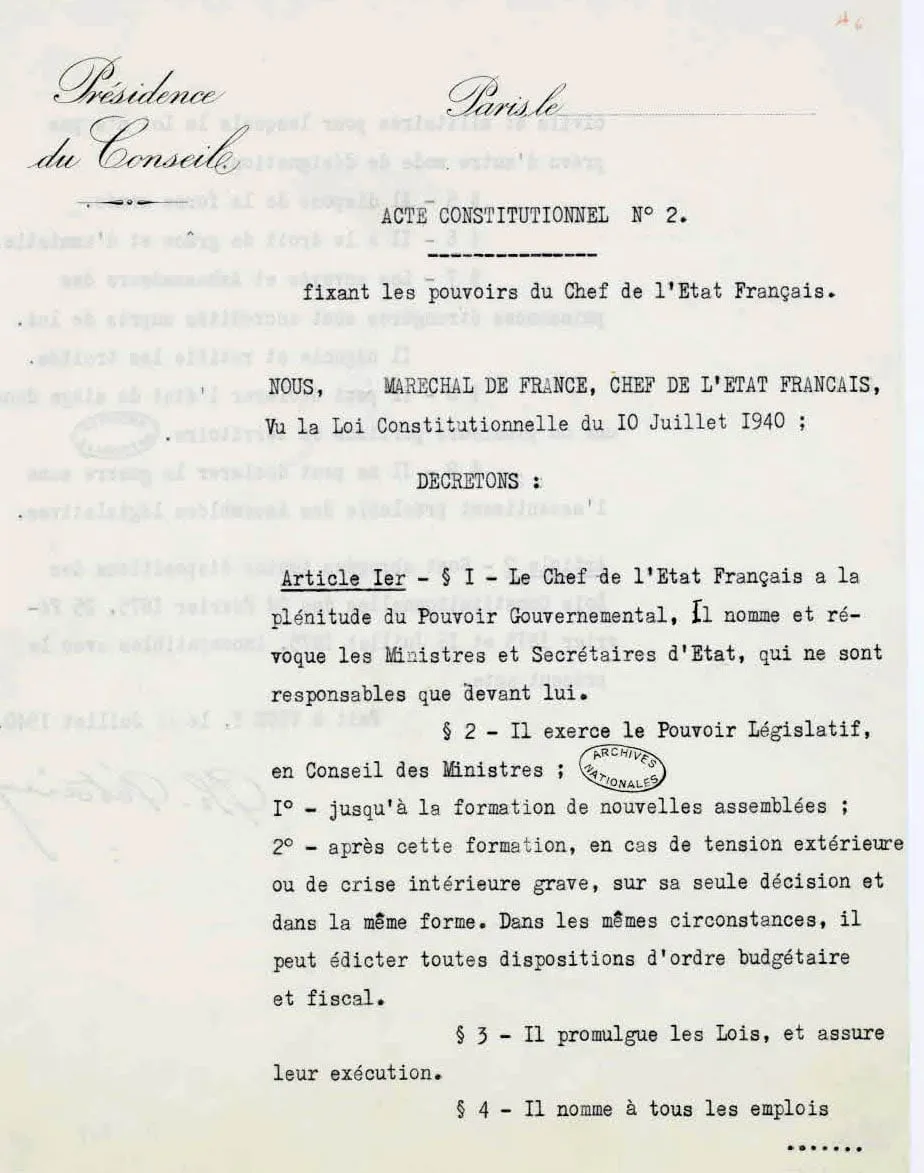
On 11 July the marshal promulgated three constitutional acts drafted by Alibert. The first opened with a formula not heard in France since the monarchy: “We, Philippe Pétain, Marshal of France, in view of the constitutional law of 10 July 1940, declare that we assume the functions of Head of the French State.” It repealed the article of the 1875 law on the election of the President of the Republic. The second act gave the head of state “the fullness of governmental power”: he appointed and dismissed ministers, who were responsible only to him, and exercised legislative power in the Council of Ministers. The third kept the Senate and the Chamber of Deputies in being until new assemblies were formed, but adjourned them “until further notice”, and only the head of state could convene them. The chambers never met again. According to an often-repeated anecdote, Pétain, reading through his new powers, remarked that he had more power than Louis XIV.
The word “Republic” disappeared from official documents. On 12 July Pétain, who also remained head of the government, appointed Laval Vice-President of the Council of Ministers and by a fourth constitutional act designated him as his successor. The same day the first government of the new regime was formed; alongside Laval it included, among others, General Maxime Weygand as Minister of Defence, Darlan as Minister of the Navy, Baudouin, Bouthillier, and Alibert as Minister of Justice. Lebrun did not resign because, as he said, there was no one to resign to. He was asked to leave the Pavillon Sévigné and went to stay with his son-in-law at Vizille. The motto “Liberty, Equality, Fraternity” was soon replaced by “Work, Family, Fatherland”, and the programme of national renewal was called the National Revolution.
The promised constitution was never produced. A draft was prepared in 1941 and Pétain signed it in 1944, but it was never promulgated or put to a vote. To the end the regime rested on successive constitutional acts, issued up to November 1942.
Place in the war
The events at Vichy closed the history of the Third Republic, which had lasted since 1870 and had won the First World War. Its place was taken by the authoritarian French State, formally independent and neutral, ruling the unoccupied zone, the colonial empire and the fleet, and, in the occupied zone, an administration subordinate to the German military authorities. Most states, including the United States and the USSR, maintained diplomatic relations with Vichy, which gave the regime an appearance of full legitimacy. Ranged against it in London stood General Charles de Gaulle, who since June had been calling for the fight to go on and whom a Vichy military court sentenced to death in absentia in August 1940. Thousands of Polish soldiers and refugees remained in the unoccupied zone, and their fate now depended on the new authorities.
The marshal’s regime did not wait for the occupier’s demands. As early as the autumn of 1940 it adopted the first Statute on Jews, and in October, after meeting Adolf Hitler at Montoire, Pétain announced a policy of collaboration. From 1942 the French police, directed by Laval’s men, arrested Jews who were then deported to the extermination camps. After the Allied landings in North Africa in November 1942 the Germans occupied the whole of France and Vichy became a mere façade, and in August 1944 the Germans carried Pétain and Laval off to Sigmaringen.
As early as April 1944 the Free French authorities in Algiers stripped the parliamentarians who had voted for full powers of the right to stand for office, and in August 1944 they declared the law of 10 July and all acts issued under it null and void from the outset. Many later returned to politics thanks to their record in the Resistance or to amnesties; one of them was René Coty, President of the Fourth Republic. De Gaulle called the Eighty who said “no” on 10 July the first of the Resistance on French soil. Not all of them deserved it, and not everyone who voted “yes” became a collaborator, but the vote in the Grand Casino has remained in France the symbol of the moment when the Republic gave itself away without a shot being fired.
Sources
Meanwhile
(04)Elsewhere, within a week.
- 1 July 1940 · Middle EastItalian air raids on PalestineIn July 1940 Italian bombers from Rhodes began attacking Haifa. The first raid, on 15 July, set oil tanks ablaze; the second, on 24 July, killed over forty.
- 3 July 1940 · MediterraneanThe attack on the French fleet at Mers-el-KébirOn 3 July 1940 the Royal Navy shelled the French squadron at Mers-el-Kébir near Oran. Nearly 1,300 sailors died, and Vichy broke off relations with London.
- 29 June 1940 · PolandThird deportation from the eastern landsOn the night of 28 to 29 June 1940 the NKVD began a third deportation from the Kresy. Those taken were mainly refugees from German-occupied Poland, mostly Jews.
- 29 June 1940 · Far EastArita proclaims a new order in East AsiaOn 29 June 1940 Foreign Minister Hachirō Arita declared on the radio that East Asia and the South Seas formed one sphere whose stability Japan guaranteed.
Related events
(04)The same battle, people or subject.
- 16 June 1940 · PoliticsPétain becomes Prime Minister of FranceOn 16 June 1940 at Bordeaux Reynaud resigned and President Lebrun entrusted the government to Marshal Pétain. That night France asked for an armistice.
- 18 June 1940 · PoliticsGeneral de Gaulle’s appealOn 18 June 1940 General de Gaulle urged the French on BBC radio to fight on. On 28 June London recognised him as leader of the Free French.
- 2 August 1940 · PoliticsDe Gaulle sentenced to deathOn 2 August 1940 a military court at Clermont-Ferrand sentenced General de Gaulle to death in absentia for treason, a month after Toulouse gave him four years.
- 10 June 1940 · PoliticsThe French government leaves ParisOn 10 June 1940 the French government left Paris for châteaux along the Loire. After talks with Churchill at Briare and Tours it reached Bordeaux on 14 June.