France
Philippe Leclerc
Commissioner General of Cameroon (1940), commander of the forces in Chad (1940–1942), commander of the 2nd Armoured Division (1943–1945), commander of the French Far East Expeditionary Corps (1945–1946), Marshal of France (posthumously, 1952)
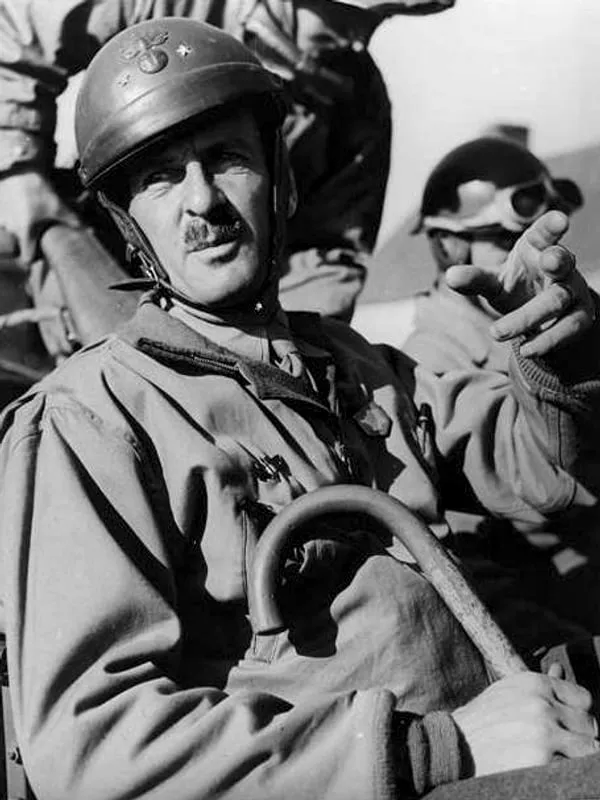
- Born:
- 22 November 1902, Belloy-Saint-Léonard (France)
- Died:
- 28 November 1947, near Colomb-Béchar (French Algeria)
- Author:
- Natalia
- Photo:
- Downey John, from the US Office of War Information, domena publiczna, Wikimedia Commons

Philippe de Hauteclocque, known to the whole world by his nom de guerre Leclerc, was in June 1940 a staff captain who twice escaped from the Germans and crossed defeated France by bicycle. Four years later, as a general, he accepted the surrender of the German garrison of Paris. In between he brought Cameroon over to Free France, captured the Italian oasis of Kufra in the Sahara, led a column across the desert from Chad to Tripoli and created the 2nd Armoured Division, the most famous French unit of the Second World War. For the French he became the symbol of an army that refused to accept the defeat of 1940. He was killed in an air crash in 1947, and five years later he was posthumously awarded the baton of a Marshal of France.
A nobleman from Picardy
Philippe François Marie de Hauteclocque was born on 22 November 1902 in the family château at Belloy-Saint-Léonard in the Somme department. He came from an old noble family from Artois whose members had served in the army for generations. Two of his uncles were killed in 1914. He was the fifth of the six children of Adrien de Hauteclocque and Marie-Thérèse, née Van der Cruisse de Waziers. Until the age of thirteen he was taught by his parents; he then attended a Catholic school in Amiens, which was evacuated to Poitiers during the First World War. All his life he was a devout Catholic.
In 1922 he entered the military academy of Saint-Cyr, graduating fifth in his year in 1924. He passed out first from the cavalry school at Saumur in 1925. On 10 August 1925 he married Thérèse de Gargan. They had six children. Their eldest son, Henri, was killed in Indochina in 1952.
Morocco and Saint-Cyr
His first posting was to the 5th Cuirassier Regiment in Trier, in the Rhineland, then under French occupation. A year later he transferred to the 8th Spahi Regiment in Morocco, where, after the Rif War, the “pacification” of the Moroccan mountains continued until the mid-1930s. In 1929 he took command of a goum, a unit of local soldiers under French officers. There he learned mobile warfare, the handling of small units and operations in difficult terrain, and he distinguished himself by his courage in combat.
From 1931 he was an instructor at Saint-Cyr. This tour was interrupted by a second spell in Morocco, where he was promoted to captain in 1934 and soon afterwards received the Legion of Honour. In 1938 he passed the entrance examination for the École supérieure de guerre, the staff college, from which he graduated top of his year in 1939. Like many officers from his background, he read the monarchist newspaper of Action Française and shared its sympathies. He broke with it in 1940, when Charles Maurras’s movement backed Marshal Philippe Pétain and collaboration with Germany. His biographers stress that he also shed the antisemitic prejudices of that milieu at the time.
Defeat and two escapes
In May 1940 Captain de Hauteclocque was head of the operations section on the staff of the 4th Infantry Division, which advanced into Belgium and then fell back under German pressure. During the Battle of France the division was encircled in the pocket around Lille. On 28 May, when surrender was a foregone conclusion, his commander gave him permission to try to get through the German lines. Hauteclocque set off south on an abandoned bicycle, disguised as a civilian. The next day he was stopped by a German patrol. He convinced the officer questioning him that he was a discharged soldier, a father of six suffering from malaria. The German let him go, reportedly adding that the Greater Reich would never allow France to rise again. Hauteclocque swam across a canal and reached the French lines.
He returned to the fighting in Champagne. On 15 June, at Magnant in the Aube department, he was wounded in the head when German tanks fired on the house he was in, and he was taken prisoner. Two days later, on 17 June, he escaped from the hospital in Avallon. That same day Pétain announced on the radio that the fighting must stop, and on 22 June the Armistice of Compiègne was signed. Hauteclocque had no intention of accepting it. He cycled to his wife and children, who had fled to the area around Libourne, and told them he was leaving to carry on the fight. To protect his family from reprisals, he obtained false papers in the name of Leclerc, a very common surname in his native Picardy. Travelling through Spain, where he was briefly detained by customs officers, he reached Lisbon on 17 July and from there sailed to Britain. On 25 July 1940 he reported in London to General Charles de Gaulle.
Cameroon and Gabon
De Gaulle immediately recognised him as a leader. On 31 July he made him a major and a few days later sent him to Africa. On 6 August Leclerc flew out of Britain with René Pleven and Captain Claude Hettier de Boislambert. His task was to bring over to Free France French Cameroon, a mandated territory wavering between London and Vichy. In Lagos, deciding that a major lacked the standing to address the High Commissioner and the commander of the troops, he promoted himself to colonel. On the night of 26–27 August he crossed by pirogue from British Cameroons to Douala with about twenty men and took the city without firing a shot, followed the next day by Yaoundé. This was how the Free French took over Cameroon. Leclerc became Commissioner General of Cameroon.
French Equatorial Africa rallied to de Gaulle almost in its entirety within a few days. Only Gabon held out. After the failed expedition to Dakar in September, de Gaulle arrived in Douala on 8 October and agreed to take Gabon by force. Leclerc directed the operation together with Major Marie-Pierre Kœnig. After fighting in which Frenchmen fired on Frenchmen, Libreville capitulated on 10 November and Port-Gentil on 12 November. The Battle of Gabon completed the creation of Free French Africa. De Gaulle confirmed Leclerc’s self-awarded rank of colonel and gave him command of the troops in Chad.
Kufra and the oath
Chad was the only Free French territory bordering an Axis state, Italian Libya. Leclerc decided to attack, even though more than a thousand kilometres of desert separated him from his objectives. On 11 January 1941 a small detachment of Chadian tirailleurs, together with the British Long Range Desert Group, raided the Italian base at the oasis of Murzuq. Lieutenant Colonel Jean Colonna d’Ornano, one of the men who had brought Chad over in August, was killed in the raid. The next objective was Kufra, in south-eastern Cyrenaica. Leclerc’s column – a few hundred men in lorries with a single 75 mm gun – besieged the Italian fort for several weeks. On 1 March 1941 the garrison surrendered.
In the courtyard of the captured fort Leclerc had his soldiers swear an oath: “Swear not to lay down your arms until our colours, our beautiful colours, fly over the cathedral of Strasbourg.” Militarily the victory was small, but it was one of the first Free French successes against the Axis and it attracted wide attention. Vichy retaliated: in June 1941 it stripped Leclerc of his citizenship, and on 11 October a court martial at Gannat sentenced him in absentia to death and the confiscation of his property, as it had de Gaulle a year earlier. In August 1941 de Gaulle made him a brigadier general.
From Chad to Tunis
In February and March 1942 Leclerc’s columns raided deep into the Italian Fezzan. A larger offensive had to wait, because Erwin Rommel had defeated the British at Gazala and advanced into Egypt. It began only at the end of 1942, after the victory at El Alamein and the Allied landings in North Africa. On 22 December 1942 some 4,000 African soldiers and 600 Europeans set out northwards from Chad. In January 1943 they took Sebha and Murzuq, and at the end of the month they reached Tripoli, which had already been taken by the British Eighth Army.
As Force L (after Leclerc’s name), his troops covered the left flank of the Eighth Army in Tunisia. At Ksar Ghilane in March 1943 they beat off an attack by a German battle group, and they then took part in outflanking the Mareth Line, the capture of Gabès and the advance on Kairouan. In May 1943 they paraded in Tunis among the British and American troops, rather than with the French Army of Africa of General Henri Giraud, which until recently had obeyed Vichy. Relations between the Gaullists and the “Africans” were poor, and for a time Giraud sent Leclerc’s units back to Libya.
The 2nd Armoured Division
On 25 May 1943 Leclerc became a major general. His Force L was renamed the 2nd Free French Division and, on 24 August 1943, the 2nd Armoured Division (2e DB). It was given American equipment and organisation. At Temara camp in Morocco Leclerc welded together veterans from Chad, escapees from France who had crossed the Pyrenees and soldiers of the former Army of Africa, among them Spanish Republicans. In April 1944 the division sailed for Britain as the only French division earmarked for the fighting in Normandy.
On 1 August 1944 the 2e DB landed on Utah Beach and joined the US Third Army of General George Patton. On 12 August it liberated Alençon, and it then fought on the southern flank of the Falaise Pocket. Leclerc pressed constantly to be allowed to move on Paris, where an uprising had broken out on 19 August. General Omar Bradley gave his consent on 22 August. On the evening of 24 August the division’s first vehicles, Captain Raymond Dronne’s company, reached the Hôtel de Ville. On 25 August, at the Prefecture of Police, Leclerc accepted the surrender of General Dietrich von Choltitz and signed the instrument of surrender with him; at Montparnasse station it was countersigned by the leader of the uprising, the communist Henri Rol-Tanguy. The next day Leclerc walked beside de Gaulle in the procession down the Champs-Élysées. Paris, occupied by the Germans on 14 June 1940, was free.
In September the division destroyed a German panzer brigade at Dompaire in Lorraine. On 23 November 1944, after a rapid passage through the passes of the Vosges, it entered Strasbourg. The French flag was raised over the cathedral. The oath of Kufra had been fulfilled. In the winter the division fought in the Colmar Pocket, and some of its units took part in the capture of the German stronghold of Royan on the Atlantic coast. Leclerc chafed at being subordinated to the French First Army of General Jean de Lattre de Tassigny and preferred to serve under the Americans.
Berchtesgaden and the Bad Reichenhall affair
In the last days of the war soldiers of the 2e DB saw the liberated camp at Dachau, and on 4–5 May 1945 they reached Berchtesgaden, site of Adolf Hitler’s Alpine residence. The French and the Americans still argue over who was first into the “Eagle’s Nest”.
A dark episode is linked to those days. The Americans handed over to the division twelve captured Frenchmen of the Waffen-SS, most of them from the Charlemagne Division. On 6 May Leclerc spoke to them at Bad Reichenhall. According to accounts, he asked one of them whether he was not ashamed to wear a German uniform, and the man replied that the general was wearing an American one. Leclerc is then said to have snapped: “Get these men out of my sight.” On 7 or 8 May the prisoners were shot without trial. Who gave the order has never been established. Leclerc’s biographer Jean-Christophe Notin believes it is impossible to determine whether the order came from the general himself or whether someone on his staff took his words as an instruction to carry out an execution.
Indochina
On 22 June 1945 Leclerc took leave of his division and assumed command of the French Far East Expeditionary Corps. French Indochina had been progressively occupied by the Japanese since 1940, and in March 1945 they had destroyed the French administration. On 2 September 1945, aboard the battleship USS Missouri in Tokyo Bay, Leclerc signed the instrument of Japan’s surrender on behalf of France. That same day in Hanoi Hồ Chí Minh proclaimed the independence of Vietnam.
Under the Potsdam decisions the north of Indochina was occupied by the Chinese and the south by the British, so the French could return only in October. Between October 1945 and early 1946 Leclerc’s troops took control of Cochinchina and southern Annam. Leclerc quickly realised that the country could not be regained by force alone. He supported the agreement of 6 March 1946, under which France recognised Vietnam as a “free state” within the French Union, and on 18 March he entered Hanoi. He held talks with Hồ Chí Minh and argued for a political solution, which brought him into conflict with the High Commissioner, Admiral Georges Thierry d’Argenlieu. In July 1946 he returned to France. When the First Indochina War broke out at the end of the year, he went back to Indochina on a government mission, but declined the post he was offered.
Death and memory
In July 1946 he was promoted to general of the army and became Inspector of Land Forces in North Africa. As early as November 1945 he had received permission to add his wartime pseudonym officially to his surname. On 28 November 1947, during a tour of inspection, his B-25 Mitchell crashed in a sandstorm near Colomb-Béchar (today Béchar) in Algeria. Twelve people on board were killed. The death of so popular a commander gave rise to rumours of assassination, but no evidence of foul play has ever been found. Researchers point rather to the poor condition and modifications of the aircraft and to the general’s habit of ordering flights in bad weather. He was buried in the crypt of Les Invalides. On 23 August 1952 he was posthumously made a Marshal of France.
Leclerc is one of the few French heroes of the Second World War who is not the subject of major political controversy. In 1940, when most officers chose obedience to Vichy, he chose rebellion for the sake of continuing the fight. He also showed that Free France was not merely a London affair: its first victories were won largely by African soldiers from Chad and Cameroon, led by a cavalryman who had learned his trade in Morocco. Dozens of streets and squares in France bear his name, as does the French main battle tank.
Sources
Commanded in battles
(01)Mentioned in battles
(06)Often appears with
People who appear in the same events.
On the timeline
(22)1940
1941
1943
1944
1945
January
September
- 02
- Key eventThe Japanese surrender on the “Missouri”On 2 September 1945, in Tokyo Bay, Japan signed the instrument of unconditional surrender aboard USS Missouri. The Second World War was over.
- The Vietnamese Declaration of IndependenceOn 2 September 1945, in Ba Đình Square in Hanoi, Hồ Chí Minh proclaimed the independence of the Democratic Republic of Vietnam, quoting the US Declaration.