France
Marie-Pierre Koenig
Commander of the 1st Free French Brigade (1941–1942), commander of the French Forces of the Interior (1944), military governor of Paris (1944–1945), commander-in-chief in the French occupation zone of Germany (1945–1949), Minister of Defence (1954, 1955), Marshal of France (posthumously, 1984)
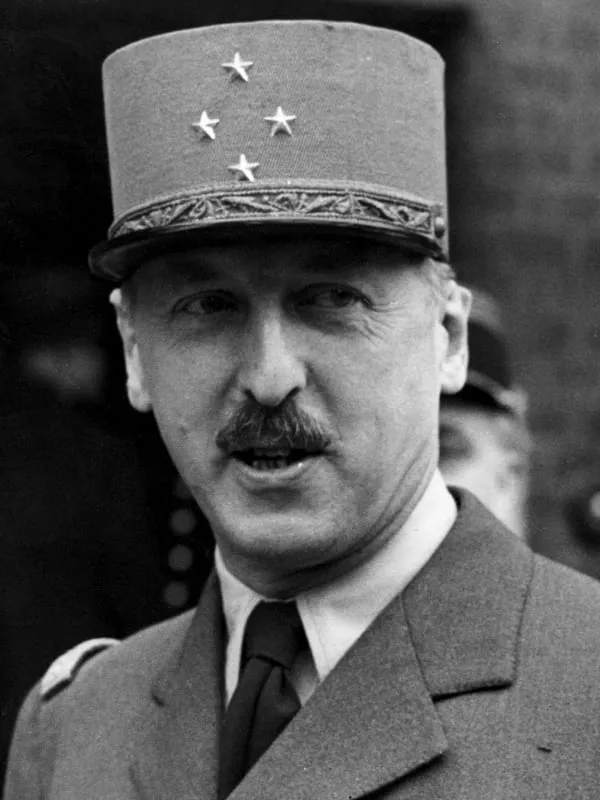
- Born:
- 10 October 1898, Caen (France)
- Died:
- 2 September 1970, Neuilly-sur-Seine (France)
- Author:
- Natalia
- Photo:
- Hulton Archive, domena publiczna, Wikimedia Commons

Pierre Koenig, often referred to as Marie-Pierre Koenig, was in June 1940 a 42-year-old captain of the Foreign Legion and one of the first professional officers to sail to England after the fall of France to fight on alongside General Charles de Gaulle. In November 1940 he led legionnaires in the landing near Libreville, in a campaign in which Frenchmen fought Frenchmen. He won fame in 1942, when his 1st Free French Brigade held the position of Bir Hakeim in the Libyan desert for two weeks against Erwin Rommel’s forces and then broke out of the encirclement by night. For France it was the first battle since 1940 of which she could be proud. In 1944 he commanded the French Resistance placed under Allied command, and after the war he governed the French occupation zone of Germany for four years. He died in 1970, and in 1984 he was posthumously given the baton of a Marshal of France.
The son of an organ builder from Caen
Marie Joseph Pierre François Koenig was born on 10 October 1898 in Caen in Normandy. The family came from eastern France: his father, Joseph Koenig, born in Luxeuil-les-Bains, was an organ builder who had trained under the famous Aristide Cavaillé-Coll; his mother, Ernestine, née Mutin, came from the Jura and kept a flower shop. The boy was educated at the Catholic Collège Saint-Joseph and then at the Lycée Malherbe in Caen.
The war found him still at school. In 1917, immediately after his baccalauréat, he enlisted and was posted to the 36th Infantry Regiment. After an officers’ course at Issoudun he became an officer cadet (aspirant) in February 1918 and went to the front. He fought in the battles of the last year of the war, in Flanders and on the Matz, the Oise and the Ailette. He received the Médaille militaire, rarely awarded to officers, and the Croix de Guerre, and on 3 September 1918 he was promoted to second lieutenant.
Professional soldier
After the war he stayed in the army. From 1919 to 1922 he served with the 15th Battalion of Chasseurs Alpins in Upper Silesia, in the inter-Allied force that kept order during the plebiscite and the Silesian Uprisings. He then served in the Alps and, until 1929, as an intelligence officer with the troops occupying the Rhineland. He thus knew Germany at close quarters, which proved useful twenty years later. In 1931 he went to French Morocco, where he commanded a company of the 4th Foreign Infantry Regiment in the fighting against the tribes of the Atlas, the last operations of the so-called pacification of Morocco. In 1932 he was promoted to captain. He went on to serve on the staff of the division at Marrakesh and on that of General Georges Catroux. He spent most of the 1930s in the Foreign Legion. In 1931 he married Marie Klein.
Norway and the road to London
When war broke out in 1939 Koenig returned from Africa to France and joined Lieutenant Colonel Raoul Magrin-Vernerey’s 13th Demi-Brigade of the Foreign Legion, formed with mountain and winter warfare in mind, originally to help Finland. In the spring of 1940 he took part in the Norwegian campaign. His biographers associate him with the 13th Demi-Brigade’s fighting at Narvik, while his Order of Liberation biography states that he was at that time attached to General Audet’s force landing at Namsos. For Norway he later received the Norwegian War Cross with Swords.
The demi-brigade returned to Brittany in mid-June, when the Battle of France was already lost. On 19 June, the day after de Gaulle’s appeal, Koenig sailed with a group of officers and legionnaires of the 13th Demi-Brigade from the coast near Saint-Jacut-de-la-Mer, reaching England on 21 June. When the legionnaires in the camps in Britain had to choose between returning to Morocco and following de Gaulle, many of them, including some of the officers, chose to go back. Koenig, like Magrin-Vernerey, who took the nom de guerre Monclar, stayed in London. De Gaulle made him a major (chef de bataillon). Koenig became one of the pillars of the still tiny Free French Forces.
Dakar and Gabon
At the end of August 1940 a battalion of legionnaires including Koenig sailed with de Gaulle and the British on the expedition to Dakar. No landing took place: after three days of bombardment the Vichy defences forced the fleet to withdraw, and de Gaulle’s troops sailed on to Cameroon, which had gone over to Free France in August. In November Koenig set out from Douala for Gabon, the last colony in French Equatorial Africa still loyal to Vichy.
In the Gabon campaign he commanded a landing group made up of a battalion of the 13th Demi-Brigade, a motorcycle platoon and supporting units, whose task was to take Libreville from the sea. On 8 November his men went ashore from the ships Casamance and Nevada II on the shore of Mondah Bay, north of the town. The next day, together with tirailleurs from Cameroon, they pushed through forest and swamp to Libreville airfield and took it after a day’s fighting, outflanking the defenders’ positions from the beach. That evening General Marcel Têtu accepted the terms of surrender, and on 10 November the legionnaires entered the town. It was a bitter victory: Frenchmen fought on both sides, and on the Vichy side there were soldiers with whom the legionnaires had served in the same army only a few months before. A few days later the whole colony was in Free French hands. In December 1940 Koenig, by now a lieutenant colonel, became military commander of Cameroon.
Syria
In the spring of 1941, having recovered from an illness, Koenig became chief of staff to General Paul Legentilhomme, commander of the Free French division that in June 1941 entered Syria and Lebanon, mandates ruled by Vichy, together with the British (Operation Exporter). Once again Frenchmen fought Frenchmen, this time in a bloody campaign lasting several weeks. After the Armistice of Saint-Jean-d’Acre in July 1941, Koenig represented Free France on the armistice commission. In July 1941 de Gaulle promoted him to brigadier general. On 3 December 1941 a Vichy court martial in Oran sentenced him to death in absentia, as it had earlier sentenced de Gaulle, Larminat and Leclerc.
Bir Hakeim
At the end of 1941 Koenig took command of the 1st Free French Brigade, some 3,700 men strong: legionnaires, a battalion of marine infantry, battalions from Africa and the Pacific, artillery and engineers. The brigade fought in Libya alongside the British Eighth Army, around the turn of 1941 and 1942 at the Halfaya Pass, and in February 1942 it took up positions at the wells of Bir Hakeim, at the southern end of the British defensive line at Gazala. The position lay in open desert, surrounded by minefields and gun pits.
On 26 May 1942 Rommel opened his offensive at Gazala. His plan assumed that Bir Hakeim would fall within hours. The first assault, by the Italian Ariete Armoured Division, broke down on the mines and under the fire of the French anti-tank guns. Then came further attacks by Italians and Germans, raids by dive bombers and artillery bombardment, while water and ammunition ran short. Rommel called on Koenig to surrender, but the French did not give in. De Gaulle sent him a message by radio: “Know, and tell your troops, that the whole of France is watching you and that you are her pride.”
After fourteen days, when the British command judged that the position had served its purpose, Koenig was ordered to withdraw. On the night of 10–11 June the brigade broke out through the minefields and the ring of encirclement. Koenig rode in a car driven by an Englishwoman, Susan Travers, who later became the only woman ever to serve formally in the Foreign Legion. About three-quarters of the defenders reached the British lines. For the Battle of Bir Hakeim Koenig was made a Companion of the Order of Liberation. Militarily, the defence delayed Rommel and helped the Eighth Army to withdraw into Egypt. Politically it meant more: after the defeat of 1940 and the fratricidal fighting in Africa and Syria, it showed the British, the Americans and the French themselves that de Gaulle’s soldiers could fight the Germans. According to some accounts, Koenig allowed a unit of Jewish sappers from Palestine who fought at Bir Hakeim to fly their own flag bearing the Star of David, contrary to British regulations. His later attachment to the Jewish cause and to Israel was traced back to those days.
From El Alamein to Algiers
In the autumn of 1942 Koenig fought in the Second Battle of El Alamein as deputy to General Edgard de Larminat, commander of the Free French forces in the Middle East. During the Tunisian campaign in the spring of 1943 he was promoted to major general and took command of the 1st Free French Division. After the Axis defeat in Africa de Gaulle moved to Algiers, where the French Committee of National Liberation was set up. On 1 August 1943 Koenig became deputy chief of staff of the army and took on one of the hardest tasks of the period: merging the Gaullist Free French with General Henri Giraud’s Army of Africa, whose officers had for the most part served Vichy until November 1942 – among them men he had fought against in Gabon and Syria.
Commander of the Resistance
In March 1944 de Gaulle sent Koenig to London as his delegate to General Dwight Eisenhower, Supreme Commander of the Allied forces preparing the invasion of France. Koenig commanded the French forces in Britain and was placed at the head of the French Forces of the Interior (FFI), which brought together the various Resistance organisations in France. His staff was to coordinate with the Allied services the arms drops, the sabotage of railways and communications, and the operations of the partisans during the Normandy landings and the landings in Provence. The task was partly political: de Gaulle wanted the Resistance, in which the Communists were strong, to be subordinate to a single command loyal to his government, and the Allies to recognise the FFI as part of the French army. Koenig’s efforts had limited success, since many groups fought on their own account, but the sabotage of June 1944 seriously hampered the Germans in moving reinforcements to Normandy.
On 14 June 1944 Koenig accompanied de Gaulle to Bayeux, the first liberated French town the general visited. On 28 June he was promoted to lieutenant general (général de corps d’armée). In August, when Paris rose and the tanks of Leclerc’s 2nd Armoured Division entered the city, de Gaulle appointed Koenig military governor of Paris. His task was to restore order in a city where armed Resistance units operated alongside the army and summary justice was being meted out to collaborators. On 26 April 1945, at Vallorbe on the Swiss border, he took Marshal Philippe Pétain into custody from the Swiss; Pétain had returned from Germany to France via Switzerland to stand trial. The very Vichy government that Pétain had headed had sentenced Koenig to death three and a half years earlier.
Ruler of an occupation zone
In July 1945 Koenig became commander-in-chief of the French forces in Germany and de facto ruler of the French occupation zone, as well as France’s representative on the Allied Control Council in Berlin. In May 1946 he was promoted to général d’armée. He pursued a policy in line with that of Paris, which wanted Germany weak and divided: France separated the Saar coalfield from the rest of the country, exploited the zone’s resources to rebuild its own economy and long resisted the creation of common German authorities. On the Control Council Koenig repeatedly blocked plans for central German administrative agencies. In September 1949, when the Federal Republic of Germany came into being and military government was replaced by the French High Commissioner, André François-Poncet, Koenig left Germany. He became inspector general of the armed forces in North Africa and vice-president of the Supreme War Council, and in 1950 a member of the Academy of Moral and Political Sciences.
Politician
In 1951 Koenig retired from active service and entered politics as a Gaullist. He headed the list of de Gaulle’s Rally of the French People (RPF) in the Bas-Rhin department, won a seat in the National Assembly and chaired its national defence committee. He opposed the plan for a European Defence Community, which was to merge the armies of Western Europe, including that of West Germany. He was Minister of Defence in the government of Pierre Mendès France from June to August 1954, as France was ending its war in Indochina, and again in the government of Edgar Faure from February to October 1955. As president of the France–Israel Committee he supported the rapprochement between France and Israel, which in the mid-1950s led to deliveries of French arms to the Jewish state. In 1956 he was re-elected to parliament. After de Gaulle’s return to power in 1958 he was sidelined. The general forgave him neither his part in the governments of the Fourth Republic nor his public commitment to Israel. Koenig withdrew from politics.
Death and memory
Marie-Pierre Koenig died on 2 September 1970 at the American Hospital in Neuilly-sur-Seine, two months before de Gaulle. He was buried in a modest grave in Montmartre Cemetery. On 6 June 1984, the fortieth anniversary of the Normandy landings, President François Mitterrand posthumously conferred on him the dignity of Marshal of France. He is, to date, the last Frenchman to have received it, after de Lattre de Tassigny, Juin and Leclerc. Among his many foreign decorations was the Commander’s Cross of the Virtuti Militari, Poland’s highest military order, conferred on him in 1946 by Poland’s Communist authorities. Streets bear his name in almost every major town in France, as well as in Jerusalem and Netanya.
In the history of France’s path through the Second World War, Koenig is a symbolic figure. He belonged to the small group of professional officers who chose de Gaulle in June 1940, and he went the whole way with him: from the fratricidal fighting against Vichy in Equatorial Africa and Syria, through Bir Hakeim, where the Free French first stood in a major battle against the Germans in this war, to liberated Paris and occupied Germany. Bir Hakeim, whose name is borne today by a bridge over the Seine and a Paris Métro station, became for the French proof that the army defeated in 1940 had not stopped fighting.
Sources
Commanded in battles
(02)Mentioned in battles
(03)Often appears with
People who appear in the same events.