Battles of Narvik
- Dates:
- 9 April – 8 June 1940
- Front:
- Scandinavia
- Location:
- Narvik and the Ofotfjord with its arms (Herjangsfjord, Rombaksfjord, Beisfjord), the Vestfjorden, the Harstad area on the island of Hinnøya, Gratangen, the Ankenes peninsula and the mountains along the Swedish border near Bjørnfjell (northern Norway)On the battle map →
- Sides:
- United KingdomWilliam Boyle, Pierse Mackesy, Claude Auchinleck, Bernard Warburton-Lee, William WhitworthNorwayCarl Gustav FleischerFranceAntoine BéthouartPolandZygmunt Bohusz-SzyszkoNazi GermanyEduard Dietl, Friedrich Bonte
- Result:
- German victory. In April the Royal Navy destroyed ten German destroyers, and the Allies retook Narvik on 28 May, but after the defeats in France they evacuated by 8 June.
- Author:
- Natalia
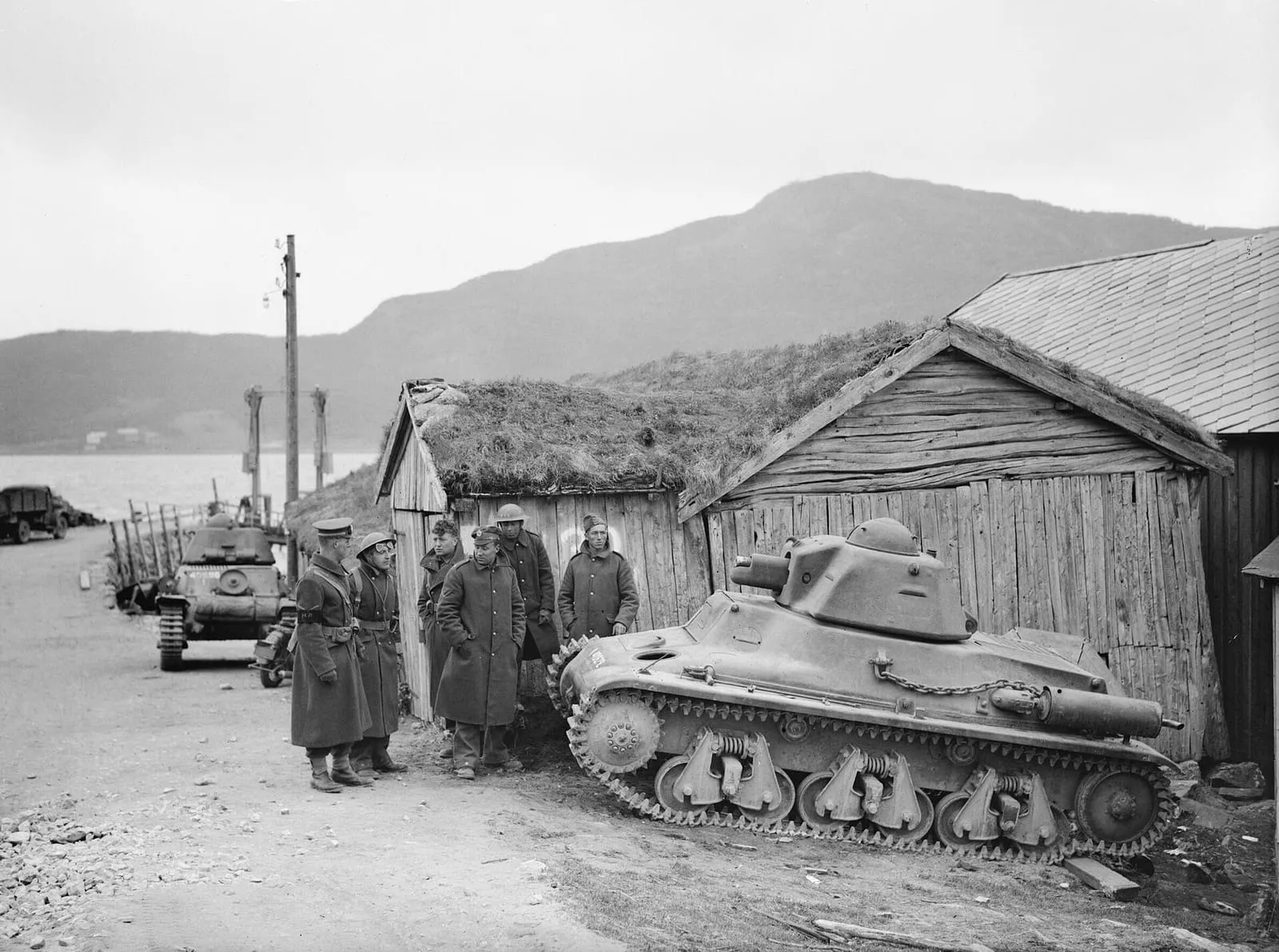
The battles of Narvik were the longest and largest operation of the Norwegian campaign of 1940, and the only front of that campaign on which the Germans stood for several weeks on the brink of defeat. On the morning of 9 April 1940 ten German destroyers under Commodore Friedrich Bonte landed some two thousand mountain troops of General Eduard Dietl at Narvik. The port, through which Swedish iron ore was shipped to the Reich in winter, fell into German hands with hardly any fighting on land, but the ships that had captured it never left. On 10 and 13 April the British fleet fought two battles in the fjords in which the Kriegsmarine lost all ten destroyers – half of all the ships of that class at its disposal. Then, for six weeks, in the snow and on the rocks around the Ofotfjord, the Norwegians of General Carl Gustav Fleischer, the British, French Chasseurs Alpins and legionnaires, and Polish Podhale riflemen pushed the Germans back towards the Swedish border. On 28 May the Allies recaptured Narvik, the first Allied land victory over the Wehrmacht in the war. By then, however, there was no one left to hold it: the German armies stood on the Channel, and London and Paris had known for several days that Norway would have to be abandoned. By 8 June the Allied troops had sailed away, and Dietl returned to the deserted town.
Name and dates
Polish works speak of the battle for Narvik or the fighting at Narvik, the Norwegians of the battles for Narvik (kampene om Narvik), the Germans of the battle of Narvik (Schlacht um Narvik), and the British often, in the plural, of the Battles of Narvik. The plural makes sense, because the name covers very different events: the German landing on 9 April, the two naval battles in the Ofotfjord on 10 and 13 April, often described separately as the naval battles of Narvik, and a two-month land campaign in the mountains of Nordland and Troms.
Most accounts date the battle from 9 April to 8 June 1940. The first date is the day of the German landing; the second is the last day of the Allied evacuation, when the last transports left the Narvik area and German units began to return to the town (some sources say they reoccupied it on 9 June). The Norwegians fought on for one day more: their 6th Division ceased fire at midnight on 9/10 June, and on 10 June an agreement on the capitulation of the Norwegian forces on this front was signed at Bjørnfjell. In some chronologies the first naval battle appears under 11 April. In fact the British destroyers entered the harbour at dawn on 10 April, as British, German and Norwegian sources all confirm.
Background
Ore and the railway
Narvik lies deep within the Ofotfjord, about a hundred nautical miles from the open sea, beyond the broad Vestfjorden that separates the mainland from the Lofoten Islands. It was a railway town and port built at the beginning of the 20th century for a single cargo: iron ore from Kiruna in Swedish Lapland. The Ofotbanen line ran from the port to the Swedish border at Bjørnfjell and on to the mines. In summer the ore was shipped out through Luleå on the Gulf of Bothnia, but in winter the gulf froze, while Narvik, warmed by the Gulf Stream, stayed free of ice. From there the ore ships sailed south within the belt of Norwegian territorial waters, where, as neutral waters, they could not be stopped by the Royal Navy.
Both sides were aware of the importance of this route. In October 1939 Grand Admiral Erich Raeder warned Hitler that the British might seize Norwegian ports and cut Germany off from the Atlantic and the ore. On the Allied side it was above all the First Lord of the Admiralty, Winston Churchill, who had his eye on Narvik. The Winter War gave him a pretext: on 5 February 1940 the Supreme War Council adopted a plan for an expedition to help Finland, which was to land at Narvik and travel by rail through the Swedish mines. The plan also included a Polish mountain brigade then being formed in France. The Moscow Peace Treaty of 12 March made the expedition pointless, but the Allies returned to the idea of mining Norwegian waters. Operation Wilfred got under way on 8 April, and landings at Narvik and in the ports of southern Norway were prepared in case of a German reaction. When, however, reports arrived on 7 and 8 April of German warships heading north, the Admiralty concluded that the Germans were trying to break out into the Atlantic and ordered the troops to be disembarked from the cruisers so that every ship would be available for battle at sea. That decision weighed on the whole campaign.
Weserübung and Group “Narvik”
The Germans had been preparing their operation since January, and the directive of 1 March gave it its final shape. Narvik was the most distant and most important objective of the entire undertaking, because it was there that the ore was at stake. Given the distance, more than a thousand nautical miles from Germany, the landing was entrusted to the fastest ships the Kriegsmarine could spare: ten destroyers of the Type 1934A and Type 1936 classes. On board were the 139th Mountain Infantry Regiment of the 3rd Mountain Division, with the divisional staff and several smaller units, some 1,900–2,000 men in all. They were commanded by the divisional commander, the Bavarian Eduard Dietl, a Generalleutnant and an old comrade of Hitler’s from his Munich years. The plan assumed that on the evening of 9 April the destroyers would refuel from two waiting tankers and return to Germany before the British fleet could close their route home.
The group sailed from Wesermünde (Bremerhaven) during the night of 6/7 April, covered by the battleships Scharnhorst and Gneisenau. A gale in the North Sea washed several soldiers and some equipment overboard. On 8 April the British destroyer Glowworm ran into the ships of the group bound for Trondheim and was lost ramming the cruiser Admiral Hipper, while the battlecruiser Renown, covering the minelaying in the Vestfjorden, was drawn away with her destroyers from the entrance to the fjord. The way to Narvik was open.
Course of the battle
9 April: the Germans at Narvik
During the night, in a snowstorm, Bonte’s destroyers entered the Vestfjorden and the Ofotfjord. They stopped Norwegian patrol boats, but one of them managed to alert the harbour defences. Some of the ships turned off into the Herjangsfjord to land troops at the mobilisation depot of a Norwegian regiment at Elvegårdsmoen near Bjerkvik; others searched the entrance to the fjord for coastal batteries which, as it turned out, did not exist. Three destroyers, including the flagship Wilhelm Heidkamp, approached Narvik.
The harbour was guarded by two old coastal defence ships dating from 1900, Eidsvold and Norge. At about 4.15 a.m. Eidsvold fired a warning shot. The Germans, who had orders to occupy Norway without fighting wherever possible, sent an envoy on board. Captain Odd Isaachsen Willoch, after consulting the captain of Norge, Per Askim, refused to give up his ship. As the German officer pulled away he fired a red flare, and Wilhelm Heidkamp launched her torpedoes. Eidsvold was torn apart by a magazine explosion. About 175 sailors were killed; only a handful survived. A quarter of an hour or so later Norge opened fire on the destroyer Bernd von Arnim, but in the driving snow her shots went wide. The German ship hit her with torpedoes and the coastal defence ship sank in less than a minute, taking 101 men with her. Nearly 280 Norwegians thus died on the two ships – more than in any other engagement in Norway that day.
On land the Germans met with almost no resistance. The garrison commander, Colonel Konrad Sundlo, a sympathiser of Quisling’s party, agreed to talks and surrendered the town. Some of the Norwegian soldiers withdrew along the railway towards the border, and his deputy received orders to arrest Sundlo, but by then it was too late. At Elvegårdsmoen the Germans captured stores containing several thousand rifles, more than three hundred machine guns and equipment that would soon be used to arm the survivors of the sunken ships. Several dozen ore carriers lay in the harbour, among them British, Swedish, Norwegian and German ships. The plan for the destroyers’ return, however, failed at once: of the two tankers, only Jan Wellem reached Narvik, and refuelling ten ships from a single vessel with makeshift pumps was going to take a day and a half.
10 April: Warburton-Lee’s attack
From press reports the Admiralty knew of one German ship at Narvik, and sent against it the 2nd Destroyer Flotilla under Captain Bernard Warburton-Lee: the flotilla leader Hardy together with Hunter, Havock, Hotspur and Hostile. On the afternoon of 9 April Warburton-Lee learnt from Norwegians at Tranøy that there were four to six destroyers and a submarine in the harbour. He signalled that he would attack “at dawn, high water”, and the Admiralty left the decision to him.
At about 4.30 a.m. on 10 April, in a snowstorm, the British ships entered the harbour unobserved. In the first attack they torpedoed and sank Wilhelm Heidkamp, on which Commodore Bonte was killed, and Anton Schmitt, badly damaged Diether von Roeder and more lightly two other destroyers, and also sank several merchant ships. Warburton-Lee turned back for further runs along the harbour, and as his flotilla made for the mouth of the fjord it was intercepted by five German destroyers that had been lying in the side arms: three from the Herjangsfjord under Fregattenkapitän Erich Bey and two from Ballangen bay. In a brief, ferocious exchange of fire Hardy was wrecked and beached, Warburton-Lee was mortally wounded, Hunter sank and Hotspur was badly damaged. The German ships, short of fuel and with little ammunition left, did not pursue the remaining British destroyers. On their way out these also sank the ammunition ship Rauenfels, which was carrying heavy weapons and ammunition for Dietl. Warburton-Lee was awarded a posthumous Victoria Cross, one of the first of the war, and Bonte a posthumous Knight’s Cross.
13 April: Warspite in the Ofotfjord
The remaining eight German destroyers were trapped at Narvik: some damaged, all short of fuel, while British cruisers now guarded the exit from the Vestfjorden. An attempt to break out on the night of 10 April ended with the ships turning back on sighting the enemy. On 13 April a force under Vice-Admiral William Whitworth entered the fjord: the battleship Warspite and nine destroyers, supported by aircraft from the carrier Furious. The battleship’s Swordfish floatplane spotted the submarine U-64 in the Herjangsfjord and sank her with bombs. It was the first U-boat of the war to be sunk by an aircraft.
In a battle lasting several hours the British destroyers and Warspite’s guns destroyed three German destroyers, and the crews of the other five, out of ammunition and fuel, scuttled their own ships – in the harbour, in the Herjangsfjord and in the narrow Rombaksfjord, where Bey had withdrawn the last of them. The British lost no ships, but Eskimo had her bow blown off by a German torpedo, and Punjabi and Cossack were damaged. German submarines, which attacked Warspite and her escort several times, hit nothing because of faulty torpedo pistols, a defect that the Norwegian campaign exposed on a large scale.
The outcome of the two battles was disastrous for the Kriegsmarine: ten modern destroyers, half of its strength in that class, and a submarine. Whitworth reported, however, that Narvik could have been taken at once had even a small landing force been at hand. There was none, and the Germans gained some 2,600 shipwrecked sailors, from whom Dietl formed an improvised naval regiment under Fregattenkapitän Fritz Berger, armed with Norwegian weapons from Elvegårdsmoen and with anti-aircraft guns taken off the wrecks.
Crisis in Berlin and the landing at Harstad
The destruction of the destroyers cut Dietl off from supply by sea. According to the diary of General Alfred Jodl, in mid-April Hitler was close to breaking down and wanted to order Group “Narvik” to cross into Sweden and accept internment. Officers of the OKW staff managed to hold back the order, and Dietl was instructed to hold out for as long as possible. The Luftwaffe began dropping supplies to him, and Sweden let a small group of specialists through by rail, officially as medical personnel.
The British failed to seize the moment. The first units of the expedition that before 9 April had been meant to take Narvik unopposed landed on 14 and 15 April at Harstad on the island of Hinnøya, several dozen kilometres north of Narvik. This was the 24th Guards Brigade: battalions of the Scots Guards and Irish Guards and a battalion of the South Wales Borderers. At sea the commander was Admiral of the Fleet Lord Cork (William Boyle, 12th Earl of Cork and Orrery); on land, Major General Pierse Mackesy. The two had received contradictory instructions in London. Lord Cork, backed by Churchill, wanted an immediate landing at the town. Mackesy, whose troops had arrived without artillery, landing craft, skis or aircraft, in waist-deep snow, considered such an attack suicidal and preferred a slow approach along both sides of the fjord. On 21 April Lord Cork was given authority over the whole force, but he did not win the general over. On 24 April Warspite and the cruisers bombarded Narvik in the hope that the Germans would surrender. They did not, and no landing followed.
The Norwegians in the north
The first weeks of the land fighting were borne by the Norwegians. The commander of the 6th Division, Major General Carl Gustav Fleischer, who after 9 April took command of all Norwegian forces in the north, ordered mobilisation and assembled 8,000 to 10,000 men, though he had to leave part of his strength in eastern Finnmark in case of a move by the USSR. His soldiers, trained during their winter service on the Finnish border and superb on skis, were the only troops on the Allied side prepared for war in an Arctic winter. The first attempts ended in failure. A group of Norwegian soldiers who had escaped from Narvik and blocked the railway was taken by surprise at Bjørnfjell. During the night of 24/25 April at Gratangen a German counter-attack routed a resting battalion of the 12th Infantry Regiment. According to Norwegian figures 34 soldiers were killed, 64 wounded and about 130 taken prisoner. Even so, the Germans had to withdraw from Gratangen, and in May the Norwegians slowly pushed them back towards Narvik and the railway.
The French and the Poles
On 28 April units of the French Expeditionary Corps in Scandinavia began landing in the Narvik area. They were commanded by Brigadier General Antoine Béthouart, a specialist in mountain warfare: first the 27th Demi-Brigade of Chasseurs Alpins, and then, on 6 May, two battalions of the 13th Demi-Brigade of the Foreign Legion. On 9 May the Independent Podhale Rifles Brigade of Brigadier General Zygmunt Bohusz-Szyszko arrived at Harstad: four battalions, nearly 4,800 men in all. The brigade had been formed in France during the winter with an expedition to Finland in mind, and its dispatch to Norway gave the Commander-in-Chief, General Władysław Sikorski, and the government-in-exile an opportunity, after the defeat of September, to show the Polish soldier fighting the Germans once again. Polish naval forces had been on the spot earlier: the destroyers Grom, Burza and Błyskawica shelled German positions, and on 4 May a German bomber sank Grom in the Rombaksfjord. Fifty-nine sailors were killed.
On 10 May Germany attacked France and the Low Countries, and in London the government of Neville Chamberlain, weakened precisely by the failures in Norway, fell. Churchill became Prime Minister.
Bjerkvik, 13 May
Béthouart, with Lord Cork’s support, pushed through the landing that Mackesy had shied away from. Around midnight on 12/13 May British warships, among them the battleship Resolution, bombarded Bjerkvik at the head of the Herjangsfjord, and landing craft put ashore legionnaires with a few Hotchkiss light tanks. It is regarded as the first opposed landing of the war to include tanks. After fighting in the burning village the legionnaires took Bjerkvik and then the camp at Elvegårdsmoen, where they freed Norwegian prisoners. A dozen or so local inhabitants were killed in the bombardment. Chasseurs Alpins and Norwegians advanced from the north, and two Polish battalions approached from the west, though the difficult terrain prevented them from arriving in time. The encirclement was not closed, and the Germans slipped away through a gap between the French and the Norwegians. But the whole northern shore of the Ofotfjord was now in Allied hands.
The same day Lieutenant General Claude Auchinleck, who had arrived on 11 May, took over command of the land forces, and Mackesy returned home. Auchinleck judged that Narvik could be held only if the Allies stopped the German column advancing north from Trondheim through Mosjøen and Mo. He therefore sent the British south, towards Bodø. The move began badly: during the night of 14/15 May German aircraft sank the Polish troopship Chrobry carrying a battalion of the Irish Guards, and on 17 May the cruiser Effingham, carrying a battalion of the South Wales Borderers, ran onto the rocks. The attack on Narvik was entrusted to Béthouart with the French, Poles and Norwegians. The Poles took over the front on the Ankenes peninsula, south of the town, on the far side of the Beisfjord.
The recapture of Narvik, 28 May
The attack was delayed by the wait for air support. Only when RAF Gladiator and Hurricane fighters were established at Bardufoss airfield could the Allies cross the Rombaksfjord. Meanwhile, on 24 May, the British government decided, in strict secrecy, to withdraw all its troops from Norway. Lord Cork received the order during the night of 24/25 May. The Allied commanders concluded that the attack on Narvik should go ahead regardless: it would destroy the port, conceal the preparations for the evacuation and make it easier to break contact with the enemy. The Norwegians were told nothing.
At 11.40 p.m. on 27 May the warships opened fire, and landing craft ferried across the Rombaksfjord to Orneset first one battalion of legionnaires, then a second, and a Norwegian battalion of the 15th Infantry Regiment. The crossing was slow, because the craft could carry at most 290 men at a time. The Germans counter-attacked, and for several hours the bridgehead hung by a thread. In the south, after a short artillery preparation, the Poles attacked Ankenes and Nyborg. According to Polish accounts, the 2nd Battalion of Lieutenant Colonel Władysław Dec and the 4th Battalion of Major Arnold Jaskowski advanced on Ankenes and Nyborg, while the 1st Battalion of Major Wacław Kobyliński climbed the heights above the Beisfjord. The radio failed, so the warships could not give the attack accurate support. Hill 275 changed hands several times, and the 1st Battalion took peaks 650 and 773 at about 9 a.m. At that point the Germans began evacuating by boat to Narvik. On the morning of 28 May the German command ordered Narvik to be abandoned, and its defenders withdrew eastwards along the Beisfjord and the railway. In the afternoon the French and Norwegians entered the town. According to many accounts Béthouart made sure that the Norwegians were the first to march in. On 29 May the Polish 1st Battalion reached the head of the Beisfjord and linked up with the legionnaires.
It was the first Allied victory over the Wehrmacht on land in the Second World War. It came, however, at a moment when the French and British armies in Flanders were already encircled and the evacuation from Dunkirk was beginning.
The evacuation
After the fall of Narvik the Germans held only a narrow strip of mountains along the railway up to the Swedish border at Bjørnfjell. From the second half of May they were receiving reinforcements by air: paratroops and mountain troops who had been put through a crash parachute course. Even so, in the first days of June Dietl’s position was desperate. The Norwegians were attacking from the north, the French from the west and the Poles from the south-west, while the German column advancing from the south, which had taken Bodø after the British abandoned it, was still separated from Narvik by vast, trackless mountains. According to German accounts, Dietl was once again considering crossing into Sweden.
The Norwegian government and high command learnt of the Allied decision only on 1 June. They received it with disbelief and bitterness. A plan for a neutral, free northern Norway under Swedish patronage was still considered, but nothing came of it. Fleischer wanted to fight on, though without Allied supplies his division could have held out for a few weeks at most. From 4 to 8 June, in Operation Alphabet, some 25,000 Allied soldiers sailed from Harstad and the surrounding area with all the equipment that could be taken. The Polish brigade, simulating continued fighting, covered the embarkation and left with the last transports. The Germans did not realise what was happening in time, but on 8 June in the Norwegian Sea the battleships Scharnhorst and Gneisenau came upon the aircraft carrier Glorious, which had taken the RAF fighters off from Bardufoss, and sank her together with the destroyers Ardent and Acasta. More than 1,500 British servicemen were killed. On 7 June King Haakon VII, the Crown Prince and the government had sailed from Tromsø for Britain. Dietl’s troops returned to the ruined town of Narvik on 8 June. During the night of 9/10 June the Norwegians ceased fire, and on 10 June Dietl and Lieutenant Colonel Harald Wrede Holm signed the capitulation of the Norwegian forces on this front at Bjørnfjell. The same day in Trondheim a representative of the commander-in-chief, General Otto Ruge, signed the capitulation of the entire Norwegian army.
Losses
The naval losses are well documented. On 9 April the Norwegians lost two coastal defence ships and nearly 280 sailors. At Narvik the Kriegsmarine lost ten destroyers, the submarine U-64, tankers and supply ships. In April the Royal Navy lost the destroyers Hardy and Hunter, and in the following weeks several smaller vessels and transports to Luftwaffe bombs. The Polish Navy lost Grom with 59 men, and the Polish merchant navy lost Chrobry. The carrier Glorious and two destroyers, sunk on 8 June, were lost on the voyage home.
Figures for losses on land vary, because different studies count them within different limits of time and space, and statistics for the Norwegian campaign as a whole do not single out Narvik. According to Polish figures, the Polish brigade lost 97 killed, 28 missing and 189 wounded. The Norwegian 6th Division, the French legionnaires and Chasseurs Alpins, the British Guards, and the German mountain troops and sailors each lost several hundred men killed and wounded; to these must be added the casualties from frostbite and the civilian victims of air raids on Narvik, Harstad, Bjerkvik and Bodø. Hitler instituted a special badge for those who had fought on the German side, the Narvik Shield. It was awarded to more than 8,500 soldiers and sailors, which shows how small a force the Germans held out with against an enemy at least four times as numerous.
Significance
Narvik was the only place in the Norwegian campaign where the Allies achieved their aims, and at the same time the clearest illustration of why they did not win that campaign. At sea the Royal Navy won a clear victory, and the loss of ten destroyers, together with the losses off Oslo, Bergen and Kristiansand, weakened the Kriegsmarine so badly that in the summer of 1940 it could not seriously contemplate a landing in the British Isles. On land, however, the Allies came too late, too weak and without a plan. The quarrels between Lord Cork and Mackesy, the lack of landing craft, skis and aircraft, and the division of command among the British, French and Norwegians allowed a few thousand Germans to survive for six weeks. When victory was finally within reach, the fate of Narvik was decided by events in France.
For the Germans Narvik became a legend. Dietl, awarded the Knight’s Cross on 9 May, in July 1940 became the first soldier of the Wehrmacht to receive the Oak Leaves to it, together with promotion to General of Infantry, and propaganda turned him into the “hero of Narvik”. The port, wrecked by both sides, shipped no ore for about six months, but then served the Reich again right up to 1945, and Norway became a German base against the Arctic convoys for the rest of the war. In Britain the Norwegian defeat cost Chamberlain his office and brought to power Churchill, who had been one of its chief architects. Auchinleck, Béthouart and Fleischer drew lessons from Narvik that served them in the years of war that followed.
For the Poles Narvik was their first victory since September 1939 and proof that Poland was still fighting. The Podhale brigade returned to Brittany, where in mid-June 1940 it disintegrated amid the chaos of the French collapse. Some of its soldiers reached Britain, and Bohusz-Szyszko himself later fought with the Polish Armed Forces in the East and in Italy. The name “Narvik” was inscribed on the tablets of the Tomb of the Unknown Soldier in Warsaw. The Norwegians remembered the battles for Narvik as proof that their army, caught by surprise on 9 April, could beat the best troops of the Wehrmacht in the mountains.