1941–1942: The Japanese offensive in the Pacific
Battle of Singapore
- Dates:
- 8–15 February 1942
- Front:
- Pacific
- Location:
- Singapore Island (Straits Settlements) and the Johor Strait: from the Sarimbun beaches and the mouth of the Kranji river in the north-west to Bukit Timah, the Pasir Panjang ridge and the city of SingaporeOn the battle map →
- Sides:
- JapanTomoyuki YamashitaUnited Kingdom, British India and MalayaArthur PercivalAustraliaGordon Bennett
- Result:
- Japanese victory. On 15 February 1942 Percival signed an unconditional surrender at the Ford factory at Bukit Timah. About 80,000 Commonwealth soldiers were taken prisoner on the island, and about 130,000 in the Malayan campaign as a whole.
- Author:
- Łukasz
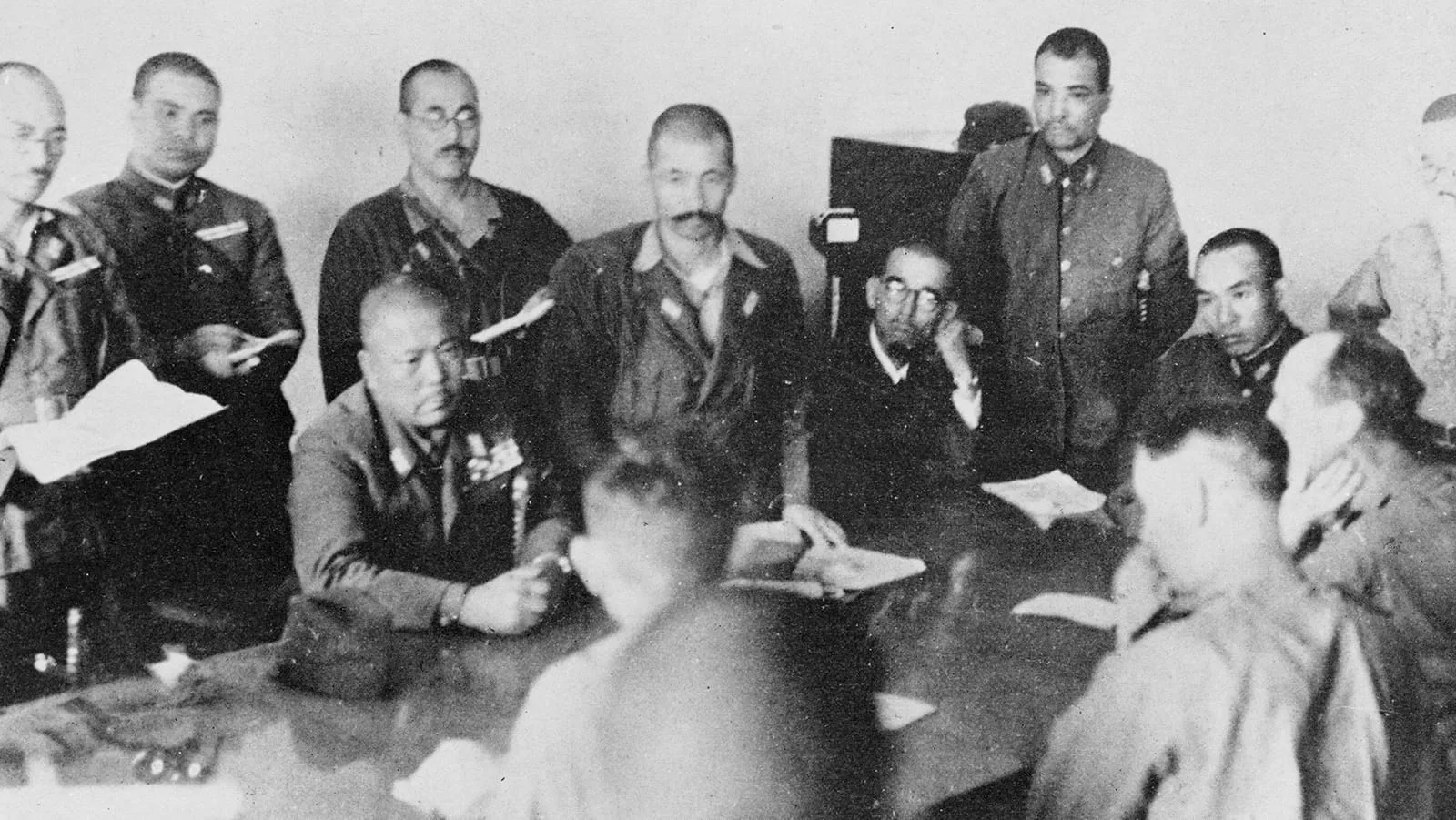
On the evening of 8 February 1942 the first Japanese landing craft pushed off from the shore of Johor and headed across the narrow strait towards the north-west coast of Singapore Island. A week later, on 15 February, the first day of the Chinese New Year, Lieutenant General Arthur Percival drove under a white flag to the Ford motor factory in the hills of Bukit Timah and there signed an unconditional surrender before the commander of the Japanese 25th Army, Lieutenant General Tomoyuki Yamashita. So ended the Malayan campaign and the twenty-year history of the fortress that Britain had built as the keystone of the defence of the whole Far East, Australia and New Zealand. Some 80,000 British, Indian, Australian and Malay soldiers laid down their arms before an army that had crossed to the island about 30,000 strong and in the final days of the battle was already rationing its shells. Prime Minister Winston Churchill called the fall of Singapore the worst disaster and largest capitulation in British history. For Asia it was a sign that the European empires could be defeated.
Name and dates
English-language writing speaks both of the Battle of Singapore and of the Fall of Singapore; some accounts prefer the former. In Japan the fighting on the island was the final stage of the “Malaya operation”. The Battle of Singapore in the strict sense covers only the fighting on the island itself, from the evening of 8 February, when Japanese infantry began crossing the Johor Strait, to the evening of 15 February 1942, when the firing stopped at 8.30 p.m. under the terms of the surrender. The earlier fighting on the Malay Peninsula, from the landing at Kota Bharu on 8 December 1941 to the withdrawal to the island on 31 January 1942, belongs to the wider Malayan campaign.
Times are given in the local time used by the British. The Japanese kept Tokyo time, an hour and a half ahead, so the same events carry different times in the sources of the two sides. This also applies to the signing of the surrender: according to most British accounts it took place at about 6.10 p.m., though some studies give an earlier or later time. Japanese artillery and aircraft had been shelling and bombing the island since the beginning of February, and Japanese troops entered the city centre only in the days after the surrender, but the battle is conventionally framed by the crossing and the laying down of arms.
Background
A fortress without a fleet
After the First World War the British government came to regard Japan as the most serious threat to the Empire in the Far East and decided to build a great naval base at Singapore. The island, ruled directly from London as part of the Straits Settlements, commanded the route from the Indian Ocean to the Pacific and was the most important port in the region. The Washington Treaty of 1922 prohibited the fortification of Hong Kong but did not cover Singapore. Construction, halted several times for reasons of economy, was completed in 1938; the base at Sembawang on the north coast of the island had what was then the largest dry dock in the world. The whole scheme rested on the so-called Singapore strategy: in the event of war with Japan the main fleet would sail from Europe, and the garrison had to hold out until it arrived.
The most famous part of the fortress was its coastal batteries, including five 15-inch (381 mm) guns. After the war it was repeated that they had “faced the wrong way”, out to sea, and were therefore useless against an attack from the land. This is a simplification. Most of the heavy guns, including the three of the Johore Battery at Changi, could traverse landwards, and in February 1942 they fired at the Japanese in Johor. The problem lay elsewhere: they had mainly armour-piercing shells, designed to penetrate the armour of warships, which buried themselves in soft ground and did little harm to infantry. Singapore’s real weakness was not the direction of its guns but the fact that the whole concept assumed a fleet and an air force that in 1941 did not exist. The sinking of Prince of Wales and Repulse on 10 December 1941 deprived the British of what was left of their naval strength, and Japanese aircraft dominated Malaya from the first days of the war.
As early as 1936–1938 the General Officer Commanding Malaya, Major General William Dobbie, and his chief of staff, then Colonel Arthur Percival, had warned that the Japanese might land on the east coast of the peninsula and in Thailand and then approach Singapore overland, from the north. That is what happened. After seven weeks of fighting in which the Japanese 25th Army defeated Commonwealth forces in turn at Jitra, on the Slim river, at Gemas and on the Muar, on the night of 30–31 January 1942 the last units crossed the causeway linking the island to the mainland, and the sappers blew a gap in it. The island’s north coast, facing the strait, had never been properly fortified. According to the account of Malaya Command’s chief engineer, Brigadier Ivan Simson, at the end of December 1941 Percival rejected his proposal to build field defences on that shore, explaining that they would be bad for the morale of the troops and the civilian population. This account comes from one side and is sometimes disputed, but the fact remains that when the troops returned to the island, at most a few isolated positions awaited them.
The week before the assault
Blowing the causeway gave the defenders a little over a week. On the island, about 40 kilometres long and about 20 wide, nearly a million people were crowded together: the inhabitants of the city, most of them Chinese, refugees from Malaya and the army. A pipeline that supplied the city with a large part of its water from Johor also ran along the causeway; once it was cut, Singapore depended on three reservoirs in the centre of the island – MacRitchie, Peirce and Seletar – and on a network of pipes that every bombardment broke in new places. The last RAF fighters were based at Kallang airfield near the city, because the other airfields in the north of the island lay within range of the Japanese artillery, and most of the air force had already been sent to Sumatra.
Reinforcements were still arriving in Singapore. The 53rd Brigade of the British 18th Infantry Division arrived on 13 January and went straight into action in Johor; the main body of the division landed on 29 January, and the last convoy on 5 February. Japanese bombers then sank the transport Empress of Asia at the entrance to the harbour; almost all the soldiers were saved, but much of their equipment was lost. The division, made up of Territorial battalions from the east of England, was at full strength, but it had spent three months at sea, was unacclimatised and had no combat experience whatever. Thousands of half-trained Australian and Indian replacements also arrived, some of whom had never fired a rifle.
Percival did not know where the blow would fall and decided to defend the whole coastline, more than a hundred kilometres long, rather than keep a strong reserve in the interior of the island. He expected an attack in the north-east, where the naval base lay and the strait was wider, but where the Japanese were deliberately making a show of troop movements. General Archibald Wavell, commander of the new Allied ABDA command, to which Percival had been subordinate since January, believed that the west, cut by river mouths and where the strait was narrowest, was more threatened. Percival nevertheless placed the fresh 18th Division in the north-east and gave the western sector to the weakened 8th Australian Division. Japanese reconnaissance aircraft, and above all observers in the tower of the Sultan of Johor’s palace, from which the whole northern part of the island could be seen, gave Yamashita an accurate picture of the British positions. Australian patrols that crossed the strait on the night of 6–7 February reported a large concentration of troops opposite the western sector, but Malaya Command did not change its dispositions on that basis.
Opposing forces
According to the British official history Percival had about 85,000 men, but some 15,000 of them served in supply, signals and administrative units. There were 49 infantry battalions on the island: 21 Indian, 13 British, six Australian, four battalions of Indian States Forces, two battalions of the Malay Regiment and three volunteer battalions of the Straits Settlements. Only one Indian battalion was at full strength; many others, shattered on the mainland, had been made up with recruits. Equipment lost during the retreat was lacking, there was not a single tank, and the air force had practically ceased to exist.
The defence was divided into three areas. The Northern Area, with the naval base, was held by Lieutenant General Lewis Heath’s III Indian Corps, with Major General Berthold Key’s 11th Indian Division and Major General Merton Beckwith-Smith’s 18th Division. The Western Area was entrusted to Major General Henry Gordon Bennett with two brigades of the 8th Australian Division and the 44th Indian Brigade. Brigadier Harold Taylor’s 22nd Brigade had a sector about sixteen kilometres wide between the mouth of the Kranji river and the western tip of the island, defended by some 3,000 men, and Brigadier Duncan Maxwell’s 27th Brigade a short sector between the Kranji river and the causeway. The Southern Area, with the city, was held under Major General Frank Simmons by the 1st and 2nd Malaya Brigades and the volunteers, with the 12th Indian Brigade in reserve. Percival ordered the Australians to defend the water’s edge itself, which deprived them of depth and reserves.
Yamashita had three divisions for the crossing: Lieutenant General Takurō Matsui’s 5th Division, Lieutenant General Renya Mutaguchi’s 18th Division and Lieutenant General Takuma Nishimura’s Imperial Guards Division, supported by tanks and heavy artillery – some 30,000–35,000 men in the front line in all. Behind them stood the rear services of the 25th Army, but its supply line ran the length of the peninsula and could not be abundant on the island: after seven weeks of advance artillery ammunition and fuel were short. The Japanese, on the other hand, had complete air superiority, experience from the fighting in China and Malaya, hundreds of boats and barges brought up through the jungle, and commanders used to the idea that outflanking an enemy position always paid. The army’s chief of operations was Lieutenant Colonel Masanobu Tsuji, one of the authors of the campaign plan.
Course of the battle
The night of 8–9 February: the landing at Sarimbun
On 8 February Japanese artillery and aircraft pounded the positions of the 22nd Brigade for many hours. The fire was heavier than anything the Australians had experienced on the mainland: it cut the telephone lines, isolated the forward companies from their headquarters and destroyed some of the searchlights set up on the shore. Malaya Command, however, judged it to be the prelude to several days of shelling, or perhaps a diversion before an attack in the east, and did not order the artillery to fire on the places where Japanese boats might be assembling.
Shortly before 8.30 p.m. the first waves of the 5th and 18th Divisions pushed off from the Johor shore. Sixteen assault battalions struck the sectors of the Australian 2/18th and 2/20th Battalions around the mouths of the Buloh and Murai rivers and Sarimbun beach, and some also hit the right flank of the 2/19th Battalion. The gunners of the 2/4th Machine Gun Battalion opened fire on the boats in the water and sank many of them, and the Australian artillery fired thousands of rounds during the night. Most of the searchlights that were meant to illuminate the strait were never switched on, however, and calls for defensive fire, sent up by signal rockets, often went unanswered. Once ashore, the Japanese, in the darkness, among the mangroves and creeks, easily slipped into the gaps between the scattered platoons, surrounded them and attacked them from behind.
Around midnight the Japanese divisions fired flares to tell Yamashita that their first objectives had been reached. The Australian battalions tried to regroup inland, but many companies had been broken up or cut off, and the soldiers trying to fight their way back to their own lines suffered heavy losses; the 2/20th Battalion alone lost, by Australian reckoning, several hundred killed and wounded in the first days of the battle. By the morning of 9 February there were about 13,000 Japanese on the island, and another 10,000 crossed during the day together with their guns.
In the morning British fighters appeared over the western part of the island for the last time: about ten Hurricanes from Kallang clashed with a large Japanese formation covering the landing. In the evening Percival agreed to send the surviving aircraft to Sumatra, and from then on the Japanese had undisputed command of the air over the island. During the day they took Tengah airfield, the largest on the island. Percival, still fearing a second landing in the north-east, sent reinforcements to Bennett piecemeal: the 2/29th Battalion from Maxwell’s sector, two weakened battalions of the 12th Indian Brigade and the composite 6th/15th Indian Brigade. Bennett decided to stop the Japanese on the so-called Jurong Line, between the upper reaches of the Kranji and Jurong rivers, east of Tengah. This line, however, existed mainly on maps: it had no fortifications, and the units manning it were intermingled, tired and poorly linked to one another.
Kranji and the collapse of the Jurong Line, 9–10 February
Late on the evening of 9 February the Imperial Guards Division attacked the 27th Brigade’s sector between the mouth of the Kranji and the causeway. Here the defenders inflicted the heaviest losses of the whole battle on the Japanese. The Australians had earlier let oil from the nearby tanks at Woodlands into the water; when it caught fire, some of the Japanese boats and men in the shallows found themselves engulfed in flames. According to the accounts of Japanese officers, Nishimura asked Yamashita for permission to break off the attack, and Yamashita ordered him to press on.
The fate of this sector was decided by something else. Maxwell, out of contact with the 22nd Brigade and afraid that the Japanese would get into his rear along the Kranji river, withdrew his battalions from the shore into the interior of the island during the night and early morning of 10 February. Who authorised this remains disputed; Bennett later maintained that he had issued no such order. The Guards occupied the shore and the high ground above the causeway without a fight, and their engineers began to repair the gap, through which tanks and artillery soon crossed. A counter-attack by the 8th Indian Brigade failed to restore the situation.
On 10 February the Jurong Line also fell apart. An order from Percival to prepare, as a precaution, a second line further east was understood at several headquarters as an order to withdraw at once, and one brigade commander after another – Taylor, then the commanders of the 12th and 44th Indian Brigades – fell back, each fearing that his neighbour had already gone. That day Wavell flew to the island for the last time. In the evening a telegram arrived from Churchill, who was convinced that the defenders had a huge numerical superiority: the battle had to be fought “to the bitter end at all costs”, there could be no thought of sparing the troops or the population, and commanders should die with their men. Wavell passed this tone on to Percival almost word for word and ordered him to retake the Jurong Line.
Bukit Timah and the reservoirs, 11–13 February
The hastily prepared counter-attack never took place. On the night of 10–11 February the Japanese 18th Division, supported by tanks, attacked along the Bukit Timah road, and the 5th Division towards Bukit Panjang. The Japanese ran into the so-called X Battalion, a scratch force of about two hundred Australian reinforcements bivouacked in the assembly area for the counter-attack; two-thirds of them were killed or wounded. On the morning of 11 February, the Japanese festival of the founding of the empire, the Japanese took Bukit Timah hill, the highest point on the island, and with it the garrison’s main stores of food, ammunition and fuel. That day Japanese aircraft dropped over the British positions a letter from Yamashita that praised the defenders’ courage and called on Percival to give up his “senseless and desperate resistance”. Percival did not reply.
Yamashita was in a more difficult position than the British knew. His artillery was beginning to run short of shells, and before him lay a city full of people, where house-to-house fighting could cost him more than he could afford. After the war he said that his attack on Singapore had been a bluff that worked. The British, meanwhile, were growing ever more anxious about water. The 27th Australian Brigade tried to recover Bukit Panjang and cover the reservoirs, but the Guards beat off the counter-attack and the brigade was split in two. Fighting went on at the edge of the reservoirs for days. The Japanese did not cut off the water supply; that was largely done by the bombs and shells which, in the crowded city, broke the pipes faster than the sappers could repair them.
On the night of 12–13 February Percival pulled his troops back from the north and east coasts, including the naval base and Changi, and deployed them on a perimeter about 45 kilometres long around the city. The Australians closed themselves into a perimeter of their own by the Tanglin barracks; to their right stood the 18th Division, the 11th Indian Division and the 2nd Malaya Brigade, and to their left, down to the sea, the 44th Indian Brigade and the 1st Malaya Brigade. On 13 February Japanese engineers finished repairing the causeway, and more tanks crossed by it to the island. Oil tanks were burning in the harbour, and the last ships and small craft were leaving the quays with women, children, wounded and military specialists; most of them were sunk or intercepted by Japanese warships and aircraft in the straits south of Singapore. That day senior commanders urged Percival for the first time to surrender before civilian casualties grew still greater. Percival refused, but asked Wavell for discretion; Wavell replied that the fight must go on.
Pasir Panjang and the Alexandra Hospital, 13–14 February
The heaviest fighting of the last days took place at the western end of the perimeter, on the Pasir Panjang ridge running along the south coast. The ridge commanded the Alexandra district, with the main ammunition depots, fuel tanks and the military hospital. It was defended by the 1st Malaya Brigade, including the 1st Battalion of the Malay Regiment, formed in the 1930s from Malay volunteers, which had not yet been under fire. On 13 February an infantry regiment of the Japanese 18th Division, supported by artillery and tanks, attacked the ridge. B Company of the Malay Regiment was overwhelmed in hand-to-hand fighting. On 14 February the Japanese attacked again, and when they broke the left flank of the defence, Second Lieutenant Adnan Saidi’s C Company defended Bukit Chandu hill to the last. Adnan Saidi, badly wounded, was captured and murdered; accounts differ in detail, but all speak of death by the bayonet. In Malaysia and Singapore he became a national hero, and the fight on Bukit Chandu one of the most important symbols of the war.
The fall of the ridge opened the way for the Japanese to the Alexandra military hospital. At about 1 p.m. on 14 February Japanese soldiers – according to most findings from the 18th Division – approached the building. A British lieutenant who went out to meet them with a white flag was bayoneted. The Japanese entered and began to murder doctors, orderlies and the wounded, including a patient on the operating table. About two hundred men from the staff and the less seriously wounded patients were tied up and locked overnight without water in cramped rooms in nearby buildings; some died before morning, and the rest were led out the next day and bayoneted. A few survived by feigning death and gave evidence after the war. In all, more than two hundred people were killed in the massacre.
The surrender, 15 February
The perimeter held through the night of 14–15 February, but the situation had become hopeless. The municipal water engineer reported that the system could work for another day, two at most. Food was running out, fuel for vehicles was almost exhausted, and the field and anti-aircraft artillery had few shells left. Looting spread in the city, and units, especially those made up of recently arrived replacements, were melting away through desertion. Japanese bombs and shells were killing ever more civilians; according to various estimates several thousand died in the final week.
At 9.30 a.m. on 15 February Percival assembled his commanders in the underground command post at Fort Canning. He set out two options: an immediate counter-attack to recover the reservoirs and the depots at Bukit Timah, or surrender. The commanders agreed that a counter-attack was impracticable. Post-war analyses suggest that the Japanese were at the end of their strength, but the British did not know this. That morning a telegram also arrived from Wavell allowing Percival to cease resistance once he was convinced that further fighting was impossible. Percival decided to surrender and ordered the destruction of ciphers, secret documents, technical equipment and heavy guns. A delegation went to the Japanese lines with Brigadier Terence Newbigging, the Colonial Secretary Hugh Fraser and Major Cyril Wild, who spoke Japanese. It returned with the demand that Percival present himself in person to Yamashita and that the Japanese flag be hoisted over the tallest building in the city.
The meeting at the Ford factory near Bukit Timah lasted about an hour. Yamashita demanded immediate and unconditional surrender; Percival tried to play for time. According to a famous account, Yamashita struck the table with his hand and demanded the answer “yes or no”; he himself said later that what had made him impatient was above all the slow interpreting. Under the instrument signed that evening all forces in Singapore surrendered unconditionally, the firing was to stop at 8.30 p.m., and the British were allowed to keep a thousand armed men to maintain order until the Japanese could replace them. Yamashita took upon himself responsibility for the lives of the civilian population. Photographs of the tall, gaunt Percival facing the stocky Yamashita were spread by Japanese propaganda throughout Asia.
When Bennett learned of the surrender, he handed over command of the 8th Division to his divisional artillery commander, Brigadier Cecil Callaghan, and with a few officers escaped by boat across the strait that night, reaching Australia via Sumatra at the beginning of March. He explained that he had wanted to bring his country the lessons of fighting the Japanese. His soldiers, meanwhile, were marching into captivity, and his escape weighed on Bennett’s reputation for the rest of his life.
Losses
According to Japanese figures the 25th Army lost about 1,700 killed and between 2,800 and 3,400 wounded in the fighting for the island. The defenders’ losses in killed and wounded over the same days are estimated at about 5,000, most of them Australians. About 80,000 soldiers went into captivity on the island (some tallies give nearly 85,000); together with those taken earlier on the mainland, the number of prisoners for the whole campaign reached about 130,000. According to the most frequently cited breakdown they included some 38,000 British, 18,000 Australians, 67,000 men of the Indian Army and 14,000 local volunteers. The number of civilian casualties is not known; estimates for the final days of fighting run to several thousand killed, not counting the victims of the earlier air raids.
For many prisoners captivity proved worse than the battle. The British and Australians were gathered in camps at Changi, from where thousands were later sent to build the Burma Railway and to other labour camps; many of them died of hunger, disease and ill-treatment. The Japanese separated the Indian prisoners from their British officers. According to the most commonly cited figures, several tens of thousands of them joined the Indian National Army, formed under Japanese patronage; those who refused were sent to labour camps on the Pacific islands.
Significance
The fall of Singapore was the largest capitulation in the history of the British Army. An army numerically stronger than its opponent, defending a fortress that had been twenty years in the building, surrendered after a week of fighting on the island. Many causes have been identified: the absence of the fleet and air force on which the entire defence plan rested; the spreading of the troops along the whole coastline without a strong reserve; the misjudgement of where the blow would fall; the lack of fortifications on the north shore; chaos in orders and communications; the poor training of the replacements; and finally the passivity of Percival, whom many historians blame, though others stress that he had been given an impossible task. The dispute over responsibility, including between the British and the Australians, continues to this day; Wavell’s secret report, made public in 1992, blamed the Australian soldiers, while Australian historians point out that the 8th Division suffered a disproportionately large share of the dead of the whole campaign.
For the people of Singapore the surrender opened three and a half years of occupation. The city was renamed Syonan-to, “Light of the South”. From 18 February the military police and units of the 25th Army carried out a “purge” of the Chinese population known as Sook Ching. Men arbitrarily judged to be “anti-Japanese” were taken to the beaches and shot. The Japanese command later admitted to about 5,000–6,000 victims; Singaporean and Chinese estimates speak of several tens of thousands, most often of about 50,000 on the island alone.
Strategically, the capture of Singapore opened the way for the Japanese to Sumatra and Java and on towards the Indian Ocean, and allowed them to transfer troops to Burma. For Australia it was a shock: Prime Minister John Curtin said that the fall of Singapore, like Dunkirk two years earlier, opened the battle for his own country, and his government ultimately turned to the United States for help. Churchill went through the gravest crisis of his premiership in these weeks; according to his doctor, Lord Moran, many months later he was still saying that he could not get over Singapore. The longest-lasting consequence, however, was the loss of prestige. The peoples of Asia had seen a European empire lay down its arms before an Asian army. The British returned to Singapore in September 1945, but their rule in the region never regained its former standing, and the fall of the fortress is counted among the causes that hastened the end of the colonial empires in Asia. Yamashita, hailed as the “Tiger of Malaya”, was soon sidelined to Manchuria and in 1946 was executed after a trial for crimes committed under his command in the Philippines. Percival spent the war in captivity, and in September 1945 stood behind General Douglas MacArthur as Japan’s surrender was received in Tokyo Bay.