Japan
Tomoyuki Yamashita
Commander of the 25th Army (1941–1942), the First Area Army in Manchuria (1942–1944) and the 14th Area Army in the Philippines (1944–1945), General
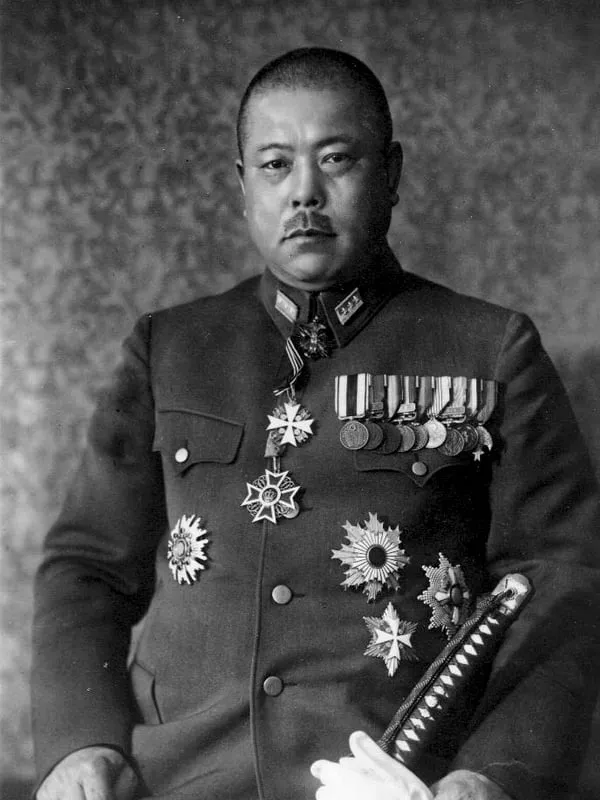
- Born:
- 8 November 1885, Kōchi Prefecture, Shikoku (Japan)
- Died:
- 23 February 1946, Los Baños, Luzon (Philippines)
- Author:
- Łukasz
- Photo:
- fotograf armii japońskiej, domena publiczna, Wikimedia Commons

Tomoyuki Yamashita was one of the ablest commanders of the Japanese army and at the same time one of the most awkward for its leadership. Linked to the faction that lost the struggle for influence in the army after the coup attempt of February 1936, he was kept away from Tokyo for years. In December 1941, however, he was given the most important land task of the entire southern offensive, and in seventy days he conquered Malaya and Singapore, forcing the surrender of an army larger than his own. The Japanese press called him the “Tiger of Malaya”. Soon afterwards he was sidelined to Manchuria, and by the time he was summoned to save the Philippines in 1944 the war was already lost. After Japan’s surrender he stood before an American military court in Manila, which sentenced him to death for crimes committed by troops under his command. His trial became one of the most important and most contested precedents in the law of war.
A doctor’s son from Shikoku
He was born on 8 November 1885 in Kōchi Prefecture on the island of Shikoku, the second son of a country doctor. Sources differ on his birthplace: according to Japanese biographies he was born in the village of Akatsuka in Kami District and moved with his family at the age of two to his father’s native village of Ōsugi, which most Western sources give as his birthplace. His elder brother became a naval doctor. Tomoyuki chose the army: in 1900 he entered the military cadet school in Hiroshima, and in November 1905 he graduated from the Military Academy, in its eighteenth class, with a high place. In 1906 he was commissioned a second lieutenant of infantry.
His career advanced quickly. In 1914 he fought against the Germans in the Chinese province of Shandong, and in 1916 he graduated with distinction from the Army War College, which opened the way to staff appointments. A year later he married Hisako, the daughter of General Nagayama. He was regarded as an expert on Germany: from 1919 to 1922 he was assistant military attaché in Bern and then stayed in Germany. From 1927 to 1930 he was military attaché in Vienna and Budapest. At home he worked on the General Staff and in the War Ministry, where he dealt with the reform and reduction of the army. In 1930, as a colonel, he took command of the 3rd Infantry Regiment in Tokyo, one of the most prestigious in the army, and in 1934 he became a major general.
The Kōdō-ha and the February 26 Incident
In the 1930s the Japanese army was torn by the rivalry of two informal factions. The Kōdō-ha, the “Imperial Way faction” gathered around Generals Araki and Mazaki, preached the spiritual renewal of Japan and preparation for war with the USSR, and many young officers in its orbit dreamed of a coup. The opposing “Control faction”, to which Hideki Tōjō belonged, stood for discipline, a modern army and cooperation with the bureaucracy. Through his father-in-law and his ties to the young officers of his former regiment, Yamashita was seen as a Kōdō-ha man.
When on 26 February 1936 young officers, many of them from the 3rd Regiment he had recently commanded, led soldiers onto the streets of Tokyo and murdered several ministers, Yamashita, then a section chief in the War Ministry, was among those who negotiated with them. As the revolt was collapsing, he proposed that the Emperor send an aide-de-camp to witness the suicide of the rebel leaders. Hirohito indignantly refused, holding that the rebels deserved no honour, and Yamashita lost, as he himself believed, the Emperor’s trust. He wanted to leave the army, but his superiors talked him out of it. He was sent to Korea to command a brigade, far from the capital. For the rest of his life he felt that he had to redeem himself in the Emperor’s eyes.
China, aviation and the mission to Germany
After the outbreak of the war with China in July 1937 his brigade fought near Beijing, and Yamashita made his name as a commander who led his men from the front line. In November 1937 he became a lieutenant general, and in July 1938 chief of staff of the North China Area Army. In that post he drew up the principles for suppressing the anti-Japanese guerrillas in northern China and backed a hard line towards the Western concessions, which in 1939 led to the blockade of Tianjin (Tientsin). In September 1939 he took over the 4th Division, and in July 1940 he became Inspector General of Army Aviation.
In December 1940 he led a military mission to Germany and Italy, which spent half a year studying German air power, armoured forces and the lessons of the 1940 campaign. He met Adolf Hitler and Benito Mussolini. On his return he recommended mechanising the army and expanding the air arm and the airborne troops, and warned that Japan was not ready for war with the great powers. By some accounts he also advised avoiding war with the United States and Britain until the army had been modernised. In July 1941, contrary to his hopes, he was sent to Manchuria to command the Kwantung Defence Army.
The Tiger of Malaya
On 6 November 1941 Yamashita took command of the 25th Army, which was entrusted with the conquest of Malaya and Singapore. Tōjō, who disliked him, judged that no one was better suited to the task. The plan was risky: three divisions, some 60,000–80,000 men including rear units, were to defeat a garrison that in December numbered around 88,000 and was receiving reinforcements, before the British could dig in. Yamashita staked everything on speed: continuous attack, outflanking positions through the jungle and from the sea, infantry on bicycles and tanks on the roads.
The Malayan campaign began on the night of 7–8 December 1941 with landings at Kota Bharu and in Thailand, and as early as 10 December Japanese aircraft sank Prince of Wales and Repulse. Yamashita’s army routed the British at Jitra and on the Slim River, took Kuala Lumpur on 11 January 1942 and by the end of January had reached the Johor Strait. On the night of 8–9 February it crossed to Singapore Island. Yamashita had no numerical superiority and his artillery was running short of ammunition; he later admitted that the attack had been a bluff. On 15 February General Arthur Percival signed the surrender of some 80,000 troops at the Ford factory in Bukit Timah, and in the campaign as a whole about 130,000 went into captivity. The story of Yamashita banging his fist on the table and demanding a “yes or no” answer went round the world; the general himself later explained that he had grown impatient with the slow interpreting. In Japan he became a national hero, and the Emperor sent him his commendation.
The victory had a dark side. On 14 and 15 February Japanese soldiers massacred the staff and patients of the Alexandra military hospital. Yamashita is said to have later apologised to the survivors and, by some accounts, ordered the culprits punished. A few days after the surrender, from 18 February, the military police and units of the 25th Army carried out the Sook Ching massacre in Singapore and then in Malaya, directed against the Chinese population. The Japanese command later admitted to some 5,000–6,000 victims; Singaporean estimates put the figure at several tens of thousands. The order to “purge” the city of “anti-Japanese elements” was issued in the name of the army command; its details were worked out by the chief of staff, Sōsaku Suzuki, and Lieutenant Colonel Masanobu Tsuji. Historians disagree over how far it was Yamashita’s own idea, but as army commander he bore responsibility for the crime. After the war, in 1947, the British sentenced two senior officers to death for it; Tsuji escaped trial by going into hiding.
Sidelined to Manchuria
Fame brought Yamashita no advancement in Tokyo. In July 1942 he was transferred to command the First Area Army in Manchuria, a front where nothing was happening, and without the customary audience with the Emperor on the way. This was explained by military secrecy, but it was widely believed that Prime Minister Tōjō did not want a popular rival in the capital. According to some accounts, the pretext was a speech in which Yamashita had called the inhabitants of Singapore new subjects of the Emperor, a status the government had no intention of granting them. In February 1943 he was promoted to full general. When the Tōjō government resigned in the summer of 1944 after the fall of Saipan, some politicians and members of the imperial family saw him as war minister, but the army chose someone else.
The Philippines
At the end of September 1944 he was given command of the 14th Area Army, which was to defend the Philippines. Before leaving he was at last received by the Emperor. He flew into Manila at the beginning of October, and less than two weeks later the Americans of General Douglas MacArthur landed on Leyte. Against his advice, the command in Saigon and Tokyo ordered him to pour more and more forces into Leyte, most of which perished at sea or on the island. When the Americans landed on Luzon in January 1945, Yamashita, with some 260,000 poorly armed troops, gave up the idea of a decisive battle. He resolved to tie down the enemy for as long as possible in the mountains of northern Luzon and withdrew the army’s troops from Manila.
He did not, however, declare it an open city, and Rear Admiral Sanji Iwabuchi, with well over ten thousand sailors and formally under his command, decided against his orders to defend Manila. In the fighting from February to March 1945 and the accompanying massacre more than 100,000 Filipino civilians died, many of them murdered by Japanese soldiers and sailors. In other parts of the islands, too, army units murdered civilians suspected of helping the guerrillas. Yamashita held out in the mountains until the end of the war. He came down only after Japan’s surrender, and on 3 September 1945 at Baguio he signed the instrument of surrender of the Japanese forces in the Philippines. Percival, whom MacArthur had brought from captivity, was present at the signing.
Trial and death
From 29 October to 7 December 1945 Yamashita was tried in Manila by an American military commission of five generals. He was charged not with ordering crimes but with failing, as commander, to prevent the mass murder, rape and plunder committed by his troops. The defence, led by Colonel Harry Clarke, argued that in the chaos of the American offensive Yamashita had no communication with many units, and that the slaughter in Manila was the responsibility of the navy, which did not obey him. The prosecution presented testimony, partly hearsay, that he had condoned executions without trial. The commission found him guilty and sentenced him to death by hanging. MacArthur confirmed the sentence, and on 4 February 1946 the United States Supreme Court declined to overturn it; two justices, Frank Murphy and Wiley Rutledge, called the trial hasty and unjust in their dissenting opinions. President Harry Truman did not exercise his power of clemency. On 23 February 1946 Yamashita was hanged at Los Baños, south of Manila.
Significance
Yamashita went down in history as the author of Japan’s most brilliant victory of the Second World War. The capture of Singapore shook British rule in Asia, and his campaign is still studied as an example of bold command of small forces. At the same time, two great crimes against civilians were committed under his command: in Singapore in 1942 and in the Philippines in 1944–1945. The principle on which he was convicted – that a commander is responsible for the crimes of his subordinates if he knew or should have known of them and did nothing to prevent them – is known as the “Yamashita standard” and, in modified form, has entered international law. The trial itself remains contested: some see it as the just punishment of a commander, others as victors’ revenge and a verdict reached in haste. His name is also linked to the post-war legend of “Yamashita’s gold”, a supposed treasure looted in Asia and hidden in the Philippines, which has never been confirmed.
Sources
Commanded in battles
(05)Often appears with
People who appear in the same events.
On the timeline
(25)1936
1939
1941
December
- 08
- The Japanese invasion of ThailandOn 8 December 1941 the Japanese landed on the Thai coast and crossed from Indochina. After hours of fighting, Bangkok ceased fire and let them pass to Malaya.
- The Malayan campaign beginsJust after midnight on 8 December 1941 the Japanese landed at Kota Bharu in Malaya and in Thailand. Five days later Yamashita's army beat the British at Jitra.
1942
1944
1945
January
February
March
April
July
September
- 02
- Key eventThe Japanese surrender on the “Missouri”On 2 September 1945, in Tokyo Bay, Japan signed the instrument of unconditional surrender aboard USS Missouri. The Second World War was over.
- The surrender of YamashitaOn 2 September 1945 General Tomoyuki Yamashita came down from the mountains near Kiangan and surrendered; on 3 September he signed the surrender at Baguio.