United Kingdom
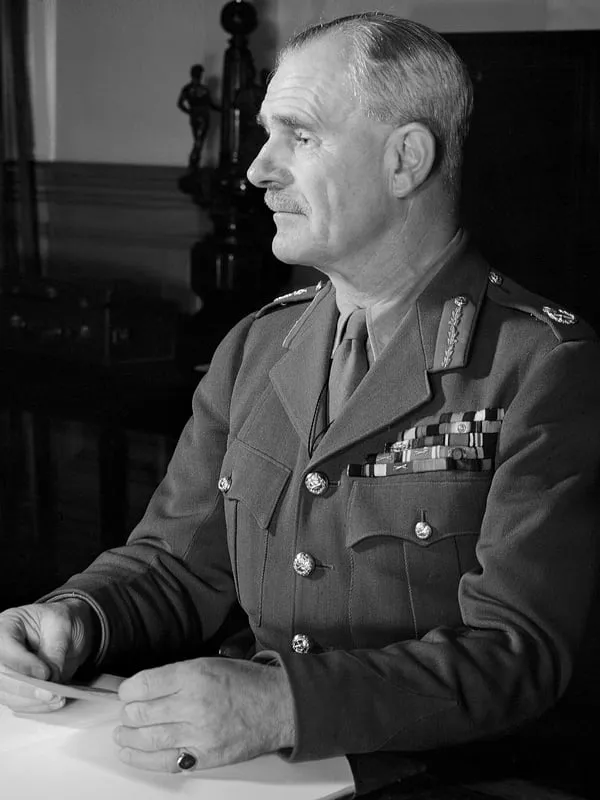
Archibald Wavell
Commander-in-Chief Middle East (1939–1941), Commander-in-Chief India (1941–1943), Viceroy of India (1943–1947), field marshal
- Born:
- 5 May 1883, Colchester (England)
- Died:
- 24 May 1950, London
- Author:
- Łukasz
- Photo:
- autor nieznany, domena publiczna, Wikimedia Commons

In the first two years of the Second World War, Archibald Wavell was the most important British land commander actually fighting the enemy. As Commander-in-Chief Middle East he was responsible for an area stretching from Libya to Iraq and from Turkey to Kenya. In the winter of 1940–1941 his forces destroyed the Italian army in Libya and conquered Italian East Africa, winning Britain’s first great land victories of the war. In the spring of 1941, however, he had to conduct campaigns in Greece, Crete, Iraq, Syria and the Libyan desert all at once, and the defeats he suffered there cost him his post. He then commanded in India and South-East Asia during the worst months of the war against Japan, and as Viceroy of India he conducted the negotiations that preceded the end of British rule. He was a soldier of rare culture, an author of books on war and a lover of poetry. Winston Churchill never trusted him.
Youth and first wars
Archibald Percival Wavell was born on 5 May 1883 in Colchester, into a family with a military tradition. His father was a British Army officer, later a major general, and the boy spent part of his childhood in India. He was educated at the elite Winchester College, where he was a scholar, and the headmaster is said to have tried to persuade his father that the son was able enough to make a career outside the army. Wavell nonetheless chose the army. After passing out of the Royal Military College, Sandhurst, he was commissioned in May 1901 as a second lieutenant in the Black Watch, a Scottish infantry regiment, and was sent to South Africa for the closing months of the Second Boer War. From 1903 he served with the regiment in India, and in 1908 he fought against the tribes of the North-West Frontier.
He belonged to the officers who took their profession seriously. In 1909–1910 he passed through the Staff College at Camberley with distinction, and in 1911 he spent a year in Russia learning the language and observing the Russian army. He then worked in the Russian section of the War Office in London. On one of his subsequent journeys to Russia, in 1913, he was detained on suspicion of espionage.
The First World War
When war broke out in 1914, Wavell went to France as a staff officer of the British Expeditionary Force, and in November he became brigade major of the 9th Infantry Brigade. In 1915 he was badly wounded at Ypres and lost his left eye. He was awarded the Military Cross. After recovering he returned to staff work, and in 1916, as a Russia specialist, he became liaison officer with the Russian army fighting the Turks in the Caucasus. In 1917 he was transferred to the Middle East, to the staff of General Edmund Allenby’s Egyptian Expeditionary Force, which was conquering Palestine. In 1918, as a temporary brigadier general, he was chief of staff of XX Corps. Allenby became his model of a commander. Wavell later wrote a history of his Palestine campaigns (1928) and his biography (1940).
Between the wars
After the war Wavell, like many officers, reverted to a lower rank and for years worked on staffs and at the War Office, several times finding himself temporarily without a post. In 1930 he took command of the 6th Infantry Brigade, which was used for experiments with new methods of mobile warfare; in 1933 he became a major general, and in 1935 commander of the 2nd Infantry Division. He gained a reputation as one of the most thoughtful commanders in the British Army – demanding, but close to his soldiers, and sparing with words. In 1936 he was among a group of British officers who observed the great Red Army manoeuvres in Belarus, with their mass parachute drops.
In 1937 he was sent to Mandatory Palestine, where the Arab revolt was under way. As commander of British forces in Palestine and Transjordan he fought the insurgents for several months, and in January 1938 he was promoted to lieutenant general. In April 1938 he took over Southern Command in England, and in February 1939 he gave a series of lectures on command at Cambridge, later published as Generals and Generalship.
Commander-in-Chief Middle East
In the summer of 1939, as the crisis over Gdańsk (Danzig) deepened, Wavell was appointed Commander-in-Chief of the newly created Middle East Command in Cairo. Under him were the land forces in Egypt, the Sudan, Palestine, Transjordan and Cyprus, and in time also in East Africa, Iraq and Greece. The first months of the war were quiet in the Middle East, since Italy stayed out of the war. Wavell used them for planning and for talks with allies, among them General Maxime Weygand, commander of the French army in the Levant.
When Italy entered the war on 10 June 1940, and command in Libya was soon taken over by Marshal Graziani, Wavell’s position became difficult. In Egypt he had about 36,000 men, facing more than 200,000 Italians in Libya and an even larger army in Italian East Africa. After the fall of France he lost French support in Tunisia, Djibouti and Syria. He chose a strategy of flexible defence: General Richard O’Connor’s motorised units harried the Italians on the Libyan frontier, while on the other fronts Wavell gave up ground to gain time. From 30 June 1940 the Polish Independent Carpathian Rifle Brigade, which had crossed into Palestine from French Syria, came under his command. In the autumn it was moved to Egypt, but because Poland was not formally at war with Italy, it was not sent to the front line.
In August 1940 the Italians occupied British Somaliland. Wavell, who was then in London and meeting Churchill for the first time, supported the decision to evacuate. When the prime minister concluded that the small losses proved the defence had been too weak, Wavell replied that a big “butcher’s bill” was not the sign of good tactics. Churchill never forgave him that remark. He considered him too cautious and took his taciturnity for a lack of fighting spirit. Wavell was defended by the Secretary of State for War, Anthony Eden, with whom the general had become friends.
On 13 September 1940 the Italians crossed into Egypt, beginning an invasion that stalled at Sidi Barrani after four days’ march. Wavell did not intend to defend the frontier: the covering force of the 7th Armoured Division fell back, and the decisive battle was to be fought at Mersa Matruh. But Rodolfo Graziani halted at Sidi Barrani, and Wavell used the three-month pause to prepare a counter-attack. Although London and Athens were pressing ever more loudly for help to Greece, which Italy had attacked in October, he kept the plan for a strike in the desert secret.
Compass and East Africa
On 9 December 1940 O’Connor’s forces struck the Italian camps around Sidi Barrani. Wavell presented it to journalists as an “important raid” rather than an offensive, but the operation soon outgrew its original aims. In Operation Compass British and Australian troops took Bardia and Tobruk, and in February 1941 at Beda Fomm they cut off and destroyed what was left of the Italian Tenth Army. About 130,000 soldiers were taken prisoner, and the whole of Cyrenaica fell into British hands. It was Britain’s first great land victory of the war. Immediately after the first successes, however, Wavell took the 4th Indian Division out of the desert and sent it to the Sudan, which O’Connor considered a mistake.
At the same time Wavell was conducting the East African campaign. From the Sudan, where in July the Italians had captured Kassala, General William Platt struck into Eritrea and, after the hard-fought Battle of Keren in March 1941, opened the road to Asmara and Massawa. From Kenya, General Alan Cunningham, brother of Admiral Andrew Cunningham, occupied Italian Somaliland and reached Addis Ababa. Emperor Haile Selassie returned to his capital on 5 May 1941, and in May the viceroy, Amedeo d’Aosta, surrendered. Wavell had long supported the Ethiopian rising and had approved the guerrilla operations of Orde Wingate.
A spring of defeats
The victories over Italy, however, brought the Germans to the Middle East. In February 1941 the first units of General Erwin Rommel began arriving in Libya, and in Cairo Eden and the Chief of the Imperial General Staff, John Dill, persuaded Wavell to send an expeditionary force to Greece. Wavell, who had earlier opposed the idea, changed his mind and accepted a share of responsibility for the decision, regarding it as a debt of honour to an ally. Weak, inexperienced units were left in the desert. On 31 March Rommel went over to the attack and within two weeks had pushed the British back to the Egyptian frontier. O’Connor was taken prisoner. Wavell then decided to hold Tobruk, which, though encircled, held out until the end of the year.
In April the Germans attacked Yugoslavia and Greece, and General Henry Maitland Wilson’s British, Australian and New Zealand corps had to evacuate the mainland, leaving all its heavy equipment behind. In May German paratroopers took Crete, and the Battle of Crete cost the Royal Navy a number of ships. At the same time power in Iraq was seized by the pro-German Rashid Ali al-Gaylani, and Wavell, who did not want to disperse his forces, only sent a column from Palestine to relieve the besieged air base at Habbaniya under pressure from London. In June he also had to strike at Vichy-controlled Syria in Operation Exporter. There were weeks when he was conducting five campaigns at once, with scattered and exhausted troops at his disposal.
Churchill, who had sent him a convoy of tanks across the Mediterranean, demanded a swift offensive in the desert. Operation Brevity in May and Operation Battleaxe in mid-June 1941 both failed, largely because of German 88 mm anti-aircraft guns used against tanks. At the end of June 1941 the prime minister informed Wavell that he was to exchange posts with the Commander-in-Chief in India, General Claude Auchinleck. Wavell accepted the decision calmly. Auchinleck later wrote appreciatively of the solid foundations he had found in Cairo.
India and the war against Japan
In India, in August 1941, Wavell directed the British part of the joint Anglo-Soviet operation against Iran. After the outbreak of the Pacific war in December 1941 he again found himself where things were hardest. In January 1942 he took over the American-British-Dutch-Australian Command, ABDA, with headquarters in Java, which was to defend Malaya, Singapore, the Dutch East Indies and Burma. He had neither the troops nor the aircraft to do it. During his last visit to Singapore, on the night of 10–11 February, he fell from a quayside in the dark and injured his back. A few days later Singapore surrendered, and at the end of February ABDA Command was dissolved.
Wavell returned to India as Commander-in-Chief. The British had lost Burma, and India faced both a Japanese invasion and internal revolt: in August 1942 the Congress launched the “Quit India” campaign, and Wavell had to use troops to put down the disturbances. His Arakan offensive of 1942–1943 ended in failure, and the first raid by Wingate’s Chindits behind Japanese lines in February 1943 was of mainly moral significance. On 1 January 1943 Wavell was promoted to field marshal.
Viceroy of India
In June 1943 Churchill offered him the post of Viceroy of India. Wavell was made a viscount and in October 1943 succeeded Lord Linlithgow in Delhi. His first task was to fight the Bengal famine, which by various estimates claimed between two and three million lives. Wavell deployed the army to distribute food and pressed London to increase grain imports, but the War Cabinet granted far less than he asked for.
The prime minister had expected him to be a tough defender of the empire, but Wavell came to the conclusion that after the war India would have to be brought quickly to self-government, and he tried to prepare an agreement to that end. In May 1944 he released the ailing Mahatma Gandhi from prison, and in June and July 1945 he convened a conference of Indian leaders at Simla, which was to form a government made up of Indians. The talks foundered on the dispute between the Indian National Congress and the Muslim League of Muhammad Ali Jinnah. After the war tensions mounted: the trials of soldiers of the Indian National Army, the mutiny in the Royal Indian Navy in February 1946, and in August 1946 the bloody riots in Calcutta in which thousands of people were killed. In September 1946 Wavell formed an interim government headed by Jawaharlal Nehru.
Convinced that the British administration was falling apart, he proposed a plan for a phased withdrawal from India by a fixed date. Clement Attlee’s government, however, had lost confidence in him. In February 1947 it was announced that the British would leave India by June 1948 at the latest, and that Wavell would be replaced by Lord Louis Mountbatten. In March 1947 Wavell handed over office to him. A few months later, in August 1947, India and Pakistan became independent amid a partition that by various estimates cost between several hundred thousand and more than a million lives.
Last years and significance
After returning to England Wavell was created an earl, served as Constable of the Tower and devoted himself to writing. As early as 1944 he had published an anthology of his favourite poems, Other Men’s Flowers, much of which he knew by heart, closing it with one poem of his own. He died in London on 24 May 1950 after an operation. His coffin was carried along the Thames from the Tower to Westminster, and he was buried in the cloister of Winchester College. His only son, the second Earl Wavell, was killed in Kenya in 1953 fighting the Mau Mau insurgents.
Wavell is remembered as an unlucky commander, sent wherever everything was in short supply and recalled when defeat became inevitable. Yet under his command Britain won its first land victories over the Axis powers in 1940–1941, saved Egypt and the Suez Canal, and destroyed Italy’s empire in East Africa at a time when it stood alone against Germany. Historians point out that some of his defeats stemmed from decisions taken in London, above all the expedition to Greece, and some from his own caution and his underestimation of Rommel. As viceroy he was one of the first British statesmen to understand that the rule over India was coming to an end.
Sources
Commanded in battles
(08)- 10 June 1940 – 27 November 1941East African CampaignAfrica
- 3–19 August 1940Italian invasion of British SomalilandAfrica
- 9–16 September 1940Italian invasion of EgyptMediterranean
- 9 December 1940 – 9 February 1941Operation CompassMediterranean
- 24 March – 15 April 1941Rommel’s first offensiveMediterranean
- 2–31 May 1941Anglo-Iraqi WarMiddle East
- 15–17 June 1941Operation BattleaxeMediterranean
- 11 January – 9 March 1942Dutch East Indies campaignPacific
Mentioned in battles
(12)Often appears with
People who appear in the same events.
On the timeline
(90)The 40 most important of 90 events. All tagged “Archibald Wavell” (11) →
1940
1941
January
February
March
April
- 18
- The suicide of Alexandros KoryzisOn 18 April 1941, as the Greek front collapsed, Prime Minister Alexandros Koryzis took his own life. The British were already preparing to evacuate.
- The British land at BasraOn 18 April 1941 the 20th Indian Infantry Brigade landed at Basra; the day before, aircraft had begun flying a British infantry battalion into Shaibah.
- 25
- Rommel takes the Halfaya PassOn 25–26 April 1941 Colonel von Herff's group drove the British from Sollum and the Halfaya Pass. Axis forces stood in Egypt but went no further.
- The Battle of Thermopylae (1941)On 24 April 1941 New Zealanders at Molos and Australians on the Brallos Pass held the Germans all day, then withdrew at night to the evacuation ports.