United Kingdom
Arthur Percival
General Officer Commanding, Malaya (1941–1942), Lieutenant General
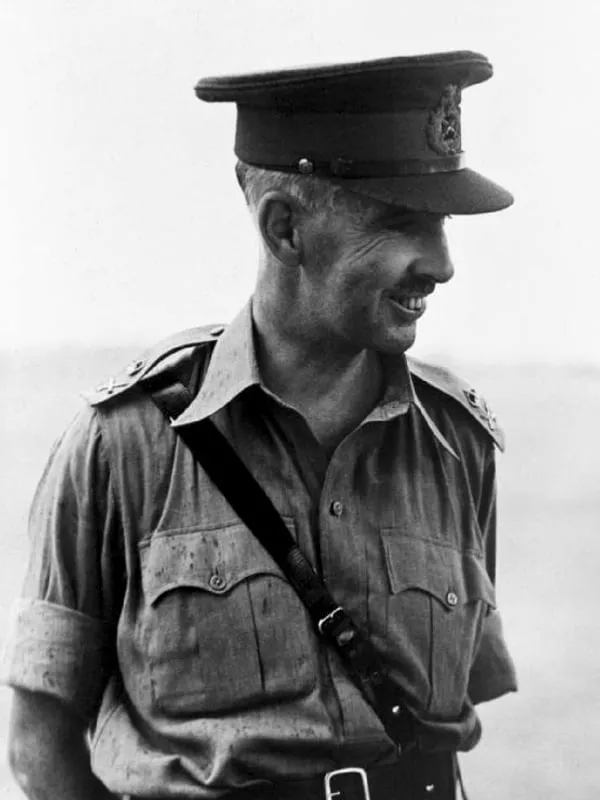
- Born:
- 26 December 1887, Aspenden, Hertfordshire (England)
- Died:
- 31 January 1966, London (United Kingdom)
- Author:
- Łukasz
- Photo:
- autor nieznany, domena publiczna, Wikimedia Commons

Arthur Ernest Percival went down in history as the general who surrendered Singapore. On 15 February 1942, after seventy days of campaigning in Malaya and a week of fighting on the island, he signed an unconditional surrender to the Japanese general Tomoyuki Yamashita at the Ford factory near Bukit Timah. Some 80,000 Commonwealth troops went into captivity that day, and about 130,000 in the campaign as a whole. Prime Minister Winston Churchill called the defeat the worst disaster and largest capitulation in British history. Yet Percival was not the man he appeared to be in the famous photographs from Bukit Timah. In the First World War he had been a battalion commander decorated for gallantry, between the wars one of the ablest staff officers in the British Army, and in the 1930s, in a study of the defence of Malaya, he had correctly predicted where the Japanese blow would come from. The dispute over how much of the blame for the fall of Singapore lies with him and how much with the government in London, which gave him neither a fleet nor aircraft nor tanks, continues to this day.
Background and youth
He was born on 26 December 1887 at Aspenden Lodge in the village of Aspenden in Hertfordshire, the second son of Alfred Reginald Percival, a land agent, and Edith, née Miller, who came from a family of Lancashire cotton manufacturers. From 1901 he was a boarder at Rugby. He was an average pupil, better at cricket, tennis and cross-country running than at Latin and Greek, and in the school’s volunteer corps he rose to the rank of sergeant. On leaving school in 1906 he did not join the army. He worked as a clerk in a London firm of iron ore merchants, and his military interests were confined to the local rifle club.
The First World War
The war changed everything. In the first days of August 1914 the 26-year-old Percival enlisted as a private in the Inns of Court Officer Training Corps, and five weeks later he was commissioned as a second lieutenant. By November he was already a captain. In 1915 he went to France with the 7th Battalion of the Bedfordshire Regiment, part of the 18th Division. He came through the first day of the Battle of the Somme, 1 July 1916, unscathed, but in September, while leading his company in an attack on the German Schwaben Redoubt beyond the ruins of the village of Thiepval, he was badly wounded by shell fragments in four places. For this he received the Military Cross, and, while still in hospital, a regular commission in the Essex Regiment.
In 1917, as a lieutenant colonel, he commanded a battalion. During the German Spring Offensive of 1918 he led a counter-attack that saved French artillery batteries from capture, for which he was awarded the French Croix de Guerre. In May 1918 he briefly commanded a brigade. For his command of his battalion he received the Distinguished Service Order. He ended the war as a highly regarded front-line officer, described in his reports as “very efficient” and recommended for the Staff College.
Russia and Ireland
Instead of going straight to staff training, in 1919 Percival volunteered for the British intervention force in northern Russia, which was fighting on the White side in the Civil War. As second-in-command of the 45th Battalion, Royal Fusiliers, in the Archangel command, in August 1919 he led a column on the Northern Dvina which, in the operation at Gorodok, helped to take several hundred Red Army soldiers prisoner. This earned him a bar to his DSO.
In 1920–1921 he served in Ireland during the Irish War of Independence, first as a company commander and then as intelligence officer of the 1st Battalion, Essex Regiment, at Bandon and Kinsale in County Cork. He proved an energetic and effective opponent of the guerrillas: he built up a network of informers, formed mobile units on bicycles and captured the commander of the local IRA brigade, Tom Hales, and its quartermaster, Patrick Harte, for which he was appointed to the Order of the British Empire. In February 1921, during a search operation, he shot dead a fleeing IRA volunteer, Patrick Crowley. Both of the commanders he had captured claimed that they had been tortured, and Harte died a few years later in a psychiatric hospital. The Irish guerrilla leader Tom Barry called Percival the most vicious enemy of the Irish among the British officers, and the IRA put a price on his head and made several attempts on his life. Some historians repeat the accusations of brutality; his biographer Clifford Kinvig, by contrast, considers the image of Percival as a cruel man to be largely the work of republican propaganda. In 1921, as an expert on the situation in County Cork, he discussed Ireland with Prime Minister David Lloyd George and with Churchill, and he later lectured on counter-insurgency, stressing the importance of intelligence, surprise and cooperation between the different services.
Staff career
In 1923–1924 Percival attended the Staff College at Camberley, then headed by General Edmund Ironside. The instructors placed him among the eight best students selected for accelerated promotion. He then spent four years as a staff officer with the Nigeria Regiment in West Africa, studied at the Royal Naval College, Greenwich, in 1930, and taught at Camberley in 1931–1932. The commandant of the college at that time was General John Dill, who became his mentor and patron for the whole of the following decade. Dill wrote of him that he had “outstanding ability, wide military knowledge and sound judgement”, but added that he did “not have a very impressive presence” and was easily underrated at first meeting. The remark proved prophetic. Thanks to Dill, Percival commanded the 2nd Battalion of the Cheshire Regiment from 1932 to 1936, initially in Malta, and in 1935 he completed the course at the Imperial Defence College.
In 1927 he married Margaret Elizabeth MacGregor Greer, the daughter of a linen merchant from County Tyrone, whom he had met while serving in Ireland. They had two children: a daughter, Dorinda, and a son, James, who was born in Singapore and later became an officer himself.
The study of the defence of Malaya
In March 1936 Percival, by then a colonel, became chief of staff to Major General William Dobbie, General Officer Commanding, Malaya. The defence of Singapore at the time rested on the assumption that in a war with Japan the main fleet would sail from Europe, and that until it arrived the garrison would only have to defend the island and southern Johor. Percival was given the task of assessing how the Japanese were most likely to attack. His study of late 1937 indicated that the decisive fighting would take place in the north of the peninsula: the enemy would land on the east coast of Thailand and Malaya to seize airfields and command of the air, and would then approach Singapore from the landward side. He himself wrote that the Japanese might “break into Malaya by the back door”. He also supported Dobbie’s plan, never carried out, to build fortifications in southern Johor. Years later he considered that his analysis had been very similar to the plan the Japanese carried out in 1941.
The first years of the Second World War
In 1938 Percival returned to Britain as a brigadier on the staff of Aldershot Command. In September 1939 he went to France with the British Expeditionary Force as chief of staff of I Corps, commanded by Dill. In February 1940, as an acting major general, he briefly took over the 43rd Division, and in the spring he became Assistant Chief of the Imperial General Staff at the War Office. After the evacuation from Dunkirk he asked for a field command and for nine months commanded the 44th Division, which defended some hundred kilometres of the English coast against the expected invasion.
In April 1941 he was promoted to acting lieutenant general and appointed General Officer Commanding, Malaya. It was a big step up for him, since he had never commanded a corps, and two of his subordinates – the commander of III Indian Corps, Lewis Heath, and the commander of the 8th Australian Division, Henry Gordon Bennett – were his seniors in service or experience and were not always willing to obey him. After a two-week flying-boat journey via Gibraltar, Malta, Alexandria, Basra, Karachi and Rangoon, he reached Singapore in May 1941. He himself expected either several years of inactivity or, if war broke out, “a very unpleasant affair” with the inadequate forces usually found at the far ends of the empire.
Malaya and Singapore
In Malaya Percival found an army that was large on paper but poorly trained, without tanks, and with an air force that the Chiefs of Staff themselves considered several times too weak. Since there was no fleet, the defence of the peninsula was to rest on aircraft, and the ground forces were dispersed to guard airfields in the north and on the east coast. Percival tried to train his troops and to fortify positions at Jitra, but neither he nor his superior, Air Chief Marshal Robert Brooke-Popham, received from London what they asked for. Nor did they receive permission in time for a pre-emptive advance into Thailand, prepared as Operation Matador.
On 8 December 1941 the Japanese landed at Kota Bharu and in Thailand. Two days later Prince of Wales and Repulse were sunk, and within seven weeks Yamashita’s Japanese 25th Army drove Percival’s troops down the length of the peninsula, defeating them in turn at Jitra, on the Slim River and on the Muar. On 27 January 1942, with the approval of Archibald Wavell, Percival ordered a withdrawal to Singapore Island. There, in the Battle of Singapore, he made the mistakes that historians most often cite. He spread his troops along the entire coast without forming a strong reserve. Contrary to Wavell’s opinion, he expected the main blow in the north-east, near the naval base, and placed the fresh British 18th Division there, leaving the most threatened western sector to the weakened Australians. According to his chief engineer, he had earlier rejected the building of fortifications on the north shore of the island on the grounds that they would harm morale.
On the night of 8–9 February 1942 the Japanese crossed the Johor Strait precisely in the west. Within a week they had taken Bukit Timah, with its food and fuel depots, and the reservoirs, and the defenders were crowded into a perimeter around the city, home to nearly a million people. On the morning of 15 February, when according to reports the city’s water supply would last only a day or two, Percival gathered his commanders at Fort Canning. All of them judged a counter-attack impossible. In the afternoon Percival drove to the Ford factory and signed the surrender. He did not know that the Japanese artillery was running out of ammunition, and Yamashita himself later regarded his attack as a bluff.
Captivity
Percival was taken with the other prisoners to Changi at the eastern end of the island. Fellow prisoners recalled him walking round the camp for hours, brooding on the defeat. In captivity he re-formed the staff of Malaya Command to maintain discipline and lectured the prisoners on the French campaign of 1940. In August 1942 the Japanese moved the senior British officers to Taiwan and then to Manchukuo, to a camp near Xi’an (today’s Liaoyuan), about 160 kilometres north-east of Mukden. Other high-ranking prisoners were held there with him, among them the American general Jonathan Wainwright, the defender of Corregidor. In August 1945, after Japan’s surrender, they were freed by a team from the American Office of Strategic Services.
On 2 September 1945 Percival and Wainwright stood aboard the battleship Missouri in Tokyo Bay just behind General Douglas MacArthur as he accepted the surrender of Japan; MacArthur gave Percival one of the pens with which he had signed the document. The next day both were at Baguio in the Philippines, where Yamashita signed the surrender of the Japanese forces. According to those present, Yamashita was surprised to see his former prisoner, and Percival, embittered by the fate of the prisoners in Singapore, refused to shake his hand.
After the war
After returning to Britain in September 1945, Percival wrote his official despatch on the campaign at the War Office. The government edited it and did not publish it until 1948. In 1946 Percival retired with the honorary rank of lieutenant general but with the pension of a major general, since that was the only rank he held substantively. In 1949 he published The War in Malaya, in which he saw the main cause of the defeat in the fact that equipment that could have saved Singapore had been sent to Russia and the Middle East, although he conceded that, given the struggle for survival in the West, this had been a decision that was “painful, but inevitable and right”. The book was coolly received, and post-war opinion settled on an image of Percival as a colourless staff officer who had lacked resolve.
He devoted much of the rest of his life to former prisoners of war. He was president of the Far East Prisoners of War Association (FEPOW) and chairman of its welfare fund, campaigned for compensation and helped to secure a token £5 million for the purpose from frozen Japanese assets. In 1957 he protested against the film The Bridge on the River Kwai, which in his view misrepresented the conduct of British officers in captivity, and secured the addition of a notice that the story was fictional. From 1950 to 1955 he was Colonel of the Cheshire Regiment, and in Hertfordshire he was a Deputy Lieutenant and president of the local Red Cross. He died on 31 January 1966 at King Edward VII’s Hospital for Officers in London, aged 78, and was buried at Widford in Hertfordshire.
Assessment
Percival remains one of the most controversial figures in British military history. To many contemporaries and historians he was the embodiment of defeat: tall, thin, with protruding teeth, softly spoken and lacking charisma, an officer who analysed brilliantly but could not impose his will on his subordinates or on the enemy. He is criticised for the poor disposition of his troops on the island, for forgoing fortifications, for slowness in decision-making and for surrendering to a numerically weaker army whose supplies were running out. Others – such as John Smyth, who himself commanded a division in Burma in 1942 and later wrote about the war, or Percival’s biographer Clifford Kinvig, author of a book with the telling title Scapegoat – stress that the real losers were the government in London and the whole Singapore strategy: Malaya was defended by an army without a fleet, with a handful of obsolete aircraft, without tanks and with half-trained recruits, against an experienced enemy who commanded both the air and the sea.
In the history of the Second World War Percival is above all the face of the British Empire’s deepest humiliation in that war. The photographs of him walking under a white flag to Yamashita went round the whole of Asia and became a symbol of the end of European dominance on that continent. He carried the burden of the defeat for the rest of his life, and both in captivity and after the war he remained bound to the soldiers he had surrendered.
Sources
Commanded in battles
(02)Mentioned in battles
(01)Often appears with
People who appear in the same events.
On the timeline
(11)1941
1942
1945
August
September
- 02
- Key eventThe Japanese surrender on the “Missouri”On 2 September 1945, in Tokyo Bay, Japan signed the instrument of unconditional surrender aboard USS Missouri. The Second World War was over.
- The surrender of YamashitaOn 2 September 1945 General Tomoyuki Yamashita came down from the mountains near Kiangan and surrendered; on 3 September he signed the surrender at Baguio.