1931–1933: Japanese expansion in Manchuria and northern China
The defence of the Great Wall
- Dates:
- 1 January – 31 May 1933
- Front:
- Far East
- Location:
- Shanhaiguan and the coastal strip of eastern Hebei, Rehe (Jehol) province with its capital Chengde, the Great Wall passes (Jielingkou, Lengkou, Xifengkou, Luowenyu, Gubeikou), the Luan River valley and the approaches to Beijing (Miyun, Huairou, Tongzhou)On the battle map →
- Sides:
- China (Republic of China)Zhang Xueliang, He Yingqin, Song ZheyuanJapan and ManchukuoNobuyoshi Mutō
- Result:
- Japanese victory. Rehe was incorporated into Manchukuo, and the Tanggu Truce of 31 May 1933 created a demilitarised zone between the Great Wall and Beijing and Tianjin.
- Author:
- Natalia
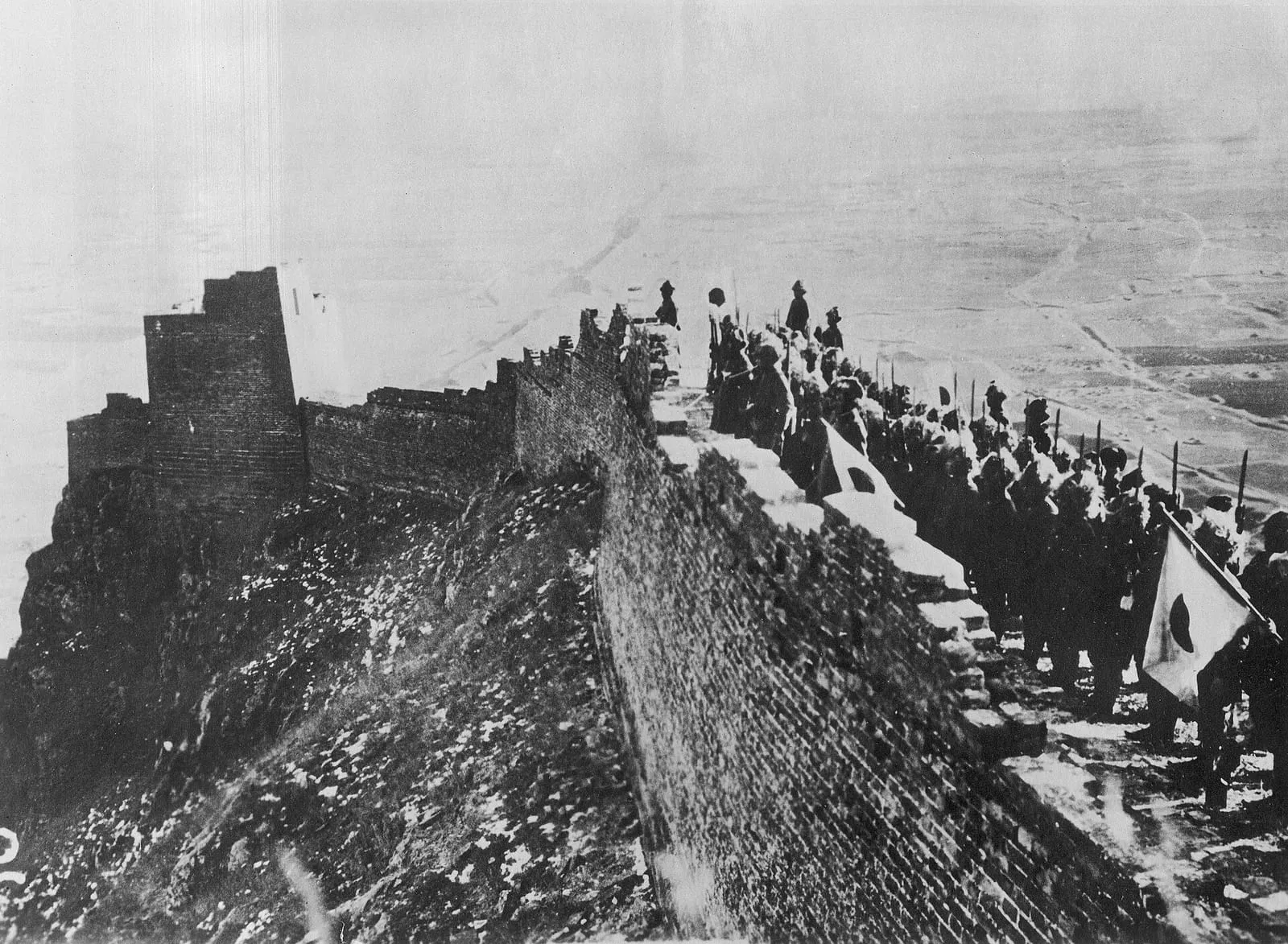
The defence of the Great Wall was a series of battles fought between Japan and China from January to May 1933 on the borderlands of Manchuria and northern China. Japan’s Kwantung Army, supported by troops of the puppet state of Manchukuo, first captured the fortress of Shanhaiguan at the eastern end of the Wall, then in less than two weeks overran the whole of Rehe province, and after that fought for nearly three months for the passes of the Wall, twice pushing south of it into Hebei province. At the passes Chinese units, worse armed but determined, put up a resistance the Japanese had met neither in Manchuria nor in Rehe. In the end, however, China had to accept the Tanggu Truce, which handed Japan the line of the Wall and opened its way into northern China. The campaign was the last act of the conquest begun at Mukden in 1931 and a portent of the war that broke out in 1937.
Name and dates
In China the campaign is called the defence of the Great Wall or the Great Wall War of Resistance (changcheng kangzhan), and the part concerning Rehe the Rehe War. In Japan it is known as the Rehe operation (Nekka sakusen), and the later fighting south of the Wall as the operations “inside the passes” (Kannai sakusen), that is, in China proper. Some English-language works use the name “the First Battle of Hebei”.
The campaign is usually taken to have begun on 1 January 1933, the day of the provocation at Shanhaiguan. Some authors date it from 23 February, when the offensive in Rehe got under way (some from 21 February, when the first clashes occurred on the provincial border), and treat the fighting at Shanhaiguan as its prelude. It is taken to have ended on 31 May 1933, the day the Tanggu Truce was signed, although combat had ceased a few days earlier, after the Chinese request for a ceasefire of 25 May.
Background
After the Mukden incident of 18 September 1931 the Kwantung Army occupied Manchuria within a few months, and on 1 March 1932 Manchukuo was proclaimed. From the outset its founders counted as part of the new state the province of Rehe as well, which had been carved out of Inner Mongolian lands in 1914 and turned into a province in 1928. Rehe, with its capital at Chengde, lay between Manchuria and Beijing. To the south it was closed off by the Great Wall, beyond which Hebei province began. It was ruled by General Tang Yulin, a former comrade-in-arms of Zhang Zuolin. He played a double game with Manchukuo and Nanjing, and his power rested on revenue from opium.
For the Kwantung Army, taking Rehe would settle the Manchurian question once and for all. The border of Manchukuo was to run along the Wall, which for centuries had separated China from the peoples of the steppe. From Rehe the Japanese could also hold Beijing in check. At first the army counted on Tang Yulin going over to Manchukuo, and when that failed it began to prepare a military operation. On the Chinese side responsibility for the defence lay with Zhang Xueliang, Zhang Zuolin’s son, who after the loss of Manchuria headed the northern branch of the Military Affairs Commission in Beijing and commanded the remnants of the North-Eastern Army. Chiang Kai-shek promised reinforcements, but the main government forces were fighting the communists in central China.
Forces
The Kwantung Army, commanded by General Nobuyoshi Mutō, who was at the same time Japan’s ambassador to Manchukuo, committed to the operation the 6th and 8th Divisions, the 14th and 33rd Mixed Brigades, the 4th Cavalry Brigade, a tank company, armoured cars and several air squadrons. The army’s chief of staff was General Kuniaki Koiso, and his deputy General Yasuji Okamura. According to various estimates the Japanese had between 40,000 and 50,000 men in the campaign. They were accompanied by units of Manchukuo and Chinese collaborators, which sources put at 30,000–40,000 men.
The Chinese had numerical superiority. In Rehe there were between 100,000 and 150,000 troops, according to various sources, and more than a dozen Chinese armies, over 200,000 men in all, took part in the campaign as a whole. They were, however, of very uneven quality. Tang Yulin’s troops were poorly trained and had not been paid for months. The North-Eastern Army was demoralised by the loss of Manchuria. Song Zheyuan’s 29th Army, which descended from the former forces of Feng Yuxiang, had good soldiers but few weapons and little ammunition. Only in March did the government divisions of Xu Tingyao’s 17th Army reach the front, partly trained and equipped on German lines. The Chinese lacked aircraft, artillery, anti-tank weapons and communications, and commanders from different factions did not trust one another.
Course of the campaign: Shanhaiguan
Shanhaiguan closed the coastal corridor from Manchuria into China along which the Beijing–Mukden railway ran. Under the protocol that ended the Boxer Rebellion, Japan kept a small garrison there. The fortress was defended by two battalions of the 626th Regiment of the Chinese 9th Independent Brigade under He Zhuguo. On the evening of 1 January 1933 several grenades exploded near the Japanese military police post and at the railway station. The Japanese blamed the Chinese and demanded that the southern part of the town be handed over to them. Many historians believe that the incident was arranged by the commander of the Japanese garrison himself.
On 2 January the Japanese occupied the station and attacked the gate, but were beaten off. Units of the 8th Division arrived by train to help them. On 3 January, after bombardment from aircraft, armoured trains and warships lying in the bay, Japanese infantry with tanks broke through the defences at a corner of the walls. An Dexin’s battalion was almost entirely wiped out, and the regimental commander, Shi Shian, withdrew the remnants of his men across the Shi River. Over the following days the Japanese took the surrounding hills and, on 10 January, the Jiumenkou pass. Then they halted. The government in Tokyo presented the clash as a local incident, while the Kwantung Army prepared the real operation.
Course of the campaign: Rehe
On 4 February Emperor Hirohito approved the Rehe operation on condition that the army would not cross the Great Wall or bomb areas south of it. According to Herbert Bix, the emperor later had misgivings, because an operation launched while the League of Nations was debating the Lytton Report risked sanctions, but he did not withdraw his consent. In mid-February ministers from Nanjing led by Song Ziwen (T. V. Soong) arrived in Beijing, and Zhang Xueliang and more than twenty generals declared that they would defend Rehe to the last. On 18 February the Manchukuo authorities announced an expedition against the “invaders” in Rehe. On 23 February Japan handed the Chinese government a demand to withdraw its troops from the province, and on the same day its forces moved off.
The Japanese struck from three directions. The 6th Division, with cavalry and Manchukuo units, advanced from the north-east on Kailu and Chifeng. General Yoshikazu Nishi’s 8th Division pushed along the main road from Jinzhou through Chaoyang, Lingyuan and Pingquan towards Chengde. The mixed brigades advanced from the coast, along the Wall, towards the Lengkou, Jielingkou and Xifengkou passes. The defence collapsed almost at once. Some Chinese commanders surrendered or went over to Manchukuo; others withdrew without a fight. Chaoyang fell in the last days of February, Lingyuan on 2 March. At Chifeng Sun Dianying’s troops held out for several days and even counter-attacked, but they too had to fall back.
Governor Tang Yulin commandeered military lorries, loaded them with his possessions, including opium, and sent them off to Tianjin. On the evening of 3 March he himself left Chengde. On 4 March the provincial capital was taken without a fight by a Japanese advance guard. Chinese sources state that it consisted of a mere 128 cavalrymen, accompanied by a few armoured cars and tanks. The vast, mountainous province had fallen in less than two weeks. The fall of Rehe shook China. On 9 March Chiang Kai-shek met Zhang Xueliang at Baoding and persuaded him to step down. On 12 March the government accepted his resignation, and command in northern China passed to the War Minister, He Yingqin. Zhang Xueliang soon left for Europe. The government issued a warrant for Tang Yulin’s arrest.
Course of the campaign: the battle for the passes
After taking Rehe the Japanese moved on the passes of the Wall in order to seal the border. Here the situation changed. At the passes in the Yan Mountains the defenders could make use of the terrain and of the structure itself: the walls and towers, built under the Ming dynasty to defend China from the north, served once again as fortifications, and the walkways linking them allowed soldiers to be shifted from one sector to another.
The most famous fighting took place at the Xifengkou pass, defended by Song Zheyuan’s 29th Army. On 9 March a Japanese brigade seized the pass. The Chinese, knowing that by day they stood no chance against Japanese artillery and aircraft, turned to night attacks. On the night of 11–12 March Zhao Dengyu’s brigade sent volunteer detachments over the mountains through the snow, armed with grenades and dadao – heavy, broad-bladed swords. They fell upon the Japanese encampments and artillery positions. The Chinese press announced a great victory and claimed that the Japanese had lost more than a thousand men. These figures are certainly exaggerated, but the attack took the enemy by surprise, and the 29th Army held its positions at Xifengkou for more than a month. On 17–19 March it also repulsed an attack on the neighbouring Luowenyu pass. The sword-bearing detachments became a symbol of resistance in China, and Song Zheyuan a national hero.
At the Gubeikou pass, on the road from Chengde to Beijing, the government divisions of the 17th Army, supported by units of the North-Eastern Army, fought from 10 March. Guan Linzheng’s 25th Division lost many officers, and its wounded commander handed over to Du Yuming. On 11 and 12 March the Japanese captured the pass and the surrounding hills. The Chinese fell back to positions at Nantianmen, a few kilometres to the south, and held them until May in heavy fighting under artillery fire and bombing. According to Chinese figures, Huang Jie’s 2nd Division alone lost more than six thousand killed and wounded in April. Further east there was fighting for the Lengkou, Jielingkou and Yiyuankou passes, which changed hands several times.
Course of the campaign: beyond the Wall
The Chinese troops, though unable to retake Rehe, clung on right at the foot of the Wall and sent detachments across to its northern side. The Kwantung Army concluded that the border of Manchukuo would not be secure until it had pushed them further back. On 27 March General Mutō ordered an operation in eastern Hebei, between the Wall and the Luan River. Around 10 April the Japanese broke through the defences at Lengkou and crossed the Wall. The Chinese troops abandoned the passes, Xifengkou included, and fell back behind the Luan.
Crossing the Wall violated the condition set by the emperor. On 18 April Hirohito asked his Chief Aide-de-Camp, General Shigeru Honjō, whether the army ought not to be given a direct order to withdraw. The General Staff in Tokyo, unwilling to allow such a humiliation, itself ordered the Kwantung Army back to the line of the Wall. By 23 April the Japanese had pulled back. Chinese troops, however, moved back into the abandoned localities, and the Kwantung Army regarded this as a provocation. Koiso went to Tokyo and obtained approval for a new operation.
At the beginning of May the 6th and 8th Divisions crossed the Wall again. This time the Chinese defence collapsed. The 17th Army abandoned its positions at Nantianmen, and the troops in eastern Hebei retreated westwards. By around 20 May the Japanese were at Miyun and Huairou, and their units had reached the vicinity of Tongzhou, a dozen or so kilometres from Beijing. In Tianjin General Seishirō Itagaki tried to stage a coup with the help of former militarists. The government in Nanjing, which had just thrown its best forces against the communists in Jiangxi, decided to ask for a ceasefire. On 25 May an officer of He Yingqin’s staff delivered a formal request for a cessation of hostilities to the Japanese command at Miyun, and the Japanese halted their advance.
The truce
Talks were held at Tanggu near Tianjin. On 31 May 1933 General Yasuji Okamura and the Chinese general Xiong Bin signed a document drawn up by the Japanese, which the Chinese were not allowed to change. The Chinese troops were to withdraw west and south of the line Yanqing – Changping – Shunyi – Tongzhou – Xianghe – Baodi – Ninghe – Lutai. The Japanese were to return “in principle” to the line of the Wall and were entitled to monitor compliance from the air. Between the Wall and that line a demilitarised zone was created, in which order was kept by Chinese police. The truce made no mention of Manchukuo, but in practice China resigned itself to the loss of Rehe and to the Great Wall becoming the border.
Rehe was incorporated into Manchukuo as one of its provinces. General Mutō did not enjoy his victory for long: he died in July 1933 in the Manchukuo capital, Xinjing (Changchun).
Losses
The data on losses are uncertain. According to a tally by the Chinese command, cited in the literature, between 1 January and 24 May 1933 the Chinese forces lost about 15,800 killed (including more than 500 officers) and about 22,600 wounded. Japanese losses were many times smaller: Chinese literature gives about 2,400 killed and wounded for the whole campaign, and according to estimates based on Japanese data fewer than two hundred Japanese soldiers were killed in the Rehe operation itself. It is not known how many Manchukuo soldiers or civilians died, although Japanese aircraft bombed Chinese towns and villages and the fighting took place among inhabited settlements.
Significance
The defence of the Great Wall ended in defeat for China. Within five months Japan had occupied the vast province of Rehe and anchored the border of Manchukuo on the Wall. In less than two years China had lost four north-eastern provinces. The League of Nations, which in February 1933 adopted the Lytton Report and refused to recognise Manchukuo, did nothing to help China. Japan left the League, and the whole world saw that aggression could go unpunished. The lesson was noted in Rome and Berlin.
The Tanggu Truce gave Chiang Kai-shek several years of relative calm in the north, which he used to force the communists onto the Long March, strengthen the government’s authority and, with the help of German advisers, modernise the army. But the state paid for that calm. The demilitarised zone became a base for further Japanese conquest. In 1935 the Japanese forced the removal of government troops from Hebei and Chahar and set up a puppet administration of eastern Hebei in the zone. In July 1937 a clash at the Marco Polo Bridge near Beijing started the Sino-Japanese War, and the Japanese took Beijing and Tianjin within a few weeks.
The 1933 campaign also left a lasting mark on Chinese memory. The fighting at Xifengkou and Gubeikou proved that the Chinese soldier could stand up to the Japanese, while Tang Yulin’s flight and the Tanggu Truce became symbols of the policy of appeasement. Growing opposition to that policy led in December 1936 to the kidnapping of Chiang Kai-shek in Xi’an by Zhang Xueliang and to the conclusion of a united front with the communists against Japan. It was Song Zheyuan’s 29th Army that defended the Marco Polo Bridge in July 1937. One of the best-known Chinese war songs, the “Big Sword March”, was written in 1937 in honour of that army’s soldiers, and its refrain recalls the swords with which they went into the attack at Xifengkou.