China
Zhang Zuolin
Military Governor of Fengtian (from 1916), ruler of Manchuria (1918–1928), Generalissimo and head of the Beijing government (1927–1928)
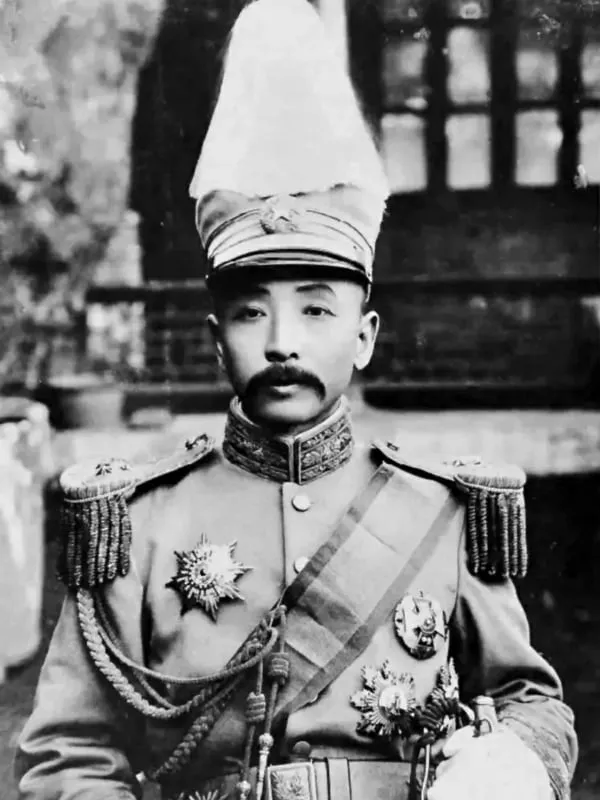
- Born:
- 19 March 1875, Haicheng, Fengtian Province (Qing Empire)
- Died:
- 4 June 1928, Mukden (Shenyang)
- Author:
- Natalia
- Photo:
- autor nieznany, domena publiczna, Wikimedia Commons

In the 1920s Zhang Zuolin was the most powerful of the Chinese warlords. Illiterate and a former leader of a mounted bandit gang, he ruled Manchuria like a sovereign principality, and in 1927 he proclaimed himself Generalissimo and took charge of the government in Beijing, which the world recognised as the government of China. Throughout his career he manoeuvred between Japan, which saw him as the guardian of its interests in Manchuria, and Chinese patriotism and his own ambitions. When he ceased to obey the Japanese and lost his war with Chiang Kai-shek, officers of Japan’s Kwantung Army blew up his train outside Mukden. The assassination foreshadowed the conquest of Manchuria in 1931, and the murdered man’s son, Zhang Xueliang, later played one of the leading parts in China’s road to war with Japan.
From a poor village to a bandit gang
He was born on 19 March 1875 in Haicheng County in southern Manchuria, in Fengtian Province (today Liaoning), into a poor peasant family. His grandfather had come there from Zhili province, fleeing famine like the hundreds of thousands of Chinese who in the 19th century settled the former homeland of the Manchus. His father was killed in 1889. The boy never went to school; he picked up a little veterinary knowledge, worked with horses at an inn and early on came to know the world of the mounted bandit gangs that abounded in Manchuria, where the authorities had little control. The Chinese called them “red beards”.
During the First Sino-Japanese War of 1894–1895 he served as a cavalryman, and after the war he returned home and became a gang leader himself. His men extracted protection money from merchants and villages and in time formed a small private army. Zhang later wryly called his bandit years his studies at the “university of the green forest”. Among his companions at the time was Zhang Jinghui, later prime minister of the puppet state of Manchukuo.
Around the turn of the century the imperial authorities, unable to suppress the gangs, began to win them over with the promise of service. Zhang accepted the offer, and his men became a unit of the Qing army hunting down other gangs. During the Russo-Japanese War, fought in 1904–1905 on Manchurian soil, he collaborated with the Japanese. According to Japanese tradition, he at first worked for the Russians and fell into the hands of the Japanese army, which wanted to execute him, but he was saved by General Gentarō Kodama, and the pardon was conveyed by a young major, Giichi Tanaka – the same man who more than twenty years later, as Prime Minister of Japan, would decide his fate. From then on Zhang had acquaintances and patrons in the Japanese army.
Lord of the Three Provinces
After the war Zhang rose in the forces of Fengtian Province. When the Xinhai Revolution broke out in October 1911, he helped the Governor of Manchuria suppress the republican movement in Mukden and killed many revolutionaries. When the empire fell, he quickly backed the new president, General Yuan Shikai, who made him a general and a divisional commander. After Yuan’s death in 1916 Zhang removed the governor sent from Beijing and became military and civil governor of Fengtian, helped by local Japanese officers. Within two years he had also brought Jilin and Heilongjiang under his control, and in 1918 the Beijing government appointed him Inspector-General of the Three Northeastern Provinces. From then on he was the de facto ruler of all Manchuria, except for Japan’s Kwantung Leased Territory and the Japanese railway zone, and his followers were known as the Fengtian clique.
Under his rule Manchuria became an almost independent state. In the early 1920s its finances were run by an able official, Wang Yongjiang, who put taxation in order, paid off debts and stabilised the currency. The province took in hundreds of thousands of settlers from northern China; Chinese railway lines, spinning mills, an arsenal at Mukden and Northeastern University were built, along with an air force and a river fleet. Zhang’s army grew from about 100,000 men in 1922 to several hundred thousand by the end of the decade and was among the best-equipped in China. It swallowed, however, a huge share of the revenue. Zhang lived lavishly and had several wives and more than a dozen children. He was known as the Old Marshal or the Tiger of Mukden.
The wars for Beijing
Manchuria was not enough for Zhang. After Yuan Shikai’s death China broke up into the spheres of influence of generals who fought for Beijing, because whoever held it had a government recognised by the powers and access to the customs revenue. In 1920 Zhang helped the Zhili clique to overthrow Duan Qirui, and in 1921 he imposed his own government on Beijing. In the spring of 1922 his troops were defeated by the army of the Zhili clique commanded by Wu Peifu. Zhang withdrew beyond the Great Wall and declared Manchuria independent of Beijing.
For two years he rebuilt his army, and in the autumn of 1924 he began a second war with the Zhili clique. It was decided by treachery: General Feng Yuxiang seized Beijing and overthrew President Cao Kun. Zhang and Feng then shared power in northern China, but soon fell out. In September 1924 Zhang concluded a separate agreement with the USSR on the Chinese Eastern Railway, which ran across northern Manchuria. In November 1925 his best general, Guo Songling, rebelled against him and marched on Mukden. Zhang was on the brink of defeat. He was saved by the Kwantung Army, which would not let the rebels cross the Japanese railway zone, and in December the revolt collapsed and Guo was killed. In return for this help the Japanese expected gratitude: new concessions, the right to lease land and permission to build further railway lines.
In 1926 Zhang, in alliance with his recent enemy Wu Peifu, drove Feng out of Beijing. He was now the strongest man in northern China. In December 1926 he took command of an alliance of the northern armies, called the National Pacification Army, which was to halt the Kuomintang’s Northern Expedition. He was a determined opponent of communism and of the USSR, whose advisers were then helping the Nationalists. On 6 April 1927, with the consent of the diplomatic corps, his police burst into part of the Soviet embassy compound in Beijing and arrested the Chinese communists hiding there. On 28 April, in the same weeks in which Chiang Kai-shek carried out the massacre of communists in Shanghai, Zhang had Li Dazhao, a co-founder of the Chinese Communist Party, and more than a dozen of his comrades hanged. On 18 June 1927 he proclaimed himself Generalissimo of the land and naval forces and took control of the Beijing government. He was the last head of state of the so-called Warlord Era to be recognised by the foreign powers.
Between Tokyo and Nanjing
Relations with Japan grew steadily worse. Zhang needed Japanese support but did not want to give the Japanese what they demanded, and as a leader who aspired to rule all of China he could not afford to be seen as their servant. He built Chinese railway lines competing with the South Manchuria Railway, delayed fulfilling his promises, and the wars he waged south of the Great Wall were ruining the Manchurian economy. The provincial currency, which in the early 1920s had been worth as much as the yen, had by early 1928 lost more than ninety per cent of its value against it. Some Japanese officers in Manchuria, among them a senior staff officer of the Kwantung Army, Colonel Daisaku Kōmoto, concluded that Zhang was ungrateful and had to be got rid of. Prime Minister Tanaka thought otherwise: he wanted Zhang to withdraw to Manchuria and rule there under Japanese protection.
In the spring of 1928 Chiang Kai-shek resumed the Northern Expedition, and the armies of Zhang and his allies began to fall back. In May Chiang’s troops clashed with the Japanese at Jinan in the Jinan Incident, but did not halt their advance. The Japanese pressed Zhang to leave Beijing before his defeated troops poured into Manchuria in disorder. Zhang finally agreed. Early in the morning of 3 June 1928 he left for Mukden on a special train.
Death beneath the viaduct
On 4 June at 5.23 a.m., as the train was passing under a viaduct of the Japanese South Manchuria Railway near Huanggutun station, a charge laid by Kōmoto’s men exploded. It was a carefully prepared assassination, whose perpetrators intended to pin the blame on Kuomintang agents. Zhang, gravely wounded, died a few hours later in his residence in Mukden. His entourage concealed his death for more than two weeks, until his eldest son, Zhang Xueliang, reached Mukden and took over. Zhang Zuolin’s death was officially announced on 21 June.
The assassins had counted on Manchuria sinking into chaos after the Old Marshal’s death, so that the Kwantung Army could march in to restore order. That did not happen. Zhang Xueliang, who knew who had killed his father, placed Manchuria under the National Government in Nanjing on 29 December 1928. Japan lost its most important partner in China and gained an enemy.
Legacy
Zhang Zuolin was a typical warlord of his era: brutal, cunning and loyal only to himself and his army, yet also a builder under whose rule Manchuria became one of the most rapidly developing regions of China. In the history of the road to the Second World War he left his mark above all through his death. His assassination was the first so blatant case of Kwantung Army officers acting on their own initiative to change Japan’s policy on the continent, and the first in which they got away with it. Three years later the same men and their successors staged the Mukden Incident and seized the whole of Manchuria. On the throne of the state they created they placed the last Emperor of China, Puyi, to whom Zhang had shown respect for years, and as prime minister they appointed Zhang’s old companion from his bandit days, Zhang Jinghui.
Zhang Xueliang, the Young Marshal, withdrew his army from Manchuria in 1931 almost without a fight, and in December 1936, in the Xi’an Incident, he detained Chiang Kai-shek and forced him into a front with the communists against Japan. He paid for it with more than fifty years of house arrest, first in China and then in Taiwan, and died in Hawaii in 2001 at the age of 100. Zhang Zuolin’s residence in Shenyang is now a museum, and in China the Old Marshal, for years condemned as a reactionary militarist and the killer of Li Dazhao, is today sometimes also presented as a man who refused to hand Manchuria over to the Japanese.
Sources
Mentioned in battles
(02)Often appears with
People who appear in the same events.