Japan
Seishirō Itagaki
Senior staff officer of the Kwantung Army (1929–1932), its Chief of Staff (1936–1937), War Minister (1938–1939), commander of the Korean Army (1941–1945), general
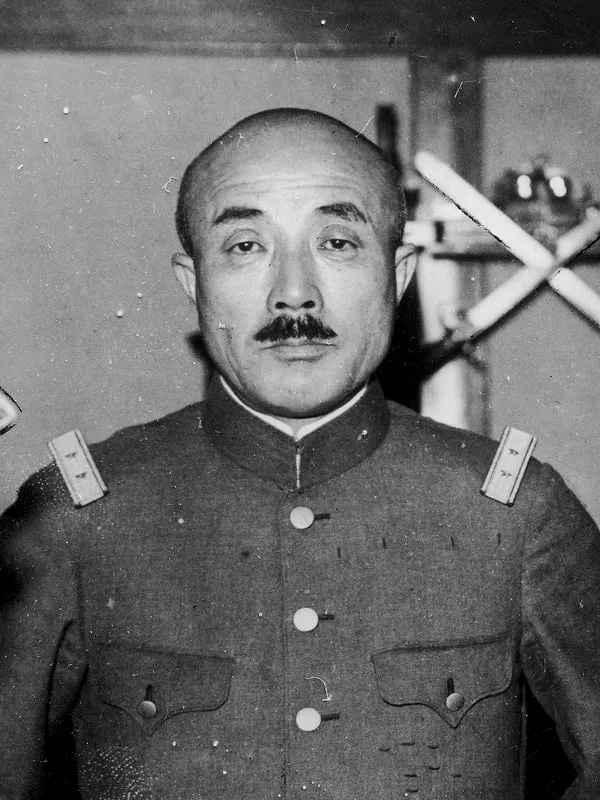
- Born:
- 21 January 1885, Numakunai, Iwate Prefecture (Japan)
- Died:
- 23 December 1948, Tokyo (Sugamo Prison)
- Author:
- Łukasz
- Photo:
- autor nieznany, domena publiczna, Wikimedia Commons

Seishirō Itagaki was one of the two officers who on 18 September 1931 staged the Mukden Incident and so began the Japanese conquest of Manchuria. It was he who, that night, standing in for an absent commander, gave the order to attack the Chinese barracks and the old city of Mukden. Over the following years he was one of the creators and the real rulers of the puppet state of Manchukuo, and as Chief of Staff of the Kwantung Army he pursued policies that drew Japan ever deeper into the affairs of northern China. In the Sino-Japanese War he commanded a division, in 1938–1939 he was War Minister, and later he served as chief of staff of the Japanese forces in China and as commander of the army in Korea. In September 1945 in Singapore he signed the surrender of the Japanese forces in South-East Asia. The Tokyo tribunal sentenced him to death.
From Iwate to the army
He was born on 21 January 1885 in the village of Numakunai in Iwate Prefecture, in the north of the island of Honshu (some sources give his birthplace as Morioka, where he went to school). He came from a samurai family of the Morioka domain. His grandfather was a Confucian scholar and his father an official and the head of a girls’ school. The family followed Nichiren Buddhism. At secondary school in Morioka he was a contemporary of the future admiral and prime minister Mitsumasa Yonai and of the poet Takuboku Ishikawa.
He graduated from the cadet school in Sendai and, in October 1904, from the Military Academy, in the same class as Kenji Doihara, Tetsuzan Nagata and Yasuji Okamura, who would become pillars of the army. As a young second lieutenant he fought in the Russo-Japanese War. He married the daughter of his former tutor at the Sendai cadet school, Kenkichi Ōkoshi, who had been killed at the Battle of Mukden in 1905. In 1916 he graduated from the Army Staff College.
A China expert
Itagaki spent most of his career dealing with Chinese affairs. In 1917 he was in Kunming in south-western China, then on the staff of the Japanese forces in central China and in the China section of the General Staff, and in 1924–1927 he was assistant military attaché at the legation in Beijing. He was one of the army’s “China experts”, officers who believed that a China torn apart by warlords was incapable of building a modern state and that Japan ought to “guide” it. He was also a member of the junior officers’ associations that at the end of the 1920s merged into the Isseki-kai, a group seeking to reform the army and to settle the Manchurian question by force. In 1928, as a colonel, he commanded the 33rd Infantry Regiment.
Mukden
In May 1929 Itagaki became senior staff officer of the Kwantung Army in Port Arthur, succeeding Colonel Daisaku Kōmoto, the organiser of the assassination of Zhang Zuolin. The head of the operations section there was already Lieutenant Colonel Kanji Ishiwara. Itagaki was no theorist like Ishiwara, but he adopted his plan for seizing Manchuria and became its chief executor. He later said that without Manchuria Japanese heavy industry had no foundation and that a future war with the Soviet Union would be fought on the plains of northern Manchuria.
In the spring of 1931 Itagaki, Ishiwara and two intelligence officers prepared a provocation on the South Manchuria Railway. On 18 September Itagaki stayed in Mukden, officially to welcome General Yoshitsugu Tatekawa, who had been sent by the General Staff to stop the plot. He spent the evening with him, and when a charge exploded on the tracks outside the city at 10.20 p.m., he issued the orders to attack from the building of the Japanese special mission. When the Japanese consul suggested negotiations, Itagaki replied by asking whether the consulate intended to interfere in matters of military command. For several years afterwards only his version reached the public: that the Chinese had blown up the track.
In the following months, as the Kwantung Army, in defiance of Tokyo, occupied the whole of Manchuria (the Japanese invasion of Manchuria), Itagaki negotiated with the Manchurian generals and politicians who were to form the new authorities. According to testimony given after the war by General Ryūkichi Tanaka, in January 1932 Itagaki gave him 20,000 yen to stir up incidents in Shanghai that would divert the world’s attention from Manchuria. An attack on Japanese monks in Shanghai preceded the Shanghai Incident.
Ruler of Manchukuo
After the proclamation of Manchukuo in March 1932 Itagaki became adviser to its nominal head, Puyi, and head of the special mission in Mukden, and in August he was promoted to major general. During the operations in Rehe province in 1933 he directed intrigues from Tianjin intended to provoke a coup in northern China against the government of Chiang Kai-shek, but they came to nothing. After a journey to Europe he returned to Manchukuo in 1934 as senior military adviser; in December that year he became Deputy Chief of Staff, and in March 1936 Chief of Staff of the Kwantung Army, soon afterwards being promoted to lieutenant general.
According to the testimony of his subordinates, under his influence the Kwantung Army controlled every decision of the supposedly independent state. Itagaki supported a plan to settle a million Japanese families in Manchuria within twenty years. He also argued that China should not be unified and that Japan should cooperate with its individual regions. He backed the autonomists in northern China and the Mongol prince Demchugdongrub, whose troops, armed by the Kwantung Army, launched the unsuccessful Suiyuan campaign in November 1936. Ishiwara, by then on the General Staff, came to Manchuria to stop these moves, but his former colleagues ignored him.
At war with China
In March 1937 Itagaki took command of the 5th Division from Hiroshima. After the Marco Polo Bridge Incident the division fought near Beijing, in Chahar province and in Shanxi. On 25 September 1937 at the Pingxingguan pass the 115th Division of the communist Eighth Route Army under Lin Biao ambushed the supply train and part of his division. It was the first celebrated Chinese victory of the war, and the two sides described its scale very differently. After heavy fighting at Xinkou, Japanese troops took Taiyuan in November. In the spring of 1938, in the Battle of Xuzhou, Itagaki’s division was halted at Linyi and was unable to support the units that suffered a heavy defeat at Taierzhuang.
War Minister
On 3 June 1938 Itagaki became War Minister in the government of Fumimaro Konoe. He was regarded as a man who could persuade the army to make peace with China, but that did not happen. In peace talks he demanded Chiang Kai-shek’s resignation, and his vice-minister was Hideki Tōjō. In July 1938, during the fighting at Lake Khasan, he asked Emperor Hirohito for permission to use force, assuring him that the Foreign Minister and the Navy Minister supported it. The Emperor knew this was untrue and rebuked him sharply, declaring that without his order the army would not move a single soldier.
Itagaki remained War Minister in the government of Kiichirō Hiranuma from January 1939. At meetings of the Five Ministers’ Conference he pressed for turning the Anti-Comintern Pact into a military alliance with Germany directed also against Britain and France, which the diplomats and the navy opposed. In December 1938 the same conference, on his motion, adopted principles under which Japan was not to expel Jews from its territories, contrary to the policy of its German ally. In the summer of 1939 he supported the actions of the Kwantung Army in the conflict with the Soviet Union at Khalkhin Gol, which ended in a Japanese defeat. When Germany signed its pact with the Soviet Union in August 1939, the Hiranuma government fell and Itagaki lost his post.
The last years of the war
In September 1939 he became Chief of Staff of the China Expeditionary Army in Nanjing. He took part in setting up the collaborationist government of Wang Jingwei and in secret peace talks with Chiang Kai-shek’s representatives, which collapsed partly because Japan demanded recognition of Manchukuo. In July 1941, promoted to full general, he became commander of the army in Korea. The post, far from the fronts, was regarded as a sidelining. This army supported the policy of forced Japanisation of Koreans pursued by the Government-General of Korea and, from 1944, the conscription of Koreans into the army. In April 1945 Itagaki took command of the 7th Area Army in Singapore, whose area covered Malaya, Sumatra, Java and Borneo. On 12 September 1945 in Singapore he signed the surrender of the Japanese forces in South-East Asia before Admiral Louis Mountbatten.
Trial and execution
Itagaki was taken from Singapore to Tokyo and brought before the International Military Tribunal for the Far East. The tribunal found him guilty of taking part in a conspiracy to wage aggressive war, of waging aggressive wars against China, the United States, Britain, the Netherlands and the Soviet Union (including at Lake Khasan and Khalkhin Gol), and of war crimes. The last charge concerned the prisoner-of-war camps and civilian internment camps in the territories under his command in 1945, where prisoners died of hunger, disease and ill-treatment. On 12 November 1948 Itagaki was sentenced to death. He was hanged on 23 December 1948 in Sugamo Prison in Tokyo, together with Hideki Tōjō, Kenji Doihara, Iwane Matsui and three other condemned men. Their ashes were scattered over the Pacific.
In his prison diary, on the anniversary of the Mukden Incident, Itagaki wrote that the Manchurian Incident had been a success and that the mistake had been only the later meddling in Chinese affairs, for which he “deserves ten thousand deaths”. In 1978, together with others condemned by the Tokyo tribunal, he was enshrined among the spirits venerated at the Yasukuni Shrine, which still provokes protests in China and Korea.
Significance
Itagaki embodied the generation of Japanese officers who in the 1930s seized the initiative from the politicians. He was no ideologue but a man of action: colleagues praised his calm and his ability to win people over, while critics, even within the army, accused him of recklessness and of pursuing a policy of faits accomplis. His decision on the night of 18 September 1931 launched the conquest of Manchuria, and his later activities in Manchukuo and northern China prepared the ground for the war with China in 1937. As War Minister he could neither end that war nor restrain the army from new conflicts. His prison note that the mistake had been China, not Manchuria, captures well the thinking of the men who set Japan on the road to war.
Sources
Commanded in battles
(02)Mentioned in battles
(05)Often appears with
People who appear in the same events.