China
Zhang Xueliang
Ruler of Manchuria and commander of the Northeastern Army (1928–1933), Deputy Commander-in-Chief of China (1930–1933), deputy commander of the anti-communist campaign in Xi'an (1935–1936)
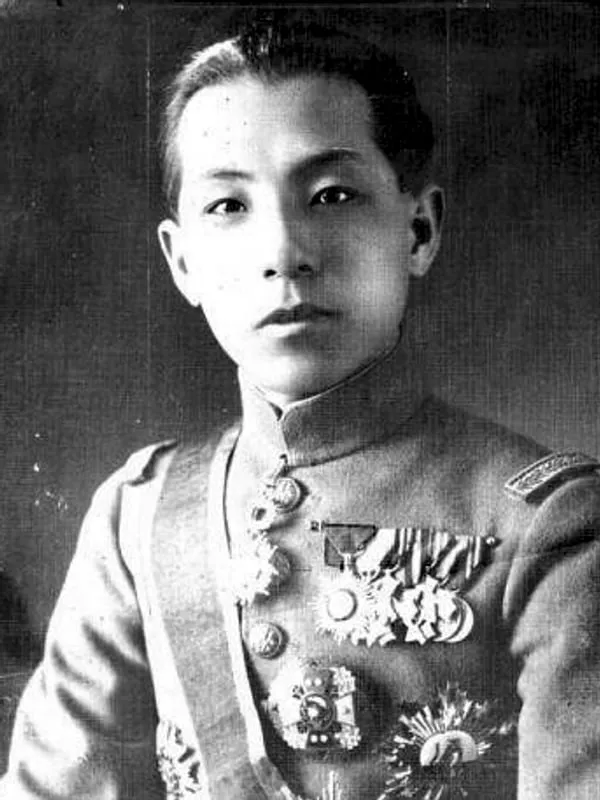
- Born:
- 3 June 1901, Haicheng County, Fengtian province (Qing Empire)
- Died:
- 14 October 2001, Honolulu (Hawaii, United States)
- Author:
- Łukasz
- Photo:
- Central Archive Press, domena publiczna, Wikimedia Commons

Zhang Xueliang, known as the Young Marshal, was twenty-seven when he inherited from his father, murdered by the Japanese, power over Manchuria and one of the largest armies in China. His life became entwined with Asia’s road to the Second World War at two moments. In September 1931, when the Japanese Kwantung Army struck at Mukden, he ordered his troops not to resist, and within a few months he had lost the whole of Manchuria, for which his compatriots called him the “non-resistance general”. Five years later, in December 1936, he detained China’s leader, Chiang Kai-shek, at Xi’an and forced him to end the war against the communists and prepare for war with Japan. He paid for it with more than half a century of detention – probably the longest political imprisonment of the twentieth century – and died in Hawaii at the age of a hundred.
Son of the Old Marshal
He was born on 3 June 1901 (some sources give 1898 or 1900) in Haicheng County in southern Manchuria, the eldest son of Zhang Zuolin, at that time the leader of a mounted bandit gang and soon an officer of the imperial army and ruler of the three north-eastern provinces. His mother died when he was eleven. Unlike his illiterate father, he received a careful education from private tutors, and unlike him he was at ease in the company of foreigners. In 1916 he married Yu Fengzhi, chosen by his family.
He graduated from the military academy in Mukden (Shenyang) and in 1919, as a colonel, became commander of his father’s bodyguard. In 1921 he went to Japan to observe military manoeuvres and was fascinated by aviation. On his return he organised the air arm of the Fengtian army, and by 1922, at the age of twenty-one, he was already a general commanding a large force in his father’s wars for Beijing. A major role in his career was played by the able general Guo Songling, his mentor and deputy, who in November 1925 rebelled against Zhang Zuolin. The revolt was put down with Japanese help, and Guo was killed. In the mid-1920s the young general became addicted to opium, and his love affairs were the talk of the whole of northern China.
Changing the flag
On 4 June 1928 officers of the Japanese Kwantung Army blew up the train in which Zhang Zuolin was returning from Beijing to Mukden. The Old Marshal died a few hours later. His son made his way to Mukden disguised as a soldier, and those around him concealed his father’s death until he had taken over power. At the beginning of July he became commander of the north-eastern forces and the de facto ruler of Manchuria.
The Japanese expected him to be weaker and more pliable than his father. They were wrong. Zhang knew who had killed his father, and although the Japanese prime minister, Giichi Tanaka, warned him through a special envoy, he opened talks with the Kuomintang government in Nanjing. On 29 December 1928 the flags of the Republic of China were raised on buildings across Manchuria, and China was, for the first time in years, at least formally united under Chiang Kai-shek. On 10 January 1929 Zhang invited to his residence two veterans of the Fengtian clique, General Yang Yuting and the governor of Heilongjiang, Chang Yinhuai, whom he suspected of conspiracy and close ties with the Japanese, and had them shot.
The Young Marshal wanted to modernise Manchuria. He was rector of Northeastern University in Mukden, funded schools, and built Chinese railway lines to compete with the Japanese South Manchuria Railway, as well as a new port at Huludao intended to take traffic away from Japanese-held Dalian. In 1929, however, he made a serious mistake. On 10 July his authorities seized the Chinese Eastern Railway, run jointly with the USSR, and arrested its Soviet employees. Moscow broke off diplomatic relations, and in the autumn Vasily Blyukher’s Special Far Eastern Army routed Zhang’s troops in a short war over the railway. The Khabarovsk Protocol of 22 December 1929 restored Soviet control of the line. Kwantung Army officers followed this war closely and concluded that Zhang’s army was no formidable opponent.
In 1930 China was engulfed by a civil war in which Generals Yan Xishan and Feng Yuxiang took the field against Chiang Kai-shek. Both sides courted Zhang. On 18 September 1930 he declared his support for Nanjing and moved troops into Beijing (then called Beiping) and Tianjin, which decided the war. As a reward Zhang became Deputy Commander-in-Chief of the army, navy and air force – the second man in the state – and his authority extended beyond Manchuria to a large part of northern China. He moved to Beijing, and his best units, more than 100,000 men, were stationed south of the Great Wall.
The non-resistance general
On the evening of 18 September 1931 Kwantung Army officers, Colonel Seishirō Itagaki and Lieutenant Colonel Kanji Ishiwara, set off an explosion on the railway near Mukden and blamed it on Zhang’s soldiers. The Japanese invasion of Manchuria had begun. Zhang was in Beijing at the time, being treated for typhoid. Since the summer he had been ordering his commanders to avoid any clashes with the Japanese, and when shots rang out in Mukden he ordered them not to resist. For years it was debated whether this order came from Chiang Kai-shek, who was then busy fighting the communists in Jiangxi and did not want war with Japan before he was ready for it. Zhang himself, in interviews given after he regained his freedom in the 1990s, claimed that he had taken the decision on his own, because he did not believe the Japanese would go so far and was counting on intervention by the League of Nations. Historians also stress that he wanted to preserve the army that was the basis of his power. In any case the policy was in line with Nanjing’s.
Within days the Japanese took Mukden, Changchun and Jilin. Zhang moved the Liaoning provincial authorities to Jinzhou, which Japanese aircraft bombed on 8 October, and in October he appointed General Ma Zhanshan governor of Heilongjiang; Ma was the only one to offer the Japanese serious resistance, on the Nen River in November. When at the end of December the Japanese advanced on Jinzhou, Zhang withdrew his troops behind the Great Wall, and on 3 January 1932 the Japanese occupied the city without a fight. Harbin fell in February, and on 1 March 1932 the puppet state of Manchukuo was proclaimed, headed by the last emperor, Puyi. Zhang had lost his patrimony, his revenues and the base of his power. The press and students accused him of cowardice, and his army became an army of exiles.
He did, however, retain power in northern China. At the beginning of 1933 the Japanese attacked Rehe province, defended by his subordinate, General Tang Yulin. The defence collapsed in less than two weeks, and on 4 March 1933 a Japanese detachment entered the provincial capital, Chengde, which Tang had abandoned. Zhang took responsibility and in March 1933, after a conversation with Chiang Kai-shek, resigned.
Europe and the war against the communists
In the spring of 1933 Zhang underwent a detoxification cure in Shanghai and rid himself of his opium addiction. In April he left for almost a year in Europe. He spent the longest time in Italy, where he was received by Benito Mussolini and became friends with his daughter Edda and his son-in-law, Galeazzo Ciano. He returned in January 1934 impressed by fascism, convinced that China needed a single strong leader, and declared his complete obedience to Chiang Kai-shek.
Chiang appointed him deputy commander of the campaign against the communists in Henan, Hubei and Anhui provinces, with headquarters in Wuchang, and in the autumn of 1935, when Mao Zedong’s Red Army ended the Long March in northern Shaanxi, transferred him to Xi’an as deputy commander of the headquarters for the suppression of “bandits” in the north-west. The Northeastern Army, which had not fought the Japanese, was now to fight the Chinese. In the autumn of 1935 the communists destroyed two of its divisions. Its soldiers and officers, who had not seen their homes for four years, wanted to return to Manchuria with weapons in their hands, not to die in a civil war.
Zhang began to seek an understanding with the enemy. At the beginning of 1936 he established secret contacts with the communists, and in April 1936 he met Zhou Enlai in Yan’an. A de facto truce settled over the front. Zhang urged Chiang to end the civil war and join in fighting Japan, but Chiang was convinced that the communists were close to defeat, and kept repeating that the Japanese were a disease of the skin, but communism a disease of the heart. In December 1936 he flew to Xi’an to prepare the final offensive in person.
Xi’an
In the early hours of 12 December 1936 the soldiers of Zhang and of General Yang Hucheng, commander of the Shaanxi provincial forces, surrounded Chiang’s residence at the Huaqing hot springs outside Xi’an. Chiang fled up the mountainside but was found a few hours later. The conspirators announced eight demands, the most important being an end to the civil war, the formation of a government of national unity and the taking up of the fight against Japan. Negotiations lasted two weeks, involving Zhou Enlai, sent from Yan’an, Chiang’s brother-in-law T. V. Soong (Song Ziwen) and his wife, Soong Mei-ling. On 25 December Chiang was released, having signed no document but with verbal promises. Zhang, wishing to show that he had not acted out of a desire for power, flew with him to Nanjing. So ended the Xi’an Incident, one of the turning points in the history of China.
In Nanjing Zhang was arrested. On 31 December 1936 a military court sentenced him to ten years’ imprisonment. A few days later, on 4 January 1937, the government pardoned him, but on condition that he remain under the “strict supervision” of the Military Commission. That supervision lasted more than fifty years. The Northeastern Army was broken up. The civil war, however, was over. The talks between the Kuomintang and the communists, conducted throughout 1937, led after the outbreak of war with Japan in July to the formation of the Second United Front.
Fifty years of detention
Throughout the Sino-Japanese War Zhang was a prisoner. He was moved from place to place: from Chiang’s home region in Zhejiang to Anhui, Hunan, Guizhou and the outskirts of Chongqing. At first he was accompanied by his wife, Yu Fengzhi, who in 1940 went to the United States for medical treatment, and later by his long-time companion Zhao Yidi (Edith Chao), who voluntarily shared his captivity. The communists demanded his release several times, including during the peace talks after 1945, but Chiang never agreed. In November 1946 Zhang was taken to Taiwan. His partner at Xi’an, Yang Hucheng, imprisoned since 1937, was murdered by Kuomintang agents together with his son and daughter in September 1949, shortly before the communists took Chongqing.
On Taiwan Zhang lived in seclusion. He studied the history of the Ming dynasty, collected painting and calligraphy, converted to Christianity and in 1964, after divorcing Yu Fengzhi, married Zhao Yidi. Over time the restrictions were eased. Yet he did not regain his freedom either after the death of Chiang Kai-shek in 1975 or immediately after the death of Chiang’s son and successor, Chiang Ching-kuo, in January 1988. The restrictions were lifted gradually, and 1990 is regarded as the end of his detention, when his ninetieth birthday was celebrated publicly and he gave interviews for the first time in half a century (according to some sources his freedom was formally restored as early as March 1988). In 1991 he travelled abroad for the first time, to the United States.
Last years and memory
In the mid-1990s (sources give 1993 or 1995) Zhang settled with his wife in Honolulu. The authorities of the People’s Republic of China repeatedly invited him to visit Manchuria, but he declined, citing his health and his wish not to take sides. Zhao Yidi died in June 2000. Zhang died of pneumonia in Honolulu on 14 October 2001 (in China and Taiwan it was already 15 October), at the age of a hundred.
In the People’s Republic of China Zhang Xueliang is regarded as a national hero, “meritorious for all time”, because his coup at Xi’an saved the communists from destruction and united China for the struggle against Japan. On Taiwan he was long considered a traitor who had saved the communists, and in the eyes of many Chinese his record is still burdened by 1931, when he gave up Manchuria without a fight. On the road to the Second World War he played both roles. His decision not to resist allowed the Japanese to take Manchuria almost without loss and convinced them that China would not fight. His coup at Xi’an meant that when the Marco Polo Bridge Incident came in July 1937, China was already fighting, and the war that grew into the eight-year Sino-Japanese War became part of the Second World War in December 1941.
Sources
Commanded in battles
(02)Mentioned in battles
(02)Often appears with
People who appear in the same events.