- Category:
- Military operations
- Front:
- Far East
- Date:
- 18 September 1931
- Author:
- Łukasz
- Tags:
- Japan, China, Manchuria, Japanese imperialism
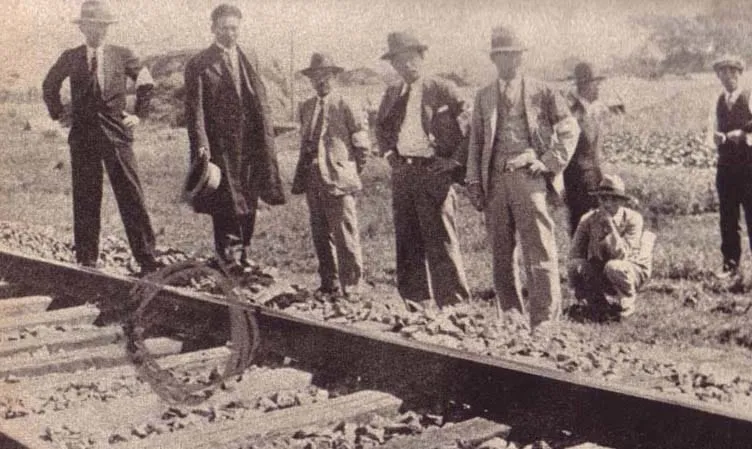
On 18 September 1931, at about 10.20 p.m., a small charge exploded on the track of the Japanese-owned South Manchuria Railway a few kilometres north of Mukden (Shenyang), at a spot called Liutiaohu. It damaged a few dozen centimetres of one rail and two sleepers. A few minutes later the express from Changchun passed over the same track without difficulty and arrived in Mukden on schedule at 10.30 p.m. The Japanese command nevertheless announced at once that Chinese soldiers had blown up the line and fired on a Japanese patrol. That same night Japanese units attacked the nearby barracks of the Chinese army and the old city of Mukden. The explosion was a provocation: the charge had been laid by Japanese soldiers, and the whole operation had been planned by two staff officers of the Japanese Kwantung Army, Colonel Seishirō Itagaki and Lieutenant Colonel Kanji Ishiwara. The Mukden incident, which the Japanese called the Manchurian incident and the Chinese the 18 September incident, opened the way to the conquest of the whole of Manchuria.
It is often said that the Japanese blamed the explosion on “Chinese dissidents”. In fact they accused the regular Chinese army – soldiers of the Northeastern Army of the Young Marshal, Zhang Xueliang – because it was precisely with them that they wanted to provoke a clash.
Manchuria after the assassination of Zhang Zuolin
Japan had held special rights in Manchuria since the Treaty of Portsmouth of 1905: the lease of the Kwantung Leased Territory at the southern tip of the Liaodong Peninsula, the South Manchuria Railway from Changchun to Port Arthur (Lüshunkou), and a strip of land along the line in which it exercised administration and kept troops. The Kwantung Army grew out of this garrison. Its officers regarded Manchuria as a prize paid for in blood in the war with Russia, and at the same time as a shield against the USSR and a source of the raw materials Japan lacked.
In June 1928 Colonel Daisaku Kōmoto of the same army organised the assassination of Marshal Zhang Zuolin, the ruler of Manchuria. The assassination did not provide a pretext for war, and in December 1928 Zhang’s son, Zhang Xueliang, submitted to Chiang Kai-shek’s government in Nanjing. Chinese nationalism was growing in Manchuria. The authorities built railway lines parallel to the Japanese one and made it harder for Japanese and Koreans to lease land, and the South Manchuria Railway, also hit by the Great Depression, made a loss in 1930 for the first time in its history. In Japan, mired in a severe economic crisis, the right accused the Foreign Minister, Kijūrō Shidehara, of “weak diplomacy”. In January 1931 an opposition deputy, Yōsuke Matsuoka, a former vice-president of the railway, called Manchuria and Mongolia Japan’s “lifeline” in parliament.
In the summer of 1931 tension rose. In June Chinese soldiers in western Manchuria shot Captain Shintarō Nakamura, an officer of the Japanese General Staff who had been reconnoitring the area in disguise. When the affair came to light in August, the Japanese press presented it as the murder of an innocent traveller. In July, in the village of Wanbaoshan near Changchun, a dispute between Chinese peasants and Korean settlers over an irrigation canal turned into a clash with the Japanese police. No one was killed, but exaggerated reports provoked anti-Chinese pogroms in Korea in which more than a hundred people died.
The plan of Ishiwara and Itagaki
Ishiwara joined the Kwantung Army staff in October 1928 as head of the operations section, and in May 1929 Itagaki succeeded Kōmoto as senior staff officer. Both belonged to a circle of younger officers who wanted to reform the army and solve the “Manchuria–Mongolia problem” by force. Ishiwara, a military thinker and a follower of a nationalist strand of Nichiren Buddhism, foresaw a future “final war” between Japan and the United States. Manchuria was to provide Japan with raw materials and a base, and its seizure was to forestall the growing strength of the USSR, whose Red Army had defeated Zhang Xueliang’s forces in 1929 in the conflict over the Chinese Eastern Railway. Itagaki, the senior in rank, was no theorist, but he backed the plan firmly and had a gift for winning people over.
According to Ishiwara’s diary, on 31 May 1931 he, Itagaki and two intelligence officers – Major Tadashi Hanaya of the special mission in Mukden and Captain Shintarō Imada, a military adviser to Zhang Xueliang – agreed on an “action against the railway”. The attack was to take place at the end of September. In Tokyo several senior officers knew of the plot, and according to Hanaya’s memoirs, published after the war, those who looked on it favourably included the head of the General Staff’s operations division, General Yoshitsugu Tatekawa, and the commander of the Japanese army in Korea, General Senjūrō Hayashi.
At the beginning of September rumours of the Kwantung Army’s plans reached the Foreign Ministry. Shidehara protested to the War Minister, Jirō Minami, and Emperor Hirohito, on the advice of Prince Kinmochi Saionji, questioned the minister about discipline in the army. The General Staff sent Tatekawa to Manchuria to restrain the plotters. Warned by a telegram from Tokyo, Itagaki and Ishiwara brought the operation forward by about ten days. On 18 September Tatekawa arrived in Mukden, and Itagaki, who had stayed in the city to greet him, took him to a Japanese inn, where the general spent the evening over sake.
The explosion on the track
The charge was laid, with the help of a few soldiers, by Lieutenant Suemori Kawamoto of the 3rd Company of the 2nd Battalion of the Independent Railway Guard, stationed at Hushitai near Mukden. The explosive had been prepared by Captain Imada. The spot was chosen with care: a stretch of straight track on open ground, about 800 metres from Beidaying, the large barracks housing some 7,000 Chinese soldiers. Captain Tadashi Kawashima’s company was holding exercises a few kilometres away that night and, on hearing the explosion, set off towards the barracks. According to the later official version, it came under Chinese fire.
Itagaki was waiting in the building of the Japanese special mission in Mukden. As the senior staff officer on the spot, in the absence of the army commander, General Shigeru Honjō – who had returned with Ishiwara that evening from an inspection to headquarters at Port Arthur – he ordered an attack on Beidaying and on the old walled city of Mukden, the seat of the Manchurian authorities. When Consul Morito Morishima hurried to the mission and proposed settling the matter by negotiation, Itagaki asked him whether the consulate intended to interfere in the affairs of the military command, which was answerable only to the emperor. Major Hanaya drew his sword as he did so. Only after the orders had been issued did Hanaya send telegrams to Port Arthur and Tokyo reporting that the Chinese had destroyed the railway and that fighting was under way.
The telegram reached Port Arthur at 11.46 p.m. Honjō initially wanted to confine himself to disarming the Chinese units in the vicinity, but Ishiwara and the other staff officers persuaded him that the Chinese forces had to be crushed throughout the railway zone. At about 1.30 a.m. Honjō issued the orders Ishiwara had prepared and asked Hayashi’s Korea Army for reinforcements.
The attack on Beidaying and Mukden
The Chinese soldiers at Beidaying were taken by surprise. The Japanese shelled the barracks with, among other weapons, two heavy 24-centimetre howitzers that had earlier been secretly brought from Japan and emplaced in the grounds of the Japanese barracks in Mukden. The Chinese resisted only here and there, because they had orders from Zhang Xueliang not to return fire in response to Japanese provocations and not to give a pretext for war. All night the Chinese authorities in Mukden telephoned the Japanese consulate, insisting that they were offering no resistance and asking for the attack to stop. By 6.30 a.m. on 19 September the Japanese had taken Beidaying. According to Japanese figures they lost 2 killed and 22 wounded there, and counted about 300 bodies of Chinese soldiers on the battlefield. At the same time the 29th Infantry Regiment attacked the old city and took it before dawn. The Japanese seized the arsenal, the airfield and some 60 of Zhang Xueliang’s aircraft.
Zhang Xueliang himself was in Beijing at the time, recovering from an illness, and the best part of his army was with him. Of the more than 200,000 soldiers of the Northeastern Army, a large proportion were stationed south of the Great Wall, and the rest were scattered across Manchuria. The Kwantung Army then numbered some 10,000 men, but it was concentrated along the railway, well trained in night fighting and able to count on reinforcements from Korea. A day later it became clear that the capture of Mukden was only the beginning.
A lie Japan believed
On the morning of 19 September the Japanese press and radio carried the army’s version: Chinese soldiers had blown up the railway and the Japanese had acted in self-defence. Most Japanese at home believed it and greeted the army’s actions with enthusiasm. The diplomats had their doubts. The consul-general in Mukden, Kyūjirō Hayashi, cabled Shidehara that very night that the army intended to occupy the entire railway zone, and suggested that the incident might have been planned. Knowledge of the provocation circulated in government and court circles in Tokyo, but no one made it public. Japanese documents and memoirs from 1931–1932, and testimony before the Tokyo tribunal after the war, confirmed that the explosion was the work of the Kwantung Army. The details of the preparations were revealed in 1956 by Tadashi Hanaya in his published memoirs. Today no serious historian in either China or Japan disputes who was behind the provocation.
The League of Nations commission headed by Victor Bulwer-Lytton, which investigated the affair in 1932, did not determine who had caused the explosion, but it concluded that the damage to the track could not justify the Japanese military operations, which were not self-defence.
Even the name of the place was false for years. Itagaki gave the consulate and journalists the name Liutiaogou (“Liutiao ditch”), and the press wrote of a “bridge”, although in reality it was an ordinary stretch of track on open ground near the hamlet of Liutiaohu (“Liutiao lake”). The wrong name survived in Japan and in many books long after the war. Japanese historians restored the correct one from the late 1960s, and Chinese historians followed in the 1980s.
Was this the beginning of the Second World War?
Many regard the Mukden incident as the beginning of the Second World War in Asia. This is, however, only one of several views. In Japan the term “Fifteen Years’ War” has been used since the 1950s for the whole period from 18 September 1931 to the surrender in 1945. It was coined by the philosopher Shunsuke Tsurumi and popularised by historians who stressed the continuity of Japanese expansion. In China, since 2017, school textbooks have spoken of a “fourteen-year War of Resistance” dated from the Mukden incident, rather than, as before, an “eight-year” war beginning in 1937. Some historians point out that this change also served a political purpose.
Other historians recall that between the Tanggu Truce of May 1933 and July 1937 China and Japan were not fighting a regular war, maintained diplomatic relations, and Chiang Kai-shek’s government avoided combat. Most of them therefore date the beginning of the Sino-Japanese War to July 1937 and the beginning of the world war to September 1939 or, for Asia and the Pacific, to December 1941. All agree, however, that the road to war in Asia began at Mukden.
The long shadow of the Mukden incident
Within a few months of 18 September the Kwantung Army, in defiance of the government in Tokyo and of the resolutions of the League of Nations, had occupied the whole of Manchuria and set up the puppet state of Manchukuo there. Japan left the League, and in the following years its troops and agents pushed ever deeper into northern China, until full-scale war broke out in 1937. Mukden set the pattern for this course. Middle-ranking officers planned a provocation, started a war without orders and presented the government with a fait accompli – and instead of punishment they received promotions and decorations. Ishiwara and Itagaki became heroes, and the Japanese army acquired an entrenched habit of insubordination towards superiors known as gekokujō, “the lower overthrowing the higher”.
The consequences were global, too. The League of Nations, facing its first serious test by a great power, confined itself to a commission of inquiry and a condemnation, and the Kellogg–Briand Pact, which Japan had signed in 1928, proved powerless against a war called an “incident”. Britain, mired in economic crisis, and the United States were unwilling to risk a conflict in the Far East. Mussolini in Ethiopia and Hitler in Europe soon learnt the lesson. In China 18 September became a day of remembrance: every year on that date sirens wail in many cities.
Sources
Related events
(04)The same battle, people or subject.
- 27 February 1932 · Far EastThe end of the fighting in ManchuriaBy late February 1932 the Kwantung Army held every major city in Manchuria. Regular Chinese resistance had collapsed, but a guerrilla war was just beginning.
- 7 January 1932 · DiplomacyThe Stimson DoctrineOn 7 January 1932 the US told Japan and China it would not recognise any situation or agreement in Manchuria reached in breach of the Kellogg–Briand Pact.
- 1 March 1932 · Far EastThe proclamation of ManchukuoOn 1 March 1932 the “independent” state of Manchukuo was proclaimed in Japanese-occupied Manchuria. At its head stood Puyi, the last emperor of China.
- 28 January 1932 · Far EastThe Shanghai incidentOn 28 January 1932 Japanese naval infantry attacked the Chinese district of Zhabei in Shanghai. Five weeks of fighting ended with an armistice on 5 May.