1937–1945: The Sino-Japanese War
Operation Ichi-Go
- Dates:
- 17 April – 10 December 1944
- Front:
- Far East
- Location:
- Central and southern China along the Beijing–Hankou and Canton–Hankou railways and the Hunan–Guangxi railway: the provinces of Henan, Hunan, Guangxi and southern Guizhou, from the Yellow River near Zhengzhou to the border of French IndochinaOn the battle map →
- Sides:
- China (National Revolutionary Army) and the United States (Fourteenth Air Force)Chiang Kai-shek, Joseph Stilwell, Claire Chennault, Xue Yue, Tang Enbo, Fang XianjueJapan (China Expeditionary Army)Shunroku Hata, Yasuji Okamura, Isamu Yokoyama
- Result:
- Japanese operational victory. The Japanese took the Beijing–Hankou and Canton–Hankou railways, captured the forward bases of the Fourteenth Air Force and linked up with their forces in Indochina, shattering a large part of the Nationalist army. They did not achieve their strategic aim: B-29s bombed Japan from the Marianas, and China did not drop out of the war.
- Author:
- Natalia
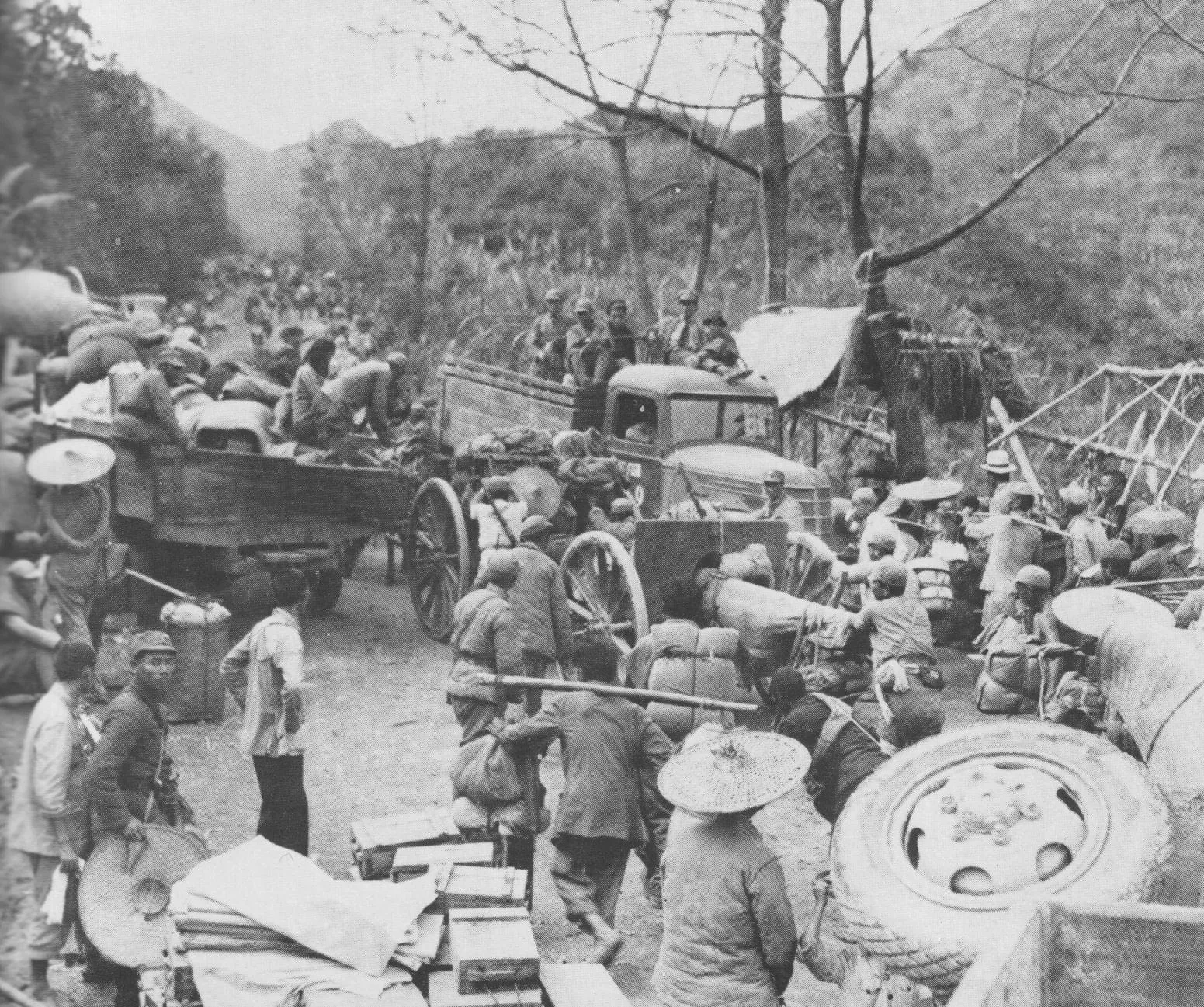
Operation Ichi-gō was the largest land offensive in the history of the Japanese army and the last great campaign of the Second Sino-Japanese War. From mid-April to early December 1944 some half a million Japanese soldiers advanced from northern Henan through Hunan to Guangxi and right up to the border of French Indochina. On the way they smashed several Chinese war zones, captured Luoyang, Changsha, Hengyang, Guilin and Liuzhou, and took from the Americans the forward airfields used by General Claire Chennault’s air force. Militarily it was a great Japanese victory; strategically it was almost useless. Politically, however, the campaign struck the government of Chiang Kai-shek harder than any earlier defeat: it laid bare the decay of his army, brought about a crisis in relations with Washington and led to the recall of General Joseph Stilwell.
Name and dates
The Japanese name Ichi-gō sakusen simply means “Operation Number One”. Japanese documents also used the term Tairiku datsū sakusen – “operation to break through the continent”. The whole was divided into two parts: Operation Kogo (Ko-gō), the seizure of the Beijing–Hankou railway in Henan, and Operation Togo (To-gō), the march south along the Canton–Hankou and Hunan–Guangxi railways. The Chinese call this fighting the Battle of Henan–Hunan–Guangxi (Yu Xiang Gui huizhan), and its parts the Battle of Central Henan, the Battle of Changsha and Hengyang, and the Battle of Guilin and Liuzhou.
The start is taken to be the night of 17–18 April 1944, when a company of the Japanese 37th Division crossed the new bed of the Yellow River near Zhongmou in Henan. The main body of the 12th Army had been crossing a rebuilt railway bridge since 14 April, but the attack proper began only that night. The end is dated to 10 December 1944, when near Suilu in Guangxi the leading units of the Japanese 37th Division met an advance detachment of the 21st Division that had come up from Indochina. This created on the map a continuous Japanese corridor from Manchuria to Vietnam. The raid deep into Guizhou, in which the Japanese reached Dushan in early December, ended in the same days. The fighting of January 1945 for the southern section of the Canton–Hankou railway and for the airfields in eastern Hunan and Jiangxi is treated as a sequel rather than part of the operation.
Background
At the beginning of 1944 Japan was losing the war in the Pacific. The Americans had taken the Gilbert Islands and landed in the Marshalls, submarines were sinking more and more transports, and the sea route from South-East Asia to Japan was becoming unreliable. Imperial General Headquarters therefore planned two great land offensives for that year: one in Burma against India (Operation U-Go) and one in China. The China plan was approved by Emperor Hirohito on 24 January 1944. According to Japanese studies the operation had two main aims. The first was to destroy the bases of the American Fourteenth Air Force in south-eastern China, from which Chennault’s aircraft attacked Japanese coastal shipping and Taiwan, and from which heavy B-29 bombers might reach the Japanese home islands. The second was to seize a continuous railway line from Beijing through Wuhan and Canton to Indochina, which would replace the threatened sea route. The headquarters of the China Expeditionary Army under General Shunroku Hata extended these aims to include destroying as much of the Chinese army as possible. Some historians suppose that Tokyo also hoped a defeat would push the government in Chongqing into talks.
The forces assembled were enormous. According to Japanese figures some 500,000 men were assigned to the operation (510,000 in some studies), together with about 100,000 horses, 1,500 guns, 800 tanks, 15,000 vehicles and 200 bombers, with fuel for eight months and ammunition for two years. The Japanese historian Takeshi Hara called it the largest operation in the history of the Japanese army. The figure of “more than 600,000 soldiers” found in some chronologies is an exaggeration.
China entered the seventh year of the war exhausted. Inflation was wrecking the economy and soldiers’ pay; units obtained their own food, traded and smuggled, and corruption was growing. Divisions were often at half their establishment strength or less. In Henan the population had only just lived through the great famine of 1942–1943, made worse by grain requisitions for the army. Chiang Kai-shek had long been warning Roosevelt that the Allies’ concentration on Europe, agreed at the Tehran Conference after the promises made at Cairo, would encourage Japan to attack. At the same time the Americans were pressing for the best divisions in Yunnan, trained by them (the so-called Y Force), to join the offensive in Burma; in April they even threatened to suspend Lend-Lease deliveries. Chinese intelligence misread the Japanese preparations: it was believed that the bridge over the Yellow River would not be ready before May, and troop movements in the north were taken to be a feint.
Course of operations: Kogo – Henan (April–June 1944)
The first phase was conducted by the Japanese 12th Army under General Eitarō Uchiyama, part of General Yasuji Okamura’s North China Area Army: the 37th, 62nd and 110th Divisions, an independent mixed brigade, the 3rd Tank Division and a cavalry brigade – by various estimates 60,000–70,000 men in the first echelon, and more with reserves. Facing them was the Chinese 1st War Zone under General Jiang Dingwen, whose deputy and the actual commander of most of the troops was General Tang Enbo. On paper the war zone numbered hundreds of thousands of soldiers; in reality its divisions were often at 60–70 per cent of their strength, and Chennault himself called these units an “ill-disciplined mob”.
After crossing at Zhongmou the Japanese struck the rear of the Chinese positions. On the morning of 19 April they took Zhengzhou; on 20 April the main body of the 12th Army attacked the 85th Army near Bawangcheng and then routed the Chinese 23rd Division near Mixian. On 26 April Chiang Kai-shek ordered Xuchang to be held to the last; the city fell on 1 May, and the commander of the New 29th Division defending it, General Lü Gongliang, was killed. Tang Enbo’s armies coming to the rescue were broken within a week. On 9 May the Japanese 27th Division, advancing from the south from the direction of Wuhan, met the forces from the north near Queshan – the whole length of the Beijing–Hankou railway was now in Japanese hands.
Okamura then turned the 12th Army west towards Luoyang, the old capital and the main centre of the 1st War Zone. Chiang wanted to repeat the tactics that had served him well in the battles for Changsha: to let the Japanese surround a fortified city and then strike their extended flanks. According to Jiang Dingwen, however, he received permission to counter-attack only on 1 May, when it was already too late, and communications between headquarters had all but broken down. The Japanese encircled Luoyang on 14 May and took it after fighting on 23–25 May. The commander of the 36th Army Group, General Li Jiayu, was killed. At the same time the Japanese 1st Army from Shanxi crossed the Yellow River near Yuanqu and entered Shaanxi; it threw back a counter-attack by General Hu Zongnan’s troops near Lingbao in early June and then returned to its starting positions.
The defeat in Henan did not have only military causes. A population worn down by famine and requisitions was unwilling to help its own army. According to the accounts of Chinese commanders and of the American correspondent Theodore H. White, peasants refused to break up the roads, disarmed and sometimes killed fleeing soldiers and seized abandoned weapons; Jiang Dingwen wrote of a situation resembling a peasant uprising. White judged that within three weeks a Chinese army of 300,000 men had “ceased to exist”. Losses are hard to establish: Tang Enbo himself reported more than 58,000 killed, wounded and missing in his two army groups, and the total losses of the 1st War Zone are estimated at nearly 100,000. The Japanese official history (Senshi sōsho) gives, up to the capture of Luoyang, some 37,500 killed and 15,000 taken prisoner on the Chinese side, and about 850 killed and 2,500 wounded on its own.
Course of operations: Togo – Changsha and Hengyang (May–August 1944)
The second and larger phase was conducted from Wuhan by the 11th Army under General Isamu Yokoyama – according to Japanese figures some 200,000 men in several divisions, later reinforced by more. Hata, promoted to field marshal in June 1944, moved to Wuhan on 25 May to supervise the offensive in person. It began on 27 May in three columns on a front about 150 kilometres wide, heading south along the Canton–Hankou railway and the Xiang River. The defence here was in the hands of General Xue Yue’s 9th War Zone, which had three times driven the Japanese back from Changsha in 1939–1942 and had fought in the Battle of Changde in the autumn of 1943. This time its old tactics – a fighting retreat and scorched earth, followed by a blow against an exhausted enemy – failed, because the Japanese came in far greater strength and were well supplied. Matters were made worse by relations within the Chinese command: Chiang suspected Xue Yue of disloyalty and kept him short of supplies.
Changsha was defended by three under-strength divisions of General Zhang Deneng’s 4th Army, some 10,000 men in all against about 30,000 Japanese. Two of them and the artillery were placed on Mount Yuelu on the other side of the river. Japanese aircraft bombed the batteries on Yuelu, the infantry outflanked the city, and the shifting of units across the river threw the defence into disorder – many soldiers took vague orders as an instruction to retreat. Changsha fell on 18 June after three days of fighting. Zhang Deneng was later executed on Chiang Kai-shek’s orders.
The Japanese met real resistance only at Hengyang, an important railway junction on the Xiang. The fighting for the city lasted from 23 June to 8 August. It was defended by the Chinese 10th Corps (10th Army) under General Fang Xianjue – some 17,000–18,000 men in concrete fortifications, well supplied with artillery and anti-tank guns, with flooded rice paddies to the west and hills to the south. On 25–26 June the Japanese took the nearby American airfield, and on 28 June the Japanese 68th and 116th Divisions launched the first assault. It was halted with heavy losses. The second assault, on 11–16 July, moved the front forward by only one line of defence. The Japanese brought up more divisions and aircraft, which reduced the city to ruins, while the Chinese relief armies attacked piecemeal and to no effect.
Hengyang ran out of food and ammunition. Chennault, whose aircraft were supporting the defenders, asked General Stilwell to release 1,000 tons of supplies from Lend-Lease deliveries for the troops in Hunan. Stilwell, who controlled those deliveries and was absorbed in the campaign in northern Burma, refused – according to the US official history, he was convinced that Chinese politics would in any case prevent the weapons from being used against the Japanese. The quarrel between the two Americans, which had dragged on since the creation of the Fourteenth Air Force, flared up with new force over Hengyang. Five Japanese divisions launched the final assault on 3 August and broke through the northern wall on 7 August, and on the morning of 8 August Fang Xianjue, with the remnant of some 3,000 men, most of them wounded, opened surrender talks and was taken prisoner. In September he escaped, and in December he was received in Chongqing by Chiang Kai-shek. The forty-seven-day defence made Hengyang a symbol in China, which the press of the time compared with Stalingrad. Chinese estimates of the Japanese losses at Hengyang equal or exceed the strength of the entire garrison; Japanese figures are much lower.
Course of operations: Togo – Guangxi and the march towards Indochina (August–December 1944)
The heavy fighting for Hengyang alarmed Imperial General Headquarters. On 15 June the Americans had landed on Saipan, and after the fall of the Marianas B-29 bombers could reach Japan from Pacific islands – one of the main aims of Ichi-gō was losing its point. In Tokyo some staff officers, warning of a “second Imphal”, wanted to break off the operation and transfer the troops to the Pacific. The view of the head of the Operations Section, Colonel Takushirō Hattori, prevailed, however: he argued that the airfields at Guilin and Liuzhou had to be taken before the expected fighting in the Philippines. At the end of August the 6th Area Army was formed under Okamura’s command, with the 11th and 23rd Armies subordinated to it. The 11th Army, made up to strength with tens of thousands of recruits, pushed on along the Hunan–Guangxi railway and on 4 September took Lingling (today Yongzhou) with another American airfield, while the 23rd Army was approaching from the direction of Canton (Guangzhou).
In early November, after halting and resuming their advance, the Japanese struck at Guilin and Liuzhou. Guangxi was the power base of the clique of General Li Zongren and General Bai Chongxi, who decided that neither city could be held and withdrew their main forces; some 20,000 soldiers remained in Guilin, mostly stragglers from Hengyang. Most of the inhabitants had fled beforehand, and the city burned. The Americans blew up their bases before the enemy arrived. The 11th Army, contrary to the plans of the area army command, attacked both cities at once and by 10–11 November had taken them without the expected great battle. In Guilin the commander of the 131st Division, General Kan Weiyong, who had refused to retreat, was killed. Hata later suspected that the Guangxi leaders had been saving their troops for the post-war power struggle. On 24 November the 23rd Army took Nanning. Chinese sources attribute to the Japanese the deaths of more than 200,000 civilians in Guangxi – in reprisals, during looting and in the course of the fighting; these figures have not been independently verified. On 27 November, because of an error in recording the target, American aircraft bombed the small town of Liuzhai, held by the Chinese, killing according to Chinese figures some 1,000 soldiers of the 4th War Zone headquarters and many refugees.
At the end of November the Japanese 3rd and 13th Divisions entered Guizhou and on 2 December reached Dushan on the road to Guiyang, the provincial capital. There were no longer any serious forces on the road to Chongqing and Kunming – the terminus of the airlift from India. Panic broke out in Chongqing; the new American commander, General Albert Wedemeyer, was preparing a plan for the defence of Kunming, and according to American accounts even the evacuation of the government was considered, which Chiang opposed. The Japanese, however, were at the end of their strength: their supply lines stretched for more than 1,000 kilometres, fuel and ammunition were short, and the soldiers were living by plundering the surrounding villages. Sent against them were, among others, the armies of the 8th War Zone, which had until then been blockading the Communists in north-western China, and divisions flown in from Burma. The Japanese withdrew from Dushan, and on 10 December near Suilu units of the 37th Division met the troops from Indochina, which the command regarded as the end of the operation.
The Stilwell crisis
The defeats in China coincided with the most acute crisis in Sino-American relations of the war. As early as the autumn of 1943 Chiang had tried to get rid of General Stilwell, his chief of staff and commander of American forces in China, Burma and India. In the summer of 1944 Stilwell saw the collapse of the front as proof that only he could save the situation, and persuaded General George Marshall to have Roosevelt demand that Chiang give him unrestricted command of all Chinese forces. Chiang responded evasively to the first such appeal. On 19 September Stilwell personally handed him a much sharper message from the President, threatening to cut off aid, even though Roosevelt’s special envoy Patrick Hurley had asked for a delay. Chiang treated it as a humiliation and a threat to China’s sovereignty; he demanded Stilwell’s recall, while agreeing to accept any other American general.
On 18 October Roosevelt gave way and recalled Stilwell. His functions were divided: in China he was replaced by General Albert Wedemeyer, and command of the forces in Burma and India passed to General Daniel Sultan. The recall set off a wave of criticism of Chiang’s government in the American press – the New York Times correspondent Brooks Atkinson wrote of “the political triumph of a moribund, anti-democratic regime”. Censorship had previously softened the picture of Nationalist China; now the decay of the army and the corruption of the state apparatus became a public issue in the United States. There were changes on the Japanese side too: on 22–23 November Okamura replaced Field Marshal Hata as commander of the China Expeditionary Army.
Losses
The losses on both sides are known only approximately. On the Chinese side, estimates cited in the literature (by Cox among others) speak of some 750,000 soldiers killed, wounded, taken prisoner or simply lost – deserted or scattered so that their units ceased to exist. Japanese tallies gave tens of thousands of abandoned Chinese bodies and prisoners in each phase, but did not cover the whole operation. Huge quantities of weapons and equipment were also lost, and China lost territory inhabited by tens of millions of people, including important agricultural and industrial districts.
Japanese losses were smaller, but by no means light. According to Japanese figures 11,742 soldiers had been killed by mid-November, and more than twice as many died of disease, exhaustion and malnutrition; some Japanese studies estimate the total number of dead by the end of 1944 at around 100,000. Civilian victims ran into the hundreds of thousands – people died in the fighting, in bombing raids, while fleeing and at the hands of the soldiers of both armies, which lived off requisitions; the exact number cannot be established. The Americans lost several main bases of the Fourteenth Air Force and many smaller airstrips.
Significance
On the map, Ichi-gō was the greatest Japanese land victory since 1942. The Japanese took the Beijing–Hankou railway and – after the fighting of January 1945 – the whole of the Canton–Hankou railway; formally it was now possible to travel by rail from Korea to Vietnam. In practice the corridor was too long to guard, the railway lines were constantly being cut by guerrillas, and only two divisions passed through the whole corridor on foot to Indochina. The Japanese controlled the towns and the railway lines, not the countryside. In the spring of 1945, faced with the threat in the Pacific, they themselves began to evacuate the territory they had taken in Guangxi and Hunan.
The air objective also proved illusory. The B-29 bases around Chengdu in Sichuan, from which bombers had been attacking Japan and Manchuria since June 1944, were not captured; the Americans moved the bombers from China to the Marianas at the beginning of 1945 mainly because of the difficulty of supplying them by air over the Himalayas. Chennault’s lost forward airfields were rebuilt further inland. At the same time the operation tied down huge forces at a moment when Japan was losing in the Pacific and the parallel offensive against Imphal was ending in disaster in India.
The most lasting consequences were political. The campaign finished off the economy and finances of the Nationalist government, forced it to reform the army (cutting fictitious establishment posts under the direction of General Chen Cheng, who succeeded He Yingqin as Minister of War) and did lasting damage to Chiang Kai-shek’s prestige in the United States. In Washington it was finally accepted that Japan would be defeated from the Pacific, not from China. Behind the Japanese corridor Mao Zedong’s Communists were expanding their bases and their influence among the peasantry. The Cambridge historian Hans van de Ven considers that, for the post-war order in Asia, Ichi-gō was as significant as Overlord or Bagration in Europe: the government of Chiang Kai-shek, weakened by it, lost the civil war a few years later.