United States
Joseph Stilwell
Military attaché in China (1935–1939), chief of staff to Chiang Kai-shek and commander of US forces in China, Burma and India (1942–1944), commander of the Tenth Army (1945), general
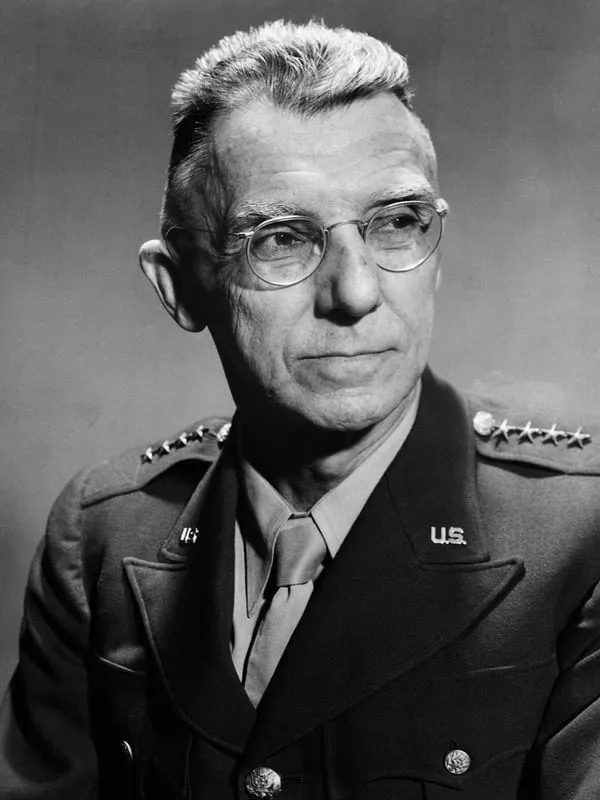
- Born:
- 19 March 1883, Palatka, Florida (United States)
- Died:
- 12 October 1946, San Francisco
- Author:
- Natalia
- Photo:
- autor nieznany, domena publiczna, Wikimedia Commons

Joseph Warren Stilwell was the best-known and at the same time the most controversial American commander of the war on the Asian mainland. An infantry officer who had spent well over a decade in China in all and spoke Chinese, he was sent to Chongqing in February 1942 as chief of staff to Chiang Kai-shek and commander of American forces in China, Burma and India. For almost three years he tried to rebuild the Chinese army, retake Burma and reopen a land route to China, clashing incessantly with the Generalissimo, with the British and with the commander of the American air force in China. Recalled in October 1944, he became in the United States a symbol of the honest soldier defeated by a corrupt regime, and to others an example of a commander whose stubbornness and contempt for his allies harmed the common cause. His story is the key to understanding why the American–Chinese alliance, concluded with such high hopes after Pearl Harbor, brought both sides so much disappointment.
Early life and West Point
He was born on 19 March 1883 in Palatka, Florida, into a family settled for generations in New York State, and grew up in Yonkers. His father, a doctor, brought him up strictly and religiously, which left the boy with a lasting dislike of the church. At high school he was a good pupil and athlete, but also a ringleader of pranks. His father decided that the boy would go not to Yale, as planned, but to the military academy at West Point. There Stilwell showed a talent for languages, coming top of his class in French; he ran cross-country and played football, and he is also credited with introducing basketball to the academy. He graduated in 1904, 32nd out of 124.
His first posting took him to the Philippines, where the American army was still suppressing the remnants of the guerrilla resistance. He later taught at West Point, and in 1910 he married Winifred Smith; they had five children. In 1911, during his second tour in the Philippines, he visited China for the first time, just as the revolution that overthrew the Qing dynasty was under way. That journey began his bond with the country that was to shape the rest of his life.
War in France and the first years in China
In the First World War Stilwell served in France as an intelligence officer. As head of the intelligence section of IV Corps he took part in planning the Saint-Mihiel offensive in September 1918 and in operations in the Woëvre, for which he received the Distinguished Service Medal.
In 1919 he became the first army officer sent to study Chinese, first at the University of California, Berkeley and from 1920 in Beijing. China was then divided among rival warlords, and the country was stricken by famine. In 1921 Stilwell served as chief engineer on a road-building project in Shanxi province run as part of famine relief, and in 1922 on the construction of a road in Shaanxi, in territory controlled by General Feng Yuxiang. Working side by side with Chinese labourers, he formed a conviction he kept for ever: the ordinary Chinese peasant, if well treated, fed and led, makes a tough and brave soldier, and the weakness of Chinese armies is the fault of their commanders.
After returning to the United States in 1923 he completed courses at the Infantry School at Fort Benning and the Command and General Staff School at Fort Leavenworth. In 1926–1929 he was again in China, as a battalion commander in the 15th Infantry Regiment in Tianjin, the unit guarding American interests in northern China. For several months he served there under the eye of the regiment’s executive officer, Lieutenant Colonel George Marshall. It was an acquaintance that would decide his career. In 1927, during the Northern Expedition of the Kuomintang forces, Stilwell made a dangerous reconnaissance journey to Xuzhou and watched the disintegration of the northern warlords’ armies at close quarters.
Fort Benning and “Vinegar Joe”
From 1929 to 1933 Stilwell headed the tactics department of the Infantry School at Fort Benning, brought there by Marshall, who was the school’s assistant commandant. Together they carried out the so-called Benning revolution: instead of elaborate written orders and rigid schemes, officers were taught simple orders, rapid appreciation of the situation and improvisation in the field. Many of the later generals of the Second World War passed through their hands. Stilwell could be merciless in his critiques of exercises. One officer stung by his remarks drew a caricature of him rising out of a vinegar bottle. Stilwell pinned it on the noticeboard, photographed it and sent copies to his friends, and the nickname “Vinegar Joe” stuck to him for good. On his desk he kept a joking motto in mock Latin, Illegitimi non carborundum – “Don’t let the bastards grind you down”.
Attaché in Beijing
From 1935 to 1939 he was military attaché at the American legation in Beijing (then Peiping). From there he watched mounting Japanese pressure on northern China and, from July 1937, after the Marco Polo Bridge Incident, the full-scale Sino-Japanese War. He travelled to the fronts, talked to Chinese and Japanese officers and analysed the course of battles in minute detail, from the fighting for Shanghai through the fall of Nanjing to the Battle of Xuzhou and the Chinese victory at Tai’erzhuang in 1938. He concluded that the Japanese army was dangerous but not invincible, and that the Chinese army suffered above all from bad leadership, lack of weapons and corruption. His reports were among Washington’s best sources of knowledge about the war.
After returning home in 1939 Stilwell, by now a brigadier general, commanded a brigade of the 2nd Infantry Division in Texas, and in 1940, as a major general, he formed and trained the 7th Infantry Division at Fort Ord, California. His care for ordinary soldiers and disregard for ceremony earned him a second nickname there, “Uncle Joe”. In the summer of 1941 he took over III Corps and during the great manoeuvres was regarded as one of the best corps commanders in the army.
Mission to China
After the attack on Pearl Harbor Stilwell was named to command the planned invasion of French North Africa, then code-named Gymnast. But when China asked for a senior American officer to serve as chief of staff to Chiang, the supreme commander of the China theatre established after the Arcadia Conference, and the first candidate, General Hugh Drum, considered the post too subordinate, Marshall proposed Stilwell. On 23 January 1942 Stilwell accepted the mission with the words “I’ll go where I’m sent”, and on 2 February he received his orders. He was to be Chiang’s chief of staff, commander of American forces in China, Burma and India, administrator of Lend-Lease aid and commander of whatever Chinese forces the Generalissimo assigned to him. Promoted to lieutenant general, he reached China at the beginning of March.
Defeat in Burma
When Stilwell arrived, the Japanese, after the disaster on the Sittang, were just taking Rangoon. Chiang gave him, at least formally, command of the Chinese Fifth and Sixth Armies, which had entered Burma to defend the Burma Road. In practice Chinese generals such as Du Yuming often waited for orders to be confirmed by Chongqing, and the Generalissimo himself came to Burma and issued instructions over Stilwell’s head. The Chinese 200th Division fought bravely at Toungoo, and in April a regiment of Sun Liren rescued the British 1st Burma Division, surrounded at Yenangyaung, but the campaign ended in defeat. At the end of April the Japanese took Lashio and cut the Burma Road.
Stilwell refused to be evacuated by air and in May 1942 led a party of more than a hundred people – soldiers, doctors, nurses and civilians – on foot through jungle and mountains to Imphal in India, setting a pace his people called the “Stilwell stride”. The trek took about two weeks and ended without loss. In Delhi he told journalists: “I claim we got a hell of a beating.” Driven out of Burma, he added, they had been humiliated; they ought to find out why, go back and retake it. His frankness won him the sympathy of Americans weary of communiqués about “planned withdrawals”. Chiang, however, regarded his departure from the troops as the abandonment of the Chinese divisions, many of which fought their way to India and Yunnan with heavy losses.
Ramgarh, the Hump and the Ledo Road
After the loss of Burma China could be supplied only by air over the Himalayas, a route known as “the Hump”. Stilwell believed that this was not enough. At Ramgarh in India he set up a centre where Americans trained and equipped Chinese soldiers withdrawn from Burma; by the end of 1942 more than 30,000 men were there. His plan called for the recapture of northern Burma, the construction of a road from Ledo in Assam to the Burma Road, and the equipping of thirty and later more Chinese divisions, which together with the Americans would one day strike the Japanese in China.
The plan drew him into three conflicts at once. Chiang wanted supplies and aircraft but did not want to hand his best divisions over to foreign command or to risk them in Burma to recover a British colony. General Claire Chennault, former commander of the Flying Tigers and from 1943 commander of the Fourteenth Air Force, argued to the Generalissimo and Roosevelt that Japan could be defeated from the air, and competed with Stilwell for the meagre supplies flown over the Hump. The British in India, led by General Archibald Wavell, had neither the forces nor the inclination for a major offensive in Burma, and Stilwell openly suspected them of caring more about their empire than about the war against Japan. In his diary he did not spare contemptuous epithets either for the British or for Chiang, whom he called “Peanut”.
From 1943 Stilwell held several posts at once: he was Chiang’s chief of staff, commander of American forces in the China–Burma–India theatre, deputy supreme commander of the new South East Asia Command under Admiral Louis Mountbatten, and commander of the Chinese–American forces on the northern Burma front. At Cairo in November 1943 he met Roosevelt, Churchill and Chiang. Around the turn of 1943 and 1944 his India-trained Chinese divisions pushed into the Hukawng Valley, while the American long-range penetration unit of Frank Merrill, known as Merrill’s Marauders, outflanked Japanese positions through the jungle. On 17 May 1944 the Chinese and Americans took the Japanese by surprise and captured the airfield at Myitkyina, but the town itself held out until early August. Stilwell, who demanded that soldiers worn out by disease fight to the last, fell into bitter conflict with the commanders of the Marauders and of Orde Wingate’s British Chindits. Yet the capture of Myitkyina was his greatest success: the airfield shortened the air route to China, and the road from Ledo could push on.
Recall
In 1944 the Japanese Operation Ichi-Go shattered the Chinese armies in central and southern China and overran Chennault’s airfields, confirming Stilwell’s warnings that without strong ground forces the air force could not hold its bases. On 1 August 1944 Stilwell received his fourth star. Marshall and Roosevelt concluded that only Stilwell could save the situation, and in September Roosevelt sent Chiang a cable in the tone of an ultimatum, demanding that he “at once” give Stilwell unrestricted command of all his forces. Stilwell handed the cable to the Generalissimo himself and recorded triumphantly in his diary that the harpoon had hit “the little bugger right in the solar plexus”. Chiang saw the demand as the greatest humiliation of his life and an attack on China’s sovereignty. He demanded Stilwell’s recall, and the President’s envoy Patrick Hurley backed him, writing that Stilwell was a worthy man but incapable of working with Chiang. On 19 October 1944 Roosevelt recalled Stilwell. His duties in China passed to General Albert Wedemeyer, and the China–Burma–India theatre was split in two.
Final years
After several months’ leave, in January 1945 Stilwell took command of Army Ground Forces, responsible for training and mobilising ground troops at home. When the commander of the Tenth Army, General Simon Bolivar Buckner, was killed on Okinawa in June 1945, Stilwell succeeded him after the fighting for the island had ended and prepared the army for the invasion of Japan. On 2 September 1945 he was present aboard the battleship USS Missouri at the signing of the Japanese instrument of surrender, and a few days later he accepted the surrender of the Japanese forces in the Ryukyu Islands. From March 1946 he commanded the Sixth Army in San Francisco. He spoke out publicly in defence of Japanese American soldiers who met with hostility on returning from the war; presenting the Distinguished Service Cross to the family of the fallen Sergeant Kazuo Masuda, he said that a true American is one who gives his life for American ideals. He died of stomach cancer on 12 October 1946 at the Presidio in San Francisco, still on active duty. On his deathbed he received the Combat Infantryman Badge, of which he was said to be prouder than of many decorations. His ashes were scattered over the Pacific Ocean.
Significance
Stilwell was an excellent field officer and an expert on China, but a poor diplomat in a post that demanded diplomacy above all. Convinced he was right, contemptuous of the British and of Chiang, he did not understand – or perhaps did not want to understand – that as chief of staff he did not have in China the kind of authority Marshall had in Washington, and that the Generalissimo, after years of fighting alone, was defending not only his country but also his own power. His diaries, published in 1948 as The Stilwell Papers, and the Pulitzer Prize-winning biography by Barbara Tuchman of 1971 fixed the image of an honest soldier betrayed by a corrupt regime; that image weighed heavily on the American debate about the “loss of China” after the victory of Mao Zedong’s communists in 1949. Some historians, such as Rana Mitter, now judge his obstinacy and strategy more severely and Chiang’s conduct more leniently. What is certain is that the Chinese divisions trained under his eye were among the best in the Chinese army, and that the road from Ledo, which Chiang named the Stilwell Road, linked India with China in 1945. His former residence in Chongqing is now a museum.
Sources
Commanded in battles
(04)Mentioned in battles
(02)Often appears with
People who appear in the same events.