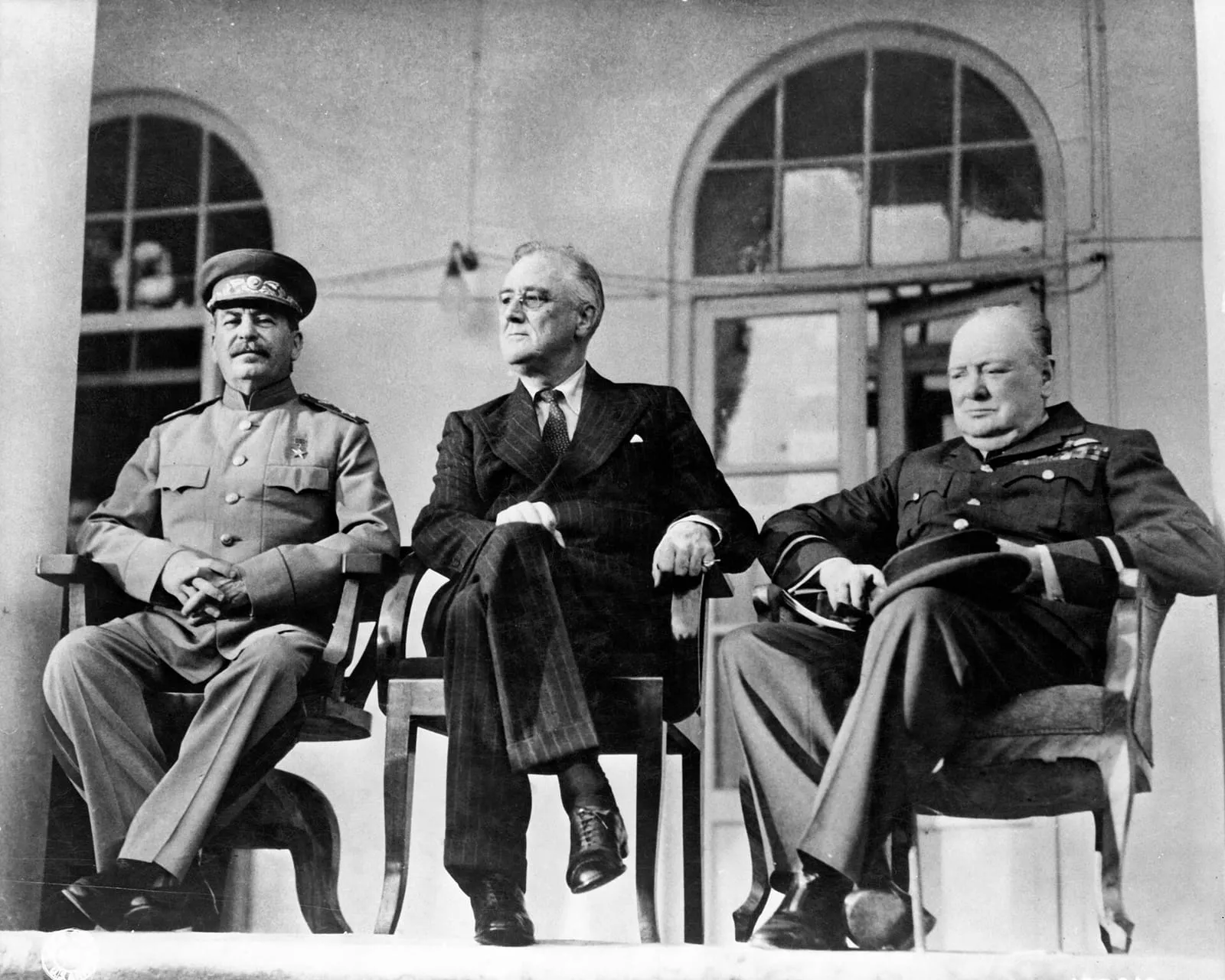
At four in the afternoon on 28 November 1943, in the Soviet embassy in Tehran, Joseph Stalin, Franklin Delano Roosevelt and Winston Churchill sat down at the same table. It was the first wartime meeting of all three leaders of the Grand Alliance. The conference, code-named Eureka in the correspondence, lasted until 1 December. It gave Stalin what he had been pressing for since the summer of 1941: a binding commitment by the Americans and the British to invade northern France. It also produced the first agreements on Poland’s post-war borders, reached without the participation or the knowledge of the Polish government.
It is often said that on 30 November an invasion of Europe planned for June 1944 was agreed. In Tehran, however, the date fixed was May: the military conclusions of the conference state plainly that Operation Overlord would be launched “during May 1944”. The postponement to early June was decided only at the turn of January and February 1944, when the landing plan was enlarged and there were not enough landing craft; the landing itself took place on 6 June.
The road to Tehran
Until the autumn of 1943 Stalin had met Western leaders only on his own ground and only Churchill, as during Churchill’s visit to Moscow in August 1942. To invitations to meetings in Casablanca, Washington and Quebec he replied that he could not leave the country because he was personally directing operations at the front. Roosevelt, who had long wanted to meet Stalin and believed that in a face-to-face conversation he could win him over to post-war co-operation, proposed various venues: the area of the Bering Strait, Cairo, Asmara, Baghdad and Basra. Stalin would agree only to Tehran, from where he had communications with Moscow and which he could reach through Soviet Transcaucasia.
The meeting was prepared by the conference of foreign ministers in Moscow in the second half of October. Afterwards Roosevelt and Churchill first met in Egypt, at the Cairo Conference attended by Chiang Kai-shek. Churchill hoped to agree a common position towards Stalin with the Americans there, but Roosevelt avoided it, not wanting Stalin to conclude that the two Western leaders were forming a common front against him.
Iran was a country occupied by the Allies. Since the Anglo-Soviet invasion of August 1941 its north had been held by the Red Army and its south by the British, and a large part of the American supplies sent to the USSR under Lend-Lease flowed through Iranian ports and railways. In September 1943 Iran declared war on Germany. Stalin flew to Tehran from Baku before his guests arrived; Roosevelt and Churchill came by air from Cairo on 27 November.
The President in the Soviet embassy
Roosevelt at first stayed at the American legation, which lay far from the neighbouring British and Soviet missions. He would not accept an invitation from either Stalin or Churchill, so as not to show that he ranked one ally above the other. On the evening of 27 November, however, Vyacheslav Molotov told the Americans that German agents were active in the city and that the President might face an assassination attempt on his way to the talks. The next day Roosevelt moved into one of the buildings of the Soviet embassy. The Americans suspected that the warning was above all a pretext; when after the conference Ambassador W. Averell Harriman asked Molotov about it, Molotov replied that no specific plot had been known of and that the concern had been the presence of German agents in general. Later Soviet stories of a foiled German operation to assassinate the “Big Three” find no confirmation in German documents. What is certain is that in the rooms occupied by the Americans Soviet intelligence was able to eavesdrop on their conversations, as participants in the operation wrote years later.
The delegations were large. Roosevelt was accompanied by his closest adviser Harry Hopkins, Harriman, Admiral William D. Leahy, General George Marshall, Admiral Ernest King and General Henry Arnold, with the diplomat Charles E. Bohlen as interpreter. With Churchill came the Foreign Secretary Anthony Eden, the Chief of the Imperial General Staff General Alan Brooke, Air Chief Marshal Charles Portal, Admiral Andrew Cunningham and General Hastings Ismay. Stalin brought only Molotov and Marshal Kliment Voroshilov.
The first session: the second front and Japan
On the afternoon of 28 November Stalin called on Roosevelt in his new quarters. They talked privately, with only the interpreters present, about the Eastern Front, about France, which Stalin regarded as discredited by its collaboration with Germany, and about the future of the colonies. An hour later the first plenary session began, chaired at the request of Stalin and Churchill by Roosevelt as the only head of state. Marshall and Arnold missed it: they had understood that the talks would begin later and had gone sightseeing.
Roosevelt outlined the war in the Pacific and the plans for operations in Europe, while Churchill argued once again for widening operations in the Mediterranean: an advance into northern Italy, operations in the Dodecanese, bringing Turkey into the war and support for the partisans in the Balkans. Stalin spoke briefly and to the point. He described the operations in Italy as secondary, since the Alps blocked the way to Germany, and said that the best way to strike at the Reich was an attack through northern or north-western France, ideally supported by a landing in the south of the country. In doing so he backed the American Chiefs of Staff against the British.
At the same session Stalin repeated officially what he had told Cordell Hull in confidence in October: once Germany was defeated, the Soviet Union would enter the war against Japan and beat it together with the Allies “by our common front”. The commitment reflected the fact that the Red Army would be able to move divisions from Europe to the Far East only after the war with the Reich was over.
Three matches
On the evening of 28 November, after a dinner given by Roosevelt, the President retired, while Churchill and Eden stayed on with Stalin. The conversation turned to Poland. Churchill, as he himself described it in his memoirs, laid three matches on the table, representing the Soviet Union, Poland and Germany, and moved them westwards, like soldiers on parade taking a step to the left. Poland was to give up its eastern lands to the USSR and receive German territory in return. Stalin welcomed the demonstration. He did not have to promise or press for anything: it was the British Prime Minister himself who had met his demands halfway.
The Sword of Stalingrad and the toast
On 29 November, before the second plenary session, a ceremony took place that everyone present remembered. Churchill, in RAF uniform, presented Stalin with the Sword of Stalingrad, a ceremonial sword forged in Sheffield on the orders of King George VI as a gift to the city’s defenders. Engraved on the blade in English and Russian was a dedication to the “steel-hearted citizens of Stalingrad”. Stalin kissed the scabbard and handed the sword to Voroshilov; the blade then slipped out of its scabbard and fell to the floor (accounts differ as to whose hands failed). In this way the victory at Stalingrad was honoured in the presence of the leaders of the whole coalition.
The soldiers also talked that day. Brooke and Marshall explained to Voroshilov how many landing craft were needed for a landing in France and why they were in short supply; Voroshilov replied that since the Americans and the British had such mighty industries, they could build them. At the plenary session Stalin asked bluntly who would command Operation Overlord. When he heard that no commander had yet been appointed, he said that without one it was hard to take the operation seriously. He also asked whether the British really believed in the invasion or were only talking about it to reassure the Russians.
In the evening Stalin gave a dinner at which the most famous incident of the conference occurred. Proposing a toast, he suggested that after the war 50,000, or perhaps even 100,000, German officers should be shot, so that Germany could never prepare another war. Roosevelt, taking it as a joke, proposed a “compromise”: 49,000. The President’s son Elliott Roosevelt, who was present, supported Stalin. Churchill was outraged: he declared that the British would never agree to the cold-blooded execution of soldiers who had fought for their country, and that war criminals must be tried, in accordance with the declaration issued in Moscow. He rose from the table and walked out into the next room. Stalin and Molotov followed him and assured him that it had only been a joke; Churchill came back, but to the end of his life he was never sure whether Stalin had really been joking. A few months after the discovery of the Katyn graves, talk of the mass shooting of officers sounded particularly sinister to anyone who knew the case.
Overlord in May 1944
On the morning of 30 November the American and British Combined Chiefs of Staff met. The British gave way: they agreed that the cross-Channel invasion would take place in May 1944 and that at the same time, as far as landing craft allowed, an operation would be mounted in the south of France, later called Anvil and eventually Dragoon. The front in Italy was to advance to the Pisa–Rimini line. Over lunch Roosevelt told Stalin that Operation Overlord would begin in May. In return Stalin announced that the Red Army would launch a great offensive at the same time, so that the Germans could not transfer divisions from east to west. For the first time since 1941 he had been given a date he could believe in: the earlier promises of a second front in 1942, and then in 1943, had not been kept.
That evening Churchill celebrated his 69th birthday at the British legation. The dinner passed in a cordial atmosphere, with a long series of toasts. Stalin drank to “my fighting friend Churchill”, and in another toast acknowledged that without American war production the United Nations would not have won the war.
Turkey, Yugoslavia and the future of Germany
The military conclusions adopted on 1 December also dealt with other matters. The three leaders agreed that it would be highly desirable for Turkey to enter the war on the Allied side before the end of the year. Stalin declared that if Bulgaria then attacked Turkey, the USSR would immediately declare war on Bulgaria. Talks with President İsmet İnönü were to be conducted by Roosevelt and Churchill at a further meeting in Cairo. It was also decided to support the partisans in Yugoslavia – that is, the forces of Josip Broz Tito – with supplies, equipment and commando operations, and to agree a deception plan to conceal the place and time of the invasion from the Germans.
The leaders also discussed the future of Germany. Roosevelt presented a plan to divide the Reich into five states and two areas under international control: Kiel with Hamburg, and the Ruhr with the Saar. Churchill preferred to cut Prussia off from the rest of Germany and to bind the south German states into a Danubian federation. Stalin supported partition but rejected federations that might revive a strong state. The matter was referred to the European Advisory Commission, set up at the Moscow Conference. In a private conversation on 29 November Roosevelt also put to Stalin his idea of the “four policemen” – the USSR, the United States, Britain and China – which were to keep the peace within a future international organisation.
Poland without the Poles
On the last day, 1 December, the Polish question came up again. In the afternoon Roosevelt received Stalin and Molotov for a conversation in which Churchill did not take part. He explained that in 1944 he would probably be standing for another term, and that there were six to seven million voters of Polish origin in the United States (Polish Americans were an important constituency for him). Personally he agreed with Stalin that Poland’s eastern border should be moved westwards and its western border pushed as far as the Oder, but for the time being he could neither take part publicly in any such arrangement nor agree to it. He also mentioned the Baltic states: he did not intend to quarrel with the USSR over them, and asked only for some form of expression of the will of their inhabitants.
That evening at the common table Churchill proposed a formula according to which “the home of the Polish state and nation” should lie between the so-called Curzon Line and the line of the Oder, with part of East Prussia and Opole Silesia added to Poland. Stalin first attacked the Polish government in London: he accused it of contacts with the Germans and of fighting the communist partisans, and made relations with it conditional on its abandoning its “slanders” over Katyn. He demanded the 1939 border as ethnically just. When Eden asked whether he meant the Ribbentrop–Molotov line, Molotov replied that it could be called the Curzon Line. In the Soviet understanding of that line, Lwów (Lviv) remained on the Soviet side. In the end Stalin accepted the Curzon Line as a basis and demanded for the Soviet Union the northern part of East Prussia with Königsberg, which was to give his fleet an ice-free port. Churchill promised to put the matter to the Poles.
The agreements were not set down in any published document and did not appear in the communiqué. The Polish government in London, led since the death of General Władysław Sikorski by Stanisław Mikołajczyk, neither took part in the talks nor was informed of them. The Prime Minister learned only gradually how far the Allies had gone: in January 1944 Churchill began urging him to accept the Curzon Line, and in October 1944 in Moscow Molotov told him outright that the border question had been settled at Tehran. Poland, which had been fighting Germany since the first day of the war, lost at Tehran its say over the shape of its own borders before the Red Army had even crossed the pre-war frontier of the Republic.
The declarations
On 1 December the leaders signed two documents that were published later. The Declaration of the Three Powers announced that their nations would work together in war and in peace, that the military staffs had concerted “the scope and timing of the operations” to be undertaken from the east, west and south, and that no power on earth could prevent the destruction of the German armies by land, their U-boats by sea and their war plants from the air. It ended with the sentence: “We came here with hope and determination. We leave here, friends in fact, in spirit and in purpose.”
The second declaration concerned Iran. The three governments, after consulting the Prime Minister of Iran, acknowledged the assistance the country had given in the war, particularly in transporting supplies to the USSR, undertook to provide economic aid during the war and to take Iran’s problems into account once it was over, and affirmed their desire to maintain its “independence, sovereignty and territorial integrity”. The young Shah, Mohammad Reza Pahlavi, thus obtained a commitment that he invoked after the war, when Soviet troops were slow to leave northern Iran. On 2 December Roosevelt and Churchill flew back to Cairo.
Significance
Tehran was a turning point in the strategy of the Grand Alliance. The dispute over whether the main Western effort should go through the Mediterranean or across the Channel was settled in favour of the invasion of France, and Stalin backed the Americans against Churchill in it. At the second Cairo Conference, on 4–6 December, Roosevelt appointed General Dwight Eisenhower to command Overlord, and the planned amphibious operation in the Bay of Bengal was cancelled so that the landing craft could go to Europe. Despite the talks with İnönü, Turkey did not enter the war before the end of 1943; it broke off relations with Germany in August 1944 and declared war only in February 1945. The invasion was postponed from May to June and began in Normandy on 6 June 1944; the Red Army kept its promise by launching a great offensive in Belorussia in June. The landing in the south of France, delayed for lack of landing craft, took place on 15 August 1944. The promise regarding Japan was repeated, with conditions attached, at the Yalta Conference in February 1945, and the USSR declared war on Japan on 8 August 1945.
For Poland, Tehran marked the beginning of the end of hopes of restoring the borders of before September 1939. The oral agreements of 28 November and 1 December were confirmed at Yalta and completed at the Potsdam Conference in the summer of 1945: the eastern border was based on the Curzon Line, Lwów and Wilno (Vilnius) ended up in the USSR, and in the west Poland received the lands up to the Oder and the Lusatian Neisse. Mikołajczyk’s government, weakened by the lack of relations with Moscow, had no real voice in these decisions, while the Soviet Union was simultaneously building up its own Polish centres of power, beginning with the Union of Polish Patriots.
The conference was also the high point of the personal relationship between Roosevelt and Stalin. The President returned convinced that Stalin was a partner with whom a post-war order could be arranged, and that the Big Three could together build a future international organisation. Churchill, who at Tehran saw clearly for the first time that the Americans and the Russians were the strongest members of the alliance, would later describe himself as a small English donkey sitting between a great Russian bear and a mighty American buffalo.
Sources
Meanwhile
(04)Elsewhere, within a week.
- 26 November 1943 · Eastern FrontThe liberation of GomelOn 26 November 1943 Rokossovsky's Belorussian Front took the ruined city of Gomel, the first Belarusian regional centre recaptured from the Germans.
- 30 November 1943 · PacificJapanese food policy in MalayaIn late November 1943 the Japanese governor of Penang ordered families to grow their own food. Malaya, cut off from rice imports, was growing ever hungrier.
- 25 November 1943 · PacificThe raid on RangoonOn 25 November 1943 the Americans and the RAF opened a joint air offensive against Rangoon. On day one cloud stopped the Liberators; only B-25s hit a target.
- 25 November 1943 · PacificThe Battle of Cape St. GeorgeOn the night of 25 November 1943 Captain Arleigh Burke's destroyers sank three of five Japanese destroyers returning from Buka, without loss to themselves.
Related events
(04)The same battle, people or subject.
- 22 November 1943 · DiplomacyThe Cairo ConferenceOn 22–26 November 1943 Roosevelt, Churchill and Chiang Kai-shek met in Cairo to discuss the war with Japan and agreed to return Manchuria and Taiwan to China.
- 18 October 1943 · DiplomacyThe Moscow Conference of Foreign MinistersOn 18 October 1943 Hull and Eden reached Moscow. Talks with Molotov yielded a pledge of the UN, the European Advisory Commission and a war crimes statement.
- 19 August 1943 · DiplomacyThe Quebec Conference and the Quebec AgreementOn 19 August 1943 in Quebec Churchill and Roosevelt signed a secret agreement on jointly building the atomic bomb. The conference also confirmed Overlord.
- 14 January 1943 · DiplomacyThe Casablanca ConferenceOn 14 January 1943 at Anfa near Casablanca, Churchill, Roosevelt and their chiefs of staff began talks. They chose Sicily and a stepped-up bombing of Germany.