Siege of Sevastopol (1941–1942)
- Dates:
- 30 October 1941 – 4 July 1942
- Front:
- Eastern Front
- Location:
- Sevastopol and its approaches at the south-western tip of the Crimean Peninsula: the Belbek valley and the Mekenziev Heights in the north, Sevastopol Bay (Severnaya), the Chernaya valley, the Sapun Ridge (Sapun-gora), Balaklava and the Chersonese peninsula; in the background, the fighting on the Kerch PeninsulaOn the battle map →
- Sides:
- Nazi GermanyErich von MansteinRomaniaGheorghe AvramescuSoviet UnionIvan Petrov, Filipp Oktyabrsky
- Result:
- Victory for Nazi Germany and Romania. The Sevastopol garrison beat off assaults in November and December 1941 and for more than eight months tied down the 11th Army in the Crimea. Only Operation Störfang (2 June – 4 July 1942), preceded by the destruction of the Crimean Front at Kerch, broke the defence. The Separate Coastal Army was destroyed and tens of thousands of its soldiers were taken prisoner; the commanders were evacuated in the last days.
- Author:
- Natalia
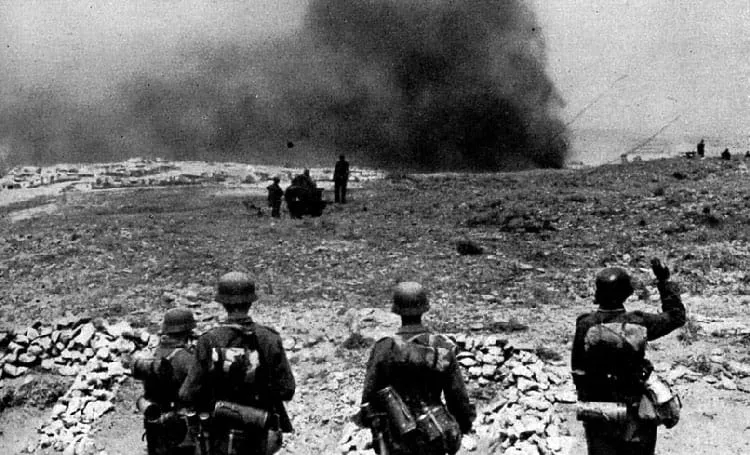
Sevastopol, the main base of the Soviet Black Sea Fleet, was the only place on the Crimean Peninsula that the German 11th Army failed to take in the autumn of 1941. When at the end of October Erich von Manstein broke through the defences on the isthmus and burst into the Crimea, his spearheads arrived on 30 October before the city, which on the landward side was defended by sailors and the crews of the coastal batteries. The fortress could not be taken on the move. It beat off a first assault in November and a second in December, survived the winter supplied solely by sea, and fell only in July 1942, after a month of the heaviest artillery bombardment and bombing that the Germans had until then directed against a single target.
In Soviet tradition the 250 days of the defence of Sevastopol became one of the most important myths of the war, compared with the defence of the same city in the Crimean War of 1854–1855. For the Germans the capture of the “strongest fortress in the world”, as their propaganda proclaimed it, was a great but costly victory: for eight months it tied down an entire army that would have been useful in the summer of 1942 in the advance on the Caucasus and Stalingrad.
Name and dates
Soviet and Russian historiography speaks of the “defence of Sevastopol” (Оборона Севастополя) and dates it from 30 October 1941 to 4 July 1942; the same dates are used in some accounts of the Siege of Sevastopol. The starting date is the day on which Coastal Battery No. 54 near Nikolayevka, armed with four 102 mm guns, according to Russian studies first opened fire on a German motorised column approaching the city from the north. The closing date is the day on which the last organised Soviet units surrendered on the Chersonese peninsula, at the western end of the approaches. Scattered groups held out in caves and casemates above the sea for several more days – according to Russian sources, until as late as 12 July.
German and Western literature more often speaks of the “Battle of Sevastopol” (Schlacht um Sewastopol) and divides it into three offensives. The first, the failed attempt to take the city on the move, lasted from 30 October (or from 2 November, when the attacks on the outer ring of fortifications began) to 21 November 1941. The second, a prepared assault, lasted from 17 December to the end of December 1941 (it petered out by 31 December, with no single date on which it was formally broken off) and was cut short by the Soviet landings at Kerch and Feodosia. The third, Operation Störfang (“Sturgeon Catch”), began on 2 June 1942 with bombardment and air raids, and on 7 June with the infantry attack. A German communiqué announced the capture of the city on 1 July, and the Soviet Information Bureau reported the abandonment of Sevastopol on 3 July.
Background
Sevastopol lies on a rocky limestone headland in the south-western corner of the Crimea, on Sevastopol Bay, which cuts deep into the land and which the Russians call Severnaya (the Northern Bay). From the sea it was in 1941 one of the most heavily fortified bases in the world. In the 1930s coastal batteries had been built around it with guns taken from warships, including two armoured turret batteries, No. 30 and No. 35, each with four 305 mm guns in armoured turrets, with underground magazines, power stations and passages cut into the rock. The Germans later called them the forts Maxim Gorky I and Maxim Gorky II. Both could traverse their turrets and fire inland as well. The landward fortifications, by contrast, were almost unfinished when the war broke out and had to be built in haste in the autumn of 1941, largely by the inhabitants of the city, whose population at that time numbered more than a hundred thousand.
For both sides the base was of great importance. From the very first days after the German attack on the USSR, Soviet bombers from Crimean airfields attacked the Romanian refineries at Ploiești and the port of Constanța. Adolf Hitler called the Crimea an “aircraft carrier” aimed at Romanian oil, and in August, when he changed the direction of the offensive, he placed the occupation of the peninsula among the most urgent objectives before winter. From Sevastopol the fleet could attack Axis shipping on the Black Sea, and as long as the base was in Soviet hands the Germans could not safely cross the Kerch Strait to the Caucasus.
The task of taking the Crimea was given to the 11th Army, advancing on the southern wing of Army Group South. In September, after the death of its commander, Colonel General Eugen von Schobert, Manstein took it over. After the battle of the Sea of Azov his motorised units were taken from him, and he had to conquer the Crimea almost entirely with infantry. With him went units of General Gheorghe Avramescu’s Romanian Mountain Corps, sent to the peninsula with the consent of Marshal Ion Antonescu. After the breakthrough at Ishun on 27–28 October, the Soviet defence of the Crimea split in two: the 51st Army fell back east towards Kerch, while Major General Ivan Petrov’s Separate Coastal Army, only just evacuated by sea from Odessa, retreated towards Sevastopol. The Romanians had occupied Odessa on 16 October, and a few days later they carried out a massacre of its Jewish population.
The first assault (30 October – 21 November 1941)
In the last days of October Sevastopol was almost defenceless on the landward side. According to Russian studies the city was defended by about 20,000 men: two naval infantry brigades, battalions hastily formed from ships’ crews and naval schools, and the crews of the coastal batteries and anti-aircraft artillery. On 30 October Battery No. 54 fired on Colonel Heinz Ziegler’s motorised brigade approaching from the north, and on 1 November the heavy guns of Battery No. 30 opened fire on the spearhead of the German 132nd Infantry Division. The 11th Army, however, had neither mobile troops nor enough aircraft to break into the city on the move, and its infantry was exhausted by twelve days of fighting on the isthmus. On 2 November the German attacks were stopped by the 8th Naval Infantry Brigade.
On 4 November the Soviet command created the Sevastopol Defensive Region, to which all land, naval and air forces in the area of the city were subordinated. A few days later command of it was taken over by the commander of the Black Sea Fleet, Vice Admiral Filipp Oktyabrsky, while Petrov, whose army was fighting its way to the city through the mountains and along the coast road via Yalta, became his deputy for land defence. By 9–10 November the main forces of the Coastal Army had reached Sevastopol, and the fleet brought further reinforcements from the Caucasus. At the same time the evacuation of the wounded and of civilians continued. On 7 November German torpedo aircraft sank the ship Armeniya off Yalta; she was sailing under the Red Cross with wounded, hospital staff and civilians from Sevastopol. According to estimates, between 5,000 and 7,000 people died, and only eight survived. It was one of the greatest maritime disasters in history.
When the main forces of the 11th Army arrived on 11 November, fighting flared up along the whole perimeter. Manstein, wishing to avoid the strong defences in the north, struck in the centre and in the south, towards Balaklava. The 50th and 132nd Infantry Divisions came within a few kilometres of Sevastopol Bay, and the 72nd Infantry Division took some of the heights above Balaklava, but the Soviet defence, supported by the fire of the coastal batteries, two cruisers and the battleship Parizhskaya Kommuna (formerly the Sevastopol), held. On 21 November Manstein broke off the attack, having lost, according to German figures, about 2,000 men. He realised that the fortress would have to be taken by a systematic, prepared assault with heavy artillery, which he did not have. According to Russian figures, by 20 November the garrison already numbered more than 62,000 men.
The second assault (17–31 December 1941)
The assault was planned for 27 November, but the autumn rains washed out the roads, and the 11th Army, according to Russian studies, lost half its wheeled transport and four of the five locomotives it had at its disposal in the Crimea. Partisans also attacked on the mountain roads. The offensive began only on the morning of 17 December, when along the whole of the rest of the Eastern Front the Wehrmacht had already gone over to the defensive against the Soviet counter-offensive at Moscow. Manstein was then the only German army commander in the east with an offensive mission. His forces were modest: according to figures cited by the historian Robert Forczyk, the four divisions of General Erik Hansen’s LIV Corps had little more than 15,000 infantrymen; more than 7,000 men in the army were sick, and there was a shortage of ammunition and heavy artillery. To defend the whole coast from Yalta to Kerch, Manstein left the weak XLII Corps with one German division and two Romanian brigades.
The defenders made good use of the pause. Between 7 and 13 December the fleet brought the 388th Rifle Division into the city, and sappers laid minefields and wire entanglements. The Germans delivered their main blow in the northern sector, in the Belbek (PL) valley. The 22nd Infantry Division, supported by assault guns, after several days of fighting pushed back the 8th Naval Infantry Brigade and got into the rear of the fortifications between the Belbek and the Mekenziev Heights. In the south the XXX Corps, with the 72nd and 170th Infantry Divisions supported by the Romanian 1st Mountain Brigade, made little progress. Around 20 December the situation in the north became dangerous: the Germans were approaching Fort Stalin and the shore of the bay. The Stavka subordinated Sevastopol to the Transcaucasian Front of General Dmitry Kozlov, who sent reinforcements by sea: on the morning of 21 December the 79th Naval Infantry Brigade disembarked in the harbour, and on 23 December the 345th Rifle Division, together with several thousand replacements. Taking advantage of the long winter nights, the ships landed them straight into the fighting, and the battleship Parizhskaya Kommuna and the cruisers shelled the German positions whenever a breakthrough threatened. The fresh units stopped the 22nd Infantry Division a few kilometres from the bay.
On 26 December the troops of the Transcaucasian Front began the Kerch–Feodosia landing operation (PL). The 51st Army landed at several points around Kerch, in a storm and icy water, suffering heavy losses, and on 29 December the 44th Army put a landing force ashore right in the harbour of Feodosia. The commander of the XLII Corps, General Hans von Sponeck – the same man who in May 1940 had led German paratroopers in the battle for The Hague – fearing that he would be cut off, ordered the 46th Infantry Division to withdraw from the Kerch Peninsula against Manstein’s instructions; the division abandoned its heavy equipment on the way. For this unauthorised retreat a court martial later sentenced him to death; the sentence was commuted to fortress imprisonment, and after the plot of July 1944 Sponeck was shot. Manstein had to take the 170th Infantry Division and parts of other units away from Sevastopol. The offensive, which on 27–28 December still brought the Germans the capture of the Mekenzievy Gory railway station, petered out by 31 December, and at the beginning of January Manstein pulled his forward units back to more favourable positions on the Belbek. According to Manstein this was his own choice; Soviet historiography wrote that the Germans had been driven back by counter-attacks. Sevastopol had held out for the second time.
Winter and spring 1942
For the next five months the siege turned into positional warfare, and the fate of the fortress was decided by what happened in the east of the Crimea. The Germans retook Feodosia on 18 January 1942 but failed to push the Russians off the Kerch Peninsula. On 28 January the troops on the peninsula were formed into the Crimean Front under Kozlov, with three armies, to which Joseph Stalin’s trusted man, Army Commissar 1st Rank Lev Mekhlis, was attached as representative of the Stavka. The front was to relieve Sevastopol, but its frontal attacks on the Parpach isthmus in February, March and April broke down with enormous losses. At the beginning of January a smaller landing at Yevpatoria (5–7 January) also failed: a naval infantry battalion, supported by some of the inhabitants, fought the German and Romanian garrison for two days and was then destroyed. The Germans afterwards shot many civilians in the town in reprisal.
Sevastopol meanwhile lived from the sea. The warships and vessels of the Black Sea Fleet brought in ammunition, food and replacements by night and took out the wounded. In galleries cut into the rock above the bay there were hospitals, schools and workshops, which according to Russian figures produced more than two thousand mortars and tens of thousands of shells during the siege. Some of the inhabitants were evacuated to the Caucasus, but many stayed in the city to the end.
On 8 May 1942 Manstein struck at the Crimean Front in Operation Trappenjagd (“Bustard Hunt”). With the support of Colonel General Wolfram von Richthofen’s VIII Air Corps he broke through the front on its southern wing, encircled the 51st Army and on 15 May took Kerch. By 19 May the Crimean Front had ceased to exist. According to German figures some 170,000 prisoners were taken, and Soviet losses in the whole operation are reckoned at more than 170,000 men. After this defeat Sevastopol stood alone in the Crimea, and Manstein could for the first time turn all his forces against it.
Operation Störfang (2 June – 4 July 1942)
Both sides spent months preparing for the third assault. According to Russian figures, about 106,000 soldiers of the Coastal Army and the fleet were defending Sevastopol, in seven rifle divisions and several naval infantry brigades, with some 600 guns and mortars, but almost without tanks and with few anti-aircraft guns. The fortress had three defence belts: an outer one, 15–20 kilometres from the city, a main one and an inner one, with hundreds of bunkers, machine-gun nests and minefields. North of the bay ran a chain of fortifications to which the Germans gave the names Stalin, Molotov, Lenin, Volga, Siberia and North Fort, dominated by Battery No. 30.
Manstein assembled two German corps before Sevastopol, the LIV and XXX, with seven infantry divisions, and Avramescu’s Romanian Mountain Corps with the 1st and 4th Mountain Divisions and the 18th Infantry Division. The 11th Army’s weakness was its infantry: according to Forczyk its divisions were at between a third and three-quarters of their establishment strength. Its strength lay in artillery and air power. The heaviest guns the Wehrmacht possessed were brought to Sevastopol: the 600 mm Karl self-propelled mortars (Thor and Odin), old 420 mm howitzers, 355 mm and 305 mm mortars, two 280 mm railway guns and the only 800 mm railway gun in history, Schwerer Gustav, widely known as “Dora” (historians disagree as to which of the two guns built fired at Sevastopol). Emplaced in a cutting a dozen or so kilometres from its target and served by more than a thousand men, the gun fired 48 rounds with shells weighing some seven tons. The effect was out of all proportion to the cost: according to German reports it destroyed an ammunition store hidden in the rock, but it did not break the forts. The only clear success of the super-heavy guns was a hit on one of the turrets of Battery No. 30 by a shell from the mortar Thor on 6 June. Far more effective was Richthofen’s VIII Air Corps, with about 600 aircraft operating from airfields a few dozen kilometres from the target.
On 2 June a five-day artillery and air preparation began. Bombers and Junkers Ju 87s took off several times a day, and the city burned. At dawn on 7 June the infantry went into the attack. The LIV Corps again delivered its main blow in the north, through the Belbek valley, at the junction of two Soviet sectors, while the XXX Corps and the Romanians made supporting attacks in the centre and in the south. The first day disappointed the Germans: according to Forczyk the LIV Corps lost more than 2,300 killed and wounded and gained only a strip about two kilometres deep. For the following week a battle of attrition raged. The ships of the Black Sea Fleet forced their way through by night with replacements, but the Luftwaffe sank more and more transports and destroyers. On 13 June an assault group of the 22nd Infantry Division captured Fort Stalin, and in the days that followed the Germans took Battery No. 30. Its garrison, cut off in the underground passages, held out for several more days, even as sappers blew in the entrances and poured explosives and inflammables down the shafts. Between 18 and 23 June the whole defence north of the bay collapsed; the last units of the 95th Rifle Division surrendered on the seashore.
In the south the 170th and 72nd Infantry Divisions and the Romanians advanced more slowly, hill by hill, towards Balaklava and the Sapun Ridge, the last Soviet line before the city. During the night of 28–29 June Manstein made a surprising move: units of the LIV Corps crossed Sevastopol Bay in assault boats and landed on its southern shore, in the defenders’ rear, while at the same time the XXX Corps broke onto the Sapun Ridge. On 30 June the Germans took the Malakhov Kurgan, the hill famous for its defence in the Crimean War.
The fall of the city and the evacuation of the commanders
On 30 June Oktyabrsky, knowing that the defenders were running out of ammunition and that ships could no longer reach the harbour, asked for permission to evacuate and received it from the Stavka. It did not, however, apply to the army, but above all to its command. During the night of 30 June – 1 July Oktyabrsky flew out to the Caucasus, and Petrov with the staff of the Coastal Army left in the submarine Shch-209, according to Russian sources on the evening of 1 July. According to Russian figures, PS-84 transport aircraft flew more than two hundred officers and several dozen wounded out of the airfield on the Chersonese, submarines took off some seven hundred members of the command cadre, and several thousand others escaped in small fleet craft. Command of the remaining units passed to the commander of the 109th Rifle Division, Major General Pyotr Novikov, who was to cover the evacuation. He himself tried to get away in a launch on 9 July, was captured by the Germans and died in captivity. The evacuation of the commanders while tens of thousands of soldiers were left behind was a subject passed over in silence in the USSR after the war, and today it remains one of the most painful strands of this story.
On 1 July the Germans entered the ruined city, in which, according to German and Soviet accounts, barely a dozen or so buildings had survived undamaged. On the same day Hitler promoted Manstein to field marshal. The remnants of the defenders, without ammunition, water or food, fell back onto the Chersonese peninsula. During the night of 1–2 July the crew of Battery No. 35, having fired its last shells, blew it up. On the rocky headland, in caves along the shore and in the casemates of the battery, thousands of soldiers and civilians waited for ships that never came. On the afternoon of 4 July, after heavy shelling and air raids, organised resistance ceased. The Germans stated that they had taken some 90,000–100,000 prisoners in all; according to Soviet archival data cited in Russian literature, there were no more than 78,000. Individual groups held out among the rocks and in the caves for several more days, and according to some accounts the Germans used smoke and gas against them, as they had done earlier in the quarries near Kerch.
Behind the troops, units of Otto Ohlendorf’s Einsatzgruppe D entered the city; as early as the autumn of 1941 they had been murdering Jews, Krymchaks and Roma in the Crimea. In Sevastopol they searched among the prisoners and inhabitants for Jews, commissars and communists, and shot them.
Losses
The losses of both sides are, as in most battles on the Eastern Front, a matter of dispute. According to the Russian statistical study edited by Grigoriy Krivosheev, Soviet forces lost 200,481 men in the defence of Sevastopol from 30 October 1941 to 4 July 1942, including 156,880 killed, missing and captured and 43,601 wounded and sick. These figures do not include the losses in the fighting for the Kerch Peninsula, where between December 1941 and May 1942 the Red Army lost several hundred thousand men.
German and Romanian losses are harder to establish. According to 11th Army figures cited by Forczyk, in Operation Störfang alone the Axis forces lost 35,866 killed, wounded and missing, including 27,412 Germans and 8,454 Romanians. Western estimates of Axis losses over the whole 250-day siege reach some 70,000 men, including about 25,000 killed. A Soviet communiqué of July 1942 spoke of 150,000 German losses at Sevastopol alone, and some Russian authors still accept such high figures, but they find no confirmation in German documents. What is certain is that the 11th Army emerged from the battle so exhausted that after it ended it had to rest and rebuild its strength for several weeks. According to German figures, in June 1942 the VIII Air Corps flew more than 23,000 sorties over Sevastopol and dropped more than 20,000 tons of bombs, and the 11th Army’s artillery fired more than 46,000 tons of ammunition.
Significance
Sevastopol did not change the course of the war, but it affected the way the war went in 1942 more than the size of the city alone would suggest. For eight months it tied down the entire 11th Army, which in the summer of 1942, when the Wehrmacht set off in Case Blue towards the Caucasus and the Volga, was exhausted and dispersed. After the war Manstein argued that his army should have been moved across the Kerch Strait to the Kuban or held in reserve behind the southern wing of the front; instead, most of its divisions were sent to Leningrad, one to Crete, and the rest were left in the Crimea. Some historians link this lack of reserves with the later catastrophe of Friedrich Paulus’s 6th Army at Stalingrad, although it was only one of many factors.
For the USSR the fall of Sevastopol and the earlier defeat at Kerch meant the loss of the whole Crimea, and with it of the ability to strike from the air at the Romanian oilfields and German shipping in the north-western Black Sea. The Black Sea Fleet lost its main base and moved to cramped Caucasian ports, and lost many ships in the fighting and the evacuations. At the same time the long defence became a symbol of resistance in Soviet propaganda: in May 1945 Sevastopol was one of the first four cities to receive the title of Hero City, and the Medal “For the Defence of Sevastopol” was instituted as early as December 1942. Manstein earned a reputation as a master of taking fortresses and received his field marshal’s baton, and a special badge, the Crimea Shield, was created for the soldiers of the 11th Army. The first gold shield was presented by Manstein, on Hitler’s behalf, to Marshal Antonescu in Bucharest, in recognition of the Romanians’ part.
The Crimea remained in Axis hands until the spring of 1944. In April and May 1944 the Red Army recaptured the peninsula in less than a month, and Sevastopol, which had cost the Germans 250 days to take, fell this time after a few days’ assault, on 9 May 1944. The German-Romanian 17th Army, hastily evacuated from Cape Chersonese, lost tens of thousands of men in the process – in the very place where two years earlier the last defenders of the fortress had waited for rescue.