Romania
Ion Antonescu
Minister of Defence (1937–1938), Prime Minister and Conducător (leader) of the Romanian state (1940–1944), Marshal of Romania (from 1941)
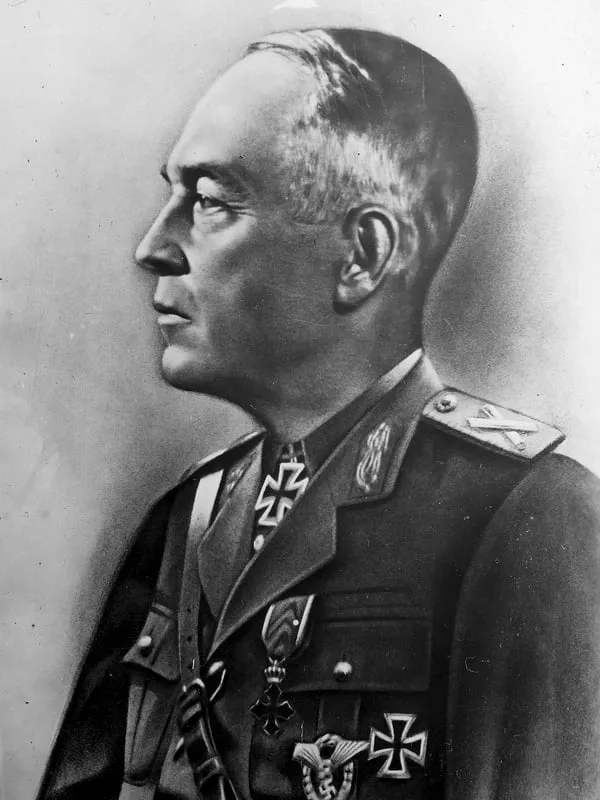
- Born:
- 14 June 1882, Pitești (Romania)
- Died:
- 1 June 1946, Jilava, near Bucharest
- Author:
- Łukasz
- Photo:
- autor nieznany, domena publiczna, Wikimedia Commons

Ion Antonescu was a professional officer who rose from staff officer in the First World War to dictator of Romania in the Second. In 1916–1919 he was one of the closest aides of General Constantin Prezan and took part in the campaigns that created “Greater Romania”, including the war with Hungary that ended with the occupation of Budapest. Twenty years later, when in 1940 that same Romania lost a third of its territory to the USSR, Hungary and Bulgaria, he seized power as Conducător, the “leader” of the state. He bound the country to the Germany of Adolf Hitler, led the Romanian army into the war against the USSR in June 1941 and ruled until the coup of 23 August 1944. According to the findings of an international commission of historians, his regime was responsible for the deaths of between 280,000 and 380,000 Jews and of more than ten thousand Roma, which makes Romania the state that, after Germany, carried out the Holocaust on its own initiative to the greatest extent. In 1946 he was sentenced to death and shot.
Youth and early service
He was born on 14 June 1882 (2 June by the Julian calendar then in use in Romania; some sources give 15 June) in Pitești in Wallachia, into a family with military traditions. His father was a cavalry officer. Antonescu took his parents’ divorce hard – afterwards his father married a woman of Jewish descent – and remembered his stepmother with bitterness for the rest of his life. He graduated from the school for soldiers’ sons in Craiova and, in 1904, from the infantry and cavalry officers’ school in Bucharest, finishing top of his class at both. As a second lieutenant he was posted to a cavalry regiment (roșiori) and completed the special cavalry school at Târgoviște.
In the spring of 1907, during the great peasant revolt that the army put down with much bloodshed, he commanded a cavalry detachment near Galați and kept the rebels out of the town. For this he was praised by the heir to the throne, Prince Ferdinand. Historians judge his part in it differently: some say he was particularly brutal, others that he behaved like the other officers. Short, reddish-haired, hot-tempered and ambitious, he earned the nickname “the Red Dog” (Câinele Roșu) in the army and a reputation as a capable but difficult officer who did not hesitate to challenge his superiors’ decisions. In 1911–1913 he completed the Higher War School, and in the Second Balkan War of 1913 he was operations officer of the 1st Cavalry Division.
The First World War
When Romania entered the war on the side of the Entente in August 1916, Captain Antonescu was head of the operations bureau of General Prezan’s Northern Army. In the autumn, as the Germans and Austro-Hungarians crossed the Carpathians, he drew up the plan for the defence of Bucharest. After the defeat and the loss of the capital, Prezan, appointed chief of staff of general headquarters in December 1916, took him along as his chief of operations. From then on Antonescu was constantly at Prezan’s side and had so much influence over him that Prezan’s rival, General Alexandru Averescu, wrote in his memoirs of the plans of “Prezan (Antonescu)”. He helped prepare the defence of Moldavia in 1917, including the operations in the Battle of Mărășești.
He regarded the separate peace with the Central Powers in 1918 as a sensible solution. During demobilisation he took command of a cavalry regiment. When Romania re-entered the war in November 1918, he was back on the staff of Prezan, who directed the occupation of Transylvania and, in 1919, the war against the Hungarian Soviet Republic of Béla Kun. For his part in the campaign that ended with the occupation of Budapest, Lieutenant Colonel Antonescu received the Order of Michael the Brave, third class, in December 1919. That same year he published a pamphlet, “The Romanians: Their Origin, Past, Sacrifices and Rights”, in which he demanded the whole of the Banat for Romania and did not rule out going to war over it with the new Yugoslav state. When Averescu became prime minister in March 1920 and dismissed Prezan, Antonescu wrote bitterly about the way his commander had been treated.
He came away from those years with a conviction that still guided him in 1941: the borders of “Greater Romania”, won in 1918–1919, were inviolable, and its chief enemies were Russia and Hungary.
Between the wars
In 1922–1926 he served as military attaché in Paris, and also in London and Brussels. He negotiated a French loan for arms purchases and became friends with the distinguished diplomat Nicolae Titulescu. On his return he headed the Higher War School; in 1928 he was secretary general of the Ministry of Defence, then deputy chief and, in 1933–1934, Chief of the General Staff. During this period he married Maria Niculescu, who had twice been married before.
As chief of staff he came into conflict with King Carol II. According to some accounts the issue was the opposition of the defence minister, Paul Angelescu, to Antonescu’s plans for modernising the army; according to others, a report on embezzlement in arms contracts that indirectly implicated the king’s entourage. Antonescu had to go, and the secret police began to keep him under surveillance. He had despised the king since 1918, when the then heir to the throne had deserted the army to marry a woman from outside the aristocracy, and he made no secret of it. He kept up contacts with politicians of every camp, including the democratic Liberal and National Peasants’ parties, but he was drawing ever closer to the far right. In 1936 he met Corneliu Zelea Codreanu, leader of the fascist and antisemitic Iron Guard.
At the end of December 1937 the king entrusted the government to the poet and nationalist Octavian Goga, whose cabinet was the first in Romania to introduce openly antisemitic legislation and stripped more than 200,000 Jews of their citizenship. Antonescu became its Minister of Defence and kept the post in the next government, after the royal dictatorship was proclaimed in February 1938. He feared above all Hungary, which was demanding a revision of the borders, and ordered the General Staff to prepare defences in the west. When the king had Codreanu arrested in the spring of 1938, Antonescu resigned in protest (30 March 1938) and appeared as a defence witness at his trial. Codreanu was convicted and, in November 1938, killed by gendarmes “while trying to escape”. Antonescu was briefly interned and then shunted off to provincial commands and passed over for further posts.
1940: the seizure of power
In the summer of 1940 the order that Antonescu had defended all his life collapsed. After the fall of France, Romania’s ally, the Soviet Union – acting on the secret protocol of the Molotov–Ribbentrop Pact – presented Bucharest on 26 June with an ultimatum delivered by Vyacheslav Molotov, and occupied Bessarabia and northern Bukovina (the Soviet occupation of Bessarabia and northern Bukovina). Antonescu sent the king a protest, for which he was arrested and interned in the Bistrița monastery. From there, through Mihai Antonescu (no relation), a lawyer and later his deputy, he made contact with the Germans. On 30 August 1940, in the Second Vienna Award, Germany and Italy gave Hungary northern Transylvania with Cluj, and in September Romania ceded southern Dobruja to Bulgaria. The country lost roughly a third of its territory and population. Lands that the Romanians had won in 1919 fighting the Hungary of the regent Miklós Horthy partly returned to Budapest.
Protests broke out in Bucharest, and the king looked for a way out. On the advice of courtiers, and after a telephone call from the German minister Wilhelm Fabricius, on 5 September 1940 he appointed Antonescu prime minister with full powers (Romanian sources say he had been given the task of forming a government a day earlier). Antonescu immediately demanded the king’s abdication. On 6 September Carol II handed the throne to his eighteen-year-old son, Michael I, and left the country, and a decree of the new king made Antonescu “Leader of the Romanian State” (Conducătorul Statului), leaving the monarch ceremonial functions. The constitution was suspended and parliament dissolved.
The National Legionary State
The democratic parties refused to join the government, so on 14 September 1940 Antonescu proclaimed the “National Legionary State” together with the Iron Guard, whose leader Horia Sima became deputy prime minister. Romania tied itself to Germany. In October a German military mission arrived to train the Romanian army and protect the oilfields, and on 23 November in Berlin Antonescu signed Romania’s accession to the Tripartite Pact. It was then that he met Hitler for the first time. The two took to each other: Hitler rated the general more highly than any of his other allies except Mussolini and listened patiently to his disquisitions on Romanian history and Hungarian perfidy. They spoke in French and German, through an interpreter.
The government tightened its predecessors’ antisemitic laws and began to take Jewish businesses and land under so-called “Romanianisation”. The legionaries, however, resorted to violence that Antonescu, a man of military order, would not tolerate. At the end of November 1940 they murdered more than sixty political prisoners from Carol II’s time in Jilava prison, as well as the historian Nicolae Iorga. In January 1941, after a conversation with Hitler, who preferred stability in Romania to revolution, Antonescu began to push the legionaries out of power. In response, on 21–23 January, the Guard attempted a putsch combined with a pogrom in which about a hundred and twenty Jews were killed in Bucharest (the Legionnaires’ rebellion (PL)). The army, with German support, crushed the rebellion and Sima fled to Germany. From then on Antonescu ruled as a military dictator, also taking the defence and foreign ministries himself.
War against the USSR and the Holocaust
Hitler let Antonescu into his plans to attack the USSR, and Antonescu embraced them with enthusiasm, seeing in them the only chance of recovering Bessarabia and Bukovina. On 22 June 1941 the Romanian army advanced alongside the Wehrmacht (Operation Barbarossa) under the order “Soldiers, I command you: cross the Prut!”. Propaganda presented the war as a “holy war” of Orthodox Romania against “Jewish Bolshevism”, and Antonescu himself regarded the Jews as allies of the Soviets and enemies of the state. A few days later, on 28–30 June, came the Iași pogrom, in which soldiers, policemen and local people murdered Jews in the streets, while thousands were taken away in sealed wagons in which many suffocated. The Romanian authorities later stated that more than 13,000 people had died. In the summer of 1941, in Bessarabia and Bukovina, Romanian troops and gendarmerie, together with the German Einsatzgruppe D, massacred tens of thousands of Jews, and the rest were shut up in ghettos and transit camps.
On 6 August 1941 Hitler presented Antonescu with the Knight’s Cross of the Iron Cross, the first Romanian to receive it, and on 22 August the king made him Marshal of Romania. Bessarabia had already been recovered, but Antonescu, ignoring the warnings of the opposition leaders Iuliu Maniu and Dinu Brătianu, led the army further, into lands that had never belonged to Romania. The area between the Dniester and the Southern Bug, named Transnistria, was placed under a Romanian civil administration with Gheorghe Alexianu as governor. The siege of Odessa lasted from August to 16 October 1941 and cost the Romanian 4th Army very heavy losses – by various estimates anywhere from several tens of thousands to nearly a hundred thousand killed, wounded and missing. On 22 October a mine planted by the Soviets blew up the Romanian headquarters in the captured city, killing several dozen people, including the city commandant. Antonescu ordered bloody reprisals. In the Odessa massacre of 22–24 October, Romanian troops murdered, by various estimates, between 25,000 and 34,000 Jews, and tens of thousands more died in the following months in the camps at Bogdanovka, Domanevka and Akhmechetka.
Transnistria became the main site of the Holocaust in the Romanian zone. More than a hundred thousand Jews from Bessarabia and Bukovina were deported there, and in 1942 about 25,000 Romanian Roma, nearly half of whom did not survive (the Porajmos). People died of hunger, cold and typhus, or were killed in mass executions. An international commission of historians chaired by Elie Wiesel, set up by the Romanian government, established in 2004 that between 280,000 and 380,000 Romanian and Ukrainian Jews died under Antonescu’s rule. At the same time the Jews of the so-called Old Kingdom and southern Transylvania, some 300,000 people, mostly survived, although they were persecuted, stripped of their property and sent to forced labour. In the summer of 1942 Antonescu agreed to their deportation to the German extermination camp at Bełżec, but in the autumn of that year he postponed the decision and then abandoned it. Historians link this change to the course of the war, to interventions by the leader of the Jewish community, Wilhelm Filderman, the papal nuncio, Queen Mother Helen and the diplomats of neutral states, and to his resentment of German pressure. Meanwhile the Jews of northern Transylvania, then part of Hungary, were deported to Auschwitz in 1944 by the Hungarian authorities together with the Germans.
From Stalingrad to the fall
Romania put more troops into the field on the Eastern Front than any other German ally. In 1942 its armies marched with the Germans to the Caucasus and the Volga, and in November the Red Army broke through precisely in the sectors held by the Romanians and encircled the Germans at Stalingrad. In the Battle of Stalingrad the Romanian 3rd and 4th Armies were smashed, with losses of about 150,000 killed, wounded and captured. Relations with Germany deteriorated and the war became unpopular at home. To the end, Antonescu also had a second front in mind: after victory over the USSR he intended to take northern Transylvania back from Hungary, and he wanted to prove to Hitler that Romania was a better ally than Hungary.
From 1943 Mihai Antonescu and, with the marshal’s knowledge, the opposition too put out peace feelers to the Allies in neutral countries. They foundered on the demand for unconditional surrender and on the Western Allies’ practice of referring the Romanians to Moscow. In the spring of 1944 the Red Army entered Bessarabia and northern Moldavia, while Allied bombers were wrecking Bucharest and the Ploiești oilfields. On 20 August 1944 a great Soviet offensive opened near Iași and Kishinev and within a few days shattered the German–Romanian front.
On 23 August 1944 King Michael summoned Antonescu to the palace and demanded an immediate armistice. When the marshal refused – declaring, according to accounts, that he had given Hitler his word as an officer – he was arrested by the palace guard. The new government of General Constantin Sănătescu broke with Germany and on 25 August declared war on it (Romania in the Second World War). The Romanian communists, who had taken charge of the prisoner, handed him over to the Soviets. Antonescu spent a year and a half in captivity near Moscow and in the Lubyanka, where he was interrogated. The Soviet state of Joseph Stalin kept Bessarabia and northern Bukovina for itself, while in 1947 the peace treaty restored northern Transylvania to Romania within the borders of Trianon.
Trial and execution
Before the trial the Soviets sent Antonescu back to Romania. From 6 May 1946 he was tried in Bucharest by a People’s Tribunal, modelled on the Nuremberg trial but strongly influenced by the communists, who were then taking power in the country. The indictment concerned above all the war against the USSR; the crimes against the Jews occupied a lesser place in it. Antonescu admitted that he had issued deportation orders but sought to justify them. The most memorable moment of the trial was the testimony of Maniu, who said that they had been political opponents, “not cannibals”, and shook the defendant’s hand. The communists later used this gesture against Maniu himself.
On 17 May 1946 Antonescu was sentenced to death. His appeals were rejected, and the king, under pressure from the government of Petru Groza, did not exercise his prerogative of mercy. On 1 June 1946 Antonescu was shot near the prison at Jilava (PL) together with Mihai Antonescu, Alexianu and the gendarmerie commander Constantin Vasiliu. He refused a blindfold.
Memory and significance
In communist Romania Antonescu was long a “fascist traitor”, but under Nicolae Ceaușescu, who combined communism with nationalism, his partial rehabilitation began, while the Holocaust was passed over in silence. After 1989 a cult of the marshal as a patriot who had fought for Bessarabia and against Bolshevism arose among part of Romanian society. Streets were named after him and busts erected. In 2002 the government banned the cult of persons convicted of war crimes, and in 2003–2004 the Wiesel commission officially confirmed the Romanian state’s part in the Holocaust, a finding Romania accepted. In 2006 the Bucharest Court of Appeal ruled the war for Bessarabia “defensive” and partly rehabilitated Antonescu on the charge of crimes against peace, but in 2008 the High Court of Cassation overturned that ruling. In the same year, 2006, viewers of public television placed him sixth in a poll of the greatest Romanians, which shows how divided the memory of him remains.
In the history of the road to the Second World War, Antonescu is a figure in whom the threads of 1918–1920 converge. As a young officer he helped to build “Greater Romania” at the expense of Hungary and Russia. When, in 1940, Moscow and Budapest, with Berlin’s backing, took back part of those gains, he concluded that they could be recovered only at Hitler’s side. The price was paid by hundreds of thousands of Romanian soldiers and by hundreds of thousands of Jews and Roma murdered by the state he ruled.
Sources
Mentioned in battles
(05)Often appears with
People who appear in the same events.
On the timeline
(42)The 40 most important of 42 events. All tagged “Ion Antonescu” (10) →