Germany
Friedrich Paulus
First Quartermaster General of the Army General Staff (1940–1942), commander of the Sixth Army (1942–1943), field marshal (1943)
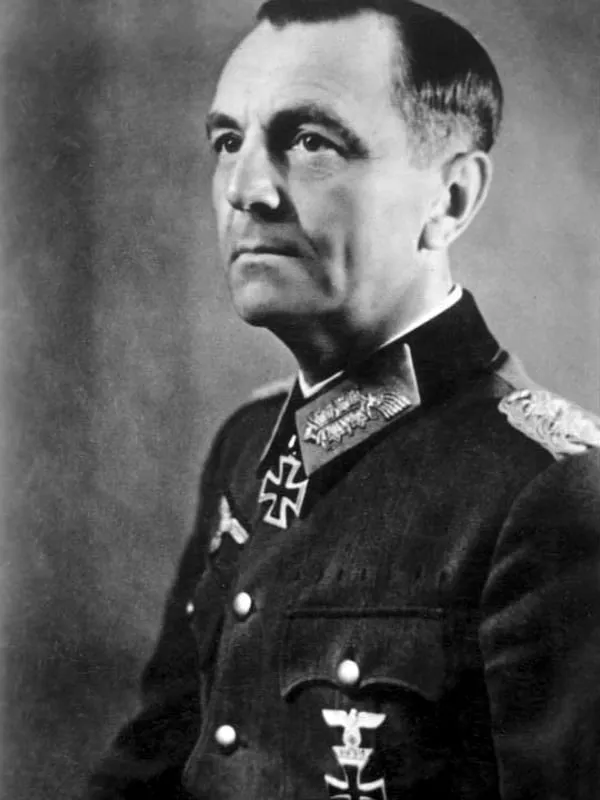
- Born:
- 23 September 1890, Breitenau, now part of Guxhagen (Hesse-Nassau, Kingdom of Prussia)
- Died:
- 1 February 1957, Dresden (East Germany)
- Author:
- Natalia
- Photo:
- Mittelstaedt, Heinz, CC BY-SA 3.0 DE, Wikimedia Commons

Friedrich Paulus was the archetypal staff officer: hard-working, meticulous and gifted at planning operations, yet unsure of himself in independent command and unconditionally obedient. In 1940–1941, as deputy chief of the Army General Staff, he co-ordinated work on the plan to invade the Soviet Union, which on 18 December 1940 took the form of Directive No. 21, Barbarossa. A year and a half later he led the Sixth Army to the Volga, and his name became for ever bound up with the defeat at Stalingrad. He was the first German field marshal to be taken prisoner; in captivity he went over to anti-Hitler propaganda, and in 1946 he testified at Nuremberg against his former superiors. He spent his last years in East Germany.
A civil servant’s son
He was born on 23 September 1890 in Breitenau, now part of the municipality of Guxhagen in Hesse, the son of Ernst Paulus, cashier at the local reformatory and later a bookkeeper in the provincial administration at Kassel. Many books, especially in English, call him “von Paulus”, but this is a mistake: the family did not belong to the nobility. In 1909 he passed his school-leaving examinations at a Kassel grammar school. He dreamed of a career as a naval officer but was not accepted – according to his biographers, because of his middle-class origins. He studied law for one semester at Marburg, and in February 1910 he joined the 111th Infantry Regiment at Rastatt in Baden as an officer cadet. In August 1911 he was commissioned as a second lieutenant.
On 4 July 1912 he married Elena Constance Rosetti-Solescu, the sister of two of his fellow officers in the regiment, who came from an old boyar family related to Prince Alexandru Ioan Cuza, the founder of united Romania. They had three children: a daughter, Olga (born 1914), and twin sons, Friedrich and Ernst Alexander (born 1918). Friedrich was killed at Anzio in Italy in 1944.
The Great War and the Reichswehr
In 1914 he fought with his regiment in the Vosges and near Arras, and in the autumn he fell seriously ill. From 1915 he served on staffs within the Alpine Corps, an elite mountain division with which he went through almost every front: the South Tyrol, Serbia and Macedonia, Verdun in 1916, Romania and the Isonzo front. He ended the war as a captain and staff officer, holding both classes of the Iron Cross and suffering from amoebic dysentery contracted in the Balkans, which troubled him for the rest of his life.
After the November Revolution he stayed in the army. At the turn of 1918 and 1919 he served in the volunteer Grenzschutz Ost (Border Guard East), one of the Freikorps (PL) fighting the Poles in the borderlands, although he dealt mainly with recruitment and organisation. He was accepted into the 100,000-strong Reichswehr, where he followed the typical path of an officer marked out for the staff: regimental adjutant at Konstanz, staff officer in Stuttgart, in 1927–1929 a company commander in the 13th Infantry Regiment, where the neighbouring machine-gun company was commanded by Erwin Rommel, and then an instructor in tactics. His biographers indicate that he sympathised with the Kapp–Lüttwitz Putsch of 1920, but he kept out of politics. In 1931, by then a major, he was teaching tactics and military history on the courses for General Staff officers in Berlin.
A builder of the armoured force
He watched the Nazis come to power from the capital. His views on the new regime at the time are not known, but like most of the officer corps he welcomed the restoration of conscription and rearmament. In 1934 he took command of the 3rd Motor Transport Battalion at Wünsdorf near Berlin, one of the units from which the German armoured force grew. In 1935, succeeding Heinz Guderian, he became chief of staff of General Oswald Lutz’s Motorised Troops Command, which directed the building and training of the panzer divisions. In 1938 he moved on to become chief of staff of XVI Army Corps in Berlin, the first German armoured corps, commanded first by Guderian and from the autumn by General Erich Hoepner. Guderian valued him as “brilliantly intelligent, conscientious and hard-working”, but doubted his decisiveness and toughness.
Reichenau’s chief of staff
In August 1939, during the covert mobilisation, Paulus – a Generalmajor since 1939 – became chief of staff of General Walter von Reichenau’s Tenth Army. It was the strongest army of the September Campaign, with most of the panzer and light divisions. It struck from Silesia through Częstochowa and Radom towards Warsaw, and its corps then fought the Polish armies on the Bzura. Reichenau, an energetic and impetuous commander who liked to be in the front line, and Paulus, a methodical staff worker, complemented each other well.
In the autumn of 1939 the army was renamed the Sixth Army. In May 1940 it advanced through Belgium: it forced the Meuse and the Albert Canal, pushed the Allies back from the Dyle and in the last days of May accepted the surrender of the Belgian army. After the Belgian campaign the Sixth Army took part in the second phase of the French campaign, from the Somme to the Loire. Paulus finished it on the Loire and on the Normandy coast, and in the summer his staff worked on plans for a landing in England. In August 1940 he was promoted to Generalleutnant.
Planner of Barbarossa
On 3 September 1940 Paulus became First Quartermaster General (Oberquartiermeister I) of the Army General Staff – in effect, General Franz Halder’s deputy for operations. Above him stood only Halder and the Commander-in-Chief of the Army, Field Marshal Walther von Brauchitsch. Hitler had been determined since 31 July to attack the Soviet Union in the spring of 1941, and several studies already lay in the General Staff’s files, above all a plan by General Erich Marcks. Halder told Paulus to combine them into a single operational plan. On 29 October Paulus submitted a memorandum on the “foundations of the Russian operation”, and on 29 November and 3 and 7 December he conducted war games at OKH headquarters in Zossen with the chiefs of staff of the future army groups. The games showed that there were barely enough forces for the offensive, that there would be almost no reserves, and that after reaching the Dnieper and the Dvina the army would have to halt to replenish its supplies. Paulus believed that the key was a rapid thrust by armoured columns that would prevent the Red Army from withdrawing into the depths of the country, and the capture of Moscow. The OKH plan, presented to Hitler on 5 December, became the basis of the directive signed on 18 December, although Hitler shifted its emphasis from Moscow to Leningrad and Ukraine.
In the first half of 1941 Paulus arranged the participation of the allies in the coming war. In April Halder sent him to North Africa to rein in Rommel, whose unauthorised offensives were swallowing forces needed in the east. Paulus witnessed the failed assault on Tobruk on 30 April and 1 May, ordered Rommel to go over to the defensive and returned to Berlin via Rome. After the invasion of the USSR on 22 June 1941 he travelled to sectors of the front as Halder’s envoy. Although he could see that the assumptions of a swift Soviet collapse had proved false, he carried out Hitler’s decisions without objection, regarding this as his duty as a soldier.
Commander of the Sixth Army
In December 1941 Reichenau took command of Army Group South and demanded that his former chief of staff succeed him at the head of the Sixth Army. Paulus, promoted to General der Panzertruppe on 5 January 1942, took command on 20 January, three days after the death of Reichenau, who had died following a stroke. The appointment raised doubts, for Paulus had never before commanded even a division and was now given an army of some 300,000 men. According to his biographers he withdrew in his army Reichenau’s notorious order of October 1941, which called on the soldiers to understand the need for “harsh but just punishment” of “Jewish subhumanity”, and he was unenthusiastic about the Commissar Order; but the Sixth Army continued to co-operate with SS and police units in its rear areas.
In May 1942 the Sixth Army repelled the Soviet offensive at Kharkiv and, together with other forces, encircled the attacking armies (the Second Battle of Kharkov). Some 240,000 Soviet soldiers were taken prisoner, and Paulus, awarded the Knight’s Cross, became a hero of German propaganda. At the end of June the summer offensive towards the Caucasus and the Volga began. On 23 July Hitler changed the plan: the Sixth Army was to take Stalingrad on its own while the main forces headed for the Caucasus. Paulus warned that his army was too weak for this. On 23 August its spearheads reached the Volga north of the city, and from September fighting raged in Stalingrad for every street and factory. The Germans took some 90 per cent of the city but could not push the last bridgeheads of the Soviet 62nd Army into the river.
Stalingrad
On 19 November 1942 the Red Army launched Operation Uranus, broke through the front of the Romanian armies north and south of Stalingrad and on 23 November closed the ring around the Sixth Army and part of the Fourth Panzer Army – in all, by various estimates, 250,000–300,000 German and Romanian soldiers and Soviet volunteers in German service. Paulus asked for freedom of action and permission to break out to the south-west. On 24 November Hitler ordered him to hold “Fortress Stalingrad”, relying on Hermann Göring’s promise that the Luftwaffe would supply the pocket by air. When the commander of LI Corps, General Walther von Seydlitz-Kurzbach, began withdrawing units on his own initiative and demanded a breakout against orders, Paulus did not back him. He trusted his superiors, including his new commander, Field Marshal Erich von Manstein, who promised that the army would not be abandoned. On 30 November Paulus was promoted to Colonel General.
The air force delivered only a fraction of the 300–500 tonnes of supplies needed each day. On 12 December Manstein’s relief force set off from the south and got to within roughly 50 kilometres of the pocket. Manstein hoped that Paulus would break out to meet it, but did not give him a clear order to do so, and Hitler withheld permission. Paulus, whose army had fuel for only a few dozen kilometres, would not act on his own responsibility. On 23 December the relief force withdrew. The starving, freezing soldiers held out for another five weeks. On 8 January 1943 General Konstantin Rokossovsky, commander of the Don Front, offered an honourable surrender. Paulus rejected it. On 10 January the final assault began, and within a couple of weeks the Germans had lost both airfields in the pocket. Paulus reported thousands of wounded without care and asked for permission to surrender, but Hitler refused, and on 29 January Paulus himself still sent him a telegram of greetings on the anniversary of the seizure of power.
On 30 January Hitler promoted him to field marshal. Since no German field marshal had ever before allowed himself to be taken prisoner, the promotion was read as an invitation to suicide. Paulus had no intention of accepting it. On the morning of 31 January soldiers of General Mikhail Shumilov’s Soviet 64th Army reached the cellars of the Univermag department store, which housed army headquarters. The surrender of the southern part of the pocket was negotiated by the chief of staff, General Arthur Schmidt, while Paulus – who later maintained that he had been taken prisoner rather than having surrendered – refused to order the capitulation of the northern part, which was still fighting. It laid down its arms on 2 February. Some 91,000 soldiers went into captivity, of whom only about 6,000 returned to Germany after the war. Hitler was enraged that Paulus had chosen captivity over death.
In captivity
During the night of 31 January to 1 February Paulus was interrogated at Don Front headquarters by Rokossovsky and Nikolai Voronov. He was then sent with other generals to prisoner-of-war camps at Krasnogorsk near Moscow, at Suzdal and at Voikovo. The NKVD monitored his state of mind. In the spring of 1943 he was still greeting his fellow prisoners with “Heil Hitler” and hoping for an exchange of prisoners. He refused to join the National Committee for a Free Germany, formed in July 1943, in which German Communists led by Wilhelm Pieck were active, or the League of German Officers, founded in September by Seydlitz. He explained that as a prisoner he could not act against his own government.
He changed his mind in the summer of 1944, after the failed attempt on Hitler’s life of 20 July and the execution of officers who included former colleagues of his, and after further weeks of pressure. On 8 August 1944 he signed an appeal to the German people calling on them to turn away from Hitler, and from then on he spoke on Soviet radio, urging Wehrmacht soldiers to lay down their arms. He also wrote to Joseph Stalin proposing the formation of German volunteer units, a proposal that went unanswered. In Germany his family was subjected to collective punishment (Sippenhaft): his son was placed in fortress detention, and his wife, who refused to renounce her husband, and his daughter were sent to camps. Most German prisoners regarded his change of sides as treachery, all the more so because little more than a year earlier he had been ruthlessly carrying out Hitler’s orders.
A witness at Nuremberg
In February 1946 the Soviets secretly brought Paulus to Nuremberg. On 11 February, to the surprise of the defence, he appeared before the International Military Tribunal as a witness for the prosecution. He described the preparations for the invasion of the USSR, his own part in the planning and the war games of the autumn of 1940, and testified that from the outset the aim had been a war of conquest, not the pre-emption of a Soviet attack. He named Wilhelm Keitel, Alfred Jodl and Göring as the chief culprits. The defence tried to undermine his credibility by pointing to his own role, but without success. His testimony was one of the most important pieces of evidence that the war in the east had been a planned aggression. Paulus himself never stood trial.
After returning to the USSR he lived under guard at a dacha in Tomilino near Moscow. He asked to be released, but the authorities procrastinated. His wife died in Baden-Baden in November 1949 without having seen him since he left for the front, and he was told of her death only several weeks later. He was not released until 1953, after Stalin’s death, under an arrangement with the East German authorities.
Last years in East Germany
On 26 October 1953 Paulus arrived in East Berlin. Before leaving he signed yet another declaration of gratitude to the Soviet Union, which in the West confirmed his image as a collaborator. The East German authorities gave him a villa in the Oberloschwitz district of Dresden, a car and a permit to carry a weapon, but also kept him under constant surveillance by the security service. He headed the military history research council at the officers’ school of the Barracked People’s Police (Kasernierte Volkspolizei), the nucleus of the future East German army. He lectured on the Battle of Stalingrad, and in 1955 lent his name to meetings of former officers from both German states, organised by the SED, which were meant to counter the remilitarisation of West Germany and its entry into NATO.
From about 1955 he suffered from amyotrophic lateral sclerosis. He died at his Dresden villa on 1 February 1957, leaving his study of Stalingrad unfinished. He was buried with military honours in the Tolkewitz cemetery in Dresden, and his urn was later moved to the family grave in Baden-Baden.
Significance
Paulus was neither one of the ideologues of Nazism nor one of the war’s great commanders. He was an outstanding staff technician and, as such, one of the executors of Hitler’s most important aim: the war for “living space” in the east. The plan he helped to draw up in 1940 rested on underestimating the enemy and overestimating Germany’s own strength, as the war games at Zossen had in fact signalled. Stalingrad became the symbol of that plan’s failure and the turning point of the war in the east, and Paulus’s conduct – obedience to Hitler to the point of catastrophe, followed by a hasty change of sides – divided Germans on both sides of the Iron Curtain for decades. To some he was Hitler’s victim, to others a cowardly commander who sacrificed his army rather than break an order. Modern historians, such as his biographer Torsten Diedrich, stress above all his share of responsibility for a war of aggression, whose nature he himself described in his testimony at Nuremberg.
Sources
Commanded in battles
(04)Mentioned in battles
(06)Often appears with
People who appear in the same events.
On the timeline
(35)1940
1941
April
- 03
- Rommel takes BenghaziOn the night of 3–4 April 1941 the Germans entered abandoned Benghazi. Defying Gariboldi, Rommel pushed on and by 8 April had taken Derna and Mechili.
- The suicide of Pál TelekiOn the night of 2–3 April 1941 Hungarian Prime Minister Pál Teleki shot himself in Budapest as his country joined Germany against friendly Yugoslavia.