- Category:
- Military operations
- Front:
- Eastern Front
- Date:
- 1 July 1942
- Author:
- Łukasz
- Battle:
- Siege of Sevastopol (1941–1942)
- Tags:
- Wehrmacht, Red Army, Erich von Manstein, Romania
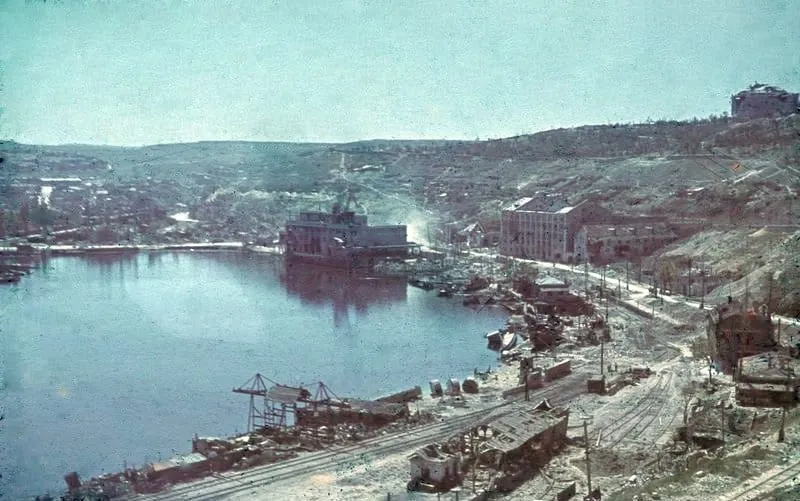
On 1 July 1942 units of the German 11th Army entered Sevastopol, the main base of the Soviet Black Sea Fleet, under siege since 30 October 1941. The city had been almost entirely destroyed. At noon a special Wehrmacht communiqué announced that the German and Romanian flags were flying over Sevastopol and that Colonel General Erich von Manstein’s troops, after twenty-five days of heavy fighting, had taken “the strongest land and sea fortress that had ever existed”. That same day Adolf Hitler promoted Manstein to field marshal. During the night of 30 June–1 July the commander of the defence, Vice-Admiral Filipp Oktyabrsky, flew out to the Caucasus, and the commander of the Independent Coastal Army, Major General Ivan Petrov, left by submarine on the evening of 1 July. Tens of thousands of their soldiers remained on the rocky Khersones peninsula west of the city, from which there was nowhere left to retreat.
Chronologies record under 1 July the fall of Sevastopol and “the end of Red Army resistance in the Crimea”. The first part of that statement is accurate; the second needs qualification. Organised defence on Cape Khersones lasted until the afternoon of 4 July, scattered groups fought on among the rocks and caves for a week and more, several thousand men held out in the quarries near Kerch until the autumn, and partisans were active in the Crimean Mountains. What did end with the fall of Sevastopol was the Red Army’s regular defence of the Crimea: after the defeat at Kerch in May, it had been the last piece of the peninsula in Soviet hands.
The fortress’s last days
The third assault on Sevastopol, the German Operation Störfang (Sturgeon Catch), began on 2 June with an artillery bombardment and air raids, and on 7 June the infantry went into the attack. Manstein was able to turn almost his whole army against the fortress only after he had destroyed the Crimean Front on the Kerch Peninsula in May in Operation Trappenjagd. For the first two weeks, up to the fighting in mid-June, it was a battle of attrition in which the German divisions melted away and the outcome long remained uncertain. Between 18 and 23 June, however, the whole Soviet defence north of Sevastopol Bay collapsed. From then on German artillery covered the whole bay and the harbour, and larger warships could no longer enter it. The last to get through, on the night of 26–27 June, was the destroyer leader Tashkent. According to Russian studies, by 27 June the defenders’ anti-aircraft artillery had run out of ammunition.
The defenders still held the inner ring of fortifications south of the bay: the Sapun Ridge (Sapun-gora), which dominated the city from the east, and the heights above Inkerman. Manstein decided not to attack them head-on. At about two in the morning on the night of 28–29 June, without an artillery preparation and under cover of a smokescreen, sub-units of General Erik Hansen’s LIV Corps crossed Sevastopol Bay in assault boats and struck at its strongly fortified southern shore, in the defenders’ rear. The surprise worked, though some of the boats sank. On the morning of the same day General Maximilian Fretter-Pico’s XXX Corps and the Romanians attacked from the east and from the direction of Balaklava. On the afternoon of 29 June the Soviet artillery on the Sapun Ridge fell silent for lack of shells, and the Germans climbed onto the ridge. From its crest they could fire on the whole city and on the Khersones peninsula.
One of the most disputed episodes of the defence dates from these days. In the tunnels beneath Inkerman, which housed ammunition dumps, stores and a hospital, there was a huge explosion. According to the Soviet version, the defenders blew up the dumps, burying the attacking Germans under the rock, and the Germans then set fire to the hospital rooms with wounded men and civilians sheltering inside. Manstein wrote in his memoirs that it was the Russians who blew up the tunnels together with the thousands of people who had taken refuge in them. What really happened there, and how many people died, is still a matter of dispute.
According to Russian figures, on 30 June the defenders had five coastal batteries left with the remnants of their ammunition and about one and a half thousand medium-calibre shells for the whole army. That day the Germans took the Malakhov Kurgan, the hill famous from the defence of Sevastopol in the Crimean War, and reached the very outskirts. The rear services of the army and the fleet began destroying stores and equipment, and lorries were abandoned along the shores of the Khersones peninsula.
The evacuation of the commanders
On the morning of 30 June Oktyabrsky asked Marshal Semyon Budyonny, commander of the North Caucasus Front, to which the Sevastopol Defensive Region was subordinate, and the People’s Commissar of the Navy, Admiral Nikolai Kuznetsov, for permission to evacuate. The Stavka agreed that same day. It was not, however, a question of evacuating the army, for which there were no longer either ships or time, but above all its command and cadres. At a meeting of the command in the casemates of Battery No. 35 on Cape Khersones it was announced who would leave by air and by sea.
During the night of 30 June–1 July Li-2/PS-84 transport aircraft from Krasnodar landed at the airfield by the lighthouse on Khersones. According to Russian studies, in successive flights they carried out more than two hundred officers and several dozen wounded, as well as secret documents. There was chaos around the aircraft: soldiers and civilians pressed onto the airfield, and some of those designated failed to get aboard. Oktyabrsky flew out on one of the last aircraft. Petrov and the staff of the Coastal Army boarded the submarine Shch-209 on the evening of 1 July. According to Russian figures, other submarines took off some 700 members of the command cadre, and further groups escaped in launches and small fleet craft, many of which were sunk by German aircraft and torpedo boats. It is not known exactly how many people got away in the first days of July – Russian authors give figures ranging from just under two thousand to several thousand, the overwhelming majority of them commanders and political workers.
Command of the remaining units passed to the commander of the 109th Rifle Division, Major General Pyotr Novikov. He was to cover the evacuation and defend the cape for as long as possible. His soldiers no longer had heavy weapons, water or food, and their ammunition was enough only for isolated skirmishes. For decades the decision to take out the commanders while leaving the army behind was passed over in silence in the USSR. For many veterans who survived captivity it remained their most painful memory of the war.
The capture of the city and resistance on Khersones
On the morning of 1 July the Germans and Romanians entered Sevastopol from the east and north, occupying the railway station, the Historical Boulevard and the centre. Organised resistance in the city itself ended that day, though isolated groups fought on in the ruins for several more hours. According to both German and Soviet accounts, only a handful, or at most a dozen or so, undamaged buildings survived in the city. Oktyabrsky, by then in Novorossiysk, said that day in a conversation with the head of the NKVD’s military counter-intelligence, Viktor Abakumov, that “Sevastopol as a city does not exist; it has been destroyed”.
The remnants of the Coastal Army and the sailors fell back onto the Khersones peninsula, a narrow, stony strip of land between the bays west of the city and Cape Khersones. On the night of 1–2 July the crew of armoured turret Battery No. 35, which had fired its last shells, blew it up. On the shore, in caves under the cliffs and in the battery’s casemates, thousands of soldiers, wounded men and civilians crowded together, waiting for ships. Individual launches and minesweepers came in to the shore at night, but could take only a few, and each night they left more people on the beach than they took away. On 3 July, according to Russian accounts, the last Soviet tank, a light T-26, fought its final action above Kazachya (Cossack) Bay. That same day the Sovinformburo announced that Soviet troops had abandoned Sevastopol and that its defence “would go down in history as one of its most glorious pages”.
On the afternoon of 4 July, after more shelling and air raids, the Germans split the defence between Kazachya Bay and Battery No. 35, and organised resistance ceased. That date is taken as the end of the siege. It was not, however, the end of the fighting. Groups of soldiers hid in the caves and tried every night to break through eastwards to the partisans in the Crimean Mountains, and according to Russian sources the last pockets of resistance on Khersones were extinguished around 12 July. General Novikov tried to get away on 9 July in the launch MO-112, which ran into German torpedo boats. Wounded, he was taken prisoner and died in captivity before the end of the war. According to the accounts of survivors, the Germans cleared the caves with explosives and smoke, and some Russian authors write of the use of gas, as in the quarries near Kerch; the scale and nature of these methods remain disputed.
Prisoners and losses
The number of prisoners taken at Sevastopol is disputed. German communiqués and some German studies spoke of 90,000–100,000 prisoners taken between the beginning of June and 4 July, most often of some 95,000–97,000. Manstein in his memoirs stated more cautiously that about 30,000 prisoners were taken at the very tip of the peninsula and another 10,000 in the Balaklava area. Russian authors, citing Soviet archival data, argue that there cannot have been more than about 78,000 prisoners, since the whole garrison numbered some 106,000 men at the beginning of June and only a few thousand replacements were sent in during the assault. Many of the prisoners were wounded. They were marched on foot to transit camps in the interior of the Crimea, and from there to prisoner-of-war camps in Ukraine. Like all Soviet prisoners in 1942, they faced hunger, disease and high mortality.
Behind the front-line troops came the commandos of Einsatzgruppe D under Otto Ohlendorf, which since the autumn of 1941 had been murdering Jews, Krymchaks and Roma in the Crimea. In Sevastopol they sought out Jews, commissars and communists among the prisoners and inhabitants and shot them. In the following months the Germans deported a large part of the city’s surviving inhabitants, and sent many to forced labour in the Reich.
According to the Russian statistical study edited by Grigori Krivosheev, Soviet forces lost 200,481 men in the whole defence of Sevastopol, from 30 October 1941 to 4 July 1942, including 156,880 killed, missing and captured. Western authors estimate the losses of the third assault alone at more than a hundred thousand men – practically the whole Coastal Army. Axis losses in Operation Störfang, according to 11th Army figures cited by the American author Robert Forczyk, amounted to 35,866 killed, wounded and missing, of whom 27,412 were Germans and 8,454 Romanians. A Soviet communiqué of July 1942 spoke of 150,000 German casualties at Sevastopol alone, but German documents do not confirm this. What is certain is that the divisions of LIV Corps lost at least a third of their strength, and some infantry regiments were bled almost white.
Resistance that went on
The fall of Sevastopol did not entirely end resistance in the Crimea. At the eastern tip of the peninsula, in the Adzhimushkay quarries near Kerch, several thousand soldiers from the units that had covered the evacuation of the Crimean Front, together with civilians, had been holding out since the second half of May. Cut off from water and food, they went out at night to fetch water and attacked German posts until the end of October 1942; few of them survived. In the forests of the Crimean Mountains partisans were active. According to the documents of their headquarters, in mid-July 1942 they numbered a little over two thousand, many of them wounded and weakened by hunger, and it was to them that the stragglers from Khersones were trying to break through. Only from the summer of 1942 did they begin to receive supplies by air. These centres of resistance did not, however, threaten German control of the peninsula, command of which was taken over by General Franz Mattenklott with XLII Corps.
Place in the war
The capture of Sevastopol concluded the Crimean campaign that Manstein had begun in September 1941 and was one of the Wehrmacht’s greatest successes of 1942. The fortress, which had repulsed the second assault in December 1941, fell after a siege of 250 days. The whole of the Crimea passed into Axis hands, and the Black Sea Fleet lost its main base and had to move to cramped Caucasian ports, where German bombers also reached it – on 2 July the Tashkent was sunk at Novorossiysk together with other vessels. Soviet aircraft lost the ability to attack the Romanian oilfields from the Crimea. Manstein received his field marshal’s baton and a reputation as a master of siege warfare, and a special badge, the Crimea Shield, was later instituted for the soldiers of his army.
The victory, however, came later than Directive No. 41 had envisaged. When Case Blue began in the southern USSR on 28 June, the 11th Army was still fighting in the Crimea, and Richthofen’s air corps had to divide its forces. After its victory Manstein’s bled-out army did not follow the rest of the forces to the Caucasus and the Volga: in August most of its divisions were transferred to Leningrad. Some historians believe that this reserve was later missed in the south, when the 6th Army became bogged down at Stalingrad. The summer of 1942 was also the high-water mark of Axis fortunes on two fronts at once – on the same day that the Germans were entering Sevastopol, Erwin Rommel was attacking the British positions at El Alamein, little more than a hundred kilometres from Alexandria.
For the Soviet Union the fall of Sevastopol was another defeat in a series that since May had included Kerch and Kharkov, but Joseph Stalin and the propaganda machine quickly turned the 250-day defence into a symbol of resistance. In December 1942 the Medal “For the Defence of Sevastopol” was instituted, and in 1945 the city received the title of Hero City. The Crimea remained in Axis hands until the spring of 1944. In the Crimean offensive the Red Army retook the peninsula in less than a month, and Sevastopol fell on 9 May 1944 after several days of assault. The German-Romanian 17th Army, hastily evacuated from Cape Khersones, lost tens of thousands of men – in the very place where two years earlier the last defenders of the fortress had waited in vain for ships.
Sources
Meanwhile
(04)Elsewhere, within a week.
- 3 July 1942 · PacificThe Japanese on GuadalcanalIn early July 1942 the Japanese began building an airfield on Guadalcanal. On 2 July Washington ordered an offensive in the Solomons to forestall them.
- 28 June 1942 · MediterraneanThe Battle of Mersa MatruhOn 26–29 June 1942 Rommel routed the badly co-ordinated Eighth Army at Mersa Matruh. The New Zealanders broke out, and the port fell on the morning of 29 June.
- 4 July 1942 · Western FrontThe first USAAF missions in EuropeOn 4 July 1942 six American crews in British Bostons joined the RAF in raiding Dutch airfields. Two did not return. A symbolic start for the Eighth Air Force.
- 27 June 1942 · AtlanticConvoy PQ 17 sails from IcelandOn 27 June 1942 convoy PQ 17 sailed from Iceland for the USSR – 35 ships carrying equipment for the Red Army, covered by British and American warships.
Related events
(04)The same battle, people or subject.
- 12 June 1942 · Eastern FrontThe third assault on SevastopolOn 12 June 1942, after five days of attacks, Manstein's 11th Army was biting into the northern sector of Sevastopol's defences. Both sides lost heavily.
- 23 July 1942 · Eastern FrontThe Germans take RostovOn 23–24 July 1942 the Wehrmacht took Rostov-on-Don for a second time. That day Directive No. 45 ordered simultaneous drives on the Caucasus and Stalingrad.
- 8 May 1942 · Eastern FrontOperation TrappenjagdOn 8 May 1942 Manstein's 11th Army attacked the Crimean Front. In under two weeks it routed three Soviet armies and retook the Kerch Peninsula.
- 17 December 1941 · Eastern FrontThe second assault on SevastopolOn 17 December 1941 Manstein's 11th Army launched a second assault on Sevastopol. After two weeks, with Soviet landings at Kerch and Feodosia, it stalled.