Germany
Erich von Manstein
Chief of Staff of Army Group South (1939) and Army Group A (1939–1940), commander of the 11th Army (1941–1942) and of Army Groups Don and South (1942–1944), field marshal (1942)
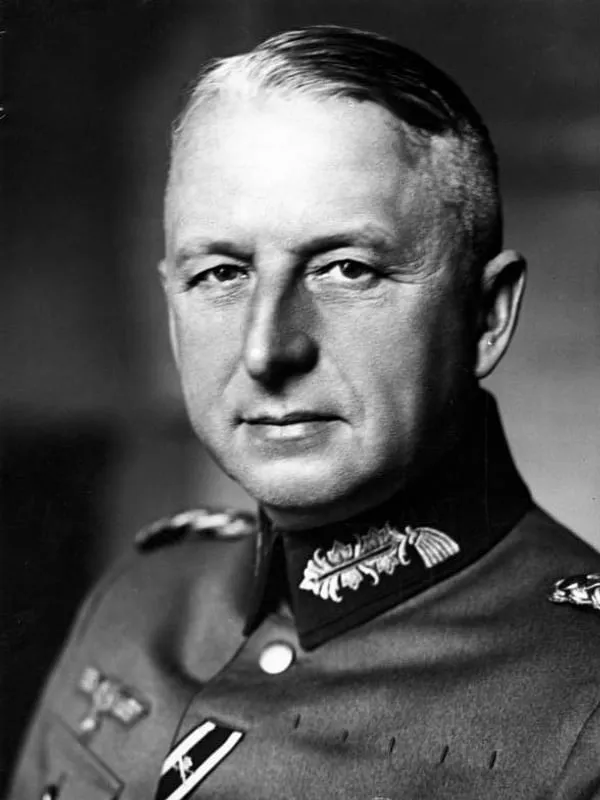
- Born:
- 24 November 1887, Berlin (Kingdom of Prussia, German Empire)
- Died:
- 10 June 1973, Irschenhausen, Icking municipality (Bavaria, West Germany)
- Author:
- Łukasz
- Photo:
- autor nieznany, CC BY-SA 3.0 DE, Wikimedia Commons

Erich von Manstein is regarded as the ablest strategist of Hitler’s army. As chief of staff of General Gerd von Rundstedt’s Army Group South, he helped draw up the plan for the invasion of Poland and directed the Battle of the Bzura. In the autumn and winter of 1939, against the wishes of the Army High Command, he pressed for a plan to strike with armour through the Ardennes, which in May 1940 brought Germany victory over France. In the war against the Soviet Union he conquered the Crimea and Sevastopol, tried to rescue the army encircled at Stalingrad and in the spring of 1943 retook Kharkiv. The same commander issued an order in the Crimea that called the “Jewish-Bolshevik system” an enemy to be exterminated, and his army cooperated with an SS unit that was murdering Jews. After the war a British court convicted him of war crimes, and his memoirs became one of the pillars of the legend of the “clean Wehrmacht”.
Of the Lewinski family
He was born in Berlin on 24 November 1887 as Fritz Erich Georg Eduard von Lewinski, the tenth child of General of Artillery Eduard von Lewinski and Helene, née von Sperling. The Lewinski family had Kashubian roots and bore the Brochwicz coat of arms. His mother’s younger sister, Hedwig, was married to General Georg von Manstein. The couple were childless and, under an earlier agreement between the families, took the newborn to bring up as their own. From then on the boy bore his adoptive father’s surname. A third sister, Gertrud, was the wife of Paul von Hindenburg, the future field marshal and President of the Reich. The Lewinski, Sperling and Manstein families had produced dozens of officers, many of them generals.
He spent his childhood in Strasbourg, where his adoptive father was stationed, and from 1900 attended the cadet schools at Plön and Groß-Lichterfelde near Berlin. In March 1906 he joined the 3rd Foot Guards Regiment, in which his cousin Oskar von Hindenburg and Kurt von Schleicher also served. He was commissioned as a second lieutenant in 1907 and in the autumn of 1913 began studying at the War Academy in Berlin.
The First World War
The outbreak of war interrupted his studies. As adjutant of the 2nd Guards Reserve Regiment he had his baptism of fire in August 1914 at Namur in neutral Belgium; his corps was then transferred to East Prussia, where he fought at the Masurian Lakes and in Poland. On 16 November 1914 he was seriously wounded and spent half a year in hospitals. On his return, although he had not completed the academy, he was posted to staff duties: with Max von Gallwitz’s army in the offensive on the Narew and in the Serbian campaign of 1915, then at Verdun and on the Somme, where he worked alongside one of Germany’s finest defensive specialists, Colonel Fritz von Loßberg. In 1917 and 1918 he was first general staff officer of a cavalry division in the Baltic region and then of an infantry division on the Western Front. He ended the war as a captain.
The Reichswehr
After the war he served on the staff of the frontier guard in Wrocław (Breslau), which at the turn of 1918 and 1919 organised the defence of the Reich’s eastern borders, against the Poles among others, and then on the commission that created the 100,000-strong Reichswehr. In 1920 he married Jutta Sibylle von Loesch, the daughter of a Silesian landowner, with whom he had three children. Like most officers he was a monarchist and looked on the Weimar Republic with distaste. He commanded a company at Angermünde, taught tactics and military history to staff officers, and in 1929 joined the disguised general staff, the Truppenamt, in the department that drew up mobilisation and operational plans. He twice visited the secret German tank school at Kazan in the Soviet Union.
Like most of the officer corps, he welcomed Hitler’s rise to power. In February 1934 he became chief of staff of the Berlin military district. When the war minister, Werner von Blomberg, introduced the Aryan paragraph into the armed forces and soldiers of Jewish descent were being expelled from the army, Manstein protested in a letter to the head of the Truppenamt, General Ludwig Beck. What he defended, however, was the autonomy of the officer corps, not the principle of equality: in the same letter he gave assurances that the whole army accepted the “racial idea”. Blomberg wanted to discipline him, and he was shielded by Werner von Fritsch.
In July 1935 Manstein took over the operations department of the Army General Staff, and in October 1936, as a Generalmajor, the post of First Deputy Chief of Staff. He was regarded as Beck’s heir apparent. At this time he made his name with the design of the assault gun, intended to support the infantry with direct fire, and with his work on operational plans. In February 1938, during the Blomberg–Fritsch affair, he was moved out of the General Staff to command the 18th Infantry Division at Legnica (Liegnitz). When Beck resigned in August 1938, Franz Halder became Chief of Staff. The rivalry between the two men was to weigh on the plans for the war against France. In March 1938 Manstein took part in preparing the Anschluss of Austria, and in the autumn his division marched into the Sudetenland. On 20 April 1939, in a speech marking Hitler’s fiftieth birthday, he extolled him as a leader sent to Germany by God and warned a “hostile world” that Germany would not shrink from another war.
Poland 1939
In the summer of 1939 Manstein, by then a Generalleutnant, became chief of staff of the secret “Working Staff Rundstedt”, which in August became the headquarters of Army Group South. Together with its operations officer, Günther Blumentritt, he prepared the southern part of Case White: the main blow was to be struck by General Walter von Reichenau’s 10th Army, in which most of the armour was concentrated, while the 8th and 14th Armies covered its flanks and were to encircle the Polish forces in western and southern Poland. On 22 August, at the Obersalzberg, he heard the address in which Hitler announced the “complete destruction of Poland”. In his memoirs he claimed that he had not understood at the time that extermination was meant.
During the September Campaign Rundstedt left the conduct of operations largely to him. When the Poznań and Pomorze Armies struck from the Bzura at the flank of the 8th Army, Manstein and Rundstedt decided not merely to repel the attack but to trap the Poles in an encirclement. They brought in corps of the 10th Army from near Warsaw and from the south, and in the Battle of the Bzura they destroyed the largest grouping of the Polish Army. Behind the front of Army Group South the Einsatzgruppen were murdering the Polish intelligentsia and Jews, and Wehrmacht soldiers committed crimes against prisoners and civilians. Manstein knew of the reports of these crimes. Ten years later, three of the seventeen charges at his trial related to Poland.
The plan to strike through the Ardennes
At the end of October 1939 Rundstedt’s staff, renamed Army Group A, moved to Koblenz. Manstein judged Case Yellow, drawn up by the OKH on the basis of Hitler’s directive of 9 October, to be a rerun of the Schlieffen Plan that would push the Allies back to the Somme without destroying them. On 31 October Rundstedt sent the OKH the first of Manstein’s memoranda, calling for the main effort to be shifted south, to Army Group A. In further memoranda, written up to January 1940, Manstein developed the idea of a thrust through the Ardennes towards Sedan and on to the mouth of the Somme, which would cut off the Allied armies in Belgium. The idea of directing the armoured drive towards the coast was suggested to him by Heinz Guderian. The Commander-in-Chief of the Army, Walther von Brauchitsch, and Halder rejected these proposals and at the end of January sent their author off to command XXXVIII Corps, which was being formed in Szczecin (Stettin).
Manstein’s friend, Major Henning von Tresckow, nevertheless managed to bring the idea to Hitler’s chief adjutant, Rudolf Schmundt. On 17 February 1940 Hitler received Manstein at the Reich Chancellery, heard him out and ordered that the plan be based on his concept. According to accounts from Hitler’s entourage, he said afterwards that Manstein was exceptionally able but that he did not trust him. In the French campaign Manstein’s corps went into action only after the front had been broken on the Meuse. In June it crossed the Somme and the Seine and reached the Loire. On 1 June Manstein was promoted to General der Infanterie, and in July he received the Knight’s Cross. In the autumn his corps waited on the Channel for a landing in Britain that never came.
The Crimea
In March 1941 he took command of LVI Motorised Corps, which advanced as part of Army Group North in Operation Barbarossa. Within the first few days of the war his tanks covered more than 200 kilometres and seized the bridges over the Dvina at Daugavpils (Dünaburg). In September, after the death of General Eugen von Schobert, Manstein took command of the 11th Army on the southern flank of the front. In the autumn he broke through the defences on the Perekop Isthmus and occupied almost the whole of the Crimea, but he failed to take Sevastopol at the first attempt.
Einsatzgruppe D operated in the Crimea, and its units murdered Jews, Krymchaks and Roma. Contrary to Manstein’s later assurances, his army cooperated with it: it supplied vehicles, fuel and drivers, its military police cordoned off the execution sites, and army headquarters pressed for the murder of the Jews of Simferopol to be carried out before Christmas 1941, because it feared food shortages. Well over ten thousand people were murdered there in December. On 20 November 1941 Manstein issued an order, modelled on that of Field Marshal Reichenau, in which he wrote that the “Jewish-Bolshevik system” must be exterminated once and for all, and called on his soldiers to show understanding for the “harsh punishment” of the Jews. While he commanded the 11th Army, Einsatzgruppe D murdered at least 33,000 Jews. The Commissar Order was also carried out in his sector.
In May 1942 he routed the Soviet forces on the Kerch Peninsula, and at the turn of June and July, after a month of heavy fighting and bombardment by the largest guns ever built, he captured Sevastopol. On 1 July 1942 Hitler made him a field marshal. In the summer he was transferred with part of the 11th Army to Leningrad, where, instead of the planned assault, he had to fend off a Soviet offensive. On 29 October 1942 his eldest son, Gero, was killed at the front.
From Stalingrad to dismissal
At the end of November 1942, when the Red Army encircled General Friedrich Paulus’s 6th Army at Stalingrad, Hitler entrusted Manstein with the newly created Army Group Don. At first Manstein did not support an immediate breakout by the encircled troops, counting on a relief operation. The relief attack in December stalled a few dozen kilometres short of the pocket, and Manstein did not order Paulus to break out in defiance of Hitler’s prohibition. Historians still argue over his share of responsibility for the fate of the 6th Army. In February and March 1943, after the surrender at Stalingrad, he launched a counter-stroke against the Soviet offensive on the Donets that halted it and allowed Kharkiv to be retaken. It was the Wehrmacht’s last great operational victory in the East.
In the summer of 1943 his Army Group South took part in the Battle of Kursk, which Manstein had long urged. He then conducted the retreat behind the Dnieper and into western Ukraine, in constant conflict with Hitler, who forbade any surrender of ground. Manstein criticised the way the war was being directed but did not join the conspirators. He turned Tresckow down, and according to Rudolf-Christoph von Gersdorff he said that “Prussian field marshals do not mutiny”. Historians doubt the authenticity of the remark, but not the refusal itself. In March 1944 he forced Hitler to agree to a breakout from encirclement by the 1st Panzer Army. On 30 March 1944 Hitler relieved him of his command, at the same time awarding him the Swords to the Knight’s Cross. He remained without a posting until the end of the war.
Trial and legend
In August 1945 he was interned by the British. In 1946 he testified at Nuremberg as a witness and, together with Brauchitsch, Halder and other generals, wrote a memorandum presenting the army as apolitical and innocent of crimes. In 1949, after long hesitation, the British put him on trial before their own military court in Hamburg, in part so as not to hand him over to the Soviet Union and Poland, which were demanding his extradition. On 19 December 1949 he was found guilty on nine of the seventeen charges – including tolerating the shooting of Soviet prisoners of war, implementing the Commissar Order and permitting his subordinates to kill civilians – and sentenced to eighteen years’ imprisonment. In 1950 the sentence was reduced to twelve years. Those who campaigned on his behalf in Britain included the historian Basil Liddell Hart and Winston Churchill. On 7 May 1953, officially on health grounds, Manstein was released. Modern historians regard as implausible his assurances that he knew nothing of the killings by Einsatzgruppe D.
In 1955 he published his memoirs, Lost Victories (Verlorene Siege). In them he presented the war as an exercise in operational art, lost through Hitler’s mistakes, while passing over the crimes and the political aims of the war. The book became a bestseller and for decades shaped the image of the Wehrmacht in the West. Manstein unofficially advised the West German government on the creation of the Bundeswehr. He died of a stroke on 10 June 1973 at Irschenhausen in Bavaria and was buried with military honours.
Significance
Manstein was an outstanding operational commander, and it was he, more than anyone else, who ensured that the plan for the attack on France took the form that shattered the Allies in six weeks. His talent, however, served a war of aggression and genocide. For Poland he is one of the architects of the September defeat; for the people of the Crimea he is the commander of an army that helped murder the Jews. His career shows how the German officer corps, convinced of its own apolitical character, became an instrument of Hitler, and after the war built the myth that it had fought honourably and known nothing. Historians, among them Oliver von Wrochem, have shown how much of that myth was self-justification and how much deliberate untruth.
Sources
Commanded in battles
(08)- 30 October 1941 – 4 July 1942Siege of Sevastopol (1941–1942)Eastern Front
- 26 December 1941 – 19 May 1942Fighting on the Kerch Peninsula (1941–1942)Eastern Front
- 23 August 1942 – 2 February 1943Battle of StalingradEastern Front
- 12–23 December 1942Operation Winter StormEastern Front
- 19 February – 15 March 1943Third Battle of KharkovEastern Front
- 5 July – 23 August 1943Battle of KurskEastern Front
- 26 August – 23 December 1943Battle of the DnieperEastern Front
- 24 January – 17 February 1944Battle of the Korsun–Cherkassy PocketEastern Front
Mentioned in battles
(11)Often appears with
People who appear in the same events.
On the timeline
(61)The 40 most important of 61 events. All tagged “Erich von Manstein” (25) →