1939: Annexations and wars before September
The Slovak–Hungarian War
- Dates:
- 23–31 March 1939
- Front:
- Central and Eastern Europe
- Location:
- The easternmost part of Slovakia, between the Uzh River and Michalovce, Snina and Stakčín (around Sobrance, Ulič, Nižná Rybnica and the Okna valley), and the airfield at Spišská Nová VesOn the battle map →
- Sides:
- Kingdom of HungaryAndrás LittaySlovak StateFerdinand Čatloš, Augustín Malár
- Result:
- Hungarian victory. After a truce concluded under German pressure, on 4 April 1939 Slovakia ceded to Hungary a strip of land around Sobrance and Stakčín.
- Author:
- Łukasz
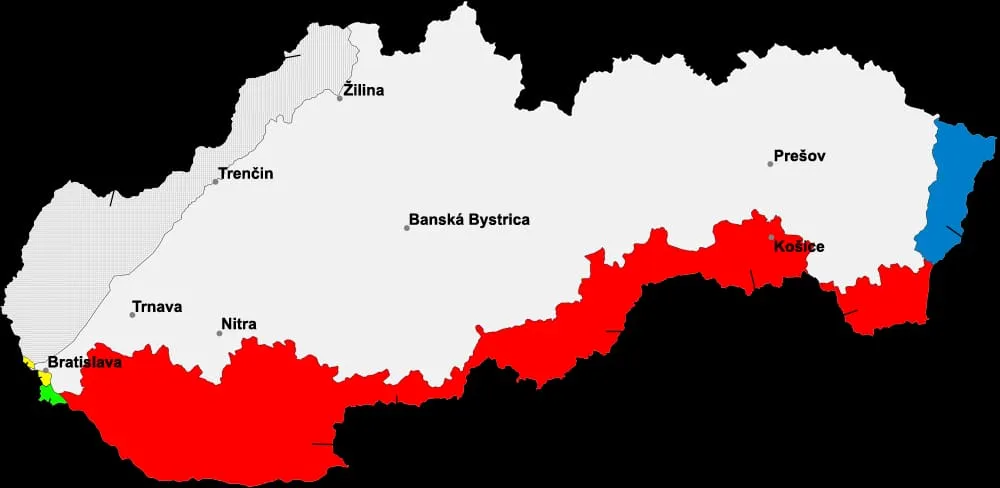
The “Little War” was the first armed conflict in Central Europe to break out after the break-up of Czechoslovakia, and the first war fought by the Slovak state. It lasted only a few days. On 23 March 1939, nine days after Slovakia proclaimed its independence, Hungarian troops, without any declaration of war, advanced from the newly occupied Carpatho-Ukraine into the eastern edge of Slovakia and pushed a dozen or so kilometres into the country. The Slovaks, whose army was only just being formed from the remnants of the Czechoslovak military, hastily assembled a few battle groups and counter-attacked on 24 March, but failed to drive the enemy out. That same evening, under pressure from Berlin, the Slovak command ordered the fighting to stop. Skirmishes and exchanges of fire nevertheless continued for several more days, and most accounts regard 31 March as the end of the war. The event that stirred the strongest feelings was the raid by Hungarian bombers on the airfield at Spišská Nová Ves. The outcome, however, was decided not by the fighting but by Germany’s attitude: the Reich, which a few days earlier had promised Slovakia protection, did not lift a finger in its defence.
Name and dates
The Hungarians call the conflict kis háború and the Slovaks Malá vojna – the “Little War”. Some accounts call it the Hungarian–Slovak War, while Slovak historians readily speak simply of the “Hungarian–Slovak armed conflict”, stressing that no one ever declared war.
The start is not in doubt: Hungarian troops crossed the border at dawn on 23 March 1939, at around 5 a.m. according to Slovak sources. The end is harder to pin down. The actual fighting lasted two days. On the evening of 24 March the Slovak Minister of Defence, Ferdinand Čatloš, ordered operations to be halted and the positions held, and on 25 March the Hungarian government agreed to negotiate. The truce took full effect only a few days later, and local clashes, shelling and exchanges of fire between outposts continued. Most accounts take the war to have ended on 31 March, when the situation on the new demarcation line calmed down. Some authors, especially Hungarian ones, take the signing of the border agreement in Budapest on 4 April as the closing date, while the Slovak Nation’s Memory Institute (ÚPN) mentions isolated clashes as late as 20 and 21 April. The war is therefore best dated 23–31 March, from the Hungarian incursion to the end of the fighting.
Background
Hungary had never come to terms with the Treaty of Trianon, which in 1920 had taken two-thirds of its territory, including the whole of Slovakia and Carpathian Ruthenia. Border revision was the aim of every Hungarian government of the interwar period, and the Regent, Miklós Horthy, and his ministers saw Hitler’s Germany as an ally that could help them achieve it. The first reward came after the Munich Agreement: the First Vienna Award of 2 November 1938 gave Hungary a strip of southern Slovakia and Carpathian Ruthenia – almost 12,000 square kilometres, including Košice, Uzhhorod and Mukachevo. Budapest regarded this as the bare minimum. Hungarian saboteurs of the Rongyos Gárda (Ragged Guard) were active in the borderlands, and between November 1938 and January 1939 there were more than twenty border incidents in which people were killed.
In March 1939 Czecho-Slovakia fell apart within three days. On 14 March the diet in Bratislava proclaimed Slovakia’s independence, which Hitler had forced on Jozef Tiso by threatening that otherwise he would hand the country over to Hungary. The next day Germany occupied Bohemia and Moravia, and Hungary moved into Carpatho-Ukraine, which had also declared independence. By 18 March the Hungarians had overrun all of it and reached the border with Poland – something the Polish Foreign Minister, Józef Beck, had been pressing for. Budapest was the first to recognise the Slovak state, but it was not satisfied with its eastern border. The line between Slovakia and Carpathian Ruthenia had been an administrative boundary within Czechoslovakia and ran only a few kilometres from Uzhhorod and from the railway that led up the valley of the Uzh towards the Uzhok Pass and Poland. The Hungarians argued that the border had yet to be drawn and that the inhabitants of the disputed villages were mostly Rusyns, not Slovaks.
There were clashes there as early as 14 and 15 March: Hungarian units tried to seize a hill opposite Uzhhorod, and shells fell on the villages of Vyšné and Nižné Nemecké. On 17 March the Hungarian Foreign Ministry presented in Berlin a map with a new line, shifted a dozen or so kilometres west, beyond Sobrance. The Germans agreed. On 18 March the German diplomat in Bratislava, Ernst von Druffel, informed the Slovaks that they should not oppose a “correction” of the border in the Uzh area. That same day Slovak politicians in Vienna initialled a protection treaty in which the Reich guaranteed Slovakia’s borders. The Hungarians knew that the guarantee would come into force only once Ribbentrop had signed it, and decided to act before then.
The timing could not have been better for them. The Slovak army was only just coming into being. Slovaks had made up only about 3 per cent of the Czechoslovak officer corps, and on 22 March, the day before the attack, the last transports of Czechs left Slovakia. Regiments had shrunk from two or three thousand men to a few dozen or a few hundred, and the Slovaks who had been serving in the Czech lands had not yet returned. In western Slovakia the Wehrmacht had moved in, emptying military depots and refusing to release weapons. Eastern Slovakia was defended by VI Corps, headquartered in Spišská Nová Ves and commanded since mid-March by Lieutenant Colonel of the General Staff Augustín Malár, a former Czechoslovak Legionnaire and later a general.
Forces
On the Hungarian side the attack was made by the units that had just occupied Carpatho-Ukraine: several infantry and cavalry brigades and a motorised brigade, supported by tanks, armoured cars, and anti-tank and anti-aircraft artillery. According to most accounts the operation was directed by General András Littay, commander of VII Corps in Miskolc. The Hungarian air force, with Fiat CR.32 fighters and Junkers Ju 86 bombers, was well trained and well prepared; as early as 15 March it reconnoitred eastern Slovakia, and it then moved its squadrons closer to the border.
The Slovaks had to improvise. On paper they had the three divisions of VI Corps, but these were mere skeletons. At the airfield in Spišská Nová Ves stood several dozen aircraft, mainly Avia B-534 fighters and Letov Š-328 (PL) reconnaissance aircraft, but the two fighter squadrons had only nine pilots between them. The few serviceable LT vz. 35 light tanks and OA vz. 30 armoured cars had to be repaired after sabotage and manned by scratch crews. The heavy weapons were in western Slovakia, in the zone occupied by the Germans, who refused to hand them over. The Hlinka Guard mobilised tens of thousands of men within a few days, but they did not get into action in time. By the end of the fighting some 15,000 Slovak soldiers had gathered around Michalovce, still less well armed and less well organised than the Hungarians.
Course of the war: the attack of 23 March
At dawn on 23 March Hungarian troops crossed the former Slovak–Ukrainian border in three columns: from Velykyi Bereznyi towards Ulič and on towards Starina; from Malyi Bereznyi through Ubľa towards Stakčín; and the strongest, with tanks and artillery, from the Uzhhorod area through Tibava towards Sobrance. The order was to advance “as far west as possible”. Surprise was complete. In the first minutes the Hungarians captured an infantry company asleep in its barracks, many outposts surrendered without a fight, and some Hungarian units advanced under white flags, implying that they were occupying an agreed line with the consent of the government in Bratislava. Sobrance fell at around 8 a.m. By evening the Hungarians had penetrated 10–20 kilometres into Slovakia and halted roughly on the line they had earlier presented in Berlin.
The government in Bratislava sent a note of protest to Budapest and appealed to Germany for help under the protection treaty. Budapest at first said nothing and then declared that it was conducting no operation in eastern Slovakia. In the afternoon Čatloš ordered Malár to launch a general counter-attack with all available forces. Three battle groups were formed on the spot: near Stakčín Major Matějka assembled an infantry battalion and two batteries; at Michalovce the reserve Captain Štefan Haššík, a local activist of the Slovak People’s Party, gathered about four battalions with artillery; and near Prešov Major Šivica covered the approach from Košice, from where Malár feared another attack. Malár appealed to Czech officers who felt attached to Slovakia to stay and help; about twenty stayed, and many of them distinguished themselves in the fighting. At Stakčín a fierce exchange of fire stopped the Hungarians.
That day the Slovak air force went into action. Flights of Letovs and Avias took off from Spišská Nová Ves and attacked Hungarian columns near Ulič and Sobrance, destroying several guns and vehicles. Hungarian anti-aircraft fire shot down two fighters; among those killed was the pilot Ján Svetlík.
Course of the war: the counter-attack and air raid of 24 March
During the night the Czech Major Kubíček arrived in Michalovce and took over command from Haššík. In the morning five armoured cars, repaired in Prešov, reached the town. The Slovaks attacked eastwards and drove a weak Hungarian outpost out of Závadka, about ten kilometres from Michalovce, back onto the main Hungarian line on the Okna (PL) river. Late in the evening, at around 11 p.m., they launched an attack on Nižná Rybnica. The attack across open ground broke down under the fire of Hungarian field and anti-tank artillery. One armoured car was hit and destroyed and another damaged, and the inexperienced infantry, led by officers they did not know, began to fall back. The retreat partly turned into a panic that could not be stopped until Michalovce. In the north the Slovaks had minor successes, improving their positions by a few kilometres.
In the air, 24 March belonged to the Hungarians. Fiat CR.32 fighters surprised Slovak flights over Vyšné Remety and Sobrance and shot down several Avias and Letovs. In the afternoon a dozen or so Hungarian Ju 86 bombers flew to Spišská Nová Ves, the main base of the Slovak air force, about 150 kilometres behind the front. Because of navigational errors and technical faults only some of them reached the target, and many bombs fell into mud and failed to explode. Even so, a hangar, barracks, stores, a brickworks and several aircraft were hit. Twelve or thirteen people were killed – five soldiers and seven civilians, according to ÚPN – and a dozen or so were wounded. The airfield remained in operation, and the funeral of the victims on 27 March turned into an anti-Hungarian demonstration. The Slovaks prepared a retaliatory raid on Budapest, but it never took place.
The truce and the last clashes
Berlin, which had agreed to a “small correction” of the border without fighting, did not want a real war in the rear of the future front against Poland. On 24 March Germany called on both sides to cease hostilities. Tiso asked for German weapons, and the Germans offered instead to send their own troops into eastern Slovakia. Tiso refused, fearing that the country would be drawn into a conflict it could not control. On the evening of 24 March Čatloš, at the Hungarian side’s request and with the government’s authority, ordered the fighting to stop and the positions to be held. On 25 March units of the 41st Infantry Regiment, a mountain artillery battery and more tanks and armoured cars reached Michalovce, and Kubíček was planning a new attack to the south, but the ceasefire order ruled it out. That day one of the Slovak anti-tank guns lost its way, drove straight into the Hungarian positions and was captured. On 25 March the Hungarian government declared that it was ready to negotiate, and on 27 March talks began in Budapest.
The front line did not change again, but until the end of March there were exchanges of fire between outposts, shelling of villages and local raids. Some of the incidents were caused by members of the Hlinka Guard who slipped out of the army’s control; the guardsmen also committed excesses against Czechs, Jews and former political opponents. Slovakia continued to send reinforcements east. The situation calmed down around 31 March. That same day Berlin advised the Slovaks not to insist on the inviolability of the border.
Losses
The figures vary by source. In their official lists the Slovaks recorded 22 soldiers killed, all of them by name. Together with civilians, including the victims of the raid on Spišská Nová Ves, 58 people died according to frequently cited figures (22 soldiers and 36 civilians); some Slovak studies speak of around 35 dead in all. A total of 360 Slovak and 311 Czech soldiers were taken prisoner, the latter mostly stragglers from the garrisons of Carpatho-Ukraine. On 25 March the Hungarians stated that they had lost 8 killed and 30 wounded, and two days later 23 killed and 55 wounded; the second figure may also have included losses suffered during the occupation of Carpatho-Ukraine. Some studies put Hungarian losses at 8 soldiers and 15 civilians. The Slovak air force lost a dozen or so aircraft – nine Avias and four Letovs, according to some accounts. The Hungarians probably lost only one aircraft, a Fiat fighter, according to some sources shot down by mistake by their own artillery.
Significance
Both sides claimed success. The Hungarians achieved their aim: they pushed the border back from Uzhhorod and the Uzh valley and secured the rail link with Poland. The Slovaks found that they could defend themselves, and according to some Slovak historians their resistance deterred the Hungarians from carrying out the “grand solution” – the seizure of the whole of eastern Slovakia as far as Poprad – which could have undermined the very rationale of the state. The war strengthened Slovak identity, accelerated the building of the army and poisoned Slovak–Hungarian relations for years. Above all, though, it showed what German guarantees were worth. The Reich not only failed to defend its protégé but had itself agreed to the Hungarian action. On 4 April 1939 Slovakia signed an agreement in Budapest in which it recognised the new border and ceded to Hungary a strip of land around Sobrance and Stakčín.
For Europe it was one of the lessons of the spring of 1939. Within two weeks Germany had seized Bohemia and Moravia and Klaipėda (Memel), Hungary had taken Carpatho-Ukraine and a sliver of Slovakia, and soon afterwards Italy took Albania. The weaker states of the region learned that in the new order force decided everything, and that law and treaties counted for only as much as Berlin and Rome wished. Poland gained the common border with Hungary it had long wanted, but at the same time Slovakia became a German springboard against Poland’s southern borderlands. In September 1939 Slovak divisions under Čatloš, with Malár commanding the 3rd Division, took part in the attack on Poland, while the common Polish–Hungarian border became an escape route for tens of thousands of Polish soldiers and civilians. Hungary and Slovakia, still at loggerheads, joined the Tripartite Pact in 1940 and in 1941 marched against the Soviet Union as Germany’s allies. Hungary held the lands seized in March 1939 until the autumn of 1944, when the Red Army moved in; after the war they returned to Czechoslovakia.
Sources
- upn.gov.sk · 23 marec 1939 madarsko slovensky ozbrojeny konflikt
- hrnko.sk · madarsky vpad na vychodne slovensko v marci 1939 alebo tiez mala vojna
- standard.sk · mala vojna pred 82 rokmi slovensko ustalo konflikt s madarskom hoci stratilo uzemie
- zsi.sk · vpad madarov na vychodne slovensko 23 marca 1939 85 rokov