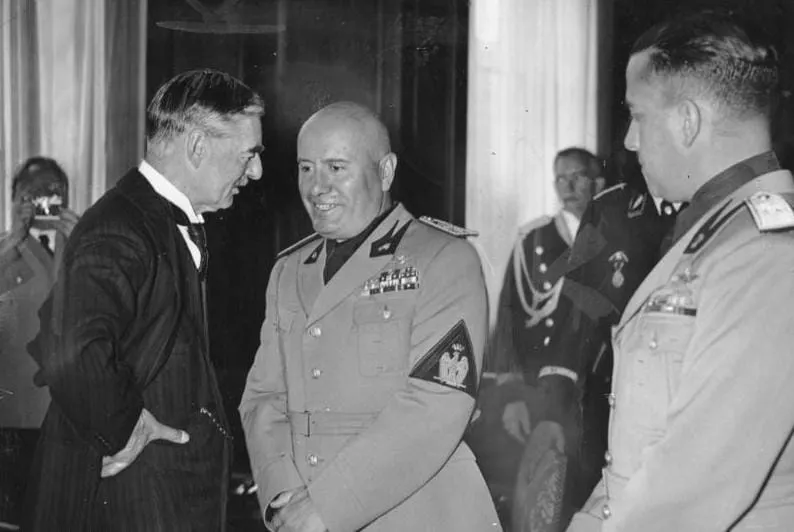
At about half past one in the morning on 30 September 1938, in the Führerbau on the Königsplatz in Munich, the heads of government of four great powers signed a document still dated 29 September. Adolf Hitler, Neville Chamberlain, Édouard Daladier and Benito Mussolini decided that within ten days Czechoslovakia would hand over to Germany its border regions with a German majority – the Sudetenland. Czechoslovakia’s representatives were not admitted to the talks; they waited in a hotel for someone to tell them what had been decided about their country. Britain and France believed that they had thereby bought peace. Czechs and Slovaks still call these events the “Munich Diktat” or the “Munich betrayal”, and throughout the world the word “Munich” became a byword for concessions to an aggressor that do not prevent war but bring it closer.
The Sudeten Germans
Czechoslovakia was created in 1918 on the ruins of Austria-Hungary, and its borders were confirmed by the Treaty of Saint-Germain and the Treaty of Trianon. It was home to more than three million Germans, about 23 per cent of the population, living mainly in the mountainous border districts of Bohemia, Moravia and Czech Silesia. Nobody had asked them whether they wished to live in a Czechoslovak state. The constitution guaranteed them equal rights; they had their own schools and parties, and from 1926 even ministers in the government; but in practice the state remained Czech and Slovak, and the Germans felt like second-class citizens in it. The Great Depression hit the industrial, export-oriented Sudetenland hardest: by the mid-1930s Germans made up the majority of the country’s unemployed.
This was the soil in which the Sudeten German Party (SdP) of the gymnastics teacher Konrad Henlein grew. In the 1935 elections it won about two-thirds of the German vote and became the strongest party in the country by number of votes. Historians debate whether it was Berlin’s instrument from the start or became one over time, but by 1938 there was no longer any doubt. Hitler had long regarded Czechoslovakia – an ally of France and the USSR with a strong army and a developed arms industry – as an obstacle to German expansion eastwards. At the secret meeting in the Reich Chancellery in November 1937 he had named it, alongside Austria, as the first target.
The crisis of 1938
After the Anschluss in March 1938, Czechoslovakia found itself in a German pincer: to the north, the west and now also the south, where it had no fortifications. On 28 March Hitler received Henlein in Berlin and told him to make demands that the Prague government would be unable to accept. On 24 April in Karlovy Vary (Karlsbad) Henlein announced eight demands which in practice amounted to autonomy for the Sudetenland under the SdP and the freedom to profess National Socialist ideology. In May, when rumours spread of German troop concentrations, Czechoslovakia carried out a partial mobilisation, and France and Britain warned Berlin. Hitler, enraged at the impression that he had backed down, signed a new directive for Case Green on 30 May, in which he wrote that it was his “unalterable decision” to smash Czechoslovakia by military action in the near future. The date for readiness was set at 1 October 1938.
The Western powers did not want a war over the Sudetenland. Chamberlain regarded the Sudeten Germans’ demands as largely justified and was convinced that neither Britain nor France could save Czechoslovakia if Germany attacked it. France was bound to Prague by an alliance of 1924 and a pact of 1925 concluded alongside the Locarno Treaties, and since 1935 the Soviet Union had promised help, but only if France came to Czechoslovakia’s aid first. Daladier’s government, however, financially weakened and convinced of the superiority of the German air force, had no intention of fighting without the British. In the summer London sent a mediator to Prague, Lord Walter Runciman. President Edvard Beneš agreed to one plan after another, until at the beginning of September he presented a “Fourth Plan” that met almost all the Karlovy Vary demands. Henlein’s followers, instructed from Berlin to prevent any agreement, broke off the talks on the pretext of an incident in Ostrava.
On 12 September, at the party rally in Nuremberg, Hitler attacked Beneš and demanded the right of self-determination for the Sudeten Germans. Riots broke out in the Sudetenland, which the Czechoslovak police and army suppressed within a few days. Henlein fled to Germany, where the Sudetendeutsches Freikorps was formed from the refugees; from then on it raided Czechoslovak border posts.
Berchtesgaden and Godesberg
On 15 September Chamberlain, flying for the first time in his life, went to meet Hitler at Berchtesgaden. Hitler demanded the incorporation of the Sudetenland into the Reich and threatened war. Chamberlain agreed in principle to hand over to Germany the districts where Germans made up more than half the population. On 18 September in London the British and French agreed on joint proposals and the next day presented them to Prague, offering in return an international guarantee of the new borders. The Czechoslovak government rejected them. On the night of 20–21 September the British and French envoys woke Beneš and declared that if Czechoslovakia did not accept the plan, it alone would bear responsibility for the war, and France would not come to its aid. On 21 September Prague gave way. The cabinet of Milan Hodža resigned, and General Jan Syrový formed a new government.
On 22 September Chamberlain flew in again, this time to Bad Godesberg on the Rhine, convinced that he was bringing Hitler everything he had wanted. Hitler declared that this was no longer enough. In a memorandum handed over on the night of 23–24 September he demanded that Czechoslovak troops leave an area marked on a map within a few days, without the right to remove anything, and he added the demands of Poland and Hungary. Chamberlain obtained only a postponement of the deadline to 1 October – the very day on which the Wehrmacht was planning to attack anyway. On the evening of 23 September Czechoslovakia proclaimed general mobilisation. Within a few days more than a million men were under arms, ready to defend the border fortifications modelled on the French Maginot Line. Prague, and after it Paris and London, rejected the Godesberg terms. France called up reservists; in London air-raid trenches were dug and gas masks handed out.
On 26 September, in the Berlin Sportpalast, Hitler declared that the Sudetenland was his “last territorial demand in Europe” and announced that on 1 October the Sudetenland would be German. On the morning of 27 September in Berlin, Chamberlain’s envoy Horace Wilson was told that Prague had until 2 p.m. on 28 September to accept the demands. That evening Chamberlain said on the radio that it was horrible, fantastic and incredible that the British should be digging trenches and trying on gas masks because of a quarrel in a faraway country between people of whom they knew nothing. President Franklin Delano Roosevelt, in messages of 26 and 27 September, appealed to Hitler for a peaceful settlement. On the night of 27–28 September the British fleet was ordered to mobilise. The following morning, at Chamberlain’s request, Mussolini telephoned Berlin and asked for action to be postponed for twenty-four hours. Hitler agreed and invited the heads of government of Britain, France and Italy to Munich. Chamberlain received the news during a speech in the House of Commons, and when he announced it, the members rose from their benches cheering.
The conference
The conference began around noon on 29 September in the Führerbau, a new NSDAP party building. Neither Czechoslovakia nor the Soviet Union was invited, although both were allies of France. The talks, held without an agenda or a chairman, were conducted in German, English and French, and the only one of the four leaders who could make himself understood in all three languages was Mussolini. It was he who presented a draft that passed as an Italian compromise proposal. In reality it had been drawn up the day before in Berlin, in Hermann Göring’s circle, and passed to the Italians. In essence it repeated the Godesberg demands, spread over several stages. Daladier, who in April had warned the British that after Czechoslovakia it would be the turn of Poland and Romania, put up no fight in Munich. Chamberlain haggled over details, such as compensation for property left behind in the Sudetenland, but gained little.
Two Czechoslovak diplomats flew to Munich: the envoy in Berlin, Vojtěch Mastný, and the Foreign Ministry official Hubert Masařík. They spent the whole day in the Hotel Regina under Gestapo supervision. The text of the agreement was handed to them after the signing by Chamberlain and Daladier. According to Masařík’s account, Chamberlain was yawning and Daladier was visibly embarrassed, and when they asked whether Czechoslovakia was expected to give any reply, they were told that no reply was expected, since the plan was regarded as accepted.
What was decided
The agreement began by stating that the cession of the “Sudeten German territory” had already been “agreed in principle” – a reference to Prague’s capitulation of 21 September. The evacuation of Czechoslovak troops and authorities was to begin on 1 October and be completed by 10 October, without any installations being destroyed. German troops were to occupy four zones marked on a map in succession: the first on 1 and 2 October, the second on 2 and 3 October, the third from 3 to 5 October and the fourth on 6 and 7 October. The remaining “predominantly German” territory was to be determined by an international commission made up of the State Secretary of the German Foreign Ministry, the British, French and Italian ambassadors in Berlin and a representative of Czechoslovakia, and Germany was to occupy it by 10 October. The commission was also to designate the areas in which plebiscites would be held by the end of November, and to fix the final frontier. The inhabitants of the transferred territories were given the right of option within six months, and within four weeks Prague was to release from the army and police any Sudeten Germans who so wished, and to free political prisoners of that nationality.
In annexes Britain and France confirmed their offer of an international guarantee of Czechoslovakia’s new borders. Germany and Italy promised to give their guarantee only once the question of the Polish and Hungarian minorities had been settled. If Prague did not reach agreement on this with Warsaw and Budapest within three months, the matter was to be taken up by another conference of the four powers.
On the morning of 30 September Chamberlain visited Hitler at his private flat on the Prinzregentenplatz and gave him a short declaration he had prepared to sign. It stated that the agreement signed the previous night and the Anglo-German Naval Agreement were symbolic of the desire of the two peoples never to go to war with one another again, and that disputes would be settled by consultation. Hitler signed it without hesitation.
Prague gives way
On the morning of 30 September the President, the government and the party leaders met in Prague. The generals were ready to fight, but fighting without allies, against Germany and possibly Poland and Hungary as well, seemed to Beneš national suicide. Shortly after noon the government accepted the Munich terms, telling the envoys of the powers that it was submitting while protesting to the whole world. In the evening General Syrový announced the decision on the radio. At the same time Chamberlain landed at Heston aerodrome near London and read out to the crowd the declaration signed by Hitler, waving the sheet of paper. In the evening, from a window at 10 Downing Street, he said that for the second time in history a British prime minister had returned from Germany bringing “peace with honour”, and added: “I believe it is peace for our time.” Daladier, who had expected a hostile crowd at Le Bourget airport, was greeted with flowers. According to those around him, he muttered to the diplomat accompanying him, Alexis Léger: “Ah, the fools! If only they knew…”
On 1 October German troops crossed the border in south-western Bohemia. On 3 October Hitler entered Cheb. The international commission yielded to Germany on every disputed point: on 5 October it adopted a line based on the Austrian census of 1910, more favourable to the Reich than the Munich maps, and on 13 October it abandoned plebiscites altogether. The final frontier, fixed on 20 November, cut off from Bohemia, Moravia and Czech Silesia almost 29,000 square kilometres – nearly 40 per cent of their area – with some 2.8 million Germans and more than 700,000 Czechs. Czechoslovakia lost its border fortifications, most of its lignite industry, a large part of its heavy industry and important railway lines. More than a hundred thousand Czechs fled or were expelled from the occupied territories, as were German anti-fascists and Jews. The annexed territories were formed into the Reichsgau Sudetenland, with Henlein as Reich Governor. On 5 October Beneš resigned as president, and on 22 October he left for London.
Zaolzie and Poland
From the spring of 1938 the Polish government had been announcing that if Czechoslovakia made territorial concessions to Germany, Poland would demand the same for the Poles in Zaolzie (the Trans-Olza area) – the part of Cieszyn Silesia that in 1920, after the Polish–Czechoslovak War and a decision of the great powers, had been awarded to Czechoslovakia without a plebiscite. On 21 September Poland formally demanded the cession of the area, troops were concentrated on the border, and saboteurs of the Zaolzie Legion (PL) crossed it and attacked Czechoslovak posts. Foreign Minister Józef Beck was indignant that in Munich the Polish question had been decided by four powers and that its settlement had in practice been made dependent on Hitler’s will. At 11.45 p.m. on 30 September the Polish envoy, Kazimierz Papée, delivered an ultimatum in Prague demanding the immediate withdrawal of the army and police from Zaolzie, with a deadline of noon on 1 October. The Czechoslovak government accepted it the next day.
On 2 October units of General Władysław Bortnowski’s Independent Operational Group Silesia entered Český Těšín, and by 11 October they had occupied the whole area. Depending on how it is counted, Poland gained between about 800 and more than 900 square kilometres with over 200,000 inhabitants, most of them Poles but also tens of thousands of Czechs and Germans. Many thousands of Czechs were subsequently dismissed from their jobs and expelled. In November Poland also took a few small strips of Slovakia in Spiš and Orava. At home the recovery of Zaolzie was celebrated as the righting of the wrong of 1920. There was no Polish-German agreement on the matter, and Polish troops did not cooperate with the Wehrmacht, but in the West Poland came to be seen as Hitler’s accomplice. Winston Churchill later wrote that Poland had “with hyena appetite” joined in the pillage and destruction of the Czechoslovak state. Today most Polish historians regard the ultimatum as a serious mistake of Beck’s policy.
Hungary and the break-up of Czecho-Slovakia
In the following weeks the Czechoslovak state began to fall apart from within. On 6 October the Slovaks proclaimed autonomy in Žilina, a few days later Subcarpathian Ruthenia was granted autonomy, and in November the state adopted the name Czecho-Slovakia. Talks with Hungary at Komárno produced no agreement, so the dispute was referred to German and Italian arbitration. On 2 November, in the Belvedere Palace in Vienna, Joachim von Ribbentrop and Galeazzo Ciano announced the First Vienna Award: Regent Miklós Horthy’s Hungary received almost 12,000 square kilometres of southern Slovakia and Subcarpathian Ruthenia, including Košice, with about a million inhabitants. The guarantee of the new borders promised at Munich was never given. On 30 November the judge Emil Hácha became president of the truncated state.
Reactions
Most Britons and Frenchmen greeted the agreement with relief. The First Lord of the Admiralty, Duff Cooper, resigned in protest. Churchill told the House of Commons on 5 October that Britain had suffered a total and unmitigated defeat. The House nevertheless backed the government by 366 votes to 144, and on 4 October the French Chamber of Deputies approved Daladier’s policy by 535 votes to 75, with almost only the communists opposed. On 6 December France and Germany signed a declaration of good-neighbourly relations in Paris, similar to the Anglo-German one.
Hitler was not satisfied. He had wanted a short, victorious war against Czechoslovakia and felt that Chamberlain had robbed him of it. At the same time Munich paralysed the opposition within the German army. The Chief of the Army General Staff, General Ludwig Beck, had resigned in August in protest against the war plans, and a group of officers around his successor, General Franz Halder, had been preparing to arrest Hitler the moment he gave the order to attack. A success without a shot being fired deprived the conspirators of their arguments. Joseph Stalin, whose country had been passed over, read Munich as proof that the West was ready to steer German expansion eastwards. The People’s Commissar for Foreign Affairs, Maxim Litvinov, the symbol of the Soviet policy of collective security, lost influence, and in May 1939 his post.
The road to war
Munich did not bring peace for even a year. On 15 March 1939, on the pretext of the state’s disintegration, German troops occupied Prague, and Bohemia and Moravia were turned into the Protectorate of Bohemia and Moravia. Slovakia became a state dependent on the Reich, and Hungary seized the rest of Subcarpathian Ruthenia. For the first time Hitler had seized a country inhabited by non-Germans, which destroyed the argument of self-determination on which the concessions had been based. Germany took over the Škoda works, the Czechoslovak army’s stocks of weapons and its tanks, which fought in Poland and France in 1939 and 1940. Slovakia and occupied Moravia became the springboard for the attack on Poland from the south.
Britain responded on 31 March 1939 with its guarantee to Poland, abandoning appeasement at the moment when it had ceased to yield anything. Stalin drew the opposite conclusion from Munich and in August 1939 came to terms with Hitler. Hitler, convinced that the Western democracies would give way again, told his generals on 22 August 1939 that their opponents were “little worms” whom he had seen at Munich. Historians still argue whether at Munich the West gained a year in which to rearm, or rather gave away without a fight a strong ally and some thirty-odd divisions at a time when Germany was not ready for a major war. There is no dispute, however, that for Czechoslovakia it was a catastrophe, and for Europe the last step before a war in which Poland was to become the first victim.
Sources
Related events
(04)The same battle, people or subject.
- 15 March 1939 · PoliticsGermany occupies Bohemia and MoraviaOn 15 March 1939 the Wehrmacht marched into Bohemia and Moravia, and that night Hitler slept at Prague Castle. Breaking the Munich Agreement ended appeasement.
- 14 April 1939 · DiplomacyRoosevelt's appeal to Hitler and MussoliniOn 14 April 1939 Roosevelt asked Hitler and Mussolini to pledge not to attack 31 named states. Hitler ridiculed the appeal in the Reichstag.
- 3 April 1939 · MilitaryFall WeissOn 3 April 1939 the OKW chief Wilhelm Keitel issued the Case White directive. The Wehrmacht was to be ready to attack Poland at any time from 1 September.
- 15 March 1939 · Central and Eastern EuropeHungary occupies Carpatho-UkraineOn 15 March 1939, as Carpatho-Ukraine proclaimed independence, Hungarian troops advanced on Khust. In three days they took it and reached the Polish border.