Slovakia
Jozef Tiso
Prime Minister of autonomous Slovakia (1938–1939) and of the Slovak State (1939), President of the Slovak Republic (1939–1945)
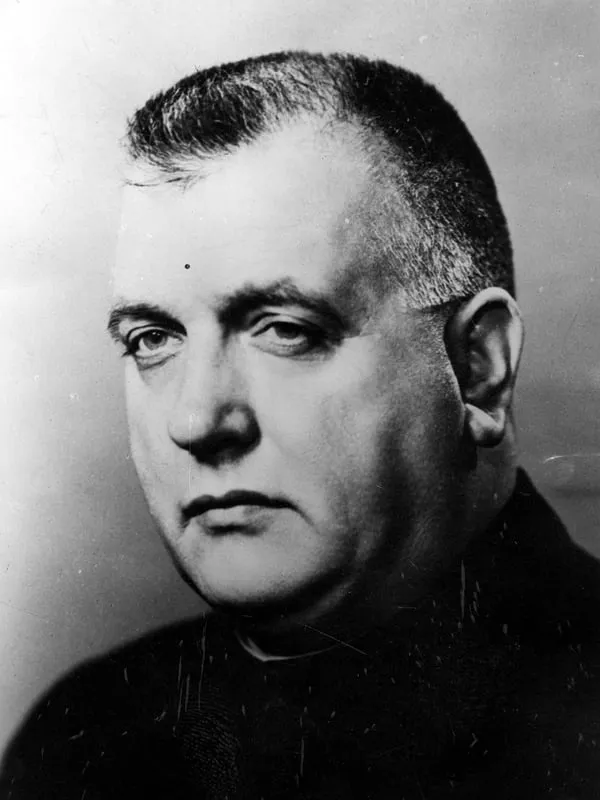
- Born:
- 13 October 1887, Veľká Bytča (Kingdom of Hungary, Austria-Hungary)
- Died:
- 18 April 1947, Bratislava
- Author:
- Łukasz
- Photo:
- autor nieznany, CC BY-SA 3.0 DE, Wikimedia Commons

Jozef Tiso was a Catholic priest from a small town in north-western Slovakia who became the first president of the first Slovak state in history. For most of his life he was a moderate politician who favoured autonomy for Slovakia within Czechoslovakia, not the break-up of the country. In March 1939, under pressure from Adolf Hitler, he brought about the proclamation of an independent Slovakia, which from its first day was a state dependent on the Third Reich. Under his rule Slovakia joined Germany in attacking Poland and then the Soviet Union, established a one-party dictatorship and became the first of the Reich’s allies to agree to hand over its Jews. After the war a Czechoslovak court sentenced him to death. To some Slovaks he remains to this day the founder of their statehood and a martyr; to historians he is above all a collaborator who shares responsibility for the Holocaust.
Youth and priesthood
He was born on 13 October 1887 in Veľká Bytča (Bytča) in the county of Trencsén in the Kingdom of Hungary, the son of a butcher. He was a gifted pupil with a talent for languages. He attended the gymnasium in Žilina, where teaching was in Hungarian, and from 1902 the Piarist gymnasium in Nitra. The Bishop of Nitra sent him to the elite Pazmaneum seminary in Vienna. There he encountered Catholic social teaching and the ideas of the Christian Socialists of Mayor Karl Lueger, and one of his professors was the future Austrian chancellor Ignaz Seipel. On 14 July 1910, before he had reached the required age, he was ordained priest with the permission of the Holy See, and in 1911 he took a doctorate in theology.
He served as a curate in several Slovak parishes, founded farmers’ associations and campaigned against alcoholism, and already in his journalism of those years he blamed Jewish innkeepers for rural poverty. He belonged to the Hungarian Catholic People’s Party and until 1918 was a loyal subject of the Habsburg monarchy, without any clear Slovak national identity. In August 1914 he went to the front as chaplain of the 71st Infantry Regiment from Trencsén, which fought in Galicia; after a few months a serious kidney illness ended his service. He became spiritual director of the seminary in Nitra and a teacher.
In Czechoslovakia
In the autumn of 1918, as Austria-Hungary fell apart, Tiso quickly came to terms with the new state. In December 1918 he negotiated the entry of Czechoslovak troops into Nitra on the town’s behalf and joined the revived Slovak People’s Party of Father Andrej Hlinka. In its newspapers he attacked the Social Democrats and the Jews, and in the schools of Nitra he pursued vigorous Slovakisation. In 1924, after two convictions for incitement and a conflict with his bishop, he was moved to the parish of Bánovce nad Bebravou. He remained parish priest there for the rest of his career and returned to the parish on Sundays even as minister and president.
From 1925 he was a member of parliament in Prague. He was regarded as a skilful negotiator, and it was he who brought the People’s Party into government: in January 1927 he became Minister of Health and Physical Education in the cabinet of Antonín Švehla, the youngest member of the government. In October 1929 the People’s Party left the coalition after Vojtech Tuka, a radical from its ranks, was convicted of high treason. In 1930 Tiso became deputy leader of the party and its chief ideologue.
In the 1930s his views became increasingly authoritarian. He proclaimed that the People’s Party was the sole legitimate representative of the Slovak nation, although in free elections it won about a third of the vote in Slovakia, and at the party congress of 1936 he spoke of the slogan “one nation, one party, one leader”. His model was the Catholic authoritarianism of Engelbert Dollfuss rather than Nazism, whose paganism he criticised. In 1935 he helped secure the People’s Party’s votes for the election of Edvard Beneš as president, but he competed for the party leadership with the more radical Karol Sidor and accepted the creation of the Hlinka Guard, the party’s paramilitary formation on the fascist model. After Hlinka’s death in August 1938 he took over the de facto leadership of the party.
Prime Minister of autonomous Slovakia
After the Munich Agreement the People’s Party proclaimed Slovak autonomy in Žilina on 6 October 1938, and the next day Tiso became prime minister of the autonomous government. He conducted talks with Hungary at Komárno, and when they failed he sought the support of Joachim von Ribbentrop in Munich against Hungarian claims. Ribbentrop let it be understood that Germany would welcome Slovak independence; Tiso replied that he preferred autonomy. The First Vienna Award of 2 November 1938 nevertheless gave southern Slovakia, with Košice, to Hungary, which Tiso took as a personal defeat.
Immediately afterwards his government, in which he was also Minister of the Interior, turned against the Jews, whom propaganda blamed for the loss of territory. On 4 November Tiso ordered that Jews “without property” and without citizenship be expelled to the territories awarded to Hungary; several thousand people, among them old people and children, were driven into no man’s land before the operation was called off a few days later. At the same time the government did away with democracy: the Slovak parties were merged with the People’s Party or banned, and in the elections to the Slovak Diet on 18 December 1938 there was only one list.
Founder of a state under German protection
At the beginning of 1939 the radicals Tuka, Ferdinand Ďurčanský and Alexander Mach were seeking Hitler’s backing for full independence, while the more cautious Tiso began to speak of “building a Slovak state” in the longer term. During the night of 9–10 March 1939 President Emil Hácha dismissed him and declared a state of emergency in Slovakia. On 13 March Tiso accepted an invitation to Berlin, where Hitler demanded an immediate declaration of independence and threatened otherwise to leave Slovakia to Hungary. Tiso refused to make the declaration from Berlin and had the Diet convened instead, which on 14 March unanimously proclaimed Slovak independence. Tiso became prime minister. A few days later he signed the Treaty of Protection, which handed Germany a strip of western Slovakia and subordinated the new state’s army and foreign policy to Berlin. The protection did not save Slovakia from a Hungarian attack in the “Little War” at the end of March.
Tiso’s apologists stress that he acted under duress and chose the lesser evil: independence under German protection instead of partition. His critics point out that the duress was real, but that Tiso and his party eagerly exploited the situation to build their own dictatorship and never tried to limit cooperation with the Reich when the opportunity arose.
War with Poland and the presidency
The constitution of 21 July 1939 gave the state the name Slovak Republic. On 1 September 1939 Slovakia joined the German attack on Poland. Tiso justified this by an alleged threat from Poland and by the recovery of territory lost to Poland between 1920 and 1938; the Slovak army entered Podhale, the Nowy Sącz region and the Bieszczady, and in November Germany gave Slovakia some 770 square kilometres of Polish Spisz and Orawa. On 1 October Tiso formally became chairman of the party, and on 26 October 1939 the Diet unanimously elected him president; Tuka became prime minister.
At the Salzburg conference in July 1940 Hitler forced changes in the government: Ďurčanský was removed and Tuka and Mach, supporters of National Socialism on the German model, gained greater influence. Tiso kept his post and for years afterwards competed with the radicals for the leadership, relying on the party, the Church and the army. In November 1940 Slovakia joined the Tripartite Pact; in June 1941 its troops entered the USSR alongside the Germans, and in December 1941 it declared war on the United Kingdom and the United States. In 1942 the party gave Tiso the title of “leader” (vodca), on the model of the German Führer.
The deportation of the Jews
In September 1941 the government issued the so-called Jewish Code, modelled on the Nuremberg Laws: Jews had to wear the Star of David and were stripped of their property, their professions and the right to education. At the beginning of 1942 the Slovak authorities agreed to hand over to the Germans first 20,000 young Jews for labour and then whole families, paying the Reich 500 marks for each person deported. Between 25 March and 20 October 1942 some 58,000 people were deported from Slovakia (PL) to Auschwitz and the Lublin region. A few hundred survived. The deportations were legalised by a constitutional law of May 1942, which left the president the right to grant exemptions; Tiso used it, and later cited this in his defence, but the exemptions covered only a small proportion of the victims.
In August 1942, when news of the fate of the deportees was already reaching Bratislava, Tiso defended the deportations in a speech at Holíč as consistent with Christian morality and called the Jews a parasite of which the Slovaks had to rid themselves. The Vatican protested repeatedly through its representative Giuseppe Burzio, and the Vatican diplomat Domenico Tardini wrote bitterly that no one would understand why the Holy See could not rein in even one priest. In the autumn of 1942, under the influence of protests from the Church and part of society and of the news of mass killings, the deportations were halted, and despite pressure from Hitler, including in a conversation with Tiso in April 1943, they were not resumed until 1944.
Uprising and fall
On 29 August 1944, as the Red Army was approaching the Carpathians and the Germans were beginning to occupy the country, the Slovak National Uprising broke out, with much of the army taking part. Tiso agreed to the entry of German troops and condemned the insurgents. After the Germans captured the centre of the uprising, Banská Bystrica, at the end of October 1944, Tiso went there, celebrated a service of thanksgiving and decorated German soldiers, among them the commander of the occupation forces, SS-Obergruppenführer Hermann Höfle. Under the occupation the Germans and units of the Hlinka Guard murdered thousands of people, burned dozens of villages and deported some 13,000 more Jews. Tiso remained president to the end, increasingly as a figurehead.
In April 1945, before the Red Army entered Bratislava, he fled to Austria and then to a Capuchin monastery in Altötting in Bavaria. In June 1945 he was arrested by the Americans, who handed him over to Czechoslovakia. His trial before the National Court in Bratislava began on 2 December 1946. On 15 April 1947 Tiso was sentenced to death for treason against the state, betrayal of the uprising and collaboration; the court found him guilty, among other things, of breaking up the republic, of the deportation of the Jews and of helping the occupiers in the repression that followed the uprising. He showed no remorse. The government of Klement Gottwald recommended by a majority vote that his plea for clemency be rejected, and President Beneš did not grant it. Tiso was hanged in his cassock on 18 April 1947 in the courtyard of the Palace of Justice in Bratislava. He was buried in secret so that his grave would not become a place of veneration. The dispute over clemency for him deepened the conflict between the Communists and the Slovak Democratic Party before the February coup of 1948. In 2008 his remains were moved to the crypt of Nitra Cathedral.
Significance
Tiso was a figure typical of Central Europe in the 1930s: a conservative cleric who abandoned democracy in the name of nation and faith and allowed himself to be used as Hitler’s instrument in the great powers’ game. His decision of 14 March 1939 made it easier for Germany to liquidate Czecho-Slovakia without formally breaking with Munich, and gave the Reich a forward base on Poland’s southern border, from which German and Slovak troops struck in September 1939. The state he led gave Slovaks the experience of statehood of their own and a few years of relative prosperity, but at the price of dictatorship, participation in attacks on its neighbours and complicity in the Holocaust, in which most of Slovakia’s Jews perished. Since 1989 Slovak nationalists have tried to portray him as a martyr, while historians such as his biographer James Mace Ward see him as priest, politician and collaborator at once, a man whose tragedy does not absolve him of responsibility.
Sources
Mentioned in battles
(02)Often appears with
People who appear in the same events.
On the timeline
(19)1939
March
- 23
- The German–Slovak Treaty of ProtectionOn 23 March 1939 Ribbentrop signed a treaty placing Slovakia under Reich “protection”, giving the Wehrmacht a zone of its territory and control of its army.
- The Slovak–Hungarian War beginsAt dawn on 23 March 1939 Hungarian troops entered eastern Slovakia without a declaration of war. Germany, guarantor of the new state, did not come to its aid.