- Category:
- Politics
- Date:
- 15 March 1939
- Author:
- Łukasz
- Tags:
- Czechoslovakia, Third Reich, Adolf Hitler, appeasement
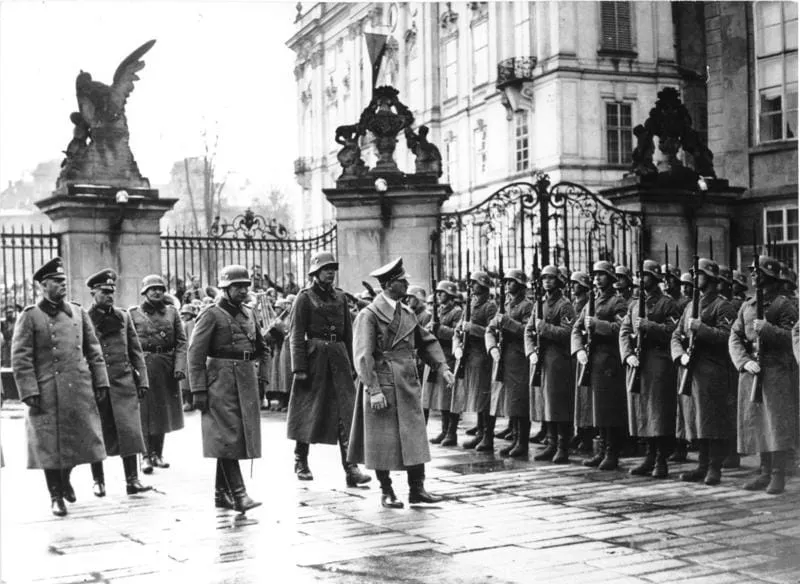
At six in the morning on 15 March 1939 German troops crossed the border of rump Czecho-Slovakia and advanced on Prague, Brno and Olomouc. A few hours earlier, during the night, at the Reich Chancellery in Berlin, President Emil Hácha – intimidated by the threat that Prague would be bombed and at the end of his strength – had signed a declaration in which he placed the fate of the Czech people and their country “with full confidence” in the hands of Adolf Hitler. The Czechoslovak army was ordered not to resist. Before nine the first German units drove into Prague through a snowstorm, and by the evening Hitler was at Prague Castle. Less than six months after the Munich Agreement, which was supposed to secure “peace for our time”, Hitler had seized a country inhabited by Czechs, not Germans. That day ended the policy of concessions to the Reich and opened the road to the war that began six months later with the attack on Poland.
A state without borders
Munich took more from Czechoslovakia than the Sudetenland. Together with the border regions it lost its defensive system: a belt of fortifications modelled on the French Maginot Line, built from 1935 along the German border and hastily extended southwards after the Anschluss of Austria. The bunkers in the Sudeten mountains were meant to hold up the Wehrmacht long enough for allies to come to the rescue. In October 1938 they passed without a shot into the hands of the Germans, who themselves later admitted that taking them would have cost a great deal of blood. The new border now ran a few dozen kilometres from Prague, across open country, and German troops stood to the north, west and south of Bohemia and Moravia. The Czechs did not attempt organised resistance, because with the Sudetenland they had lost their main line of defence. A fight in March 1939 would have been a fight without fortifications, without allies, and lost from the outset.
The state that survived Munich had been called Czecho-Slovakia since November 1938 and was a federation of three parts: Bohemia and Moravia, autonomous Slovakia, and autonomous Subcarpathian Ruthenia, renamed Carpatho-Ukraine. The First Vienna Award gave the south of Slovakia and of Subcarpathian Ruthenia, with Košice, to Hungary, and Poland seized Zaolzie (the Trans-Olza area). President Edvard Beneš resigned and went abroad, and on 30 November 1938 the National Assembly elected in his place Emil Hácha, the 66-year-old president of the Supreme Administrative Court, a non-party lawyer with no political experience. Rudolf Beran’s government was given powers to rule by decree. The Second Republic did everything it could to avoid provoking Berlin: it outlawed the Communists, restricted the press and introduced the first laws aimed at Jews, while the foreign minister, František Chvalkovský, assured the Germans of its complete loyalty. But no one ever gave the guarantee of the new borders promised at Munich.
Hitler prepares to “liquidate the rest of the Czech state”
Hitler had no intention of stopping at the Sudetenland. As early as 21 October 1938 he issued a secret directive to the Wehrmacht to be ready “to liquidate the remainder of the Czech state at any time” (Erledigung der Rest-Tschechei), and in December he added that the operation was to look like a peaceful intervention, not a war. It was not only a matter of prestige. At the secret meeting at the Reich Chancellery in November 1937 Hitler had spoken of Czechoslovakia as a source of food and raw materials and as an obstacle to further expansion. At the beginning of 1939 the German economy, overstretched by rearmament and the Four-Year Plan, was suffering from a severe shortage of foreign currency and raw materials. The Wehrmacht even had to cut its allocations of steel and non-ferrous metals. The Czech lands had what the Reich lacked: the central bank’s gold reserves, a modern arms industry led by the Škoda Works in Plzeň and Česká zbrojovka, and the weapons of an army that before Munich had numbered several dozen divisions.
The Slovak question supplied the pretext. When on the night of 9–10 March 1939 Hácha, seeking to prevent Slovakia from breaking away, dismissed Jozef Tiso’s autonomous government and sent the army into Slovakia, Berlin decided its moment had come. On 13 March Hitler summoned Tiso to Berlin and confronted him with a choice: either Slovakia declared independence at once, or it would be left to its fate – that is, to Hungary. The next day the diet in Bratislava proclaimed the Slovak State. For several days the German press had been writing about “Czech terror” against Germans in Prague, Brno and Jihlava. The incidents were largely provoked by local Nazis, and Hitler had already fixed the invasion for 6 a.m. on 15 March. Hermann Göring was summoned back from holiday in San Remo.
The first shots at Místek
Some German units set off even before the night-time talks. Berlin feared that Poland, which had claims to the rest of Cieszyn Silesia and the Ostrava coalfield, would get there first. So on the evening of 14 March, at around 5–6 p.m., units of the Wehrmacht and the Leibstandarte SS Adolf Hitler crossed the border near Moravská Ostrava and occupied the industrial basin well ahead of the appointed time.
There the only known serious fighting of those days took place. In Místek an under-strength battalion of the 8th Silesian Infantry Regiment, made up largely of recruits who had joined a few weeks earlier, was stationed in barracks set up in the former Czajanka factory. At around a quarter past six in the evening a German column halted in front of the gate. The sentry shouted “Halt!” and fired a warning shot, and when a German officer kept walking towards him, pistol in hand, a firefight broke out. The defence of the barracks was led by the commander of the machine-gun company, Captain Karel Pavlík. The soldiers fired from the windows and the roof, beat off several attacks and damaged a German armoured car that drove into the courtyard. The Germans brought up an anti-tank gun and mortars. After about half an hour of fighting, with the defenders running out of ammunition, the battalion commander, who had managed to contact his superiors, ordered them to cease fire and surrender. On the Czech side two men were seriously wounded. German losses were never officially disclosed; Czech estimates put the German dead at anywhere from a few to a dozen or more. The Protectorate authorities later banned any mention of the skirmish. Pavlík later joined the resistance and died in Mauthausen concentration camp in 1943.
A night at the Reich Chancellery
Hácha did not know that the German decision had already been taken. After the proclamation of Slovak independence, on the advice of the British minister in Prague, he asked through Chvalkovský for a meeting with Hitler, hoping to save at least the Czech part of the state. On the afternoon of 14 March he left Prague by train together with the foreign minister, his daughter and a few officials. He was an elderly, ailing man with a weak heart, and his doctors advised him against flying. Late in the evening he was received in Berlin with the honours due to a head of state: a guard of honour, flowers for his daughter, a suite at the Hotel Adlon. The first to speak with him was Joachim von Ribbentrop. Hitler, however, kept him waiting for several hours. According to the memoirs of Wilhelm Keitel, he said he would let “the old gentleman” rest. By then he already knew that his troops were in Ostrava.
The meeting in Hitler’s study at the New Reich Chancellery (PL) began at around one in the morning of 15 March. Göring, Ribbentrop and Keitel were present. According to the German record, Hácha distanced himself from the policies of Masaryk and Beneš and asked that the Czech nation be allowed to keep its own national existence. Hitler replied with a long tirade about Czech hostility and the “spirit of Beneš”, and then announced that at six in the morning German troops would march into the Czech lands. He set out the alternatives: if the entry passed off peacefully, the Czechs would be granted a “generous” life of their own, autonomy and a certain degree of national freedom; if there was fighting, resistance would be crushed by every means. When Hácha asked how he was supposed to stop an entire nation from resisting within four hours, Hitler sent him to the telephone.
After they left the study, at around two, Hácha and Chvalkovský were taken in hand by Göring and Ribbentrop. For a long time the line to Prague would not work. Göring described how within a few hours the Luftwaffe would reduce Prague to ruins. According to an account that the French ambassador, Robert Coulondre, passed on to Paris, the German ministers literally “chased” the Czechs round the table with the documents, thrusting pens into their hands and repeating that hundreds of bombers would take off at six in the morning. Hitler’s interpreter Paul Schmidt denied such scenes in his memoirs, but historians do not regard his account as reliable. What is beyond dispute is that Hácha collapsed and was revived with an injection by Hitler’s personal physician, Theo Morell. Some historians, following Joachim Fest, speak of a heart attack. Göring later admitted to the British ambassador, Nevile Henderson, that he had threatened bombing, though he explained it as a warning in case the Czech army opened fire.
At around four in the morning Hácha and Chvalkovský signed the declaration prepared in advance. It stated that the President of Czecho-Slovakia, “in order to secure calm, order and peace in this part of Central Europe”, placed the fate of the Czech people and country in the hands of the Führer, and that Hitler took it under the protection of the Reich and would guarantee it autonomous national development. Earlier, Hácha had managed to telephone Prague. The government and General Jan Syrový, the minister of national defence, ordered the army to stay in barracks and hand over its weapons without a fight. Hácha and Chvalkovský believed that the occupation would be temporary and that the Czech lands would keep their autonomy, without an army or a foreign policy of their own. According to the memoirs of his secretaries, Hitler burst into their room and told them to kiss him, saying that this was the happiest day of his life and that he would go down in history as the greatest German.
The entry
At six in the morning troops of two army groups, commanded by General Johannes Blaskowitz in Bohemia and General Wilhelm List in Moravia, crossed the border from the Sudetenland, Saxony, Bavaria and former Austria. Heavy snow was falling. In accordance with its orders, the Czechoslovak army did not resist; officers handed over barracks, depots and airfields. At around nine the first German vehicles appeared on the streets of Prague. People stood on the pavements in silence; some wept, others whistled, shook their fists and sang the national anthem. Photographs of weeping women later went round the world. The German residents of Prague and Brno gave the soldiers an ecstatic welcome. The Gestapo arrived together with the army and on the very first day began making arrests from prepared lists: Communists, Social Democrats, patriotic activists and German political émigrés who had taken refuge in Czechoslovakia. The operation, codenamed “Gitter” (“Grille”), caught several thousand people within a few days.
Hitler left Berlin in a special train and from the border travelled by car in a military column. On the evening of 15 March he reached Prague and stayed at Hradčany, the seat of the Bohemian kings and the presidents of the republic. Hácha’s train was deliberately held up on the way, so that the President returned to Prague only after him and found a German guest at the castle. The next day it was proclaimed from Prague Castle that Czecho-Slovakia had ceased to exist and that the Protectorate of Bohemia and Moravia was being established on its Czech lands.
On the same 15 March Hungarian troops were occupying Carpatho-Ukraine, which had also declared independence the day before. Czechoslovakia disappeared from the map within two days.
The spoils
For the Reich the gain was enormous and immediate. In a speech to the Reichstag on 28 April 1939 Hitler listed the booty: 1,582 aircraft, 501 anti-aircraft guns, 2,175 artillery pieces, 785 mortars, 469 tanks, more than 43,000 machine guns, 114,000 pistols, over a million rifles and vast stocks of ammunition. By various estimates this was enough to equip several dozen divisions. The Czech LT vz. 35 and LT vz. 38 tanks, renamed Panzer 35(t) and 38(t), equipped several German panzer divisions in 1939 and 1940. The Škoda Works and Česká zbrojovka began working for the Wehrmacht, and Winston Churchill later wrote that between August 1938 and September 1939 the output of Škoda alone was almost equal to that of the entire British arms industry.
The Germans also reached for the gold. Most of the Czechoslovak National Bank’s reserves were already abroad, chiefly in London and Basel. Under duress, the bank’s directors were forced to sign orders transferring the gold to the Reich. In March the Bank of England carried out an instruction to transfer some 23 tons of Czechoslovak gold, deposited in an account of the Bank for International Settlements, to the Reichsbank’s account. When the affair came to light in May, it caused a storm in the House of Commons.
The end of appeasement
The entry into Prague destroyed the argument on which the policy of concessions had rested. Until then Hitler could claim that he merely wanted to unite the Germans in a single state and right the wrongs of Versailles. The remilitarisation of the Rhineland, the Anschluss and the Sudetenland could all be presented as the exercise of the right to self-determination. The Czechs were not Germans. The occupation of Prague showed that Hitler was bent on conquest and that his word meant nothing.
The British government at first reacted with restraint. On 15 March Neville Chamberlain told the House of Commons that the British guarantee to Czechoslovakia no longer applied, because the state had collapsed from within after the secession of Slovakia, and although he expressed regret, he announced that existing policy would continue. The reaction of MPs, the press and his own party, however, was so fierce that two days later, on 17 March, in a speech in his home city of Birmingham, the Prime Minister changed his tone. He listed the promises Hitler had broken in Prague and asked the questions all Europe heard: was this the end of an old adventure or the beginning of a new one; was it the last attack on a small state, or would others follow; was it in fact a step towards an attempt to dominate the world by force? He declared that Britain would resist any such attempt with all its strength. Ambassador Henderson was recalled from Berlin for consultations, and on 18 March London and Paris lodged protests declaring the occupation devoid of any legal basis. The Foreign Secretary, Lord Halifax, who had long been pressing for a tougher line, gained new arguments.
The occupation was recognised by neither Britain, France, the United States nor the Soviet Union. The State Department condemned Germany’s “wanton lawlessness”, and Washington continued to recognise the Czechoslovak minister. Benito Mussolini, whom Hitler had not forewarned, was, according to the diary of Galeazzo Ciano, furious and humiliated, and sought his answer to the German success in Albania.
Poland and 15 March
Warsaw greeted the events with mixed feelings. Since the autumn of 1938 the Foreign Minister, Józef Beck, had been working for a common Polish–Hungarian border, which was to shield Poland from German influence in the south and block the Reich’s route to Romania. The Hungarian occupation of Carpatho-Ukraine fulfilled that hope and was welcomed in Poland. At the same time, however, something more dangerous had happened. Slovakia had placed itself under German protection, and German troops stood in Moravia and the Ostrava basin, just across the border from Cieszyn Silesia. Germany now surrounded Poland from the west, from East Prussia in the north, and now from the south as well. Poland, which in the autumn of 1938 had taken Zaolzie from Czechoslovakia, now found itself in the position Czechoslovakia had been in during the spring of 1938.
What followed
On 16 March, at Prague Castle, Hitler signed the decree establishing the Protectorate of Bohemia and Moravia, and on 23 March he subordinated Slovakia to himself with a protection treaty. On the same day Lithuania ceded Klaipėda (Memel) to the Reich, under the pressure of an ultimatum from Ribbentrop. As early as 21 March Ribbentrop had again, and more sharply, put to the Polish ambassador in Berlin, Józef Lipski, the demand for the surrender of Gdańsk (Danzig) and an extraterritorial road across Pomerania. The Czech crisis turned into a Polish crisis.
Britain drew its conclusions faster than anyone had expected. On 31 March Chamberlain announced in the House of Commons a guarantee of Poland’s independence, and France joined it. For the first time London had undertaken to defend a state in Central and Eastern Europe before it was attacked. On 3 April Hitler responded with the Case White (Fall Weiss) directive, ordering preparations for war with Poland from 1 September. Convinced that the Western democracies would back down again, he did not believe in the guarantees. In his eyes the pact with the USSR concluded in August was to render them finally worthless.
When the Wehrmacht attacked Poland on 1 September 1939, some of its units struck from Slovakia and Moravia – territories seized in March – and Czech tanks rolled in the ranks of the panzer divisions. Throughout the war Czech factories worked for the German army, beyond the reach of Allied bombers almost to the end. Britain and France, which at Munich had tried to buy peace with Czechoslovak territory, declared war on Germany two days later. The occupation of Prague was the moment when the “Sudeten problem” became a cause for which Europe was ready to fight.
Sources
Related events
(04)The same battle, people or subject.
- 30 September 1938 · DiplomacyThe Munich AgreementOn 29–30 September 1938 Hitler, Chamberlain, Daladier and Mussolini signed in Munich an agreement giving Germany the Sudetenland. Prague was not consulted.
- 3 April 1939 · MilitaryFall WeissOn 3 April 1939 the OKW chief Wilhelm Keitel issued the Case White directive. The Wehrmacht was to be ready to attack Poland at any time from 1 September.
- 31 March 1939 · DiplomacyThe British guarantee to PolandOn 31 March 1939 Chamberlain told the Commons that Britain and France would aid Poland if its independence were threatened. Appeasement was over.
- 25 August 1939 · MilitaryHitler halts the attack on PolandOn 25 August 1939 Hitler ordered an attack on Poland for the next dawn, but that evening revoked it after news of the London alliance and Mussolini's refusal.