- Category:
- Crimes and repression
- Front:
- Poland
- Date:
- 2 October 1940
- Author:
- Natalia
- Tags:
- Poland, Holocaust, Third Reich, Hans Frank
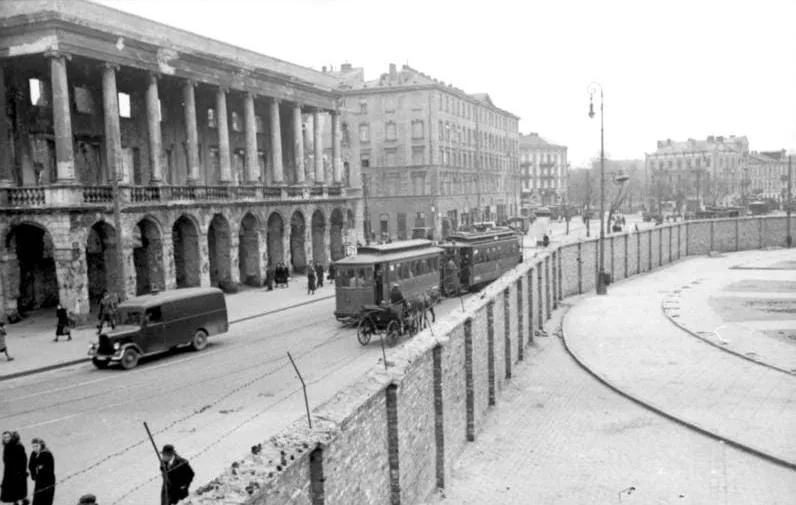
On 2 October 1940 the governor of the Warsaw District, Ludwig Fischer, signed an order establishing a “Jewish residential district” (Jüdischer Wohnbezirk) in Warsaw. All Jews living in the city or arriving in it were to take up residence in a designated part of the northern district, while Poles living within its boundaries were to move out. A list of boundary streets was attached to the order. Responsibility for carrying it out lay with the chairman of the Jewish Council, Adam Czerniaków, and the city’s commissarial mayor, Julian Kulski. Thus came into being the Warsaw Ghetto, the largest ghetto in occupied Europe, into which more than 400,000 people had been crammed by 1941.
Many chronologies give 3 October as the date on which Warsaw’s Jews were ordered to move into the ghetto. Fischer’s order, however, is dated 2 October, and it was announced to the inhabitants only ten days later. Some lists, in turn, record under 31 October that the district authorities moved all of Warsaw’s Jews into ghettos. In fact, 31 October was the original deadline for completing the moves. It was pushed back to 15 November, and the ghetto was sealed on the night of 15–16 November 1940. Both dates therefore belong to a single process that lasted six weeks.
Warsaw’s Jews under occupation
Before the war Warsaw had the largest Jewish community in Europe. In 1938 some 368,000 Jews lived there, roughly 30 per cent of the city’s population. Most lived in the northern district – in Muranów, on Nalewki and the neighbouring streets – where the buildings were the most densely packed in the city. During the siege in September 1939 this part of Warsaw suffered heavily from the bombing. After the capitulation and the entry of the Germans on 1 October 1939 the persecution began: beatings and humiliations in the streets, the cutting-off of beards, round-ups for forced labour, and the plundering of flats and shops.
At the beginning of October 1939 the deputy commander of Einsatzgruppe IV, Josef Meisinger, ordered Adam Czerniaków – whom Mayor Stefan Starzyński had appointed acting president of the Jewish Community in September – to form a 24-member council of elders, the Judenrat. According to a German census of 28 October 1939, 359,827 Jews lived in Warsaw. Their number grew quickly, because the Germans were sending Jews expelled from the territories annexed to the Reich into the General Government, and refugees were pouring into the capital from smaller towns. By October 1940 some 90,000 of them had arrived.
Regulations issued from the autumn of 1939 onwards stripped the Jews of one right after another. Once the General Government had been created, forced labour was introduced for them, their bank accounts were blocked, the cash they could hold was limited to 2,000 złoty, and Jewish businesses were placed under commissarial administration. From 1 December 1939 Jews aged ten and over had to wear armbands with the Star of David. In January 1940 the synagogues were closed and Jews were banned from using the railways, and later from entering parks and the city’s grand thoroughfares. From September 1940 they could ride only in trams marked “Nur für Juden”.
From an “area threatened by typhus” to a wall
The Germans had already tried to create a ghetto in Warsaw in the autumn of 1939. On 4 November 1939 the SS officer Bernhard Baatz, invoking an order from the city’s military commandant, instructed the Judenrat to move all Jews within three days into designated streets of the northern district. Czerniaków appealed to the commandant of Warsaw, General Neumann-Neurode, and managed to have the order reversed. Soon, however, barbed-wire barricades appeared at the ends of some of the district’s streets, together with signs forbidding German soldiers to enter.
The threat of an epidemic became the pretext for fencing the district off. German propaganda portrayed Jews as carriers of disease, above all of typhus. In March 1940 bilingual signs went up on the boundary streets of the northern district: “Seuchensperrgebiet. Nur Durchfahrt gestattet” – “Area threatened by typhus. Through traffic only”. In the last ten days of March, in the run-up to Easter and over the holiday itself, a wave of anti-Jewish violence swept through the city, known as the Easter pogrom. Gangs of hooligans, including young people from far-right nationalist circles, smashed windows, looted Jewish shops and flats and beat passers-by wearing armbands, while most of the city’s inhabitants looked on passively. Most historians believe the riots were instigated by the occupiers. The Germans filmed the scenes and later presented the wall as protection for the Jews against the Poles. The Polish underground press condemned the riots.
On 27 March 1940 the Judenrat received a map of the “area closed because of epidemic” and an order to build walls at the places marked on it. The Jews were told that the walls were there “to protect the Jews from excesses”. Construction began on 1 April. Czerniaków tried to delay it, citing technical difficulties and lack of money, but on 9 April the Germans threatened him with arrest. The walls, whose cost the Jewish community had to bear, were mostly in place by June 1940. For several months, however, the authorities shelved the plans for a ghetto. For a short time they considered concentrating all the Jews of the General Government in the Lublin District, harking back to the Nisko plan, and in the summer of 1940, after the fall of France, Berlin was counting on deporting the Jews to Madagascar. With the war against Britain, which ruled the seas, still going on, the project proved unworkable, and in August work on the ghetto resumed.
Resettlement matters in Governor Fischer’s office were handled by the Resettlement Department, set up in January 1940 under SA-Standartenführer Waldemar Schön, a long-standing associate of Fischer and of Hans Frank. On 13 September 1940 Frank issued a decree on restrictions of residence in the General Government, which allowed the district authorities to designate places of residence for particular groups of the population. It was on this basis that Fischer signed his order of 2 October.
The announcement on Yom Kippur
For ten days the content of the order did not reach the inhabitants. It was announced on Saturday 12 October 1940 through street loudspeakers. That day was Yom Kippur, the Day of Atonement, the most important holy day of the Jewish year, on which Jews fast and pray from dusk to dusk – although public prayer had been banned since January. Many historians believe the Germans chose the date deliberately, just as elsewhere they announced harsh decrees on Jewish holidays. On 15 October the plan of the ghetto, together with the list of boundary streets, was published in the occupation newspaper “Nowy Kurier Warszawski”.
The boundaries were not final. Over the following weeks the Germans kept changing them, while the Polish municipal administration and the Judenrat lobbied for particular streets and buildings to be included or excluded. The municipal administration wanted as few Poles as possible to be evicted from the district; the Judenrat wanted the ghetto to be as large as possible and to include factories, workshops and hospitals. Czerniaków still hoped that the “Jewish district” would remain open. In the end the ghetto stretched from Grzybowski Square and Złota and Sienna Streets in the south to Stawki and Dzika Streets in the north, with Muranów and Nalewki at its heart. Left outside it were, among other places, the law courts on Leszno Street, the Pawiak prison, which became a German enclave inside the ghetto, and the Evangelical Reformed church with its hospital.
Six weeks of moving
In the second half of October Warsaw witnessed the largest movement of people within the city’s limits in its history. Some 113,000 Poles had to leave their homes in the ghetto area, and some 138,000 Jews had to leave the other districts – about a quarter of a million people in all. On top of that, around 700 ethnic Germans were moved into the German district. More than 11,500 flats previously occupied by Poles within the ghetto boundaries and around 13,000 Jewish flats in other parts of the city changed hands. People swapped flats through advertisements and middlemen, carted their furniture on barrows and handcarts, and paid bribes to be allocated somewhere to live. Many Jews evicted from the better districts lost most of their possessions and their workshops in the process, while the poor and the refugees ended up in overcrowded shelters.
The original deadline for the moves was 31 October. At the end of the month the authorities extended it to 15 November. Until the last moment the Jews did not know whether the district would be sealed. Many believed it would merely be an area of designated residence from which they could go out to work and to shop, like the Jewish quarters of the pre-war years.
The sealing of the ghetto
On the night of 15–16 November 1940, a Saturday, the gates of the ghetto were closed. Some sources give the date as 15 November, but the order took effect at midnight, and for the inhabitants the first day in the sealed district was Saturday 16 November. “The Sabbath day on which the ghetto was created was terrible. The street did not know that the ghetto would be closed, and so it fell upon people like a bolt from the blue,” wrote the historian Emanuel Ringelblum. The teacher Chaim Aron Kaplan noted that people had gone to sleep in a Jewish district and woken up the next morning in a closed ghetto.
That same day the German police began rounding up Jews who had remained on the “Aryan side”. More than 11,000 people were taken to the ghetto in this way. Several thousand Jewish shops outside its boundaries were closed and emptied. The wall, about three metres high and topped with barbed wire, ran for some 18 kilometres. In November 1940 there were 22 gates into the ghetto, guarded by the German police, the Polish Police of the General Government – known as the “Blue Police” – and Jewish policemen. People could leave only with a pass or in a labour column.
At the beginning of 1941 the ghetto covered some 307 hectares. According to the United States Holocaust Memorial Museum, almost 30 per cent of Warsaw’s inhabitants were crammed into 2.4 per cent of the city’s area. More than 400,000 people lived there, on average seven or more to a room, in a district almost entirely devoid of greenery. In keeping with the rule applied in the German ghettos, administration within the walls was entrusted to the Judenrat, which was responsible for housing, supplies, social welfare, hospitals and the provision of labour. Order was kept by the Jewish Order Service, formed on German orders under the command of Józef Szeryński, which numbered about 1,700 men when the ghetto was sealed. Supervision of the district was in the hands of Schön’s office and, from May 1941, of the Commissioner for the Jewish District, Heinz Auerswald.
The ghetto also held between two and five thousand Christians, most of them Catholics, whom the German racial laws classed as Jews. Many of them regarded themselves as Poles. The Polish underground condemned the occupiers’ crimes, but Polish attitudes to the ghetto itself varied. There were those who helped, smuggled in food and hid escapees, and those who profited from their neighbours’ misfortune, such as the szmalcowniks, blackmailers who preyed on Jews on the Aryan side. In the autumn of 1940 Ringelblum noted that among the Poles “a few sympathise, the majority are indifferent”.
Place in the war
The Warsaw Ghetto was not the first in occupied Poland. The first, in Piotrków Trybunalski, was set up in October 1939, and in the spring of 1940 the Germans sealed the ghetto in Łódź. Warsaw, however, became the largest of them all and a model for those that followed. In March 1941 the Germans created the Kraków Ghetto and ghettos in other towns of the General Government.
The ghetto turned out to be a prison in which people died of hunger and disease. Official food rations were desperately low, and when Schön almost cut off supplies at the turn of 1940 and 1941, survival depended on smuggling, carried on by adults and children over the wall and through the gates. Epidemics of typhus followed – the very disease the Germans had used as a pretext for sealing the district, and which in practice spread precisely because of overcrowding and hunger. Historians estimate that between 83,000 and 92,000 people died of hunger and disease in the ghetto, and in the summer of 1941 more than 5,000 were dying every month. From the autumn of 1941 leaving a ghetto in the General Government was punishable by death. At the same time the ghetto was home to Ringelblum’s underground Oneg Shabbat archive, to schools, libraries, theatres and orphanages, among them the one run by Janusz Korczak.
On 22 July 1942 the Germans launched the Great Deportation. The next day Czerniaków, who refused to hand children over to their deaths, took his own life. By 21 September 1942 some 250,000–265,000 Jews, depending on the calculation, had been deported from the loading square, the Umschlagplatz, to the Treblinka extermination camp and murdered there. Several tens of thousands of people remained in the ghetto. When the Germans set about liquidating it on 19 April 1943, the Jewish Combat Organisation and the Jewish Military Union took up the fight. The Ghetto Uprising lasted almost a month. On 16 May 1943 the Germans blew up the Great Synagogue on Tłomackie Street and razed to the ground the district that Fischer had marked out with his order of 2 October 1940. The total number of victims of the Warsaw Ghetto is estimated at around 400,000 people.
Places·Warsaw
Sources
Meanwhile
(04)Elsewhere, within a week.
- 4 October 1940 · Far EastThe Battle of HuangqiaoOn 4 October 1940 in central Jiangsu, Han Deqin's Kuomintang troops attacked the communist New Fourth Army at Huangqiao. Within three days they were routed.
- 7 October 1940 · MilitaryThe German military mission in RomaniaIn October 1940 a German military mission arrived in Romania. Officially it was to train the army; in fact it guarded Ploiești oil and prepared war on the USSR.
- 25 September 1940 · PoliticsTerboven takes power in NorwayOn 25 September 1940 Reich Commissioner Terboven declared the King and government deposed, dissolved the Administrative Council and banned all parties but NS.
- 9 October 1940 · PoliticsChurchill becomes leader of the Conservative PartyOn 9 October 1940 the Conservatives elected Churchill party leader after the gravely ill Chamberlain, who had left the government on 3 October, stood down.
Related events
(04)The same battle, people or subject.
- 15 November 1940 · PolandThe Warsaw Ghetto is sealedOn the night of 15–16 November 1940 the Germans sealed the Warsaw Ghetto. Some 400,000 Jews were walled off; hunger and smuggling became daily life.
- 20 June 1940 · PolandExecutions at PalmiryOn 20 and 21 June 1940 the Germans shot 358 Pawiak prisoners at Palmiry, among them Maciej Rataj, Mieczysław Niedziałkowski and Janusz Kusociński.
- 23 November 1939 · PolandStar of David armbandsOn 23 November 1939 Hans Frank ordered Jews in the General Government aged 10 and over to wear a white armband with a blue Star of David from 1 December.
- 24 December 1941 · Crimes and repressionThe fur collection driveOn Christmas Eve 1941 the Germans ordered Jews in the General Government to hand over all furs for troops on the Eastern Front. Hiding a fur meant death.