Poland
Janusz Korczak
Paediatrician, writer, co-founder and director of the Orphans' Home in Warsaw (1912–1942), co-founder of the Nasz Dom children's home (1919)
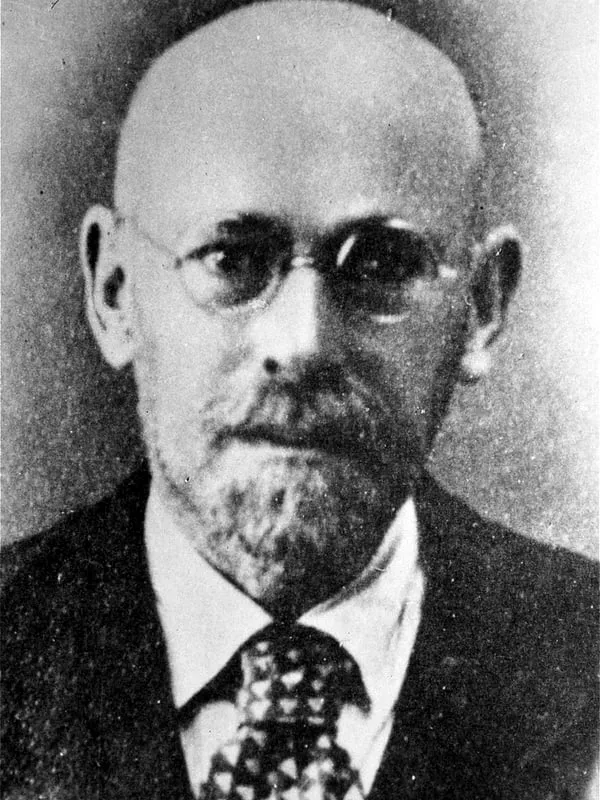
- Born:
- 22 July 1878, Warsaw (Russian Empire)
- Died:
- 7 August 1942, Treblinka
- Author:
- Łukasz
- Photo:
- autor nieznany, domena publiczna, Wikimedia Commons

Janusz Korczak, whose real name was Henryk Goldszmit, was a paediatrician, a writer and one of the most original educators of the twentieth century. For thirty years, together with Stefania Wilczyńska, he ran the Orphans’ Home (Dom Sierot) for Jewish children in Warsaw, where the children had their own parliament, court and newspaper, and his books, from King Matt the First to The Child’s Right to Respect, made him a champion of children’s rights long before the idea entered international law. A Pole and a Jew who felt bound to both peoples, he fought to the end in the Warsaw Ghetto for the survival of his charges. In August 1942, having rejected offers of rescue, he went with them to the Umschlagplatz and died in Treblinka. His fate became one of the best-known symbols of the destruction of Polish Jewry.
Childhood and youth
He was born in Warsaw on 22 July 1878 or 1879 – the documents do not settle the year, and he himself wrote about it with irony. He came from an assimilated Jewish family: his father, Józef Goldszmit, was a respected lawyer, his mother, Cecylia, came from the Gębicki family of Kalisz, and his grandfather, Hersz Goldszmit, was a physician. He spent his childhood in comfortable apartments on Krakowskie Przedmieście and Miodowa Street, brought up in Polish culture and in the positivist spirit of “organic work”. The carefree years ended when his father fell mentally ill; he was committed to an asylum several times, and the family was impoverished. Józef Goldszmit died in 1896. From then on Henryk, still a schoolboy, supported his mother and sister by private tutoring.
In 1898 he passed his school-leaving examinations and began studying at the medical faculty of the Imperial University of Warsaw. At the same time he attended lectures at the clandestine Flying University, worked in reading rooms for the poor, and found a mentor in the geographer and publicist Wacław Nałkowski (PL). From 1896 he wrote for the satirical weekly Kolce (PL) (Thorns). In 1898 he submitted a play to a competition announced by Ignacy Jan Paderewski, signing it with the pseudonym “Janasz Korczak”, taken from a novel by Józef Ignacy Kraszewski – from 1900 he signed himself Janusz Korczak. His first novels, Dzieci ulicy (Children of the Street, 1901) and Dziecko salonu (A Child of the Drawing Room, 1906), brought him renown, and his contact with the poverty of Warsaw’s backyards shaped his conviction that children were a separate social group, wronged and unheard.
Children’s doctor
He received his medical diploma in March 1905 and was almost immediately called up into the Russian army. During the Russo-Japanese War he served at an evacuation station in Harbin and on hospital trains in Manchuria. On his return, from 1905 to 1912, he was a doctor at the Bersohn and Bauman Jewish Children’s Hospital on Śliska Street. He lived on the hospital premises and was available to the sick at any hour; he took no money from the poor and demanded high fees from the rich. He trained in children’s clinics in Berlin and, in 1910, in Paris and London. According to his own notes, it was then that he decided not to have a family of his own and to devote himself to other people’s children.
Work with children at summer camps and in the Aid for Orphans society turned him towards education. The society built a modern orphanage for Jewish children at 92 Krochmalna Street, and Korczak became its director.
The Orphans’ Home
The Orphans’ Home opened in the autumn of 1912. He ran it together with Stefania Wilczyńska, a natural sciences graduate of Liège, who for three decades watched over the daily life of the institution while Korczak gave it its shape. The Home took in about a hundred children aged between seven and fourteen. It was governed by institutions Korczak created: a peer court, before which even the director could be summoned, a children’s parliament, a newspaper, a notice board, a rota of duties, a letterbox and plebiscites of kindness. Korczak systematically measured and weighed the children and recorded their sleep, conversations and quarrels; he was as much a researcher as an educator. He believed that a child does not “become” a person but already is one, and has a right to respect, to make its own mistakes and to justice.
War and independence
In August 1914 he was again called up into the Russian army and until 1917 served as junior head of a ward in a divisional hospital. During this service he wrote How to Love a Child, his most important educational work, published in independent Poland. In 1917 he worked in children’s shelters near Kiev and assisted the Kiev home for Polish boys run by Maryna Falska. With Falska, whom he had first met in 1915, he founded in 1919 in Pruszków the Nasz Dom (Our Home) institution for Polish children, which from 1928 was based in Bielany in Warsaw. During the Polish–Soviet War he served as a Polish Army doctor in hospitals in Łódź and Warsaw, including the infectious diseases hospital in Kamionek. There he contracted typhus; his mother, who nursed him, fell ill and died in February 1920. Korczak took this blow very hard. He left the army with the rank of major.
Writer and educator of the interwar years
The interwar years were the time of his greatest fame. In 1923 King Matt the First appeared, the story of a boy on the throne who tries to reform the world for children and fails – one of the most important Polish children’s books. It was followed, among others, by The Bankruptcy of Little Jack (PL) (1924), When I Am Little Again (1925), The Child’s Right to Respect (PL) (1928) and Kaytek the Wizard (1933). In 1926 he founded Mały Przegląd (PL) (The Little Review), a weekly supplement to the daily Nasz Przegląd, written by children for children; from 1930 it was run by his secretary, Igor Newerly. He lectured at the State Institute of Special Education and at the Free Polish University, served as an expert witness at the juvenile court, and trained generations of educators.
In 1935 he began giving talks on Polish Radio as “the Old Doctor”, without revealing his real name. The broadcasts were enormously popular, but in 1936 they were taken off the air – according to the recollections of radio staff of the time, under the pressure of antisemitic attacks. At about the same time his close collaboration with Nasz Dom came to an end. The growing antisemitism of the late 1930s affected him deeply. In 1934 and 1936 he visited Palestine, where he got to know the kibbutzim and met former pupils, and he seriously considered emigrating. In the end he stayed in Warsaw, with his children.
War and the ghetto
In September 1939, during the defence of Warsaw, Korczak volunteered for the army but was turned down because of his age. He nevertheless put on his Polish Army major’s uniform and wore it under the occupation as well. He refused to obey the order to wear the armband with the Star of David, regarding it as a humiliation. When in the autumn of 1940 the Germans created the ghetto, the Orphans’ Home had to leave the building on Krochmalna Street and move to a commercial school building at 33 Chłodna Street. During the move, at the end of November, the German police arrested Korczak for not wearing the armband; he spent several weeks in Pawiak prison and was released in December. In the autumn of 1941, after the ghetto was reduced in size, the orphanage moved a second time, to 16 Sienna Street.
In the sealed ghetto Korczak was already an ailing man in his sixties, yet he spent whole days going from office to office, from well-off residents to welfare institutions, begging for food, money and fuel. He quarrelled with the Judenrat and its chairman, Adam Czerniaków, while also working with him. At the beginning of 1942 he undertook to rescue the Main Shelter at 39 Dzielna Street, where children were dying of hunger and neglect. From May 1942 he wrote a diary at night – a record of exhaustion, illness, childhood memories and sober observations of the ghetto. On 18 July the children performed Rabindranath Tagore’s The Post Office, a play about a dying boy.
The last journey
From 22 July 1942 the Germans carried out the Great Deportation. Friends on the Aryan side, among them Newerly and Falska, prepared a hiding place and papers for Korczak, but he refused to abandon the children. The last entry in the diary is dated 4 August. Most probably the next day, 5 August 1942 – some witnesses give 6 August – during the blockade of the small ghetto, the Germans drove the Orphans’ Home out of Sienna Street. Korczak, Wilczyńska, a dozen or so staff and about two hundred children walked through the ghetto to the Umschlagplatz. On the square the Judenrat official Nachum Remba (PL) still offered to intervene with the Council on his behalf, but Korczak did not want to leave the children even for a moment. He boarded the train with them, and it took them to Treblinka. There they were murdered in the gas chambers, most probably soon after arrival. The exact date of his death cannot be established; in 2015 a court in Lublin set it as 7 August 1942, replacing the notional date of 9 May 1946 fixed after the war for missing persons.
The story of a German officer who supposedly offered him freedom on the Umschlagplatz is not confirmed by any reliable account and is regarded as a legend. What was true were the repeated offers of rescue from friends, which Korczak consistently rejected.
Legacy
The typescript of the diary, carried out of the ghetto a few days after the deportation and hidden in the walls of Nasz Dom in Bielany, survived the war and was published in 1958. Surviving pupils and colleagues, scattered across Poland, Israel and the world, carried on his ideas. On the centenary of his birth UNESCO declared 1978 the Year of Korczak, and Poland then submitted to the United Nations a draft convention on the rights of the child; the Convention on the Rights of the Child, adopted in 1989, is sometimes called his legacy. Korczak is commemorated by monuments in Warsaw and Jerusalem, by Andrzej Wajda’s film Korczak (1990) and by dozens of books; at Treblinka he is the only victim whose name is carved on one of the symbolic stones. In 2018 he was posthumously awarded the Order of the White Eagle.
Historians and educators point out that the legend of his heroic death often obscures who Korczak was in life: a perceptive observer of children, an innovator of an upbringing based on self-government and justice, a writer who spoke to children as equals. His fate also has another dimension. It shows that in the German plan to murder the Jews there was no room for exceptions or for merit: a celebrated doctor and writer, known throughout pre-war Poland, could choose in August 1942 only whether his children would go to their deaths alone or with him.
Sources
Often appears with
People who appear in the same events.