Germany
Ludwig Fischer
Head and, from 1941, Governor of the Warsaw District of the General Government (1939–1945)
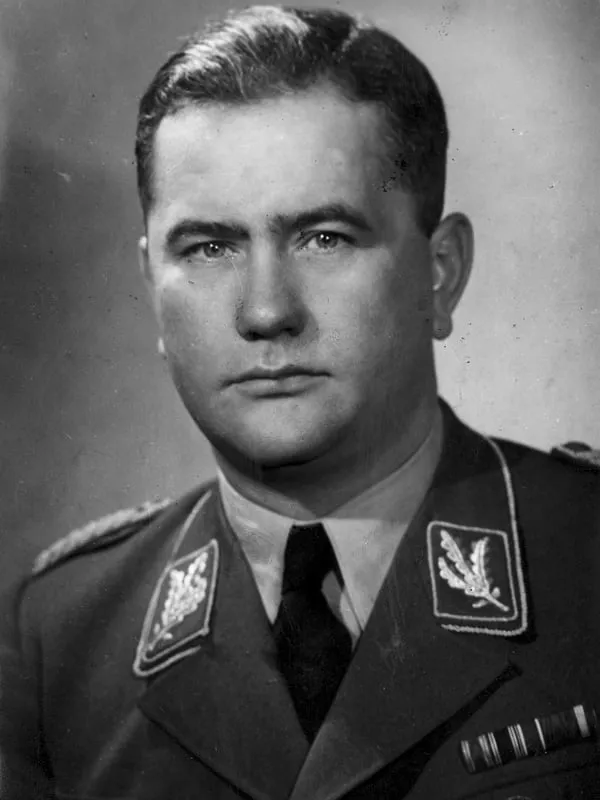
- Born:
- 16 April 1905, Kaiserslautern (Kingdom of Bavaria, German Empire)
- Died:
- 8 March 1947, Warsaw
- Author:
- Łukasz
- Photo:
- Mieczysław Bilażewski-Bil, domena publiczna, Wikimedia Commons

Ludwig Fischer was a lawyer from the Bavarian Palatinate who joined the NSDAP as a student and made his career at the side of Hans Frank in the party’s legal apparatus. When Frank became Governor-General of occupied Poland, he entrusted Fischer with the Warsaw District. Fischer ruled it from the Brühl Palace for more than five years, from the autumn of 1939 to January 1945. His office issued the regulations that stripped Poles and Jews of their rights, and his signature stands beneath the order establishing the Warsaw Ghetto. He was responsible for street round-ups, deportations for forced labour and the conditions in which hundreds of thousands of people starved to death in the ghetto. After the war the Americans handed him over to Poland, and the Supreme National Tribunal sentenced him to death.
Youth and career in the NSDAP
He was born on 16 April 1905 in Kaiserslautern, in the Palatinate, which then belonged to Bavaria, into a devoutly Catholic family. After attending the Realschule in his home town, he studied law and political science in Heidelberg, Munich, Würzburg and Erlangen. He obtained his doctorate in law at Erlangen in 1929 (some sources give 1928) with a dissertation on the failure to report a crime. From 1928 to 1932 he did his legal traineeship in the courts and the administration in Munich and Kaiserslautern.
He joined the NSDAP on 20 May 1926, while still a student, with membership number 36,499, and in 1929 joined the SA in Munich. From 1931 he worked in the party’s legal office headed by Frank, where he was deputy head of the legal department, and in 1938 he became the office’s chief of staff. He wrote articles on party law and co-edited a collection of NSDAP regulations. After Hitler came to power in 1933 he was given a post as a Regierungsrat (government councillor) and joined the leadership of the Academy for German Law founded by Frank. In November 1937 he became a member of the Reichstag. In the SA he was promoted to Oberführer in 1937.
Head of the Warsaw District
After Poland’s defeat and the creation of the General Government, Frank turned to trusted men from his own circle. On 24 October 1939 he appointed Fischer head of the Warsaw District, which covered the capital and a dozen or so counties of central Mazovia and Podlasie. From April 1941 his title was “Governor”. His office was housed in the Brühl Palace on Piłsudski Square, renamed Adolf-Hitler-Platz. Fischer lived in a requisitioned villa outside Warsaw. On 9 November 1939 he was promoted to SA-Brigadeführer and on 26 October 1940, the first anniversary of the General Government, to SA-Gruppenführer. His deputy was later Herbert Hummel, and the Stadthauptmann (head of the city administration) of Warsaw was Ludwig Leist.
Fischer was a civil official, not a policeman, but the administration he headed was a full participant in the occupation terror. His office promulgated and enforced Frank’s decrees, issued its own orders, organised the compulsory delivery quotas and the conscription of workers for the Reich, accompanied by street round-ups, and cooperated with the Security Police in arrests and mass executions, including those at Palmiry. In regular reports to Frank he described the mood of the population, the results of quota collection and the progress of the “solution of the Jewish question”. These reports, which survived and were published in Poland in 1987, are today an important source for the history of the occupation.
The Warsaw Ghetto
Fischer’s gravest responsibility lay in the policy towards the Jews, of whom more than 350,000 lived in Warsaw in the autumn of 1939. As early as 24 November 1939, the day after Frank’s decree on armbands, he issued his own order requiring Jews in the district aged twelve and over to wear a white armband with a blue star. In January 1940 a Resettlement Department was set up in his office under Waldemar Schön, which prepared the ghetto. In the spring of 1940, on the pretext of a typhus threat, the Germans ordered Adam Czerniaków’s Jewish Council to wall in the northern district.
On 2 October 1940 Fischer signed the order on the creation of the Jewish residential district. Some 138,000 Jews and 113,000 Poles had to move house within six weeks, and on the night of 15–16 November 1940 the ghetto was sealed. More than 400,000 people were crammed into about 307 hectares. Starvation rations and the ban on leaving the walls meant that by the summer of 1942 tens of thousands had died in the ghetto of hunger and disease. In December 1940 Fischer demanded the death penalty for Jews who left the ghetto without permission. Frank introduced it by a decree of 15 October 1941, and in November 1941 the first people sentenced under it – eight people, six of them women – were shot in Warsaw. From May 1941 the ghetto was supervised by a commissioner subordinate to Fischer, Heinz Auerswald.
The deportations to Treblinka in the summer of 1942 were carried out by the SS, but the district administration cooperated in them, and after the suppression of the ghetto uprising in 1943 the district was razed to the ground. In the spring of 1943, from 10 April to the end of May, Fischer was also acting governor of the Lublin District, where Operation Reinhard was organised and where the camps at Sobibór and Majdanek operated.
The underground’s verdict and the Warsaw Uprising
The Polish Underground State regarded Fischer as one of the chief criminals of the occupation. An underground court sentenced him to death, and his name headed the list of officials marked for liquidation in Operation Heads (Akcja Główki). In 1944 Home Army soldiers fired on his car, but the governor escaped with his life.
On 9 August 1944, during the Warsaw Uprising, Fischer was wounded during the evacuation of the Brühl Palace, which had been surrounded by the insurgents. His deputy Hummel was killed. After the uprising was crushed, the district administration worked with the army in removing property from the city and in its systematic demolition. Fischer was also responsible for the appalling conditions in the Dulag 121 transit camp at Pruszków, through which hundreds of thousands of expelled inhabitants of Warsaw passed.
Trial and death
On 17 January 1945, as Soviet and Polish troops entered the ruins of Warsaw, Fischer fled west. He went into hiding in Bad Neustadt an der Saale in Bavaria, where the Americans arrested him on 10 May 1945. On 30 March 1946 he was handed over to Poland. He stood trial before the Supreme National Tribunal in Warsaw together with three other members of the city’s occupation authorities: the Stadthauptmann Ludwig Leist, the former head of the Security Police Josef Meisinger and the police officer Max Daume. The trial lasted from 17 December 1946 to 24 February 1947. He was charged with organising and tolerating round-ups and executions, crimes in the ghettos, the destruction of Polish culture and the demolition of Warsaw. Among the witnesses was Jankiel Wiernik, a prisoner of Treblinka and a participant in the revolt in that camp.
On 3 March 1947 the Tribunal found Fischer guilty on most of the charges and sentenced him to death; it acquitted him of the charges of destroying Warsaw after the uprising and of destroying the ghetto. Meisinger and Daume were also sentenced to death, and Leist to imprisonment. President Bolesław Bierut declined to exercise his right of clemency. On 8 March 1947 Fischer was hanged in the prison on Rakowiecka Street in Warsaw. His superior, Frank, had gone to the gallows at Nuremberg five months earlier.
Significance
Fischer did not belong to the front rank of the Third Reich’s leaders and did not devise the policy he carried out. He was a typical representative of the stratum of educated, ambitious officials who in the General Government turned administrative law into an instrument of plunder, expulsion and murder. His trial, one of the first before the Supreme National Tribunal, documented the entire occupation of Warsaw, from the first executions through the ghetto to the destruction of the city in 1944. The witness testimonies gathered before the trial are now available in the Pilecki Institute’s “Chronicles of Terror” database.
Sources
Mentioned in battles
(01)Often appears with
People who appear in the same events.