Poland
Adam Czerniaków
Chairman of the Jewish Religious Community of Warsaw (1939), chairman of the Warsaw Judenrat (1939–1942)
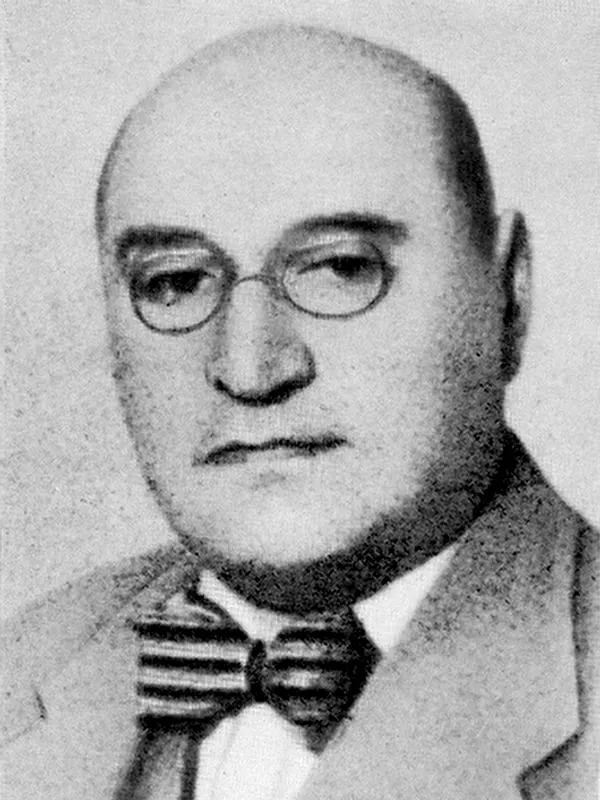
- Born:
- 30 November 1880, Warsaw (Russian Empire)
- Died:
- 23 July 1942, Warsaw
- Author:
- Natalia
- Photo:
- autor nieznany, domena publiczna, Wikimedia Commons

Adam Czerniaków was a Warsaw chemical engineer, a teacher and an activist of the Jewish artisans’ movement, before the war a city councillor and a senator who never took his seat. History, however, remembers him for the last three years of his life. In September 1939 the Mayor, Stefan Starzyński, put him in charge of the Jewish Community in besieged Warsaw, and after the capitulation the Germans placed him at the head of the Jewish Council, the Judenrat. In this role he had to carry out the occupier’s orders concerning the largest Jewish community in Europe, including the decree establishing the ghetto. For nearly three years he tried to soften German decisions, to delay them and to save whomever he could. When in July 1942 the Germans began deporting the inhabitants of the ghetto to their deaths in Treblinka, he took his own life. The diary he kept is one of the most important testimonies of the Holocaust.
Youth and studies
He was born on 30 November 1880 in Warsaw, the eldest of the four children of Aron Czerniaków, a butter merchant, and Pessa, née Reinmic. At birth he was given the name Abram, which he used in official documents until at least 1913. The family, rooted in Warsaw for generations, lived on Zimna Street, on the borderline between the Polish and Jewish districts. His father was most probably a Hasid; his mother spoke Polish, and Polish became her son’s first language. Adam understood Yiddish but never spoke it fluently, which later made it hard for him to communicate with the Jewish masses.
In 1900 he graduated from Laskus’s commercial school, and in 1901 he was admitted to the chemistry faculty of the Warsaw Polytechnic Institute; he was not admitted to mechanical engineering because of the tsarist quotas for Jews. During the Revolution of 1905 he joined the student strike, and when the authorities closed the Institute he left for Germany. He obtained his engineering diploma from the Technical College in Dresden, where he acquired a thorough knowledge of the German language and culture. After his return he lectured at the University for All (PL) and taught at the Jewish Community’s trade school. In 1909 the tsarist police briefly arrested him on suspicion of pro-independence activity. In 1910 he returned to the Polytechnic and completed his studies in 1913. In 1912 he married Felicja Zwayer, a teacher at the same school; their only son, Jan, was born in 1914.
Social activist and politician
From his student days he moved in the circles of the progressive intelligentsia, which advocated education, the “productivisation” of the Jewish poor and rapprochement with the Poles. Over time, disillusioned by antisemitism and the lack of real equal rights, he drew ever closer to Jewish nationalist circles, although he never joined any party. In 1917–1918 he headed the Central Artisans’ Union, and in 1925 he played a key part in uniting the feuding organisations into the Central Union of Jewish Artisans in Poland, of which he was secretary until 1929.
In independent Poland he worked in the Ministry of Public Works on the reconstruction of war damage, then in the Polish section of the Joint, the American Jewish relief organisation, and in a bank associated with it. From 1927 to 1934 he sat on the Warsaw City Council for the Jewish National Bloc. In 1930, in a by-election in Volhynia, standing on the list of Izaak Grünbaum, he won a seat in the Senate, but did not manage to take it up because President Ignacy Mościcki dissolved parliament. From 1932 he sat on the board of the Polish Compensation Trade Company, Zahan.
In 1937 the Sanation authorities dissolved the feuding council of the Jewish Religious Community of Warsaw (PL) and appointed a provisional board under Maurycy Mayzel (PL). Czerniaków joined it despite criticism from Jewish public opinion, which saw this as an assault on the Community’s self-government. He was in charge of the Community’s schools and looked after its museum.
September 1939
When war broke out, he stayed in Warsaw. On 6 September, in response to the appeal by Lieutenant Colonel Roman Umiastowski calling on men to leave the capital, the Community’s chairman, Mayzel, left the city, and over the following days Czerniaków took charge of the Community. On 6 September he also began keeping a diary. On 23 September Starzyński officially appointed him provisional chairman of the Jewish Community. Together with his son he stood night watches in the Citizens’ Guard and put out incendiary bombs. During the negotiations over the capitulation he volunteered as one of the hostages the Germans demanded from the city, but Starzyński refused, probably not wishing to lose the Community’s chairman.
Chairman of the Judenrat
At the beginning of October 1939 – according to his diary on 4 October – Czerniaków was taken to the headquarters of the Security Police on Aleja Szucha. The deputy commander of Einsatzgruppe IV, Josef Meisinger, ordered him to set up a 24-member council of elders and to head it. Czerniaków accepted the post out of a sense of responsibility. Later he turned down the opportunity to leave for Palestine. He brought well-known representatives of various circles into the Judenrat, and himself stubbornly called it “the Community”, regarding the German name as degrading. The Council took over matters that the pre-war Community had never handled: the population register, care of refugees and, above all, the supply of workers for forced labour, to which Czerniaków agreed in the hope of thereby putting a stop to the brutal round-ups in the streets.
Towards the Germans he pursued a pragmatic policy. He avoided open confrontation, argued, delayed the execution of the harshest decrees, paid levies and bribes, and exploited the rivalry between the civil authorities and the police. When in November 1939 the Germans ordered all Jews to move to designated streets within three days, he managed to get the order reversed through interventions with the city’s military commandant. He could not, however, save the 53 men from the house at 9 Nalewki Street who were shot in November 1939 in reprisal for the killing of a Polish policeman by a criminal. He wore the armband with the Star of David, compulsory from 1 December 1939, demonstratively. In January 1940 he tried to resign, but the Germans refused.
In the spring of 1940 the Germans declared the northern district an “area threatened by epidemic” and on 27 March ordered the Judenrat to wall it in at the Community’s expense. Czerniaków delayed the construction until he was threatened with arrest on 9 April. To the last he hoped that the “Jewish district” would remain open and would cover the whole epidemic area. The decree of Governor Ludwig Fischer on the creation of the ghetto, signed on 2 October 1940, made him responsible for resettling the Jews. In the drawing of the boundaries he fought for every street, while trying not to enter into open conflict with the Polish municipal administration. On 11 November he himself moved from Wspólna Street to Elektoralna Street. Five days later the ghetto was sealed.
In the ghetto
Supervision of the Judenrat was taken over by the head of the Resettlement Department, Waldemar Schön, with whom relations were very bad, and from May 1941 by the Commissioner for the Jewish District, Heinz Auerswald. Every week Czerniaków also had to report to the Jewish affairs section of the Gestapo. He was humiliated, kept waiting for hours in anterooms and intimidated. Twice, on 4 November 1940 and in April 1941, following denunciations by Jewish informers, German policemen beat him and held him under arrest for several days.
Throughout, he pressed for larger food allocations for the starving ghetto, mostly without success. He took particular care of the children: he obtained extra rations for them, opened orphanages and playgrounds, and collected money in the streets for the poor. He won exemption for the poorest from the charges for bread cards, permission for the first official Sabbath observance since the start of the occupation in May 1941 and, in September 1941, the reopening of Jewish elementary schools. He supported artists and the ghetto’s symphony orchestra. He opposed plans to turn the ghetto into a great labour camp on the Łódź model, because he wanted the district to survive the war with as little German interference as possible.
The Judenrat was nevertheless inefficient, underfunded and riddled with corruption at its lower levels. It was the poorest, who had no money to buy themselves out, who ended up in the labour camps, and taxes weighed more heavily on the poor than on the rich. The anger of the ghetto’s inhabitants focused on the Council and its chairman, which suited Auerswald. The social activists around Emanuel Ringelblum accused Czerniaków of favouring the assimilated and converts, of using Polish in the Council and of a courtly style. Loyal to the Polish state, he kept a portrait of Józef Piłsudski in his office. He regarded armed struggle with reserve, as premature. When on the night of 17–18 April 1942 the Gestapo murdered 52 people in the streets of the ghetto, he demanded that the distribution of the underground press be stopped. The historian Tomasz Szarota called this reaction the greatest mistake of his life.
Death
In the spring of 1942 rumours of “resettlement” circulated in the ghetto. As late as 18 and 20 July Gestapo officers and Auerswald assured Czerniaków that these were mere rumours, and he passed these assurances on to the inhabitants. On 22 July the head of the deportation staff of Operation Reinhard, Hermann Höfle, arrived at the Judenrat’s headquarters on Grzybowska Street and announced that the Jews, with certain exceptions, would be deported “to the east”. The Council was to deliver 6,000 people to the Umschlagplatz every day, and Czerniaków’s wife was threatened with being shot as a hostage. There is no evidence that Czerniaków knew of the gas chambers at Treblinka, but he probably understood that most of the deportees would die. What mattered most to him was saving the children from the orphanages.
On the evening of 23 July 1942 he was summoned to his office, where SS men most probably demanded larger quotas and the inclusion of children in the deportations. After they left, Czerniaków took potassium cyanide. He left two letters on his desk. In the letter to his wife he wrote: “They are demanding that I kill the children of my nation with my own hands. There is nothing left for me but to die.” According to his secretary, Leon Tyszka, in the letter to the members of the Council he wrote that he could not hand over defenceless children to death, and asked that his act not be regarded as cowardice. He was buried at dawn on 24 July in the Jewish cemetery on Okopowa Street. He was succeeded by his deputy, Marek Lichtenbaum. By 21 September the Germans had deported some 265,000 inhabitants of the ghetto to Treblinka and murdered them there, among them, at the beginning of August, Janusz Korczak with the children of his orphanage.
His son Jan, who had left for Lwów (Lviv) in 1939, died of typhus in Kyrgyzstan on 18 July 1942, five days before his father; Czerniaków never learnt of it. His wife Felicja escaped from the ghetto during the Great Deportation and survived the war in hiding on the Aryan side.
The diary
The diary, written in Polish from 6 September 1939 until the day of his death, survives in eight of its nine notebooks; the fifth, with entries from December 1940 to April 1941, is lost. Felicja Czerniaków lost it when she was arrested in 1943 and recovered it after the war. By way of France and Canada it reached the Yad Vashem institute in 1964. It was published in Hebrew in 1968, in Poland in 1972 in the Bulletin of the Jewish Historical Institute and in 1983 in an edition by Marian Fuks, and in English in 1979, edited by Raul Hilberg. Its brief, matter-of-fact entries on orders, conversations and humiliations are one of the most important sources for the history of the Warsaw Ghetto.
Assessments
In his lifetime Czerniaków was a hated, or at least disliked, figure in the ghetto. His death was judged in sharply different ways. Ringelblum noted: “Czerniaków’s suicide – too late, a sign of weakness. He should have called for resistance.” One of the leaders of the Jewish Combat Organisation, Yitzhak Zuckerman, thought likewise; he could not forgive the chairman for dying “as a private person” instead of warning his community. By contrast, Chaim Aron Kaplan, previously hostile to him, wrote that Czerniaków had “immortalised his name more by his death than by his whole life”.
Over time the judgements softened, and the publication of the diary made it possible to understand better the position in which he acted. Historians broadly agree that he was an honest man who sought neither power nor personal gain. In this he differed from the chairman of the Łódź Ghetto, Chaim Rumkowski. Barbara Engelking writes that Czerniaków was prepared to make compromises with the Germans in order to save Warsaw’s Jews, but that the limit of those compromises was handing Jews over to death. She regards his greatest mistake as having believed the Germans’ assurances in July 1942. Czerniaków has become one of the principal examples in the debates over the role of the Jewish councils during the Holocaust: people on whom the occupier imposed a choice in which no path led to survival.
Sources
Often appears with
People who appear in the same events.