Poland
Stefan Starzyński
Commissarial Mayor of Warsaw (1934–1939), Civil Commissioner to the Warsaw Defence Command (1939)
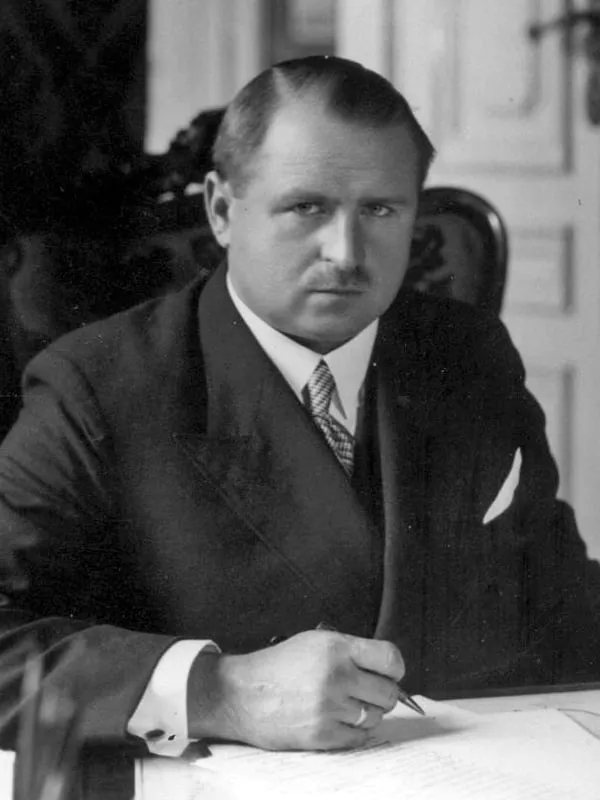
- Born:
- 19 August 1893, Warsaw (Russian Empire)
- Died:
- 1939, Unknown (according to the IPN investigation, Warsaw or its vicinity)
- Author:
- Natalia
- Photo:
- Jan Malarski (active 1903-1937), domena publiczna, Wikimedia Commons

Stefan Starzyński was an economist and a politician of the Piłsudskiite camp who in 1934 became Mayor of Warsaw not by election but by government appointment. Over five years he turned it into a modern capital, and in September 1939, when the government and the supreme military authorities left the city, he stayed and became the leader of its civilian defence. His daily radio addresses from besieged Warsaw made him a symbol of Polish resistance in the first weeks of the Second World War. After the capitulation he neither fled nor went underground. In October 1939 he was arrested by the Gestapo; he died at German hands in circumstances that have never been established.
Youth and the Legions
He was born on 19 August 1893 in Warsaw, in the Powiśle district, the youngest of the three sons of Alfons Starzyński and Jadwiga, née Lipska, a family descended from impoverished gentry with a tradition of taking part in national uprisings. He spent his childhood in Łowicz, where in 1905, as a pupil, he took part in the school strike against Russification. He later attended private Polish schools in Warsaw. In 1910 the police found a copy of the illegal socialist paper Robotnik on him; expelled from school, he spent a month in the Tenth Pavilion of the Warsaw Citadel. He belonged to the progressive pro-independence youth movement (the “Filarecja”), and in 1912 he joined the Riflemen’s Association, taking the pseudonym “Lew” (Lion). In 1914 he completed the August Zieliński Commercial Courses, the forerunner of the Warsaw School of Economics, with a thesis on the economic dependence of the Kingdom of Poland on Russia.
During the First World War he worked as an agitator and recruiter for the Polish Legions, among other places in the districts of Wieluń and Pińczów. When in 1916 Józef Piłsudski halted recruitment, Starzyński resigned and went to the front, serving in the 5th Infantry Regiment of the Legions. During the Oath Crisis of July 1917 he refused to swear brotherhood in arms with Germany and Austria-Hungary and was interned by the Germans in the camp at Beniaminów, from which he was released at the beginning of 1918. He then worked in the Polish Military Organisation.
Soldier and official of independent Poland
In November 1918 he reported to Edward Rydz-Śmigły in Lublin and joined the Polish Army. He served on staffs during the Polish–Ukrainian War and then in military intelligence; in December 1919 he escorted Otaman Symon Petliura to Warsaw. In the summer of 1920, at his own request, he went to the front of the Polish–Soviet War as a divisional staff officer and fought in Volhynia against the Cavalry Army of Semyon Budyonny. In 1921 he passed into the reserve with the rank of captain.
From 1921 to 1924 he was secretary-general of the Polish Re-evacuation and Special Commission, which in Moscow pursued the return of property removed by Russia, under the Treaty of Riga. He later described his stay in Soviet Russia in pamphlets on nationalities policy and living conditions in the USSR. In the mid-1920s he drew close to the circle of young Piłsudskiites around Adam Skwarczyński and Adam Koc, and in 1926 he drew up the “Programme of a Government of Labour”, a vision of a state actively directing the economy.
After the May Coup of 1926 he became one of the leading economists of the Sanacja regime. At the Ministry of the Treasury he was a departmental director and, from 1929 to 1932, under-secretary of state. He favoured moderate state intervention in the economy, public investment and a strong currency, which brought him into conflict with liberal ministers. He sat for the BBWR (the Nonpartisan Bloc for Cooperation with the Government) in the Sejm elected in 1930. His personnel policy at the ministry drew accusations of political purges, and in 1932 he was accused of taking bribes from the yeast cartel; the court found this to be slander and convicted his accusers. From 1932 to 1934 he was vice-president of Bank Gospodarstwa Krajowego, the state development bank, and in 1933, as commissioner-general, he successfully ran the National Loan, which brought the state 316 million złoty.
Mayor of Warsaw
In 1934 the authorities dissolved Warsaw’s elected City Council and introduced commissarial administration. On the proposal of Walery Sławek, Starzyński was appointed commissarial mayor of the capital on 30 July 1934. Varsovians received him coolly, as a man imposed by the government without a democratic mandate. The opposition accused him of dismissing thousands of municipal employees, cutting wages and spending lavishly on show.
Yet his five years in office transformed the city. He put its finances in order and channelled the money into investment: nearly thirty school buildings were opened; hospitals, health centres and social welfare were expanded, as were the water, sewerage, gas and tram networks; more than 2.7 million square metres of new street surfacing were laid; and parks and boulevards along the Vistula were added. The building of the National Museum was completed, and the “Warsaw in Flowers and Greenery” campaign changed the look of its tenement houses. Starzyński cared for historic monuments, set up the Commission for the Protection of Monuments and the Museum of Old Warsaw, and promoted tourism and local patriotism. He was the patron of ambitious urban plans: a prestigious district on the Pole Mokotowskie, a metro, a new central station and a General National Exhibition planned for 1944. The war put an end to most of them. From 1934 he was also president of the Union of Polish Cities.
After Piłsudski’s death he aligned himself with Rydz-Śmigły’s circle, and in 1937 he built up the Warsaw organisation of the Camp of National Unity. In the City Council elections of December 1938 the electoral bloc he led, seeking to win over right-wing voters, resorted to antisemitic slogans, demanding that the Jewish share in the city’s economy be restricted. The bloc won the most seats but not a majority; in March 1939 the Council elected the socialist Tomasz Arciszewski, who did not, however, obtain the required majority, so the prime minister entrusted the office to Starzyński as acting mayor. From November 1938 he was also a senator. In May 1939 his second wife, Paulina, died; in the summer, sensing that war was coming, Starzyński made his will.
September 1939
Before the war he prepared the city for air-raid defence: he stockpiled food and fuel, and on 24 August he called on the inhabitants to dig air-raid trenches, a call answered by tens of thousands of people. From the first day of the war, when the first bombs fell on the city, he organised help for the injured and for refugees, and on 4 September he set up the Citizens’ Guard to replace the fleeing police. When on 5–7 September the government, the Commander-in-Chief and the government commissioner for the capital left Warsaw, and a radio appeal by Lieutenant Colonel Roman Umiastowski set off a mass exodus of men, Starzyński stayed. It is not entirely clear whether he refused an order to evacuate, as legend has it, or whether the military authorities released him from it; what is certain is that on the night of 6/7 September he decided that the city administration would remain in Warsaw.
On 8 September the commander of the defence of Warsaw, Brigadier General Walerian Czuma, appointed him Civil Commissioner to the Warsaw Defence Command. Starzyński became head of all civilian authorities in the city and, as historians put it, the undisputed spiritual leader of the defence. He rebuilt the shattered administration, directed supplies, the health service, the fire brigade and the building of barricades, and toured the devastated districts every day. On 12 September he called for volunteers, from whom two Warsaw defence battalions were formed. He spoke every day over the Warszawa II radio station, condemning the bombing of the city and the attacks on hospitals, calling for endurance and appealing to the Red Cross and the Western allies. He urged, in vain, the commander of the Warsaw Army, Major General Juliusz Rómmel, to help the troops fighting on the Bzura. According to the notes of the defence’s head of propaganda, Lieutenant Colonel Wacław Lipiński, when after the encirclement of the city and the entry of the Red Army into Poland Rómmel wanted to form a government of his own, Starzyński opposed it, defending the continuity of the legal authorities. On 23 September he appointed Adam Czerniaków chairman of the Jewish Community of Warsaw.
That same day, before the destruction of the power station silenced the radio, he gave his last address, remembered as the testament of the defence: “I wanted Warsaw to be great. I believed that it would be great. […] And although where magnificent orphanages were to stand there is rubble, although where there were to be parks there are now barricades thickly covered with the dead, although our libraries are burning, although the hospitals are on fire – not in fifty years, not in a hundred, but today Warsaw, defending the honour of Poland, stands at the height of its greatness and glory.” On 24 September Rómmel decorated him with the Silver Cross of the Virtuti Militari. After the air raid of 25 September, which killed among others the deputy mayor Jan Około-Kułak (PL), Starzyński declared himself ready to fight on, but the decision to capitulate was taken by the military command. At the request of Major General Tadeusz Kutrzeba he took part in the negotiations of 28 September on civilian matters.
Under occupation, and death
He had the chance to fly out to Lithuania, and General Michał Tokarzewski-Karaszewicz, founder of the Service for Poland’s Victory (SZP), offered to stage his death so that he could go underground. Starzyński refused. The commander of the Citizens’ Guard, Janusz Regulski, and Lieutenant Colonel Lipiński argued that flight would squander the authority he had won in September, and that the Germans would not dare to harm a figure known throughout the world. For several weeks, under the supervision of a German commissioner, he directed the clearing of rubble, the restarting of the power station, waterworks and trams, and the feeding of the starving population. During the victory parade that Adolf Hitler took in Warsaw on 5 October he was locked in the city hall together with other hostages. He secretly helped the underground: he had false documents issued for SZP officers and handed them money from the municipal treasury. As early as October the German Security Police regarded him as the leader of the “activists of the Polish resistance movement”.
On 27 October 1939, the day after the proclamation of the General Government and following the arrival in Warsaw of Heinrich Himmler, two SS officers led him out of his office in the city hall. He was interrogated at Gestapo headquarters on Aleja Szucha, then held in the jail on Daniłowiczowska Street and in Pawiak prison, under German guard and without his name being recorded. According to accounts, he refused an escape prepared by the underground, fearing reprisals against the Polish guards. On 23 December 1939 his family was told that he had been taken away that morning to an unknown destination; the Gestapo later claimed that the mayor had been released and had “escaped”.
His fate remains unexplained to this day. An investigation by the Institute of National Remembrance (IPN), concluded in 2014, accepted on the basis of testimony from an interpreter of the Warsaw Gestapo that Starzyński was shot by Gestapo officers between 21 and 23 December 1939 in or near Warsaw, and that his body was buried in an unidentified forest. The historian Tomasz Szarota considers that testimony insufficient and inclines towards the accounts of witnesses according to whom the mayor was held in Dachau concentration camp and murdered there in October 1943; that date and place were entered in the post-war court ruling declaring him dead. Neither version is confirmed by German documents, and his body has never been found.
Memory
Starzyński was a man of the Sanacja, with its authoritarian style of government and its dark chapters, but in collective memory he has remained above all the mayor who did not abandon his city. Already during the war he became the hero of poems, among them the “Song of Stefan Starzyński” by Jan Lechoń. He has a symbolic grave in the Avenue of the Meritorious at Powązki Cemetery and several monuments in Warsaw, including one on Plac Bankowy. Streets, schools and the Kabaty Woods bear his name. In 2010 he was posthumously awarded the Order of the White Eagle. The surviving recordings of his September addresses are among the best-known sounds of the Polish September: the voice of the mayor who announced that Warsaw would defend itself, and who stayed with it to the end.
Sources
Commanded in battles
(01)Mentioned in battles
(01)Often appears with
People who appear in the same events.